
Weather has stopped being a background condition for supply chain logistics. It is now a cost center, a service-risk trigger, and often the reason a control tower spends the morning explaining why yesterday’s plan is already obsolete. Resilinc reported that extreme-weather disruption alerts rose 119% year over year, with 94.5 million businesses at risk and $92.9 billion in U.S. billion-dollar weather events in 2024 alone.[1] On the road network, weather conditions account for 23% of all roadway delays, which means a forecast miss is not just meteorology; it can become detention time, expedited freight, spoiled inventory, missed labor windows, and customer penalties.[2]
Executives know this is no longer incidental. The Weather Company’s 2025 research found that 90% of executives say weather affects operations, and 92% plan to increase or maintain weather-intelligence investments.[3] That level of interest is useful, but only if the investment reaches the people who must make the call: the dispatcher deciding whether to push a route north, the regional logistics manager deciding whether to stage product closer to demand, the cold-chain team deciding whether a reefer load should wait, move, or divert.
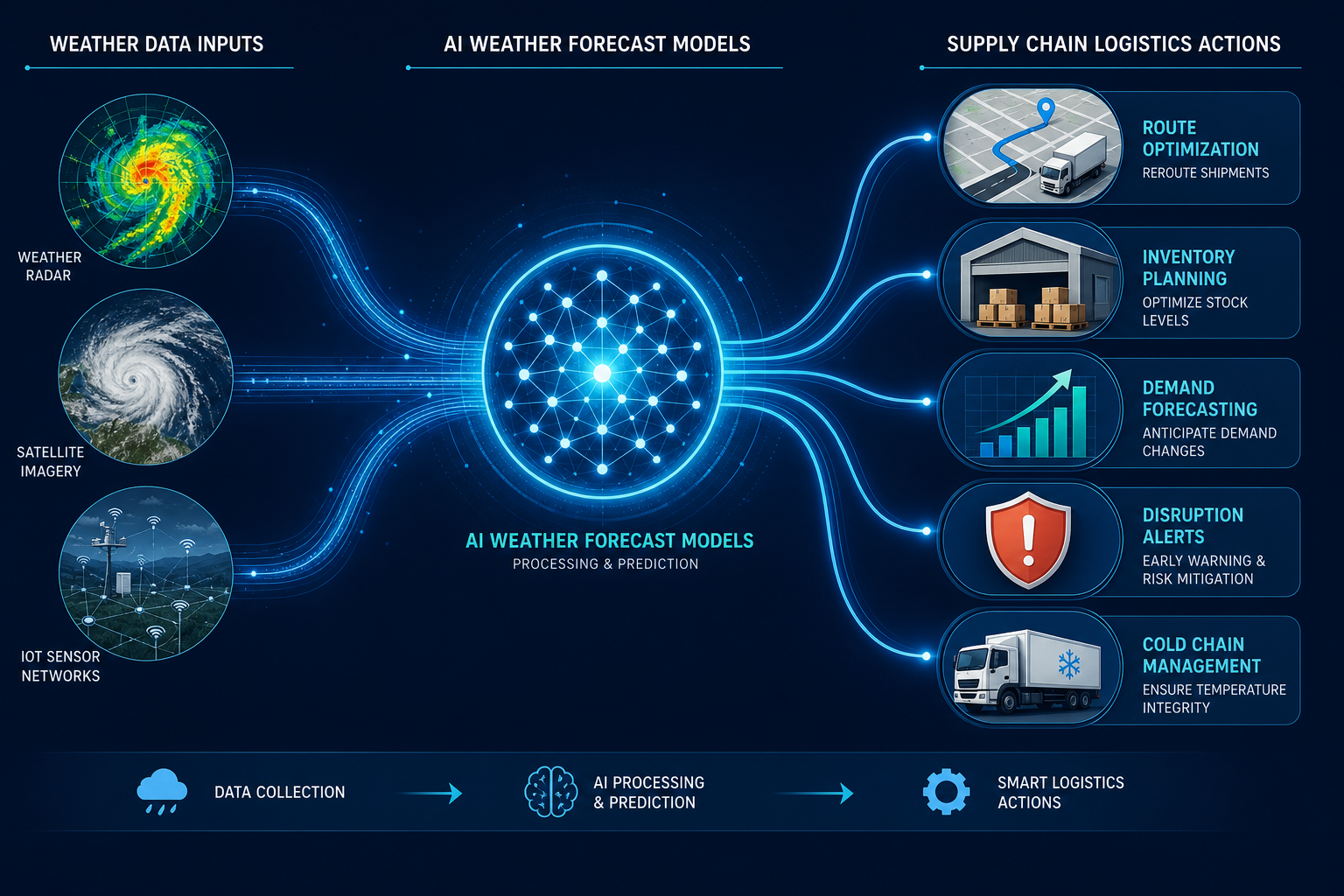
That is why AI weather forecasting for supply chain logistics has become a practical operating question rather than a science headline. The models have improved, but the real test is whether a forecast changes a decision before the disruption is visible on a tracking screen.

Why the Model Shift Matters Now
For years, supply chain teams were told better weather data was coming. The difference in 2025 and 2026 is that several AI weather models moved from impressive demonstrations toward operational relevance: faster runs, lower compute requirements, better forecast variables, and in some cases open or deployed systems that can feed downstream tools.
NOAA’s AIGFS deployment announcement said the AI Global Forecast System could produce a 16-day forecast in about 40 minutes while using 0.3% of the compute required by the traditional Global Forecast System; NOAA also reported skill gains of 18 to 24 hours in its own materials, though independent validation remains limited.[4] ECMWF’s Artificial Intelligence Forecasting System became operational in February 2025 and was described as 10 times faster, using 1,000 times less energy, with up to 20% better tropical cyclone tracks and Creative Commons open data.[5]
Google DeepMind’s WeatherNext 2 improved over its predecessor on 99.9% of variables and, in one reported case, correctly predicted Hurricane Melissa’s rapid intensification to Category 5 three days ahead.[6] Cambridge’s Aardvark Weather, published in Nature in March 2025, was reported to run on a desktop and outperform GFS while using 10% of the input data.[7]
Those numbers matter because logistics does not need a prettier forecast map. It needs enough speed, resolution, and lead time to turn uncertainty into a controlled exception queue. A forecast that arrives too late for dispatch is trivia. A forecast that arrives early enough to change route plans, inventory placement, labor scheduling, or carrier instructions is operational intelligence.
The Use Cases That Change Monday Morning
AI weather intelligence becomes valuable when it is attached to a decision owner and an action window. The same storm signal can mean different things depending on whether the team runs private fleet, refrigerated food distribution, pharma cold chain, seasonal retail, or inbound manufacturing. The useful map starts with the logistics decision, not with the model.
| Logistics problem | AI weather signal | Operational action | Evidence to treat carefully |
|---|---|---|---|
| Route exposure | Short- and medium-range weather risk along lanes | Dynamic rerouting, earlier dispatch, alternate hub selection | Second-hand McKinsey benchmarks cited by Digital Applied report 10-15% fuel cost reduction, 15-20% faster deliveries, and 30% fewer late shipments.[8] |
| Inventory at risk of arriving late | Probability of disruption near origin, port, lane, or destination | Preposition safety stock, rebalance inventory, authorize substitute fulfillment | Vendor and platform reports are useful for business-case sizing, but not equivalent to audited network-wide proof. |
| Weather-driven demand surge | Forecasted timing, duration, and magnitude of demand shifts | Move product ahead of demand, adjust replenishment, revise allocation | ClimateAi describes FICE as fusing weather data with credit-card transactions across 100+ sectors.[9] |
| Exception overload in a control tower | Weather event intersecting shipments, facilities, suppliers, or customers | Prioritize impacted orders, contact carriers earlier, escalate only material exposures | Everstream reports 50-70% faster disruption impact assessment, 5% lower expedited freight costs, and 30% lower revenue losses from disruption for clients.[10] |
| Cold-chain integrity | Temperature, storm, and lane-risk forecasts tied to shipment condition sensitivity | Reroute refrigerated loads, adjust dwell decisions, increase monitoring, change handoff timing | Cold-chain outcomes depend on weather intelligence plus telematics, SOPs, and exception authority. |
Dynamic Rerouting: The First Visible Payoff
Rerouting is the easiest use case to understand because the decision is concrete: keep the truck on the planned lane, leave earlier, hold it, or divert. The catch is that a routing engine cannot be allowed to chase every weather cell. Logistics teams need rules that distinguish a nuisance from a service failure.
The strongest business-case figures should be read with provenance in mind. Digital Applied, citing a 2025 McKinsey logistics report, gives benchmarks of 10-15% fuel cost reduction, 15-20% faster deliveries, and 30% fewer late shipments from AI-based logistics optimization.[8] Those figures are useful for framing upside, but they are not a guaranteed result from adding a weather API. They depend on route density, carrier flexibility, dispatch authority, customer appointment rules, and whether the transportation team can act early without triggering unnecessary cost.
A practical routing workflow usually needs three layers: a weather-risk score by lane segment, an operational rule for when a route can be changed, and a cost/service comparison that shows whether the alternative is worth it. A 65% probability of severe disruption may be enough to divert a refrigerated pharmaceutical load with narrow temperature tolerances. The same probability may only justify monitoring for a low-value dry van load with a flexible delivery window.
Teams evaluating hurricane-specific routing can use adjacent patterns from AI hurricane forecasting for logistics route optimization, but the operating principle is broader: forecast confidence must be translated into an authorized route action, not left as a colored layer on a map.
Inventory Prepositioning: Buying Time Before the Lane Fails
Inventory prepositioning is where weather intelligence starts to look less like transportation software and more like supply chain risk management. If a model indicates a credible disruption window around a port, distribution center, supplier region, or retail market, the question becomes whether inventory should move before the network tightens.
This is not simply a safety-stock decision. The team must compare the cost of early movement against the cost of late fulfillment, expedited freight, substitution, lost sales, spoilage, or production interruption. In food and beverage, moving inventory early may protect store availability but raise handling and freshness tradeoffs. In manufacturing, a few inbound components may deserve attention long before the broader SKU base does. In pharma, product value and compliance requirements can make a late decision much more expensive than a conservative move.
The useful forecast output is therefore not only “storm likely.” It is a ranked list of exposed products, orders, suppliers, and facilities with lead time remaining. That is the difference between weather awareness and an inventory action.
Demand Sensing: Weather as a Commercial Signal
Weather does not only block supply. It changes demand. Storm preparation can lift demand for roofing materials, generators, bottled water, batteries, groceries, and home-repair products. Heat waves can change beverage, cold-storage, and pharmaceutical demand. The operational problem is timing: if the replenishment signal arrives through sales history alone, the window for economical movement may already be gone.
ClimateAi describes its FICE system as quantifying the timing, duration, and magnitude of weather-driven demand spikes by combining weather data with credit-card transactions across more than 100 sectors.[9] The company also reports a hurricane-related case in which a roofing materials producer captured $15 million in incremental sales; that figure is vendor-reported and should be treated as a case example rather than a general benchmark.[9]
For logistics leaders, the practical value is not just forecasting that demand will rise. It is deciding which SKUs should move, which DC should serve the demand pocket, which carrier capacity should be reserved, and which customers should receive priority. More detail on the storm-demand pattern belongs in how AI predicts demand surges for storm planning; the key point here is that demand sensing only becomes logistics value when allocation and transportation rules are ready before demand appears in order data.
Disruption Impact Assessment: Fewer Blind Escalations
A control tower rarely fails because it lacks alerts. It fails because every alert asks the same team to manually determine what matters. AI weather intelligence helps when it intersects a forecast event with live shipments, supplier locations, production schedules, facility dependencies, customer commitments, and financial exposure.
Everstream reports that its clients have seen 50-70% faster disruption impact assessment, 5% reduction in expedited freight costs, and 30% reduction in revenue losses from disruption.[10] These are vendor-reported outcomes, not an independent audit. Still, the direction of value is credible: if a team can identify the truly exposed orders sooner, it can stop escalating every shipment near a storm path and focus on the orders that carry real service, revenue, compliance, or customer risk.
This use case often justifies investment faster than pure forecast accuracy. A slightly better forecast that is not tied to orders may be less useful than a good forecast that immediately produces a ranked exception list. For broader logistics risk patterns, what AI for risk assessment in logistics actually delivers is the more general frame.
Cold-Chain Rerouting: Weather Risk Meets Product Integrity
Cold chain is where vague resilience language becomes unforgiving. A delayed shipment can still arrive, but that does not mean the product is usable. Temperature exposure, dwell time, equipment availability, lane congestion, and handoff timing all matter. Weather forecasting helps only when it is connected to product tolerance and shipment status.
Everstream has described using NOAA GFS and GEFS data through AWS for Unilever cold-chain routing.[10] The important detail is the combination: forecast data, lane intelligence, and shipment context. A refrigerated load facing a storm delay may need rerouting, earlier departure, increased monitoring, a different cross-dock plan, or a decision to hold until risk falls. The right action depends on the load’s condition sensitivity and the remaining route options.
Teams that already use IoT temperature monitoring can connect that data with forecast risk so the decision is not based only on where the truck is, but on what the product can still safely tolerate. The operating model is close to the one described in how AI sensors make cold chain monitoring predictive: prediction matters because it gives the team time to intervene before a compliance problem becomes irreversible.
The Translation Layer: From Probability to Permission
The hardest implementation issue is not whether the model says 65% or 72%. It is whether the organization knows what to do with a probability. Many logistics teams still operate as if a forecast becomes actionable only when the event is nearly certain. By then, carrier capacity is tighter, inventory is in the wrong place, and customer-service teams are reacting instead of preparing.
A workable decision layer usually defines thresholds before the event:
- Monitor: the event is plausible, but no cost-bearing action is authorized; shipments and facilities enter a watch queue.
- Prepare: planners reserve capacity, identify alternate routes, check inventory options, and alert customer-facing teams.
- Act: dispatch, inventory, procurement, or cold-chain teams are authorized to spend money, change plans, or override the baseline schedule.
- Review: after the event, the team checks forecast signal, decision timing, cost, service outcome, and false positives.
Those thresholds should vary by product, lane, customer, and cost of failure. A high-margin emergency repair part, a temperature-sensitive pharma shipment, and a routine replenishment load should not share the same trigger. The point is not to remove human judgment; it is to stop forcing humans to improvise authority while the weather window closes.
Human-in-the-loop design also protects against false confidence. AI weather models still struggle with rare extreme events outside their training distribution. For supply chain risk, that limitation matters because the most expensive events are often the least normal. A model can be operationally valuable and still require escalation paths for uncertainty, low-confidence scenarios, and events that do not resemble the historical data the model learned from.
Vendor Fit by Logistics Problem
The vendor landscape is easier to evaluate when the shortlist starts with the operational problem. A platform that is strong for weather-driven demand sensing is not automatically the best tool for shipment-level ETAs, supplier exposure, or cold-chain rerouting.
| Vendor or platform | Best-fit logistics problem | What to verify in evaluation |
|---|---|---|
| ClimateAi | Weather-driven demand sensing, climate and commercial demand scenarios, storm-related demand spikes | Ask how FICE outputs translate into SKU, facility, and transportation actions; treat the $15M hurricane sales case as vendor-reported.[9] |
| FourKites | Shipment visibility with weather overlays, item-level tracking, predictive weather intelligence, frequent updates | Validate how 15-minute update cycles affect dispatch workflows and whether weather signals change ETAs or only add context. |
| Everstream Analytics | Disruption monitoring, supplier and shipment impact assessment, cold-chain routing exposure | Check integration depth with orders, suppliers, lanes, and escalation workflows; read ROI claims as vendor-reported.[10] |
| The Weather Company / IBM | Enterprise weather intelligence, predictive forecasting, GRAF model capabilities, Weather Signals | Confirm whether the tool supports logistics-specific triggers or requires internal teams to build the action layer.[3] |
| Tomorrow.io | High-resolution weather API use cases, routing exposure, logistics weather data integration | Verify resolution, latency, coverage, and how roadway-delay exposure is converted into route-level decisions.[2] |
| Resilinc | EventWatchAI disruption statistics, supplier and business-exposure monitoring | Assess event relevance scoring and whether alerts connect cleanly to supplier, product, and revenue exposure.[1] |
| Interos | Extreme-weather supply chain risk and broader operational resilience mapping | Clarify whether weather risk is analyzed at supplier, geography, facility, or shipment level, and how actions are assigned. |
A clean evaluation does not ask every vendor to prove every use case. It asks whether the platform can connect forecast signals to the company’s existing systems: transportation management, order management, warehouse management, supplier master data, telematics, inventory planning, and customer commitments. If the platform cannot reach the operational data, it may still be a strong weather product, but it will need internal engineering and process work before it becomes a logistics tool.
What ROI Evidence Can and Cannot Prove
The ROI case is promising, but uneven. The cleanest way to use the numbers is to separate broad optimization benchmarks, vendor-reported client outcomes, and case-specific commercial wins.
- Broad logistics benchmarks: Digital Applied cites McKinsey figures of 10-15% fuel cost reduction, 15-20% faster deliveries, and 30% fewer late shipments; useful for upside framing, but second-hand.[8]
- Vendor-reported operating outcomes: Everstream reports 5% lower expedited freight costs, 30% lower revenue losses from disruption, and 50-70% faster disruption impact assessment; useful, but not independently audited in the provided material.[10]
- Case-specific demand upside: ClimateAi reports $15 million in incremental sales for a roofing materials producer in a hurricane case; useful as a concrete example, not a universal expectation.[9]
- Investment signal: The Weather Company found that 92% of executives plan to increase or maintain weather-intelligence investments; this shows budget attention, not proof of effectiveness.[3]
A logistics leader building a business case should tie ROI to a few measurable failure modes: expedited freight, missed delivery windows, spoilage or product loss, detention and dwell, empty miles, lost sales during weather-driven demand spikes, and labor overtime caused by late disruption response. The pilot should measure decision latency as well as outcome: how long it takes to identify exposed shipments, approve an action, notify stakeholders, and confirm execution.
For comparison against broader AI programs, what supply chain AI ROI actually looks like can help keep weather-specific claims from being judged either too harshly or too generously.
Implementation Constraints That Decide the Outcome
Buying the forecast feed is rarely the hard part. The value appears only when the organization can connect data, assign authority, and tolerate action before certainty.
- Data connection: forecasts need to intersect with shipments, inventory, suppliers, facilities, orders, carriers, and customer commitments.
- Decision ownership: someone must own each action type: reroute, hold, expedite, preposition, allocate, substitute, or escalate.
- Threshold design: probability, confidence, product criticality, customer priority, and cost of failure should determine when action is authorized.
- Exception discipline: the system should reduce noise, not create another alert stream for control tower teams to triage manually.
- Post-event review: teams should compare forecast signal, actual disruption, decisions taken, avoided cost, unnecessary cost, and service outcome.
The maturity path does not have to start with a full network rollout. A sensible first deployment might focus on one region with weather-sensitive lanes, one product class with high service or spoilage exposure, or one control tower workflow where disruption assessment is currently slow. The broader implementation sequence should look similar to a practical AI maturity roadmap: prove the workflow, connect the data, measure the decision, then expand.
There is also a governance issue. If the model recommends prepositioning inventory and the storm misses, who owns the extra cost? If the team waits and the disruption hits, who owns the lost service? Without a pre-agreed rule, probabilistic forecasting can become a blame engine. With a rule, it becomes a way to make earlier, more consistent tradeoffs.
A Practical Threshold for 2026
AI weather forecasting is now proven enough for supply chain logistics leaders to evaluate and deploy in targeted workflows. NOAA, ECMWF, Google DeepMind, and Cambridge show that the enabling forecast layer has changed materially. Commercial platforms show that the signal can be connected to routing, demand sensing, disruption assessment, and cold-chain decisions. The business case has enough supporting evidence to justify serious pilots, while still requiring caution around vendor-reported ROI and second-hand benchmark figures.
The remaining gap is operational. A better forecast does not reroute a truck, authorize inventory movement, call a carrier, protect a refrigerated load, or tell a customer what changed. The companies that get value will be the ones that build the authority, data connections, escalation thresholds, and review discipline to act before certainty arrives.
References
- Resilinc EventWatchAI disruption statistics, Resilinc
- Weather Conditions Cause 23 Percent of Roadway Delays, Tomorrow.io / FHWA
- 2025 weather intelligence executive research, The Weather Company, 2025
- NOAA AIGFS deployment announcement, NOAA, December 2025
- ECMWF’s Artificial Intelligence Forecasting System becomes operational, ECMWF, February 2025
- WeatherNext 2, Google Research
- Aardvark Weather, Nature, March 2025
- Digital Applied blog citing McKinsey 2025 logistics report, Digital Applied
- ClimateAi FICE weather-driven demand sensing, ClimateAi
- Everstream Analytics client outcomes and cold-chain routing, Everstream Analytics
Comments
Join the discussion with an anonymous comment.