
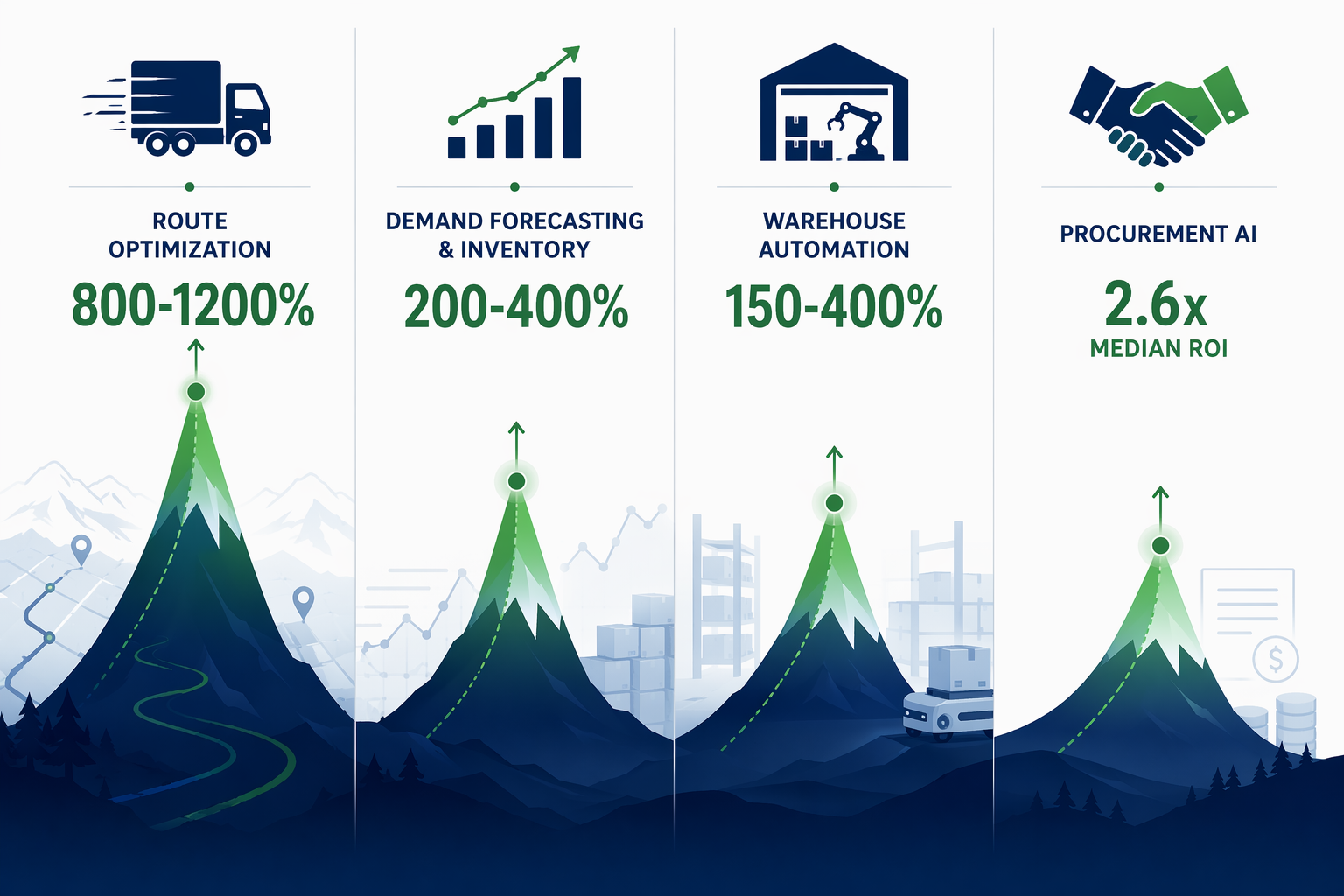
The uncomfortable question for 2026 is not whether AI in the supply chain can create value. It plainly can. The harder question is why so many investment cases still disappoint after a promising pilot. PwC’s 2026 operations survey found that 89% of leaders said their technology investments had not fully delivered expected results; the survey covered 767 leaders at U.S. companies with at least $100 million in revenue, so it should be read as a large-enterprise signal rather than a universal market law.[1]
The answer usually sits in the middle of the model, not at the top. A route optimization pilot may show a clean fuel and mileage reduction. A forecasting model may reduce error in one business unit. A warehouse vision system may cut rework in a controlled flow. Then the rollout crosses carriers, warehouses, ERPs, master-data standards, planning teams, procurement categories, and exception queues. That is where the business case either becomes a financeable operating plan or turns into blended math.
| Use case | Best-supported ROI signal | Payback / operating signal | What narrows the business case |
|---|---|---|---|
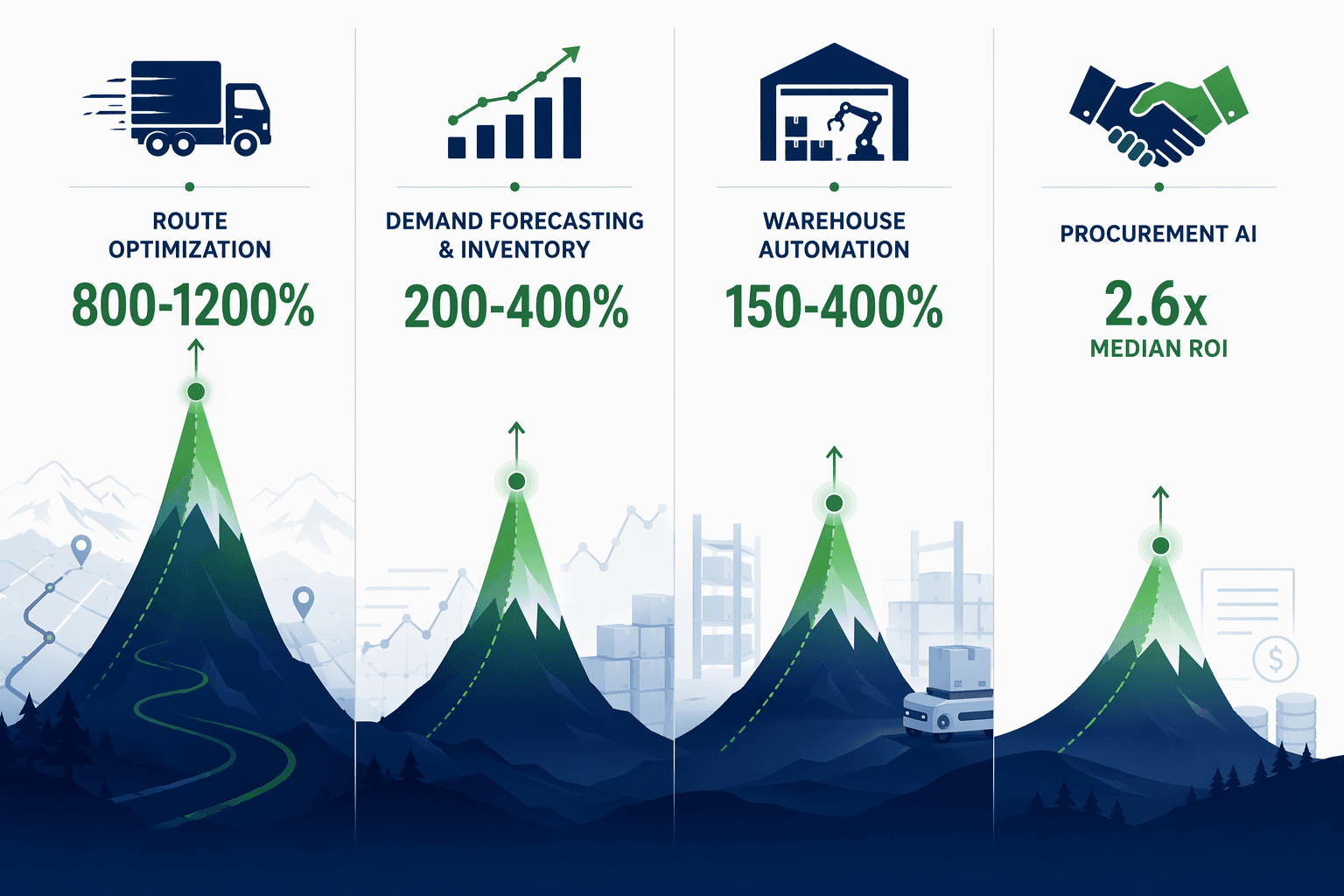
| Route optimization | 800–1,200% three-year ROI for fleets with 500+ vehicles, attributed by The Thinking Company to Gartner’s 2025 supply chain technology work [2] | 2–4 month payback in the same 500+ vehicle fleet condition [2] | Fleet size, route density, dispatch discipline, carrier mix, and integration with transport execution systems |
| Demand forecasting and inventory | 200–400% three-year returns in benchmark ranges; operational gains are tied to forecast error, logistics cost, and inventory reductions [2] | Usually compounds through planning cycles rather than appearing in one invoice | Data history, SKU volatility, promotion discipline, planning adoption, and how inventory targets are reset |
| Warehouse automation | AI-directed picking: 250–400% three-year ROI; computer vision sorting: 200–350% three-year ROI [2] | Return depends on labor mix, error rates, throughput, and rework reduction | Physical layout, WMS integration, labor standards, exception handling, and changeover complexity |
| Procurement AI | Reported GenAI procurement teams reached 2.6× median ROI and 58% faster cycle times in Hackett Group/Wharton data summarized by Open Sky Group [4] | Fast cycle-time gains can arrive before clean P&L attribution | Category coverage, contract data quality, approval workflows, policy controls, and whether savings are actually realized |
Route optimization is the cleanest high-return case, if the fleet condition is real
Route optimization deserves the first pass because the benchmark is unusually specific. The Thinking Company’s 2026 guide reports 800–1,200% three-year ROI and a 2–4 month payback for route optimization on fleets with more than 500 vehicles, citing Gartner’s 2025 supply chain technology work.[2] That last condition matters. A 700-vehicle private fleet with dense routes, consistent stops, and centralized dispatch is not the same investment problem as a shipper with fragmented carrier coverage and intermittent lane data.
The financial mechanism is easy to inspect: fewer miles, lower fuel use, better driver utilization, tighter delivery windows, and less manual dispatch intervention. This is why the UPS ORION example remains useful even though it is a single company case, not an industry average. UPS has said ORION eliminates roughly 100 million miles driven annually, an operational fact that can be pictured without dressing it up as transformation language.[2]
The business-case mistake is to detach the return from the operating surface that produced it. Route optimization ROI does not come from an algorithm floating above the transport network. It comes from changing route plans that drivers and dispatchers actually follow, against data that reflects real stops, vehicle capacities, service constraints, traffic rules, delivery promises, and exception logic. If those inputs are already clean and the fleet is large enough, the payback can be fast. If the rollout requires reconciling customer locations, carrier rules, time-window exceptions, and multiple transport systems, the same ROI line needs an integration line sitting directly beneath it.
For readers comparing logistics-specific opportunities, Machine Learning in Logistics ROI: Benchmarks Across 9 Application Areas is the more detailed lane-by-lane companion. The shorter point here is that route optimization is a strong candidate for early funding when the fleet scale and execution control match the benchmark.
Forecasting ROI shows up through inventory, service, and logistics—not model accuracy alone
Demand forecasting and inventory planning are often discussed as if the ROI comes from a smarter prediction. That is only the first step. The money appears when a lower forecast error changes a replenishment decision, a production plan, a safety-stock setting, or an expedited freight pattern. Benchmark ranges summarized in the 2026 supply chain AI ROI guide place demand forecasting and inventory use cases at 200–400% three-year returns, with cited operating improvements including 20–50% forecast error reduction, 15% logistics cost reduction, and 35% lower inventory.[2]
Those numbers should not be read as three independent savings buckets to be added together. Forecast error, inventory, and logistics costs interact. Lower error may allow a planner to reduce safety stock, but only if service targets, supplier lead times, and planning policies are changed. Lower inventory may reduce working capital but can create service risk if the organization has not separated stable demand from volatile items. A forecast model that improves statistical accuracy while planners continue overriding outputs without a governance process will not deliver the same return as a planning system that changes ordering behavior.
The cleanest finance model ties forecasting ROI to named decisions: which SKUs get lower safety stock, which lanes see fewer expedites, which plants change production sequencing, which stores reduce overstocks, and who approves planner overrides. That level of specificity may feel slower than approving a generic predictive analytics program, but it keeps the business case from counting the same benefit twice.
For a broader view of forecasting-adjacent cases, see Predictive Analytics in Supply Chain: 7 Use Cases with Sourced ROI Benchmarks. The important distinction for this article is that forecasting ROI is paired with inventory policy and execution behavior. Accuracy is an input. Cash impact is the test.
Warehouse automation is credible middle-return territory
Warehouse AI usually carries less spectacular ROI than large-fleet routing, but the investment case can be sturdier because the operating loop is visible. The Thinking Company’s benchmark ranges put AI-directed picking at 250–400% three-year ROI and computer vision sorting at 200–350% three-year ROI.[2] Those ranges are high enough to matter, but they are not permission to ignore the building.
A picking model can improve labor productivity only where work can be sequenced differently. A vision system can reduce mis-sorts only where camera placement, item visibility, label quality, lighting, and exception workflows support it. The warehouse management system still has to accept the signal, supervisors still have to trust it, and someone has to decide what happens when the model flags a problem at peak volume.
This is where a pilot can be honest and still incomplete. A single building may have a cooperative team, a narrow process, and enough manual workarounds to make the test succeed. Enterprise rollout adds older facilities, different labor standards, local slotting rules, seasonal peaks, and WMS variation. The finance case should separate the repeatable benefit from the site-specific cleanup work. Otherwise, the second and third warehouses quietly pay for assumptions made in the first.
Procurement GenAI is moving fast, but usage is not the same as return
Procurement AI has a different evidence problem. The adoption signal is strong, and the workflow pain is real: sourcing events, supplier research, contract review, intake, policy questions, and spend classification all contain text-heavy work that GenAI can accelerate. Open Sky Group’s 2026 statistics roundup cites Hackett Group/Wharton findings that procurement teams using GenAI achieved 2.6× median ROI and 58% faster cycle times; it also reports that 94% of procurement executives use GenAI weekly.[4]
The first figure belongs in a business case. The second belongs in an adoption discussion. Weekly usage can mean a category manager drafts supplier emails faster. It can also mean a team experiments with summaries while the approval path, savings validation, and contract repository remain unchanged. Finance should not treat frequency of use as realized savings.
The sharper procurement cases define the workflow boundary. If the use case is contract clause review, the measure is review time, legal rework, and compliance exceptions. If the use case is tail-spend buying, the measure is guided buying compliance, avoided maverick spend, and reduced intake labor. If the use case is supplier discovery, the measure is cycle time and competitive coverage, not a generic productivity percentage.
A deeper procurement-specific treatment is available in Procurement AI ROI in 2026: What the Evidence Actually Shows. For a portfolio-level supply chain model, procurement should be included, but its ROI should be tied to controlled workflows rather than enthusiasm metrics.
The pilot-to-scale error usually starts with data integration
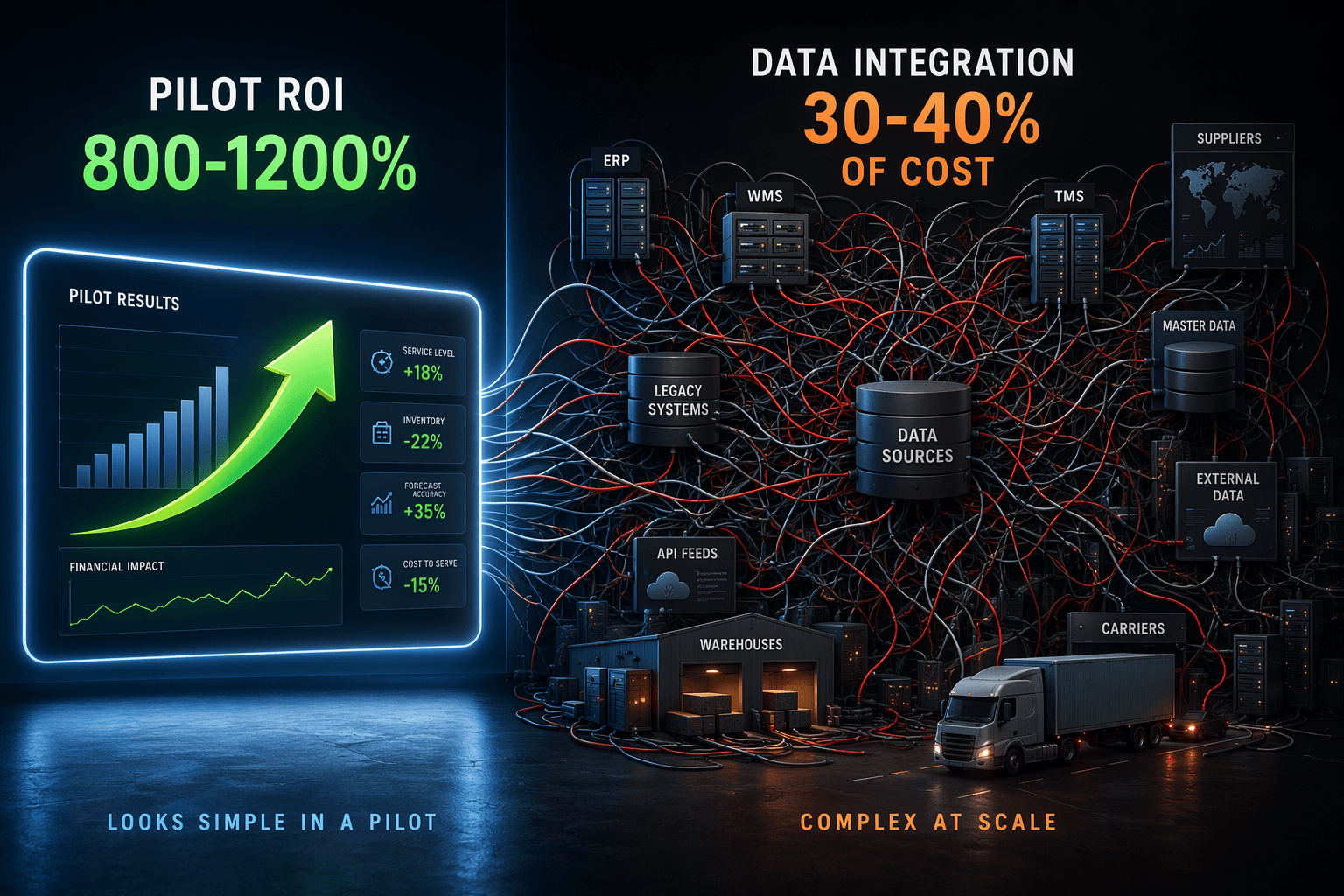
The most useful number in the whole ROI discussion may be the least glamorous one: data integration can consume 30–40% of total project spend, according to The Thinking Company’s 2026 guide.[2] That figure explains why apparently sound pilots disappoint at scale. The model cost is visible. The data reconciliation cost is often buried, delayed, or assigned to teams outside the business case.
In a pilot, the team can manually clean customer addresses, normalize SKU names, patch missing lead times, or reconcile transport events after the fact. In production, those tasks become repeatable operating requirements. Someone has to own master data, exception rules, API reliability, access controls, model monitoring, and the handoff between system recommendation and human approval. If those costs are treated as temporary project noise, the payback period is too short before the first steering committee meeting.
Trust also changes the operating case. RELEX’s 2026 supply chain AI analysis reports that only 10% of respondents trust AI to make decisions unsupervised.[3] That is not a reason to avoid AI. It is a reason to budget for human review where the organization will require it. A forecast that needs planner approval, a route change that dispatchers can override, or a procurement recommendation that requires policy review may still deliver excellent ROI, but the labor model has to reflect the actual control design.
This is the missing bridge between adoption and finance. Open Sky Group’s statistics roundup collects a range of 2026 adoption signals, and NVIDIA’s retail and CPG survey reports that 47% of retail and CPG companies are using or assessing agentic AI.[4][5] Those signals say the market is moving. They do not prove that a given supply chain AI program has earned back its integration cost, changed operating behavior, and survived exception volume.
Shared data foundations change portfolio ROI, but they do not rescue every use case
The case for a shared data foundation is not architectural tidiness. It is capital efficiency. The Thinking Company reports that companies bundling 3–5 use cases on a shared data foundation improve portfolio ROI by 40–60%.[2] The logic is straightforward: once customer, product, location, supplier, order, inventory, and transport data are made usable for one application, the next application should not have to repay the entire cleanup bill.
That does not mean every AI idea belongs in the same funding wave. Shared foundations work best when the use cases draw from overlapping data and operating owners can absorb the change. Forecasting and inventory planning may share product, demand, location, and replenishment data. Route optimization and carrier performance may share shipment, stop, lane, and service data. Procurement intake and contract analytics may share supplier, category, policy, and contract data. A portfolio is strongest when the second project uses infrastructure the first project genuinely needed.
The weaker version is the “platform first, benefits later” case, where a large data program is justified by a list of possible AI applications that no operating team has committed to changing. That can be just as sloppy as a one-off pilot. The discipline is to pair shared foundations with funded, sequenced use cases whose benefits have owners.
For teams trying to sequence that progression, The Supply Chain AI Maturity Playbook: From Pilot to Production is the right next read. The business-case point is simpler: do not make each use case carry all foundation costs, but do not let a foundation investment escape benefit accountability either.
A financeable 2026 business case asks narrower questions
The strongest business cases for supply chain AI in 2026 do not begin with a general claim that AI will modernize operations. They begin with a bounded operating question. Can a large fleet remove enough miles to pay back route optimization in months? Can a planning team convert forecast improvement into lower inventory without damaging service? Can a warehouse reduce rework or increase pick productivity in buildings where the WMS and physical flow can support the change? Can procurement shorten cycle time in a workflow where savings and compliance are traceable?
A useful approval model should show five things before it asks for capital:
- The use case and operating boundary: fleet, category, warehouse process, planning scope, or procurement workflow.
- The benchmark range and its source condition, especially when the figure depends on scale such as 500+ vehicle fleets.
- The decision that will change: route plan, safety stock setting, pick sequence, supplier selection, contract review, or approval workflow.
- The integration cost, including the 30–40% data integration load where applicable, instead of leaving it outside the payback model.
- The human review and exception process, because unsupervised autonomy is still not the default operating posture in many supply chains.
For broader benchmark coverage across additional applications, Supply Chain AI ROI: What Eight Key Use Cases Deliver can help compare adjacent opportunities. The investment rule remains narrow: AI ROI is real but uneven. The right question is not whether AI in the supply chain pays back. It is which use case, at what scale, on what data foundation, with integration costs already inside the model.
References
- 2026 Digital Trends in Operations Survey, PwC
- AI ROI in Logistics & Supply Chain — 2026 Guide, The Thinking Company
- Supply Chain AI in 2026: The Numbers Behind the Hype, RELEX Solutions
- Supply Chain AI Statistics: 18+ Statistics for 2026, Open Sky Group
- State of AI in Retail and CPG Survey 2026, NVIDIA
Comments
Join the discussion with an anonymous comment.