
A regional forecast that says heavy rain is likely tomorrow may be enough for a warehouse manager to expect trouble. It is usually not enough for a transportation planner to decide which outbound loads should leave early, which lane needs a backup carrier, or which store should get extra bottled water before replenishment cutoffs close. The useful question behind AI weather prediction for supply chain logistics is not whether the forecast sounds more advanced. It is whether the forecast can be turned into a route change, an ETA adjustment, a maintenance decision, or an inventory move while there is still time to act.
That is where AI weather prediction starts to separate from generic weather services. The better systems do not just say that rain, heat, smoke, wind, or snow may affect a region. They combine high-resolution weather data, machine-learning pattern recognition, and operational context so that a control tower can see risk by lane, stop, delivery window, facility, or product group. ClimateAi, for example, describes hyper-local forecasts at 1 km resolution for temperature and solar radiation and 25 km resolution for precipitation, along with models that quantify the timing, duration, and magnitude of demand spikes and supply disruptions for food and beverage operations.[1]
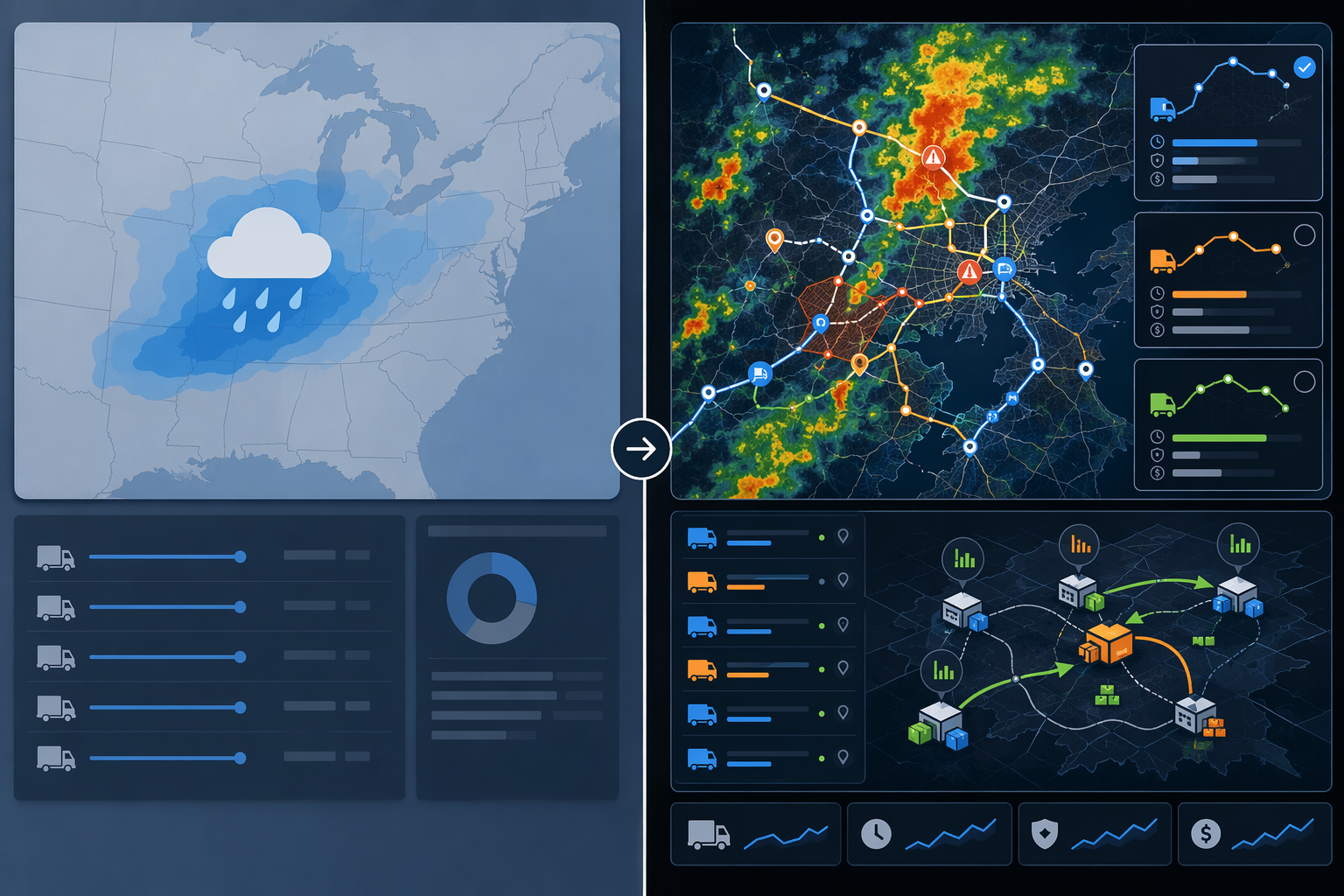
From weather awareness to weather-actionability
In daily logistics work, the gap between awareness and action is larger than it looks. A broad weather alert may tell planners that a storm line is moving across a service region. An actionable forecast needs to answer a narrower set of questions: which lane is exposed, when does the risk intersect the truck’s appointment window, how much slack remains in the route plan, and what inventory or labor decision changes before the dock schedule starts to fail.
For routing, that means weather intelligence has to meet the dispatch board. A fleet manager needs to know whether to hold a departure, reroute around a corridor, split a delivery sequence, revise an ETA before the customer calls, or schedule maintenance around likely heat, cold, flood, or wind exposure. Tomorrow.io says its FleetIQ platform has produced 25% fewer weather-related shipping delays and a 35% reduction in wasted miles for logistics fleets, but those figures should be read as self-reported platform metrics rather than independently audited industry benchmarks.[2]
For inventory positioning, the decision window often opens earlier and closes less visibly. A grocer does not wait until the heatwave arrives to move high-velocity beverages closer to demand. A pharmaceutical distributor cannot treat a cold-chain risk alert as an interesting weather note; it has to decide whether a lane, pack-out, handoff, or destination facility can still hold the required conditions. The value of AI weather prediction here is its ability to connect weather to demand and supply behavior, not merely to describe the atmosphere.
| Generic weather service | AI-enhanced logistics weather intelligence |
|---|---|
| Broad regional conditions and alerts | Hyper-local risk by route, facility, time window, or product group |
| Useful for general awareness | Useful when connected to dispatch, ETA, replenishment, or inventory rules |
| Often consumed outside operating systems | Integrated into TMS, control tower, WMS, ERP, or demand planning workflows |
| Usually describes weather events | Translates weather into probabilities of delay, demand surge, service failure, or supply disruption |
The workflow that makes a forecast operational
The operating workflow is not mysterious, but each handoff matters. First, the system needs weather data at a resolution close enough to the decision. A 15-day regional outlook may be useful for staffing or procurement. It will not tell a dispatcher whether a particular delivery route should be resequenced this afternoon. The Weather Company’s Global High-Resolution Atmospheric Forecasting model, known as GRAF, is positioned around high-resolution atmospheric forecasting used by logistics operators for predictive supply chain weather risk management.[3]
Second, machine-learning models look for patterns that matter to operations. That may include how precipitation has historically affected a corridor, how wind has changed transit time over a bridge, how heat has shifted beverage demand, or how cold has affected a commodity’s movement through a region. Everstream Analytics has described 15-day hourly gridded forecasts for any global point, five in-house meteorologists, and yield models for more than 200 crop types using seven data sources, which shows how weather intelligence starts to become supply chain context rather than a standalone forecast.[4]
Third, the model has to translate weather into operational probability. “Rain at 3 p.m.” is not the same as “a meaningful chance that this route misses the appointment window if it stays on the planned path.” The latter is what lets a control tower compare choices. A 30% flood risk on one road segment, a high probability of wind delay near a cross-dock, or a forecast heat-driven demand spike in one metro area can be weighed against driver hours, carrier capacity, customer priority, and inventory availability.
Fourth, the forecast has to enter the systems where work is assigned. If the forecast sits in a weather portal while dispatchers work in the TMS and replenishment planners work in a demand system, the organization has gained a better weather screen, not a better operating process. The forecast needs to touch route optimization, ETA calculation, tendering rules, appointment management, labor planning, WMS tasking, ERP inventory views, and demand planning where the relevant decisions are actually made.
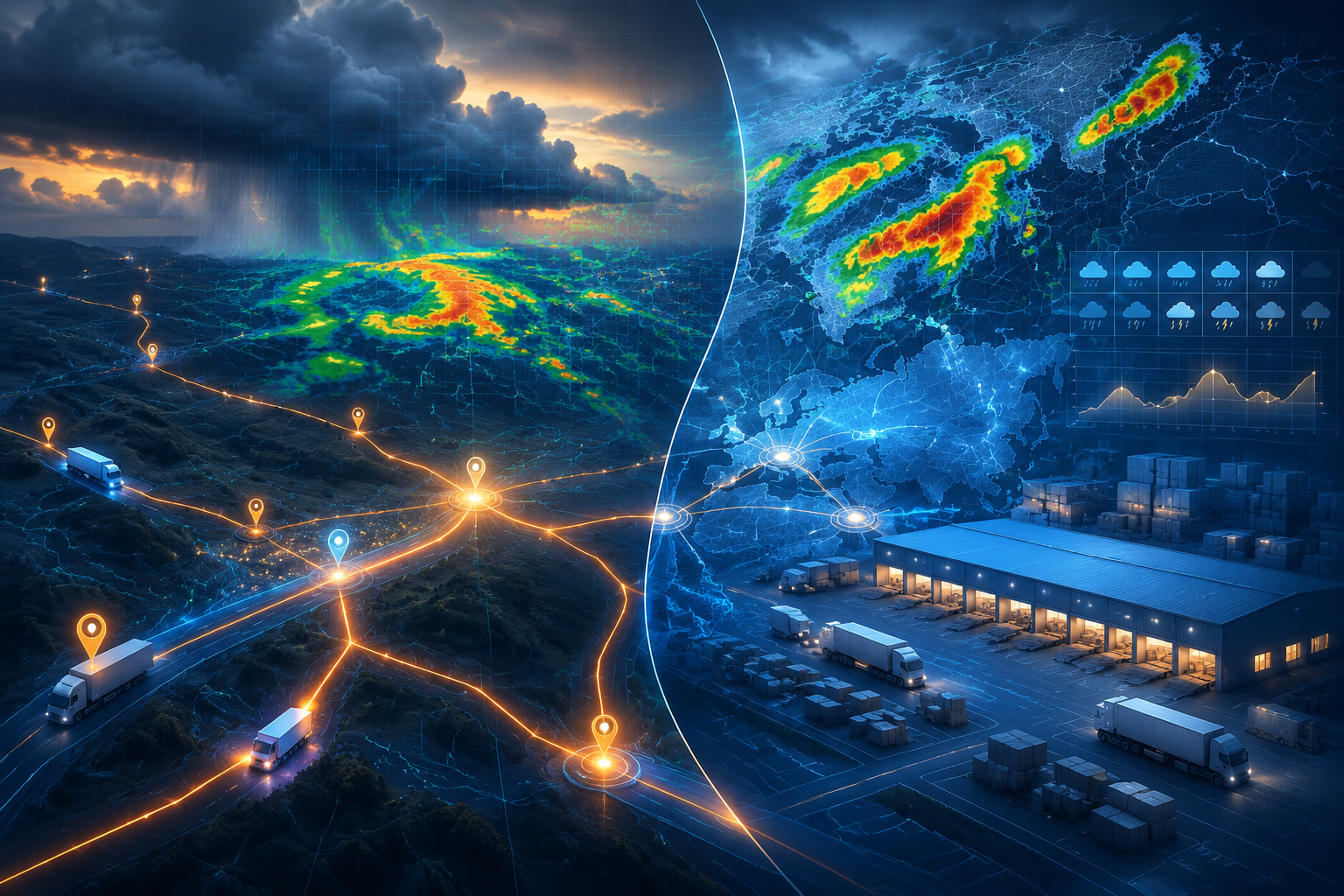
Routing: the forecast has to arrive before the truck is trapped
Routing is the more visible use case because the consequence is immediate. A storm cell intersects a corridor. A driver approaches a flood-prone road. A bridge or pass becomes risky. A delivery window starts to slip. Generic weather information can explain why the problem happened. AI weather prediction is more valuable when it changes the plan before the problem becomes obvious to everyone watching the same radar map.
The operational output is rarely a single command. It is more often a ranked set of choices: keep the route and revise the ETA, leave earlier, divert to a safer corridor, swap stop sequence, hold freight at origin, use a different carrier, or protect a later appointment by sacrificing a less critical one. That matters because dispatchers do not act on weather alone. They act on weather plus service commitments, hours-of-service constraints, dock capacity, inventory priority, and the credibility of the forecast.
The same applies to predictive ETAs. A standard ETA engine may notice the truck is slowing after congestion appears. A weather-aware ETA model can adjust earlier if the planned lane is likely to degrade during the driver’s arrival window. The practical win is not a prettier map. It is the earlier phone call to the receiver, the earlier carrier escalation, or the earlier decision to protect a higher-priority load.
Fleet maintenance is part of the same routing logic. Weather risk can change inspection timing, tire decisions, reefer checks, battery planning, or driver guidance before equipment failure becomes the disruption. This is not always marketed as routing, but it belongs on the same board: the vehicle’s ability to complete the route is one of the route’s constraints.
Inventory positioning: weather becomes demand and supply pressure
Inventory decisions use weather differently. The question is less “which road should this truck take?” and more “where should stock sit before demand or supply changes?” A heatwave can pull demand forward for beverages, ice, certain fresh products, and cooling-related goods. A storm can shift household purchasing patterns, strain inbound transportation, or cut off a node. A cold snap can affect agricultural supply, store traffic, and cold-chain handling.
RELEX reports that machine-learning demand forecasting that factors in weather can reduce forecast errors by up to 75% for weather-sensitive grocery products during unusual weather events. The scope matters: this is not a claim that weather-aware forecasting improves every SKU by that amount in normal conditions. It is strongest where product demand is genuinely weather-sensitive and where the event is unusual enough that a conventional baseline misses the shift.[5]
For replenishment teams, the useful output is a changed order quantity, a different store allocation, an earlier transfer, or a decision to stage stock closer to a likely disruption zone. For logistics teams, the inventory signal changes the transportation problem: more loads may need to move before a storm, scarce capacity may need to be reserved earlier, or a facility may need to prioritize outbound work before inbound delays begin.
This is where routing and inventory positioning become the same operating conversation. If the demand forecast says a metro area will need more stock and the weather forecast says the inbound lane is likely to deteriorate, the decision is not simply to order more. It is to decide whether the product should move now, where it should be staged, which carrier can still make the appointment, and which lower-priority move should give up capacity.
Where the model terminology matters, and where it does not
The technical vocabulary around AI weather prediction can get heavy quickly: time-series forecasting, pattern recognition, probabilistic modeling, gridded forecasts, atmospheric models, and climate adaptation playbooks. Buyers do not need to ignore the terminology, but they should keep asking what each capability changes in the workflow.
- Resolution matters when decisions differ by facility, route segment, store cluster, or appointment window.
- Probabilities matter when teams must act before certainty is available.
- Integration matters when the forecast needs to change a route, ETA, replenishment plan, or inventory transfer.
- Historical pattern recognition matters when weather affects demand, yield, transit time, or equipment reliability in repeatable ways.
ClimateAi’s adaptation playbooks, which model 5- to 40-year climate risks, belong in a different planning horizon from same-day dispatch or next-week inventory positioning.[1] They may matter for sourcing strategy, facility placement, and long-term network design. They should not be confused with the narrower operating use case of deciding whether tomorrow’s route or this week’s replenishment plan should change.
Evidence worth using, with the caveats left attached
The available evidence is promising, but it does not all carry the same weight. Vendor-reported logistics metrics, retail forecasting improvements, high-resolution forecast capabilities, and simulations can all inform a shortlist. They should not be blended into one generic ROI claim.
Tomorrow.io’s reported 25% reduction in weather-related shipping delays and 35% reduction in wasted miles are directly relevant to fleet operations, but they remain self-reported platform outcomes.[2] They are useful for forming hypotheses for a pilot: which lanes, which weather events, which baseline, which miles, and which delay categories should be measured.
RELEX’s reported forecast-error reduction is also useful, but only when kept inside its stated operating frame: weather-sensitive grocery products during unusual weather events.[5] That is still commercially meaningful. It simply does not justify assuming the same effect for slow-moving, non-weather-sensitive inventory or ordinary seasonal demand.
A July 2025 arXiv paper by Kikuchi reported that weather-aware AI increased driver revenue by 107.3% in a Tokyo taxi simulation, compared with 14% from route-only optimization; the simulation used 10,000 vehicles and also reported a 9,106% annual ROI.[6] The result is interesting because it isolates a point logistics teams understand: route optimization and weather-aware optimization are not the same thing. It should not be treated as field-validated proof of freight ROI.
What a shortlist should test
The first test is whether the system can describe risk at the level where work is assigned. A forecast that cannot get closer than a broad region may still support planning conversations, but it will struggle to change a dock appointment, a route sequence, or a store-level replenishment move. High-resolution atmospheric forecasting, hourly gridded forecasts, and hyper-local demand modeling all matter because they reduce the distance between weather information and operational accountability.
The second test is integration. A weather platform that cannot exchange data with the TMS, control tower, WMS, ERP, or demand planning system leaves too much work to manual interpretation. That does not make it useless; many teams start with alerts and dashboards. But the larger value appears when weather risk updates ETAs, flags vulnerable routes, changes replenishment quantities, triggers exception workflows, or pushes a planner to review a pre-positioning move before the cutoff.
The third test is whether the organization is ready to act on probabilities. Forecasts do not become deterministic because a model is labeled AI. A 40% disruption probability may justify moving a critical pharmaceutical shipment and may not justify expediting a low-margin consumer goods order. The threshold depends on product value, customer commitment, safety risk, spoilage exposure, and the cost of being wrong.
The fourth test is measurement. A pilot should define the baseline before the weather arrives: weather-related delay rate, avoidable miles, tender failures, ETA accuracy, spoiled or distressed inventory, stockouts during weather events, or forecast error for specific weather-sensitive products. Without that baseline, even a useful deployment can disappear into anecdote.
Where the fit is strongest
The clearest fit is in operations where weather changes either movement or demand quickly enough to punish slow decisions. Retail and food and beverage are natural candidates because weather can move store traffic, spoilage risk, and short-term demand. Pharmaceuticals and other temperature-sensitive categories need the same discipline for product integrity. Consumer goods, automotive, agriculture, and other sectors can benefit where weather affects inbound reliability, production inputs, field conditions, or lane performance.
The weaker fit is not an industry so much as an operating condition. If a company cannot connect weather data to routes, orders, facilities, SKUs, carriers, or appointment windows, the forecast will remain advisory. If planners are not allowed to adjust inventory, carriers, or schedules until disruption is certain, probabilistic intelligence will be underused. And if the organization treats every model output as a command, it will eventually overreact to noise.
The practical buyer takeaway
AI weather prediction is worth shortlisting when the logistics organization has decisions that can still be changed before weather hits: routes can be resequenced, ETAs can be revised, carriers can be escalated, inventory can be staged, and demand plans can be adjusted. It is especially worth attention when hyper-local forecasts can be integrated with TMS, control tower, WMS, ERP, and demand data rather than watched in a separate weather console.
The ceiling is still set by forecast uncertainty and operational readiness. AI weather prediction does not remove disruption, and it does not excuse a team from judgment. Its value is narrower and more useful: better timing, better specificity, and earlier choices about routing and inventory before the forecast turns into a carrier call.
References
- Weather Intelligence for F&B. ClimateAi.
- Using Weather AI to Improve Logistics and Transportation. Tomorrow.io.
- Managing Supply Chain Weather Risks with Predictive Analytics. The Weather Company.
- Effectively Using Weather Forecasts Is A Supply Chain Imperative. Forbes, Sep 2025.
- Improve Demand Forecasting Accuracy. RELEX Solutions.
- arXiv simulation by Kikuchi. arXiv, July 2025.
Comments
Join the discussion with an anonymous comment.