
The useful question behind severe weather supply chain resilience AI is not whether a model can draw a better storm cone. It is whether a Tuesday warning gives the planner enough confidence to move product, reserve capacity, pull forward a purchase order, qualify a substitute, or tell sales that a promise date is about to change. A seven-day signal is only valuable if it lands on an operating map: suppliers, lanes, ports, plants, inventory, contracts, and customers.
That is where AI weather prediction becomes materially different from another dashboard. In stronger deployments, systems have identified most major supply disruptions about a week before impact; Johnson & Johnson’s AI system has been cited as identifying 85% of major supply disruptions an average of seven days before the impacts materialized.[1] Seven days is not a comfort metric. It is enough time to expedite from a less exposed supplier, shift warehouse labor, stage critical inventory, or decide not to spend money on a false alarm.
Why reactive weather response is running out of room
The operating pressure is no longer occasional enough to absorb manually. Resilinc reported that extreme weather events jumped 119% year over year in 2024, with flood alerts up 214% and hurricane and typhoon alerts up 101%.[2] In the United States, NOAA counted 27 billion-dollar climate disasters in 2024, causing $182.7 billion in damages.[3] Interos separately estimated that 94.5 million businesses were at risk in 2025, a 48% year-over-year increase.[4]
Those numbers explain the budget attention, but they do not prove the technology case. A risk report can make everyone anxious and still leave procurement asking which purchase order to touch first. The test is whether severe weather intelligence can be translated into a ranked list of exposed supply chain nodes before the event arrives.
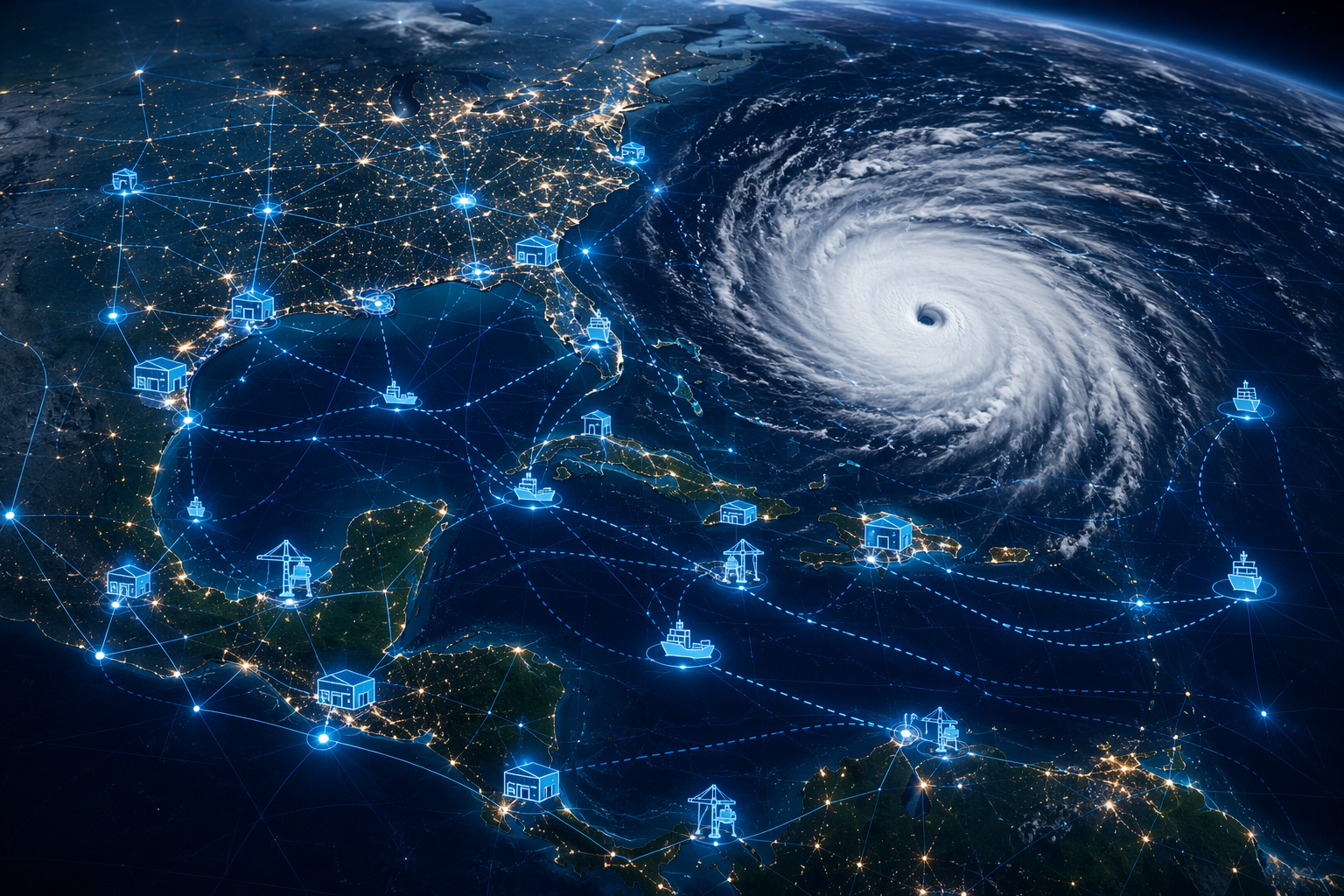
The better systems do not treat weather as a layer on a map. They combine meteorological forecasts, satellite imagery, supplier geolocation, shipping logs, port data, and risk scoring so that an alert moves from “storm likely” to “these components, facilities, lanes, and customer commitments are exposed.” That chain is where the business value either appears or disappears.
What AI is actually predicting
A severe weather model on its own predicts physical conditions: likely track, rainfall, wind, heat, flood risk, or storm surge. A supply chain risk system has to predict the commercial consequence of those conditions. The difference matters. A hurricane forecast says where the storm may go. A supply chain forecast says a resin supplier sits in the probable outage zone, a port lane is likely to slow, a contract manufacturer depends on a tier-3 component nearby, and the current finished-goods buffer will not cover demand if replenishment slips.
In practice, the chain usually looks like this:
| Input | What it adds | Decision it can support |
|---|---|---|
| Weather forecasts and satellite imagery | Probable timing, path, intensity, flood, wind, or heat exposure | When to trigger a response window |
| Supplier geolocation | Which facilities and sub-tier nodes sit in the exposed area | Which suppliers need confirmation, substitution, or allocation |
| Shipping logs, port data, and lane visibility | Which shipments and routes are likely to slow or stop | Whether to reroute, expedite, or hold |
| Inventory and demand data | Which products can absorb delay and which cannot | Where to pre-position stock or protect service levels |
| Risk scoring and business rules | Which alerts deserve action rather than observation | Who approves spend, substitutions, and customer communication |
This is why the same weather alert has very different value in two companies. One has supplier names in an ERP and a spreadsheet of direct contacts. The other has mapped tier-2 through tier-4 exposure, knows which plants feed which SKUs, and can see which in-transit shipments are already committed to customers. The first company receives a warning. The second receives a work queue.
The seven-day window is the center of the business case
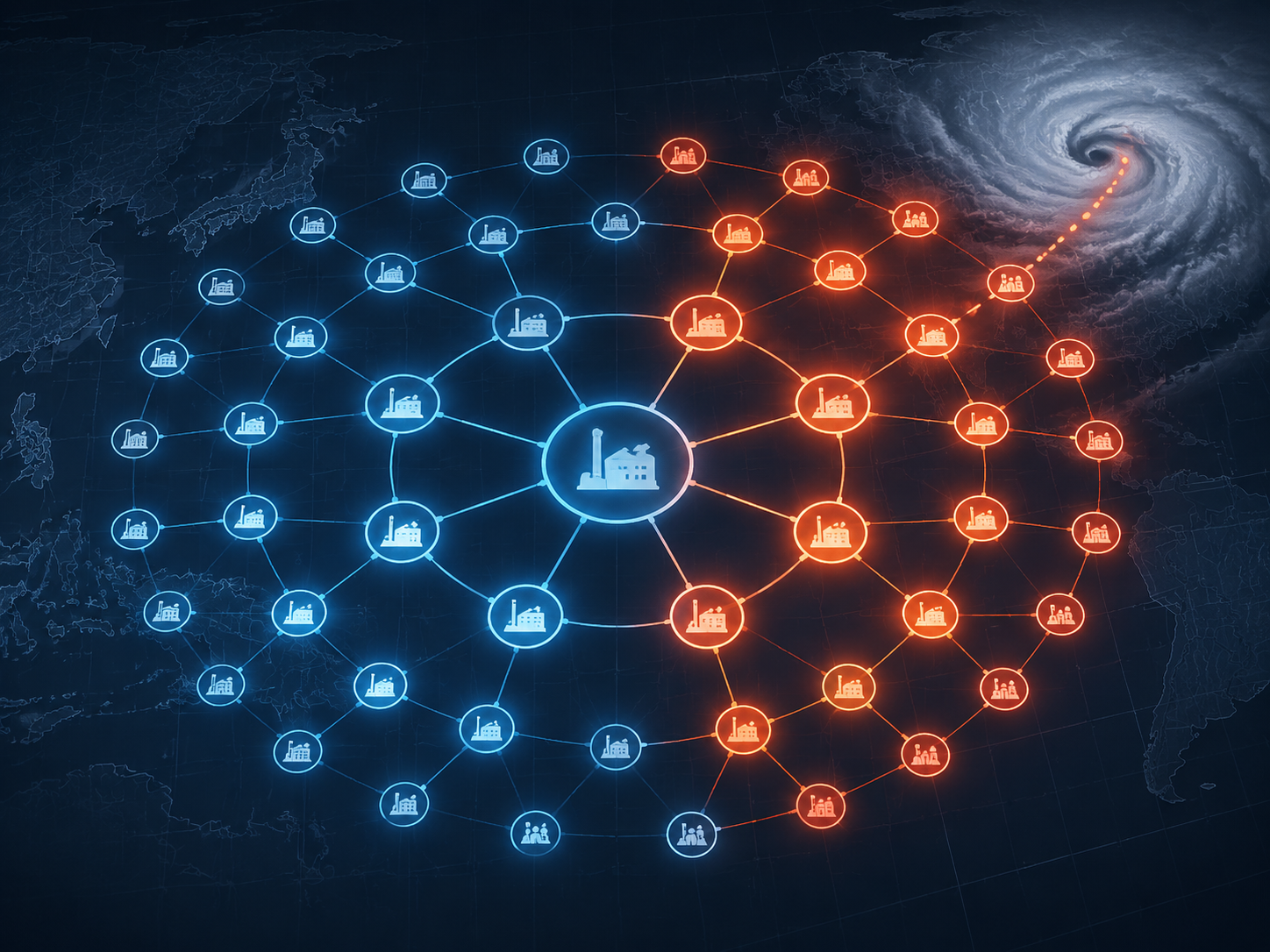
The Johnson & Johnson figure is important because it connects prediction to usable lead time, not because 85% is a magic threshold. A model that identifies 85% of major supply disruptions seven days ahead gives operators a chance to separate expensive interventions from watch-list items.[1] That is the difference between paying for emergency freight after a facility closes and reserving capacity while options still exist.
The broader accuracy claims should be read carefully. AI-driven forecasting has been cited as reducing supply chain errors by 20% to 50% and mitigating lost-sales risk by up to 65%.[1] Those are useful ranges, not universal guarantees. They depend on the type of weather event, the quality of the supply chain graph, the granularity of demand and inventory data, and whether people are empowered to act before the final forecast is certain.
Weather type sets a hard boundary. Hurricanes and some cyclones can offer a more useful multi-day planning horizon than flash floods or tornadoes. A seven-day hurricane outlook may be enough to stage roofing materials or replenish bottled water. A sudden convective storm may only improve short-term routing and labor decisions. Treating all severe weather as if it has the same forecast horizon is how optimistic pilots become disappointing deployments.
When prediction changes behavior before landfall
The ClimateAi Hurricane Ian examples are useful because they move past forecast quality and into commercial action. ClimateAi reported that its FICE model helped a roofing manufacturer capture $15 million in revenue by pre-positioning materials based on a seven-plus-day outlook before Hurricane Ian.[5] The action is the key detail: the manufacturer did not simply know a storm was possible; it moved materials into position before demand and disruption collided.
ClimateAi also reported that a grocery chain achieved $309 million in surge revenue, 32% above baseline, three days before Hurricane Ian made landfall by matching weather-driven demand predictions to inventory.[5] That result should not be generalized casually across categories. Grocery demand before a hurricane has a different pattern from industrial MRO, medical supplies, or seasonal apparel. Still, the case shows the operating pattern readers should look for: forecast, exposed demand, inventory action, and measurable commercial outcome.
The strongest evidence in these cases is not that AI “predicted Hurricane Ian.” Public and institutional weather forecasting already does that work. The supply chain contribution was converting expected local conditions into pre-landfall demand and supply decisions. For a planner, that distinction is not academic. It determines whether the model is funded by the analytics team or trusted by the people who own service levels.
Multi-tier visibility decides whether the alert is actionable
Supplier data is the less glamorous part of severe weather supply chain resilience AI, and it is usually the part that decides ROI. A direct supplier may be outside the storm path while its sub-tier supplier, packaging source, sterilization site, or specialized component plant is inside it. If the model cannot see that dependency, the forecast may be meteorologically accurate and operationally late.
Interos has described a Hurricane Idalia case with Cooper University Health Care in which multi-tier supplier disruption mapping supported proactive pre-positioning of critical medical supplies.[6] The important feature is the mapping of dependency before the disruption, not the elegance of the score. In healthcare, the consequence of a missing item is not just cost; it can be a clinical constraint. That changes the threshold for action.
Everstream Analytics has documented Southeast Asia cyclone work in which sub-tier supplier identification supported alternate sourcing before disruption.[7] Again, the narrower conclusion is the credible one: sub-tier identification can create sourcing options earlier for exposed categories. It does not mean every company can find substitutes quickly. Some parts have long qualification cycles, regulated specifications, or concentrated production footprints. In those cases, the value of the warning may be allocation, customer communication, or production resequencing rather than substitution.
This is where internal ownership becomes as important as the model. If procurement owns supplier mapping, logistics owns shipment visibility, planning owns inventory, and sales owns customer commitments, a weather alert can fall between functions. The organizations that get value define decision rights before the storm: who can approve expedite spend, who can authorize a substitute supplier, who can shift inventory away from one customer to protect another, and who can override the system when local information is better.
Where the vendor landscape fits
Vendor shortlisting should start with the operating gap, not the broad AI label. The ecosystem is not one category with interchangeable tools. Some vendors are stronger in climate and weather modeling; others are stronger in supplier-risk graphs, shipment visibility, or response orchestration.
| Vendor or platform | Most relevant role in this use case |
|---|---|
| ClimateAi | Climate modeling, FICE model, and LensConnect API for weather-driven demand and supply exposure |
| Everstream Analytics | Geography-first sub-tier risk intelligence and disruption monitoring |
| Interos | Multi-tier supplier mapping and AI risk scoring |
| The Weather Company / IBM | Enterprise weather data APIs and GRAF weather modeling infrastructure |
| FourKites | Real-time transportation visibility with weather overlays |
| Blue Yonder | Planning and response orchestration, including agentic AI disruption workflows |
| C3 AI | Enterprise AI platform modules that can incorporate weather risk |
A company with poor supplier geolocation should not begin by comparing hurricane-track accuracy claims. It should ask whether the tool can enrich, validate, and maintain supplier-site data beyond tier 1. A company with strong supplier mapping but weak execution may need workflow integration with planning, transportation, and inventory systems. A company with high route volatility may care more about weather overlays in real-time visibility; readers focused specifically on routing can compare the narrower use case of AI weather alerts for logistics.
The Weather Company and Magid have reported that companies using AI weather intelligence can achieve 5% to 10% revenue increases along with substantial operating cost reductions.[8] That kind of finding is directionally useful for a business case, but buyers should still tie expected value to their own categories: avoided stockouts, lower premium freight, reduced spoilage, better labor deployment, fewer missed customer commitments, or revenue captured from predictable surge demand.
The implementation boundary buyers should not skip
The most common overstatement in this market is that better prediction automatically creates resilience. It does not. Better prediction creates a window. The organization still has to decide what is worth doing inside that window.
Before funding a severe weather AI program, the practical readiness questions are blunt:
- Can exposed supplier sites be mapped below tier 1, including critical sub-tier nodes?
- Can the system connect weather exposure to specific SKUs, purchase orders, shipments, facilities, and customer commitments?
- Are inventory buffers, alternate suppliers, and expedite options visible early enough to compare trade-offs?
- Who has authority to act on a warning before the forecast is certain?
- How will false positives be reviewed so users do not learn to ignore the next alert?
Human-in-the-loop design is not a concession to weak AI. It is how supply chains avoid expensive automatic reactions to uncertain events. A model may rank a coastal supplier as high risk. A category manager may know that the supplier already shipped two weeks of buffer inventory. A transportation manager may know that the preferred port is less important than a rail interchange farther inland. Good systems preserve that judgment, capture the decision, and learn from the outcome.
The return case is strongest where the forecast horizon matches the operating lead time. Hurricanes, typhoons, cyclones, large flood systems, and some heat or winter weather events can give planners enough room to move inventory or capacity. Short-fuse hazards may still benefit from AI, but the value shifts toward routing, facility safety, dispatch timing, and customer communication rather than full network redesign.
What a credible pilot should measure
A useful pilot does not stop at forecast accuracy. It measures whether the alert changed behavior and whether that behavior improved the outcome. The cleanest pilot design starts with one or two weather-sensitive categories and a defined geography, then compares decisions against prior storms or a control group of similar lanes, suppliers, or facilities.
- Lead time gained: how many days or hours earlier the team identified exposed nodes.
- Action rate: which alerts led to expedite, pre-positioning, substitution, allocation, or customer communication.
- Avoided cost: premium freight avoided, downtime reduced, spoilage prevented, or labor redeployed.
- Revenue protected or captured: orders fulfilled that would otherwise have been missed, including surge-demand categories.
- Trust quality: false positives, false negatives, overrides, and user explanations captured after the event.
That last measure is easy to underweight. A supply chain team can live with uncertainty if the uncertainty is visible and reviewable. It will not live for long with black-box warnings that repeatedly ask people to spend money without showing the exposed dependency, confidence level, and consequence of waiting.
The practical answer
AI can predict severe weather supply chain impacts early enough to matter in strong use cases, especially when the event offers a usable forecast horizon and the company has mapped the nodes that weather can disrupt. The evidence around seven-day disruption identification, Hurricane Ian pre-positioning, and reported error reduction is enough to justify serious evaluation.[1][5] It is not enough to justify treating prediction as resilience by itself.
The buying question should come before the vendor demo: if the organization received a credible seven-day warning tomorrow, could it identify the exposed suppliers, inventory, lanes, and customers quickly enough to act?
References
- AI systems identifying 85% of major supply disruptions and AI-driven forecasting error reduction ranges, World Certification Institute
- EventWatchAI extreme weather disruption alerts, Resilinc EventWatchAI
- U.S. Billion-Dollar Weather and Climate Disasters, NOAA
- Business risk exposure estimates for 2025, Interos.ai
- FICE model Hurricane Ian customer outcomes, ClimateAi
- Cooper University Health Care Hurricane Idalia supplier disruption mapping case, Interos
- Southeast Asia cyclone sub-tier supplier identification case, Everstream Analytics
- AI weather intelligence revenue and operating cost findings, The Weather Company / Magid
Comments
Join the discussion with an anonymous comment.