
Most evaluations of supply chain control tower solutions start too late. By the time a buyer is comparing maps, alert queues, ETA feeds, scenario screens, and AI claims, the harder question has already been skipped: what kind of bottleneck is the platform supposed to remove?
The phrase “control tower” now covers at least three operating models. One model helps teams see disruptions sooner. Another helps planners choose better tradeoffs before the disruption becomes today’s problem. A third changes the live execution decision itself - the route, dispatch, assignment, or exception action. Those are not cosmetic differences. They decide who still has to do the remedial work at 5 p.m.
The category is crowded for a reason. Business Research Insights estimated the global supply chain control tower market at $8.75 billion in 2026 and projected a 15.59% CAGR through 2035, while noting North America held 37.2% of global share in 2024.[1] Other firms size the market differently because they define the category differently. Inbound Logistics’ 2026 research found 37% of organizations prioritizing control tower investments, up 6 percentage points year over year.[2] Treat those figures as pressure signals, not as proof that every buyer is shopping for the same thing.

The model matters more than the dashboard
A useful shortlist starts by separating “seeing the problem,” “planning around the problem,” and “acting on the problem.” Vendors may blur the boundaries, and large suites can stretch across more than one lane, but the center of gravity usually shows up in implementation scope, pricing posture, user workflow, and the kind of exception the platform actually resolves.
| Operational model | Primary bottleneck | Core job | Common vendor set | Typical implementation burden | Pricing posture | What it will not solve by itself |
|---|---|---|---|---|---|---|
| Visibility-led | Late or untrusted cross-network awareness | Track shipments, surface exceptions, notify teams, support carrier and customer communication | project44, FourKites, E2open, SAP | Often weeks to months for cloud visibility deployments, depending on carrier, ERP, TMS, and partner integrations.[4] | Lower entry point for some cloud visibility tools; project44 is cited around a $10K/year starting point, while E2open can run from about $200K to multi-million-dollar programs in comparison estimates.[4] | It usually identifies the exception; a human still has to decide the fix. |
| Planning-led | Poor forward-looking tradeoffs across demand, inventory, capacity, supply, and logistics | Run scenarios, align plans, optimize constraints, and guide decisions over weeks-to-months horizons | Blue Yonder, Kinaxis, o9 Solutions | Often months to 12+ months because the program touches planning data, business rules, master data, and decision governance.[3] | Comparison estimates place Kinaxis around $300K+/year, Blue Yonder Command Center around $500K+, and o9 at $1M+ in first-year program cost, but these are not official price lists.[3] | It does not replace live dispatch, routing, or same-day execution control. |
| Execution-led | Slow operational action after a disruption is known | Automate or recommend real-time routing, dispatch, assignment, and fulfillment decisions | Locus, Outvio, Syren | Often weeks to quarters, depending on operational footprint, order channels, route complexity, and integration depth.[3] | Locus describes a fixed-cost model tied to operational footprint; Outvio lists plans from EUR59/month to custom enterprise; Syren is custom-priced.[3] | It is strongest where repeatable execution decisions exist; it will not fix weak planning assumptions upstream. |
This is also where feature checklists become misleading. “Alerts” can mean a message to a planner, a carrier-facing exception workflow, or a trigger that reprioritizes delivery assignments. “AI” can mean ETA prediction, scenario optimization, or automated route adjustment. The label matters less than the handoff.
For buyers who want a second taxonomy by functional scope rather than operating model, the four functional clusters of a supply chain control tower is a useful companion lens. The operating-model lens is sharper when the immediate question is vendor fit.
Visibility-led control towers: when the first failure is awareness
Visibility-led platforms are often what executives picture first: live shipment maps, ETA variance, exception queues, customer notifications, and carrier performance views. In this model, the control tower becomes a trusted observation and communication layer across transport partners, facilities, orders, and customers.
That is a real operating gain when the current process depends on carrier portals, customer-service escalation, and manual status calls. A logistics director who does not know which shipments are late until the customer calls has an awareness bottleneck, not necessarily a planning or automation bottleneck. In that environment, project44, FourKites, E2open, and SAP belong in the first pass of the shortlist.
The specifics differ. AltexSoft’s control tower architecture guide cites project44 as cloud-based with an approximate starting point around $10K per year, FourKites as processing more than 3 million daily shipments, and E2open as a broader network platform with programs that can range from about $200K to multi-million-dollar deployments.[4] SAP is usually evaluated differently: not as a standalone visibility disruptor, but as a control layer embedded into an SAP-centric planning and execution environment. Buyers already standardized on SAP can use SAP Supply Chain Control Tower for standardized SAP shops for a deeper fit check.
The implementation burden is usually lighter than a planning transformation, but “lighter” does not mean trivial. The hard work is partner coverage, data normalization, order-to-shipment matching, carrier connectivity, and exception ownership. A visibility deployment that shows 200 exceptions no one owns has not failed technically; it has exposed an operating model that was never assigned.
The limit is equally important. A visibility-led control tower can shorten the time between disruption and awareness. It can improve customer communication. It can reduce time spent searching for status. But if the next step is still a dispatcher making calls, a planner re-cutting inventory manually, or a customer-service manager negotiating priority by email, the system is not autonomous. It is a better alarm with better context.
Planning-led control towers: when the expensive mistake happens before execution
Planning-led platforms deserve the most careful evaluation because they are powerful, expensive, and easy to mistake for something else. They are not built primarily to answer “Where is this truck right now?” or “Which driver should take the next stop?” They are built to help the business choose among constrained futures: inventory positions, service targets, production capacity, supplier risk, logistics cost, and demand volatility.
Blue Yonder, Kinaxis, and o9 Solutions sit in this conversation because their control tower stories are tied to planning depth. The buyer is usually not just buying a dashboard; the buyer is changing how demand, supply, inventory, and logistics decisions are synchronized. That is why the implementation profile often stretches from months to more than a year and why program risk lives as much in governance and data design as in software configuration.[3]
The reported outcomes can be attractive, but they should be read with labels attached. Blue Yonder says DHL achieved 7% transportation savings and Americold reduced labor cost by 10% using Blue Yonder capabilities; these are vendor-published customer results, not independent audit findings.[5] o9 says AB InBev reached 70-90% touchless planning, reduced stock-outs by 60%, and improved forecast accuracy by 11 percentage points to 87%; those figures also come from o9’s own published materials.[6]
Those caveats do not make the outcomes meaningless. They make them scoping questions. Was the result tied to transportation planning, demand planning, replenishment, inventory positioning, or an end-to-end planning redesign? Which regions, business units, and planning horizons were included? Did the platform reduce manual touches because the model became trusted, or because the organization narrowed the exception rules?
A planning-led control tower fits when the bottleneck is not that teams lack alerts, but that each function is optimizing its own version of the future. Sales protects service. Finance protects working capital. Supply planning protects feasibility. Logistics protects cost and capacity. The platform earns its keep when it makes tradeoffs visible early enough for the business to choose intentionally instead of discovering the consequence in execution.
This is the place to be blunt about fit. If the pain is same-day dispatch chaos, a planning-led platform may improve the assumptions that create the chaos, but it will not necessarily automate the last-mile decision. If the pain is S&OP drift, inventory whiplash, or poor scenario alignment, a routing engine will not solve the upstream decision problem. Buyers comparing Blue Yonder and Kinaxis can use Blue Yonder vs. Kinaxis for the platform-level distinction, while Kinaxis Maestro vs SAP IBP vs o9 Solutions goes deeper on deployment cost and program risk.
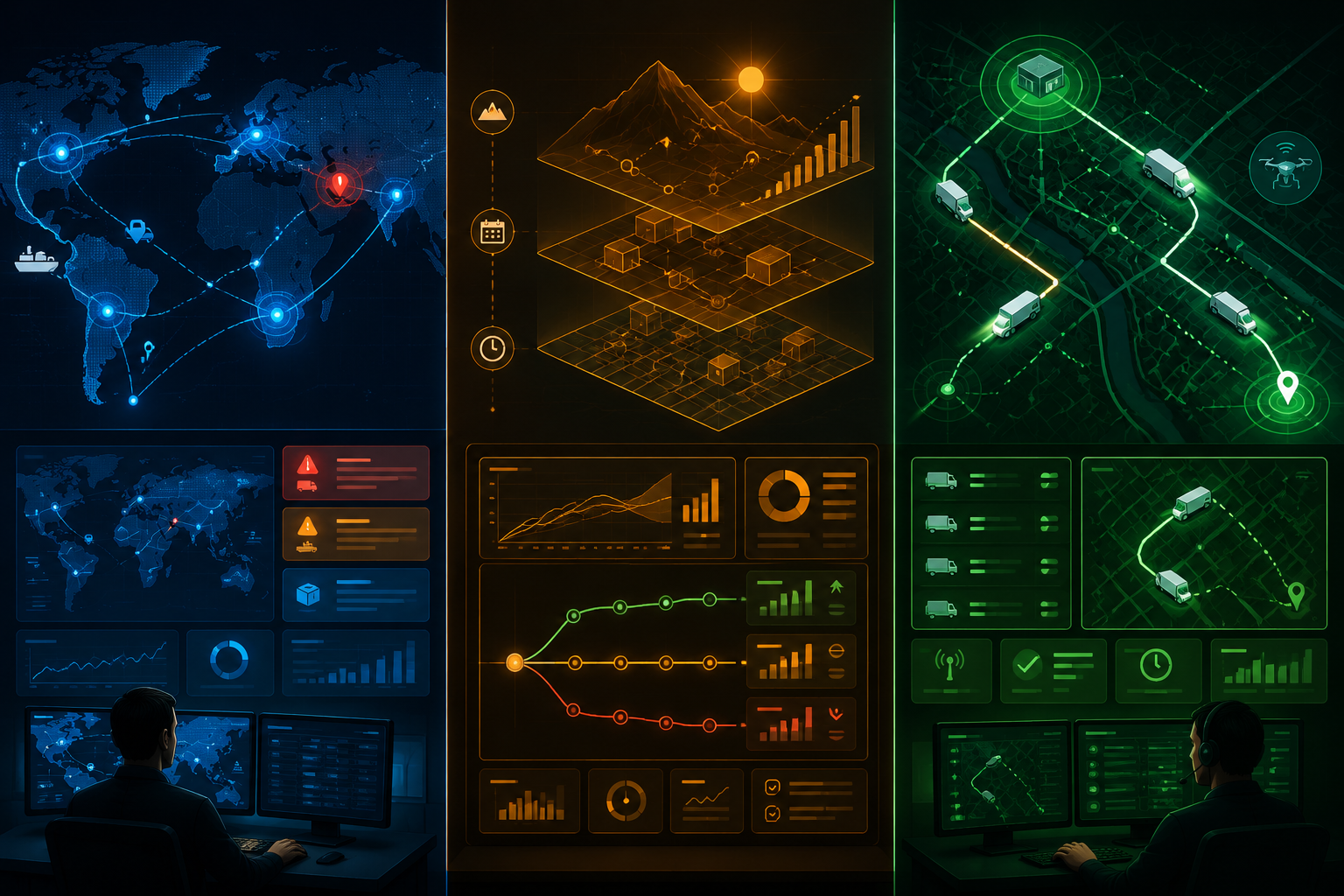
Execution-led control towers: when the handoff is the bottleneck
Execution-led platforms start from a different frustration: the organization already knows something changed, but action is still too slow. A late inbound load, a failed delivery, a capacity constraint, or a new order priority enters the operation, and the team has to reassign, reroute, resequence, or re-dispatch before service or cost deteriorates.
Locus, Outvio, and Syren are better evaluated through that operational lens than through the same dashboard checklist used for visibility tools. The practical questions are about order flow, route density, delivery windows, driver or carrier assignment, exception rules, and how much authority the system has to recommend or trigger action.
Locus claims 25% efficiency gains and 45% more deliveries per vehicle in its control tower comparison materials, while describing a fixed-cost model based on operational footprint.[3] Outvio publicly lists plans from EUR59 per month up to custom enterprise pricing, and Syren is presented as custom-priced.[3] These are not interchangeable economics. Per-stop or transaction-heavy pricing can look harmless in a pilot and change the ROI equation at scale, especially in high-volume last-mile or fulfillment operations.
The implementation pattern is also different. An execution-led rollout may move faster than a full planning transformation, but it has to touch operational truth: which constraints are hard, which are preferences, which exceptions can be automated, which require approval, and who is accountable when the system makes the economically correct decision that annoys a customer or a field team.
This is where autonomy language needs discipline. A platform that suggests a new route but waits for a dispatcher to approve every change is decision support. A platform that automatically reallocates stops within policy is operating closer to orchestration. Buyers exploring that line can use How Agentic AI Turns Logistics Control Towers into Autonomous Orchestrators to separate automation claims from actual operating authority.
The taxonomy is a buying lens, not the whole operating system
The visibility-planning-execution split is useful because it forces a buyer to name the bottleneck. It is not an industry standard, and it should not be treated as a complete control tower design method. Gartner’s Christian Titze has framed control towers as a combination of five elements: people, process, data, organization, and technology-enabled capabilities.[7] That is the corrective most software comparisons need.
A visibility tool without exception ownership becomes a nicer inbox. A planning platform without decision rights becomes a scenario generator no one follows. An execution engine without policy clarity becomes either over-constrained automation or a source of operational fights. The software model must match the bottleneck, but the operating model has to absorb the decision.
Accenture’s control tower materials put useful scale around the upside, citing potential impacts such as a 1% revenue increase, 3-5% logistics cost reduction, 10-20% labor efficiency improvement, 5-15% inventory reduction, and 8-15% reduction in destroy, donate, or discount activity.[8] Those are broad benchmarks, not a guarantee that any one vendor will deliver the same result in a different network. For a fuller benchmark view, see what ROI supply chain control tower software can deliver.
How to map the bottleneck to the shortlist
A cleaner evaluation starts with the sentence finance will eventually ask the operating team to defend: “Which step gets better because this platform exists?”
- If the problem is late awareness, poor shipment status, weak partner visibility, or customer-service escalation, start with visibility-led platforms such as project44, FourKites, E2open, and SAP.
- If the problem is poor scenario alignment, inventory and service tradeoffs, demand-supply synchronization, or planning latency, start with planning-led platforms such as Blue Yonder, Kinaxis, and o9.
- If the problem is slow dispatch action, route resequencing, fulfillment assignment, or real-time operational recovery, start with execution-led platforms such as Locus, Outvio, and Syren.
- If the problem spans all three, do not assume one control tower SKU will absorb the whole job. Decide which layer owns the decision, which layer supplies context, and which layer records the outcome.
Vendor reputation still matters. So do security, integration depth, implementation partners, support model, and total cost. But those checks should come after the operating model is clear. Otherwise a buyer can end up with an excellent visibility platform for a planning problem, a sophisticated planning suite for a dispatch bottleneck, or an execution engine deployed into a network that cannot yet trust its own data.
The decision is not which control tower looks most complete in a demo. It is where the constraint actually sits: late awareness, poor planning tradeoffs, or slow operational action. Once that is named, the right vendor set becomes smaller, the ROI case becomes more honest, and the implementation conversation becomes harder in the useful way.
References
- Supply Chain Control Tower Market Report, Business Research Insights, June 2026.
- 2026 Perspectives and Market Research: Logistics IT Accelerates, Inbound Logistics.
- Best Supply Chain Control Tower Providers, Locus.
- Supply Chain Control Tower: Visibility, Architecture, Benefits, and Examples, AltexSoft.
- The Blue Yonder Command Center: Your Guide to Logistics Excellence, Blue Yonder, 2025.
- Supply Chain Control Tower, o9 Solutions.
- Gartner: What supply chain managers should know about control towers, Supply Chain Dive.
- Supply Chain Control Tower, Accenture.
Comments
Join the discussion with an anonymous comment.