

Why Implementation Profile Is the Overlooked Discriminator
All three platforms covered here — Kinaxis Maestro (formerly RapidResponse), SAP Integrated Business Planning, and o9 Solutions Digital Brain — are named Leaders in the 2026 Gartner Magic Quadrant for Supply Chain Planning Solutions, which now publishes separate quadrants for Discrete Industries and Process Industries. Kinaxis holds the highest Ability to Execute position in the Discrete Industries quadrant. The capability question across these three platforms is, for most enterprise evaluators, settled.
What is not settled — and what this article addresses — is execution risk. Once you have received demos, reviewed architectural differences, and confirmed that all three platforms can handle your planning use cases, the decision shifts to a different set of questions: How long does deployment actually take? How dependent is the program on a system integrator? What data readiness work must happen before any planning value is extracted? What does the internal team need to look like, and for how long?
If you have not yet worked through the architectural differences between concurrent planning, knowledge graph-based decision intelligence, and ERP-embedded AI, the AI architecture comparison and platform selection framework is the prerequisite read. This article picks up where that one ends: at the moment before a program commitment, when implementation reality — not architecture — must be evaluated.
Data Readiness and ERP Integration Requirements by Platform
Every planning platform in this tier requires a data foundation before planning logic can operate. The difference between the three platforms lies in what that foundation demands — in terms of effort, skills, and time — and how tightly it is coupled to your existing ERP and master data environment.
Kinaxis Maestro is built on a supply chain data fabric that connects and contextualizes internal and external data sources into a single operational model. The architecture is cloud-native and ERP-agnostic by design, which means it can ingest from SAP, Oracle, Microsoft, and other sources without requiring a single-ERP environment. That flexibility is real, but it comes with a corresponding integration investment: each source system requires connector configuration, data mapping, and ongoing reconciliation work. For organizations with fragmented ERP landscapes or inconsistent master data, this upfront investment is substantial. The Kinaxis RapidResponse vendor profile covers the data integration prerequisites in more depth for teams that need single-vendor detail.
SAP IBP carries the deepest ERP alignment requirement of the three. Its native integration with the SAP ecosystem — S/4HANA, SAP ECC, SAP Supply Chain Control Tower — is a genuine advantage for organizations already running SAP end-to-end. For those organizations, master data alignment is significantly easier because the data models are shared. For organizations running non-SAP ERP, or running SAP partially, the integration complexity increases sharply: connector configuration, data transformation, and master data governance requirements become a program in themselves before planning value can be extracted. Practitioner reviews on PeerSpot's Kinaxis vs SAP IBP comparison specifically flag that 'architecture, connectors, and model optimization require more guidance from SAP' and that deployment 'currently demands self-learning.'
o9 Solutions Digital Brain introduces a requirement not present in the other two platforms: before the planning layer can operate, the Enterprise Knowledge Graph (EKG) must be built. The EKG functions as a living digital twin of the enterprise — modeling relationships across products, customers, locations, resources, and financial structures. This is not a configuration exercise; it requires graph data modeling expertise to translate your enterprise's planning environment into the EKG structure. For most organizations, this capability does not exist in-house, which creates a hard dependency on a specialized SI partner from day one. The o9 Solutions vendor profile covers the EKG architecture and deployment prerequisites in full.
| Dimension | Kinaxis Maestro | SAP IBP | o9 Digital Brain |
|---|---|---|---|
| ERP dependency | ERP-agnostic; multi-source connector configuration required | Deep SAP ecosystem alignment; non-SAP environments add significant integration complexity | ERP-agnostic; EKG build-out is the primary prerequisite regardless of ERP landscape |
| Primary data prerequisite | Supply chain data fabric: connector setup, data mapping, master data reconciliation | SAP master data alignment, connector configuration, governance framework | Enterprise Knowledge Graph (EKG) modeling: graph data structure build before planning layer activates |
| Specialized skills required | Data engineers with multi-source integration experience | SAP Basis, SAP IBP configuration, master data governance leads | Graph data modeling expertise (typically SI-sourced); supply chain domain SMEs for EKG design |
| Data quality risk | High if source systems have inconsistent master data | High if non-SAP systems require transformation; lower in full-SAP environments | High; EKG quality directly determines planning model quality — errors propagate across all use cases |
| Pre-go-live data work duration (directional) | Moderate to high depending on source system count and master data state | High in mixed-ERP environments; moderate in full-SAP environments | High; EKG build-out is a fixed upfront investment regardless of scope |
Go-Live Timelines and Phased Deployment Approaches
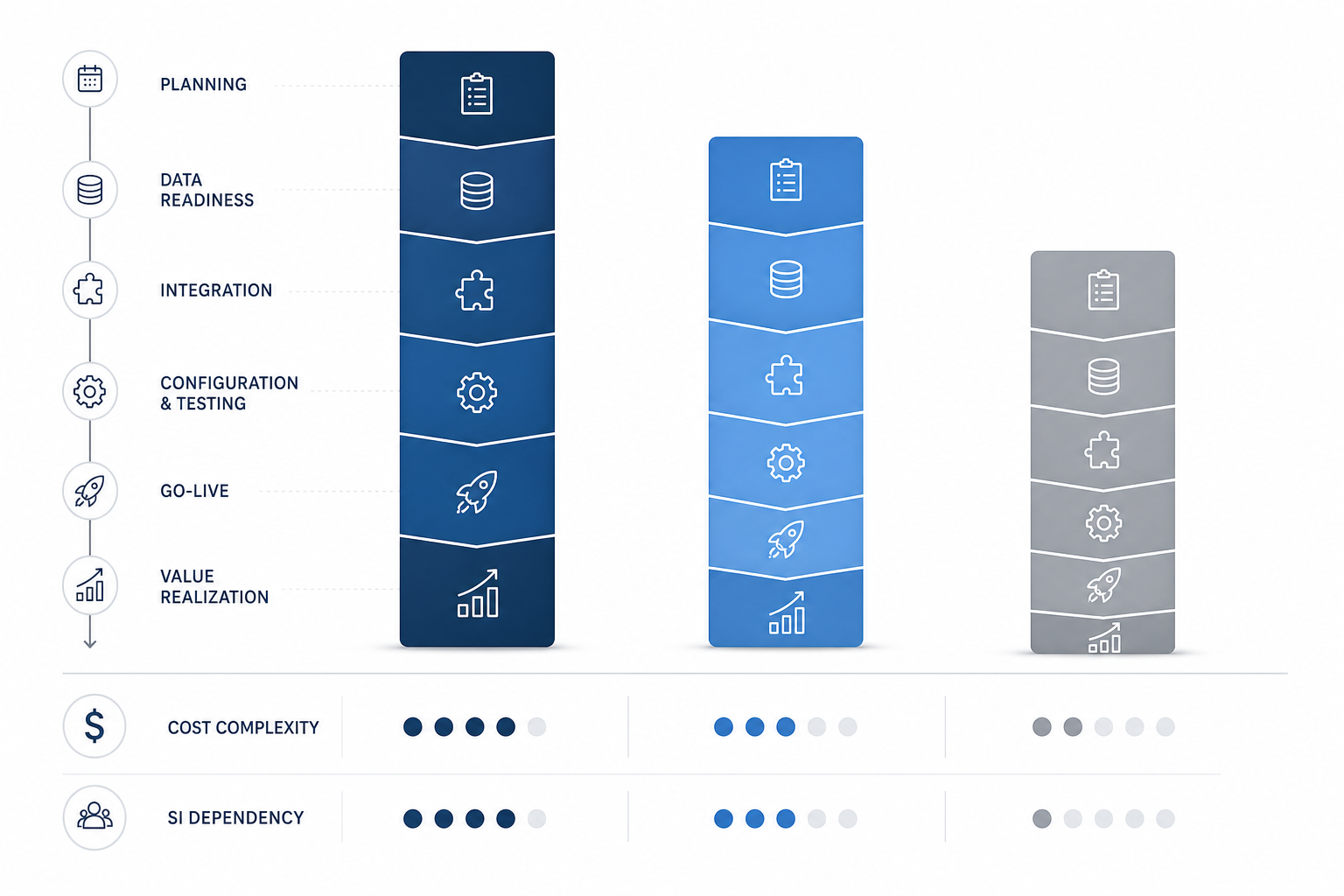
Timeline ranges for enterprise supply chain planning deployments are notoriously difficult to pin down, because program scope, data maturity, organizational readiness, and SI quality vary enormously. The figures below are directional practitioner-reported estimates, not vendor commitments. Treat them as a basis for internal scoping conversations, not as contractual benchmarks.
Kinaxis Maestro's cloud-native concurrent planning architecture allows organizations to activate specific use cases — demand planning, supply response, scenario modeling — without waiting for a full end-to-end deployment. This modular activation is a genuine time-to-value advantage for organizations that can define a bounded initial scope. Practitioner commentary consistently positions Kinaxis as faster to initial planning value than either SAP IBP or o9, with the caveat that the supply chain data fabric investment still requires substantial upfront effort if source systems are fragmented.
SAP IBP carries the longest path to full value realization of the three platforms. The integration complexity — particularly in mixed-ERP or partial-SAP environments — and the master data governance requirements mean that organizations typically need 18 to 24 months before the platform is operating at full capability. That timeline is consistent with practitioner-reported data on PeerSpot, which flags SAP IBP as requiring 'more extensive implementation time due to complex integration needs.' Early phases can deliver partial value (forecasting, basic S&OP), but the full IBP use case set takes significantly longer to activate. For a reference on the distinction between IBP and S&OP as planning frameworks, see the IBP vs S&OP terminology reference.
o9 Digital Brain uses a modular building-block deployment model: core building blocks (shared data, network visibility, collaborative workflows) are established first, then advanced building blocks (AI, automation, optimization) are layered on incrementally. This approach allows organizations to phase adoption rather than attempting a full-scope deployment. The significant constraint is that the EKG build-out is a fixed upfront investment — it cannot be deferred to a later phase, because the planning layer depends on it. Organizations that underestimate EKG modeling effort frequently experience schedule compression in later phases when the foundation is not solid.
| Phase | Kinaxis Maestro | SAP IBP | o9 Digital Brain |
|---|---|---|---|
| Initial value (first planning use case live) | Faster; bounded use cases can go live within initial months with adequate data readiness | Moderate; basic forecasting and S&OP can activate before full integration is complete | Slower; EKG build-out must precede planning activation |
| Full value realization (end-to-end IBP/orchestration) | Moderate timeline; depends on data fabric scope and source system count | Typically 18–24 months; longer in mixed-ERP environments (practitioner-reported, PeerSpot) | Moderate to long; core-then-advanced phasing allows incremental adoption but EKG quality gates later phases |
| Deployment model | Cloud-native; modular use case activation | Cloud (SAP HANA); phased by integration complexity | Cloud-native; modular building blocks with EKG as foundation |
| Primary timeline driver | Data fabric integration scope and source system data quality | SAP ecosystem alignment and master data governance | EKG modeling depth and SI graph data expertise |
System Integrator Landscape and Ecosystem Dependency
At enterprise scale, all three platforms require a system integrator. This is not a criticism — it reflects the legitimate complexity of integrating a planning platform into a multi-system enterprise environment and managing the organizational change that accompanies it. The question is not whether you need an SI, but how dependent your program is on SI quality, and how available the right SI capability is in the market.
For o9 Digital Brain, SI dependency is the highest of the three platforms, and it is qualitatively different from the other two. The EKG data model requires graph data modeling expertise that is genuinely specialized — it is not a skill set that most supply chain consulting practices have developed at scale. When an SI partner lacks this expertise, the EKG build-out produces a structurally weak foundation that limits everything built on top of it. For o9 programs, SI partner selection carries risk weight that is nearly equivalent to platform selection itself. Organizations evaluating o9 should conduct as much due diligence on their prospective SI partner's EKG track record as on the platform itself.
SAP IBP has the broadest SI ecosystem of the three — the major global consulting firms (Accenture, Deloitte, IBM, Capgemini, and others) all have substantial SAP IBP practices. The depth of the ecosystem is an advantage, but it creates a quality variation problem: SAP IBP SI engagements vary significantly in quality depending on the specific team assigned, not just the firm's brand. Practitioner reviews consistently flag that SAP IBP deployments require more self-directed learning from the customer, with limited in-deployment guidance from SAP directly. The SI partner fills this gap — meaning a weak SI team amplifies the platform's support limitations.
Kinaxis operates a tighter certified partner network than SAP. The smaller pool of qualified SI partners means less quality variation, but it also means less availability in some geographies and industries. For organizations in regions where Kinaxis SI capacity is thin, partner availability can become a program risk in its own right.
- o9 Digital Brain: Highest SI dependency; graph data modeling expertise is a hard requirement; SI partner track record on EKG deployments is a primary selection criterion. Treat SI evaluation as part of the platform evaluation process.
- SAP IBP: Broadest SI ecosystem; highest quality variation; customers must actively manage SI team composition and not rely on firm brand alone. SAP's own in-deployment support is limited per practitioner reviews — SI fills that gap.
- Kinaxis Maestro: Tighter certified partner network; lower quality variation but reduced availability in some markets; geographic SI capacity should be assessed early in evaluation.
Internal Staffing Requirements: Skills and FTE Demand by Platform
Implementation programs consume internal resources in ways that are frequently underestimated at the business case stage. The FTE demand is not limited to the go-live period — each platform requires ongoing internal capability to operate, tune, and govern the system after the SI engagement ends. The table below reflects directional relative demand across the three platforms; actual FTE counts depend heavily on program scope and organizational structure.
| Role | Kinaxis Maestro | SAP IBP | o9 Digital Brain |
|---|---|---|---|
| Data engineering / integration | High (multi-source data fabric requires ongoing connector and data quality management) | High in mixed-ERP environments; moderate in full-SAP environments | High (EKG maintenance requires ongoing graph data expertise; typically SI-supported post-go-live) |
| Supply chain domain SMEs | Moderate to high (concurrent planning model requires domain-grounded configuration) | High (IBP process design requires deep S&OP and demand planning expertise) | High (EKG modeling requires domain SMEs to define business relationships accurately) |
| Change management lead | Moderate to high (planning mode shift from static to continuous recalculation) | High (organizational process change is significant in IBP adoption) | High (enterprise decision intelligence framing requires broader organizational alignment) |
| Ongoing model administrator | Moderate (cloud-native reduces infrastructure burden; planning model tuning is ongoing) | Moderate to high (SAP Basis and IBP configuration expertise required ongoing) | High (EKG evolves with the business; ongoing graph model maintenance is a sustained FTE requirement) |
| IT / integration support | Moderate (cloud-native; primary burden is data pipeline maintenance) | High (SAP ecosystem integration requires dedicated SAP IT support) | Moderate (cloud-native; primary burden is EKG data pipeline and API maintenance) |
One pattern that appears consistently across practitioner accounts: organizations understaff the change management function relative to the technical implementation. The technical go-live receives the most resource attention; the organizational adoption work that determines whether the platform is actually used receives less. This pattern is relevant across all three platforms but is most acute in SAP IBP and o9 deployments, where the planning process changes are most significant.
Change Management Burden and User Adoption Challenges
At the 2026 Gartner Supply Chain Symposium/Xpo North America, the dominant theme was not AI capability — it was decision velocity. Practitioners across the conference confirmed that AI has moved from optional to essential in supply chain planning, but that scaling it, trusting it, and connecting it to real decisions remains the hard problem. The technology is largely ready. The people and processes frequently are not.
"We used to operate like MapQuest — a static plan. Now we need to operate like Google Maps — constantly recalculating." — Gerry Hanrahan, Extreme Networks, speaking at Gartner Supply Chain Symposium/Xpo North America, May 2026 (as reported by Kinaxis)
The MapQuest-to-Google Maps shift is an accurate description of what planning teams must accept when moving to any of these three platforms. Static monthly or weekly planning cycles, where a plan is produced and then executed until the next cycle, are replaced by continuous recalculation where the plan is always current and always changing. For planners who have spent careers in the former model, this is a significant cognitive and process shift — not a software training exercise.
The Gartner Symposium panel — featuring practitioners from Extreme Networks, Ciena, and Jamieson Wellness — specifically noted that 'technology isn't the hardest part — people and systems are.' The gap between decision speed and execution speed is the primary post-go-live risk: the platform can recalculate continuously, but the organization's ability to act on those recalculations is constrained by approval workflows, cross-functional alignment processes, and planner confidence in AI-generated recommendations.
The change management burden manifests differently across the three platforms. Kinaxis Maestro's user experience is designed for broad organizational access — from operations to C-suite — which means the change surface is wide. SAP IBP's adoption challenge is concentrated in the planning team, where the process changes are deepest. o9's 'enterprise decision intelligence' framing — the platform has expanded its positioning beyond supply chain planning — means that o9 programs often require broader organizational alignment that extends beyond the supply chain function.
Total Cost of Ownership: License, Implementation Services, and Hidden Costs
TCO for enterprise supply chain planning platforms is structurally underestimated at the business case stage because the software license cost is the most visible number, and it is typically the smallest component of total program cost. The framing below is designed to correct that.
| Cost Component | Kinaxis Maestro | SAP IBP | o9 Digital Brain |
|---|---|---|---|
| Software license | Competitive pricing; practitioner reviews cite faster ROI timeline relative to SAP IBP (PeerSpot, 2026) | Higher upfront setup costs; practitioner reviews cite deployment expenses as significantly higher per user than alternatives (PeerSpot community Q&A, 2026) | Competitive; pricing structure reflects modular adoption model |
| SI services (implementation) | Significant; directional practitioner estimate: 3–5x annual license at enterprise scope | Significant to very high; directional practitioner estimate: 3–5x annual license, higher in mixed-ERP environments | Significant; EKG build-out adds to SI cost; directional practitioner estimate: 3–5x annual license, potentially higher given specialized skills required |
| Ongoing support and maintenance | Moderate; cloud-native reduces infrastructure cost; planning model tuning is ongoing | Moderate to high; SAP support contracts plus ongoing integration maintenance | Moderate; cloud-native; EKG maintenance is a sustained cost |
| Commonly underestimated costs | Data quality remediation; multi-source connector development; change management | Master data governance program; SAP Basis support in mixed-ERP environments; self-directed learning burden on customer teams | EKG modeling rework if initial build is insufficiently detailed; SI re-engagement if graph model requires structural changes; change management for enterprise-wide adoption |
| Relative TCO positioning | Lower than SAP IBP in practitioner community comparisons; faster ROI timeline reported | Highest TCO of the three in most enterprise configurations per practitioner community data | Comparable to Kinaxis in license; SI cost variability is higher due to EKG specialization |
Implementation Risk Factors and Failure Modes by Platform
Across all three platforms, data quality remediation is the most consistently underestimated cost and schedule risk. This is not a platform-specific observation — it is a structural feature of enterprise planning platform deployments. Organizations that have not invested in master data governance before initiating a planning platform program will encounter this cost regardless of which platform they select. The question is when it surfaces and how much it disrupts the program.
Beyond the shared data risk, each platform has a distinct failure pattern.
- Kinaxis Maestro: The primary upfront risk is data fabric integration complexity when source systems are numerous or poorly governed. Programs that enter with an optimistic view of data quality and connector development effort frequently experience schedule compression in the first phase. The platform's ERP-agnostic flexibility is a genuine advantage, but it means the integration work cannot be deferred to a standard SAP-to-SAP connector — it must be built and tested for each source. For context on Kinaxis's current product trajectory and vendor stability, see the Kinaxis Q2 2026 market signal.
- SAP IBP: Two failure modes appear repeatedly in practitioner accounts. First, the self-directed learning burden: practitioner reviews note that SAP IBP deployment 'currently demands self-learning,' meaning customer teams must develop significant internal expertise without the level of in-deployment guidance that other platforms provide. Organizations that do not invest in this capability development — or that rely too heavily on SI partners to fill the gap — find themselves unable to operate the platform effectively after the SI engagement ends. Second, SI quality variation: the breadth of the SAP IBP SI ecosystem means that team composition matters more than firm selection.
- o9 Digital Brain: The dominant failure mode is EKG misalignment — when the SI partner builds an EKG that does not accurately reflect the organization's planning relationships, or builds it at insufficient depth for the intended use cases. This failure is expensive to remediate because the EKG is the foundation of the entire planning model; structural errors require SI re-engagement and can invalidate planning outputs built on top of a flawed graph. The second risk is scope creep in the EKG build-out: the platform's 36+ use case coverage is a genuine capability, but attempting to model all of them in the initial EKG build is a common program failure pattern.
Due Diligence Questions for RFP, Reference Checks, and POC
The questions below are organized by evaluation stage. They are designed to surface implementation reality rather than platform capability — the capability questions belong in the architecture evaluation. Use the ERP data readiness assessment checklist as a companion tool alongside these questions.
Reference Customer Calls
- What was your actual go-live timeline from contract signature to first production planning run — and what caused the variance from your original estimate?
- What percentage of your total program cost was data quality remediation, and how much of that was identified before versus during implementation?
- How many FTEs do you have dedicated to ongoing platform operation and model maintenance today, and how does that compare to what you planned at the business case stage?
- What was the single biggest implementation challenge you did not anticipate at the vendor selection stage?
- If you were selecting again today, would you choose the same SI partner? What would you do differently in that selection?
- How long did it take from go-live to your planning team actually trusting and acting on AI-generated recommendations?
RFP and Vendor Scoping
- Provide three reference customers with comparable ERP landscape (specify your ERP configuration) and comparable enterprise complexity. We will contact them directly.
- What are the specific data prerequisites that must be met before the planning layer can be activated? Provide a checklist, not a general description.
- What does your in-deployment support model look like after the SI engagement ends? What support is provided directly by the vendor versus by the SI?
- What change management resources and methodologies do you provide as part of the implementation program? What is typically the customer's responsibility?
- (For o9) What graph data modeling expertise does your recommended SI partner have? Provide a reference for an EKG deployment in our industry.
- (For SAP IBP) What guidance and tooling does SAP provide for deployment architecture decisions? How is the self-directed learning burden managed for customer teams?
Proof of Concept Design
- Scope the POC to include at least one data integration from your actual source systems — not a vendor-provided demo dataset. Data integration complexity is the primary schedule risk; it must be tested in the POC.
- Include a change management scenario in the POC: have your actual planning team use the system for a defined planning cycle, not just an IT evaluation team.
- Require the SI partner to participate in the POC with the specific team that would lead the implementation — not a pre-sales team.
- Define success criteria for the POC that include data integration completion and user adoption indicators, not just technical functionality demonstration.
- (For o9) Require a partial EKG build for one planning domain as part of the POC. The EKG modeling effort is the primary program risk; it must be assessed before commitment.
Decision Matrix: Matching Implementation Profile to Organizational Context
The matrix below is designed to support conditional recommendations — not a generic ranking. Every cell reflects a specific organizational context. If your context does not match any of the described conditions clearly, that is a signal that further internal assessment is needed before platform selection, not that one platform is universally superior.
| Organizational Variable | Favors Kinaxis Maestro | Favors SAP IBP | Favors o9 Digital Brain | No Clear Advantage |
|---|---|---|---|---|
| ERP landscape | Multi-ERP or non-SAP environment; need for ERP-agnostic integration | Full SAP S/4HANA or SAP ECC environment; deep SAP ecosystem investment | Any ERP landscape; EKG is ERP-agnostic but requires its own build investment | Partial SAP with significant non-SAP systems (adds complexity for all three) |
| Data maturity | Moderate to high; data fabric investment is required but manageable with clean master data | High within SAP ecosystem; lower maturity in non-SAP data sources creates significant risk | Moderate to high; EKG quality directly reflects master data quality — low maturity creates structural risk in the graph model | Low data maturity (all three platforms require remediation; none is a shortcut) |
| Timeline pressure (time to first planning value) | Shorter timeline acceptable; cloud-native architecture supports faster initial use case activation | Longer timeline acceptable; 18–24 months to full value is a realistic expectation | Moderate; willing to invest in EKG build-out before planning value is extracted | Urgent (sub-6-month) timeline requirement (none of the three is appropriate without exceptional data readiness) |
| SI availability and budget | Certified Kinaxis SI partner available in your geography; SI budget appropriate for integration scope | Major global SAP practice available; budget for deep SI engagement; willing to actively manage SI team composition | SI partner with documented EKG experience available; willing to treat SI selection as co-equal to platform selection | SI market is thin in your geography or industry (assess before platform commitment) |
| Internal staffing capacity | Data engineering capacity for ongoing data fabric maintenance; planning SMEs for model configuration | SAP Basis and IBP configuration expertise available or developable internally; high tolerance for self-directed learning | Willingness to sustain ongoing EKG maintenance capability (internal or SI-supported) | No internal data engineering or planning SME capacity (all three require sustained internal investment) |
| Change management capacity | Broad organizational change surface; need for enterprise-wide planning mode shift | Deep planning process change; S&OP and IBP process redesign capability required | Broadest change surface; enterprise decision intelligence framing extends beyond supply chain function | Low change management capacity or budget (all three will underperform without it) |
| Vendor stability and long-term program risk | Strong; dual-quadrant Gartner Leader; cloud-native product trajectory (see Q2 2026 market signal) | Strong; SAP ecosystem continuity; large installed base provides program risk buffer | Strong; growing enterprise footprint; EKG platform has multi-year investment trajectory | All three are Gartner Leaders; vendor stability is not a primary differentiator at this tier |
Two patterns are worth highlighting from the matrix. First, organizations with full SAP S/4HANA environments and high SAP data maturity have a genuine case for SAP IBP despite its higher deployment complexity and TCO — the integration advantage in that configuration is real and reduces the primary risk factors. Second, organizations that are drawn to o9's enterprise decision intelligence positioning should assess their SI market access before committing: the EKG dependency means that platform quality and SI quality are inseparable in practice.
Comments
Join the discussion with an anonymous comment.