
A supply chain team can be in the cloud and still be nowhere near ready for AI planning. The ERP may be hosted differently. The data warehouse may be newer. Forecast dashboards may refresh faster. Yet the demand planner still downloads exceptions, the inventory analyst still reconciles stock positions by hand, and S&OP still depends on which version of the spreadsheet made it into the meeting.
That is the real test for ai cloud infrastructure supply chain planning: not whether a company has moved systems to a hyperscaler, but whether the architecture can turn demand signals, constraints, simulations, and recommendations into governed operating decisions. Gartner reported that only 23% of supply chain organizations in a 2025 sample of leaders already deploying AI had a formal AI strategy; the same release predicted that 70% of large organizations will adopt AI-based supply chain forecasting by 2030.[1] That gap is not a footnote. It is how companies end up with active pilots, impressive demos, and no coherent path from model output to purchase order, deployment plan, allocation change, or executive trade-off.
Intent is even higher than readiness. ABI Research, cited in a third-party supply chain AI statistics roundup, says 94% of supply chain companies plan to use AI for decision support within two years.[2] Planning leaders should treat that as a pressure signal, not proof that the market has solved production AI. A plan to use AI is not the same thing as a planning architecture that can absorb noisy inputs, run probabilistic scenarios, respect ERP constraints, and preserve decision accountability.

The Architecture Starts Where Lift-and-Shift Stops
Lift-and-shift cloud migration changes where systems run. AI planning changes how decisions are composed. Those are not the same project.
Production AI planning workloads have to do several things at once: ingest demand, inventory, orders, shipments, capacity, supplier, product, and external signals; reconcile them into trusted planning objects; generate forecasts and scenarios; evaluate constraints; recommend actions; route exceptions; and push approved decisions back into execution systems. A model endpoint alone cannot do that. A dashboard cannot do that. A data lake, by itself, certainly cannot do that.
The useful cloud architecture has five working layers:
- Execution systems: ERP, TMS, WMS, order management, supplier systems, manufacturing systems, and planning applications that hold the operational record.
- Unified data fabric: the governed data layer that normalizes master data, transactions, events, inventory positions, constraints, and external signals into usable planning context.
- Elastic modeling and optimization capacity: compute for forecasting, probabilistic modeling, simulation, optimization, digital twins, and scenario comparison.
- Decision intelligence layer: the layer that converts signals and model outputs into recommended actions, exception workflows, approval routes, and execution pathways.
- Governance and control plane: decision rights, audit trails, model monitoring, human-in-the-loop rules, security, access control, and agentic AI guardrails.

The order matters. If the data fabric is weak, the decision layer becomes a polished exception generator. If the decision layer is missing, the company gets better insight and the same old manual translation into operational action. If governance is added after agents start recommending actions, the organization will discover too late that nobody agreed who owns the decision.
The Data Foundation Is Usually the First Failure Point
The least glamorous infrastructure question is still the most decisive one: can the planning system see the business accurately enough, soon enough, and at the right level of granularity?
In the Impinj and TraxTech material on AI in supply chain, data accuracy was identified as the top AI implementation challenge at 43%, followed by data availability at 39% and real-time access at 36%.[3] The same source says only 33% of supply chain managers consistently obtain accurate, real-time inventory data, even though 91% believe they are equipped, and that managers spend up to 60% of analytics time identifying and correcting data quality issues rather than generating insights.[3]
Those numbers describe the routine breakdown. A planner asks why the model wants to expedite a supplier order. The answer depends on whether the stock position is current, whether in-transit inventory is visible, whether substitutions are modeled, whether customer priority is encoded, whether the planning calendar aligns with the transportation calendar, and whether the item-location master data has the same meaning across systems. If any of that is unresolved, the AI recommendation is not wrong in a dramatic science-fiction way. It is wrong in the boring way planning teams already know: plausible enough to require investigation, fragile enough to waste the morning.
A production-ready data fabric for AI planning has to handle more than storage. It needs identity resolution across products, locations, suppliers, customers, and assets. It needs data lineage so planners can see where a recommendation came from. It needs timeliness rules because not every decision requires streaming data, but some decisions become useless if the inventory picture is a day old. It needs semantic consistency so “available inventory,” “projected inventory,” “allocatable inventory,” and “on hand” do not collapse into one convenient but misleading metric.
| Planning data requirement | Why it matters in production AI | Typical failure mode |
|---|---|---|
| Master data consistency | Models and rules need stable definitions for items, locations, suppliers, lanes, calendars, and constraints. | The model optimizes against product-location combinations that do not match execution reality. |
| Inventory visibility | Forecasting, allocation, replenishment, and ATP decisions depend on trusted current and projected stock positions. | Planners override recommendations because the system cannot explain what stock is actually available. |
| Latency discipline | Different planning decisions need different refresh rates, from near-real-time exception handling to weekly S&OP scenarios. | The architecture pays for speed where it is not needed and lacks speed where it is. |
| Constraint context | AI planning needs capacity, lead times, minimum order quantities, service policies, supplier limits, and transportation rules. | Recommendations look mathematically attractive but cannot be executed. |
| Lineage and quality signals | Planners need to know whether a recommendation is based on complete, current, and trusted inputs. | Every exception becomes a detective exercise. |
This is where many cloud programs become uncomfortable. A company may have funded a modern data platform, but still lack the planning-specific semantics that AI workloads need. General enterprise data modernization is useful; it is not automatically a supply chain planning data foundation.
The Decision Intelligence Layer Is the Missing Middle
The most important architectural shift is the move from analytics presentation to decision execution. ARC Advisory Group’s framework, discussed in Logistics Viewpoints, describes supply chain AI moving away from isolated functional software categories toward a decision intelligence layer that connects planning signals to execution workflows through action pathways.[4] A related Logistics Viewpoints piece defines supply chain decision intelligence around the ability to combine data, analytics, AI, and workflow so decisions can be made and acted upon in context.[5]
That layer is not another name for a control tower. A control tower may expose exceptions. A decision intelligence layer has to understand what actions are available, who can approve them, which systems must receive them, and what happens if the recommendation is accepted, modified, rejected, or deferred.
For demand forecasting, the layer may surface a probability distribution, detect a promotion-driven exception, compare it with sales input, and route a forecast override for approval. For inventory optimization, it may recommend a safety stock change, show service and working-capital impact, check policy limits, and write the approved parameter back into the planning system. For supply planning, it may compare constrained scenarios, expose which customer orders are at risk, and generate a feasible action path involving capacity, supplier expedite, allocation, or substitution.
The distinction matters because many AI pilots stop at recommendation. In production, the hard part begins after the recommendation appears. Someone has to decide whether it is allowed, whether it conflicts with commercial commitments, whether it violates a policy, whether it should update a planning parameter, and whether the ERP will accept the transaction. The decision intelligence layer is where that translation lives.
What the Layer Must Know
- Decision objects: forecast overrides, inventory parameters, allocation rules, purchase recommendations, production changes, shipment priorities, and S&OP trade-offs.
- Action pathways: which approved decisions update ERP, TMS, WMS, supplier portals, planning workbenches, collaboration tools, or executive workflows.
- Approval rules: thresholds, escalation paths, segregation of duties, policy exceptions, and who can authorize autonomous or semi-autonomous action.
- Decision context: confidence, input freshness, constraint assumptions, scenario comparisons, business impact, and known data-quality warnings.
- Feedback loops: whether the action was accepted, changed, rejected, executed, delayed, or later reversed, so models and workflows can improve.
Without those elements, AI planning remains dependent on heroic planners who translate model output into operational behavior. That may work in a pilot with a motivated team. It does not scale across categories, regions, product hierarchies, service policies, and exception volume.
Compute Matters, But It Is Not the Whole Story
AI supply chain planning does need elastic compute. Demand models have to be retrained. Probabilistic forecasts have to run across item-location-customer combinations. Scenario planning can multiply quickly when planners test demand shocks, supplier constraints, transportation disruptions, and service-level changes. Optimization and simulation workloads often arrive in bursts around planning cycles, not as smooth daily consumption.
The practical requirement is not “more cloud.” It is workload-aware capacity. A demand sensing workload with frequent signal refresh has different infrastructure needs from a monthly network optimization run. A digital twin used for executive S&OP trade-offs has different latency and explainability requirements from an exception agent monitoring late inbound shipments. Planning calendars still matter. If the consensus forecast locks on Wednesday, compute that finishes on Friday is not elastic in any useful sense.
| AI planning workload | Infrastructure implication |
|---|---|
| Probabilistic demand forecasting | Scalable training and inference, feature stores, model monitoring, and forecast versioning. |
| Inventory optimization | Reliable inventory and service-policy data, scenario compute, parameter write-back controls, and impact tracking. |
| Constraint-aware supply planning | Optimization engines, constraint data management, solver capacity, and integration with production, procurement, and allocation workflows. |
| S&OP and executive scenarios | Simulation capacity, business metric translation, scenario persistence, and collaboration workflows. |
| Exception management and agents | Event ingestion, low-latency context retrieval, decision rules, approval routing, and audit logs. |
Cloud platforms are attractive here because capacity can be scaled around planning windows and experiment cycles. But compute cannot compensate for weak planning semantics or missing execution pathways. A faster model that produces recommendations nobody trusts, approves, or implements is just a faster source of rework.
Integration Is Where Insight Becomes Work
The second common stall point is integration. Planning leaders often discover that AI insight can be produced faster than the organization can absorb it. The model recommends changing a replenishment parameter, but the ERP requires a controlled master-data update. It recommends reallocating inventory, but customer priority rules live in a separate process. It recommends an expedite, but transportation cost approval sits in another workflow. None of that is a model problem. It is infrastructure.
A production architecture needs integration in three directions. It needs upstream integration to collect signals from ERP, TMS, WMS, point-of-sale, suppliers, carriers, manufacturing, and external data providers. It needs lateral integration with planning workbenches, collaboration tools, S&OP workflows, and analytics environments. It needs downstream integration to execute approved decisions or create controlled work items in the systems of record.
This is also where MCP-style connectivity is getting attention. The promise is not magic access to enterprise truth; it is a more standardized way for AI assistants and agents to reach governed tools and context. That only helps if the underlying permissions, data contracts, and action boundaries are designed. An AI assistant that can query more systems without understanding which actions it may initiate is not a planning architecture.
Teams assessing integration readiness should avoid counting interfaces as if volume equals capability. The better questions are sharper: Can the system create a purchase recommendation with the fields the ERP actually requires? Can it distinguish a suggested allocation change from an approved allocation change? Can it preserve the reason code and model context when a planner modifies the recommendation? Can rejected recommendations feed back into model and workflow learning? Can S&OP decisions be traced back to the scenarios and assumptions that shaped them?
Governance Belongs Inside the Operating Model
Governance should not arrive as an ethics appendix after the architecture is built. Once AI systems recommend inventory, procurement, allocation, or logistics actions, governance becomes part of the operating model.
The direction of the software market makes this unavoidable. Gartner forecast that spending on SCM software with embedded agentic AI will grow from under $2 billion in 2025 to $53 billion by 2030.[6] DC Velocity’s reporting on Gartner’s 2026 supply chain technology trends lists agentic AI, collaborative multiagent systems, domain-specific language models, and decision governance among the top themes, and reports Gartner’s prediction that 15% of daily logistics decisions will be made autonomously by AI agents by 2028.[7] Gartner has also predicted that 50% of cross-functional SCM solutions will include agentic AI capabilities for autonomous decisions by 2030.[8]
Those forecasts point to a direction, not a permission slip. The more autonomous the recommendation or action, the more explicit the organization has to be about decision rights. A forecast adjustment may require planner review. A safety stock increase over a financial threshold may require planning and finance approval. A customer allocation change may require commercial governance. An expedite may require transportation budget approval. An autonomous agent should not discover those boundaries by trial and error.
Governance for AI planning infrastructure should cover at least five operating controls:
- Decision authority: which recommendations can be automated, which require review, and which are advisory only.
- Auditability: who or what made the recommendation, which data and assumptions were used, who approved it, and what system executed it.
- Model monitoring: drift, bias in forecast error patterns, degraded performance, stale features, and changing business conditions.
- Exception thresholds: confidence levels, financial exposure, customer impact, service risk, and policy violations that trigger escalation.
- Human-in-the-loop design: review steps that add judgment rather than simply turning planners into rubber stamps for opaque recommendations.
For a deeper treatment of autonomy-specific failure modes, see How Agentic AI Introduces Six New Risks in Supply Chain Planning. The short version for infrastructure planning is simple: if the architecture cannot log, constrain, explain, and reverse AI-driven decisions, it is not ready for agentic planning.
What the Provider Landscape Actually Signals
The cloud and planning software market is converging around this architecture, although each provider describes it in its own vocabulary. That does not mean buyers should turn architecture design into a logo exercise. It means the major platforms are all trying to own some combination of data fabric, AI workbench, planning workflow, integration, and decision execution.
AWS positions Connect Decisions as the next generation of AWS Supply Chain, with AI teammates that learn from planner decisions. AWS also publishes a Wells Vehicle Electronics customer result claiming a 7% inventory reduction in three months while improving fill rates.[9] That is useful as an example of the kind of outcome vendors are now associating with AI decision support, but it remains a single vendor-published case, not a benchmark for what every implementation should expect.
Google Cloud emphasizes BigQuery, Vertex AI, supply chain digital twin capabilities, multimodal AI, and partner solutions for supply chain and logistics.[10] The strategic pattern is clear: consolidate data and AI services close enough to planning context that customers can build forecasting, visibility, simulation, and optimization workloads without treating each use case as a separate platform.
Microsoft Azure shows up through Fabric, Copilot, Azure AI Foundry, and the surrounding enterprise planning ecosystem, including SAP IBP and Blue Yonder deployments discussed in third-party cloud supply chain coverage.[11] Oracle Fusion Cloud SCM, SAP IBP, Kinaxis Maestro, and Blue Yonder Luminate represent another route: cloud-native or cloud-delivered planning suites embedding more AI into established planning workflows. For a broader buying-map view, see The Supply Chain AI Companies Landscape.
MCP is the newer signal to watch. A Flowlity comparison describes its production MCP server for external AI assistants and notes SAP’s HANA Cloud MCP support.[12] Because the source is vendor-published and comparative, the detail should be read directionally. Still, the architectural implication is important: AI planning systems are moving toward governed tool access, not just embedded chat interfaces.
The provider question, then, is not “which vendor has AI?” Nearly all serious vendors now do. The better question is which combination gives your organization the cleanest path from trusted planning data to governed decision execution, without creating another isolated intelligence layer that planners must manually reconcile every Thursday.
Readiness Assessment for AI Planning Infrastructure
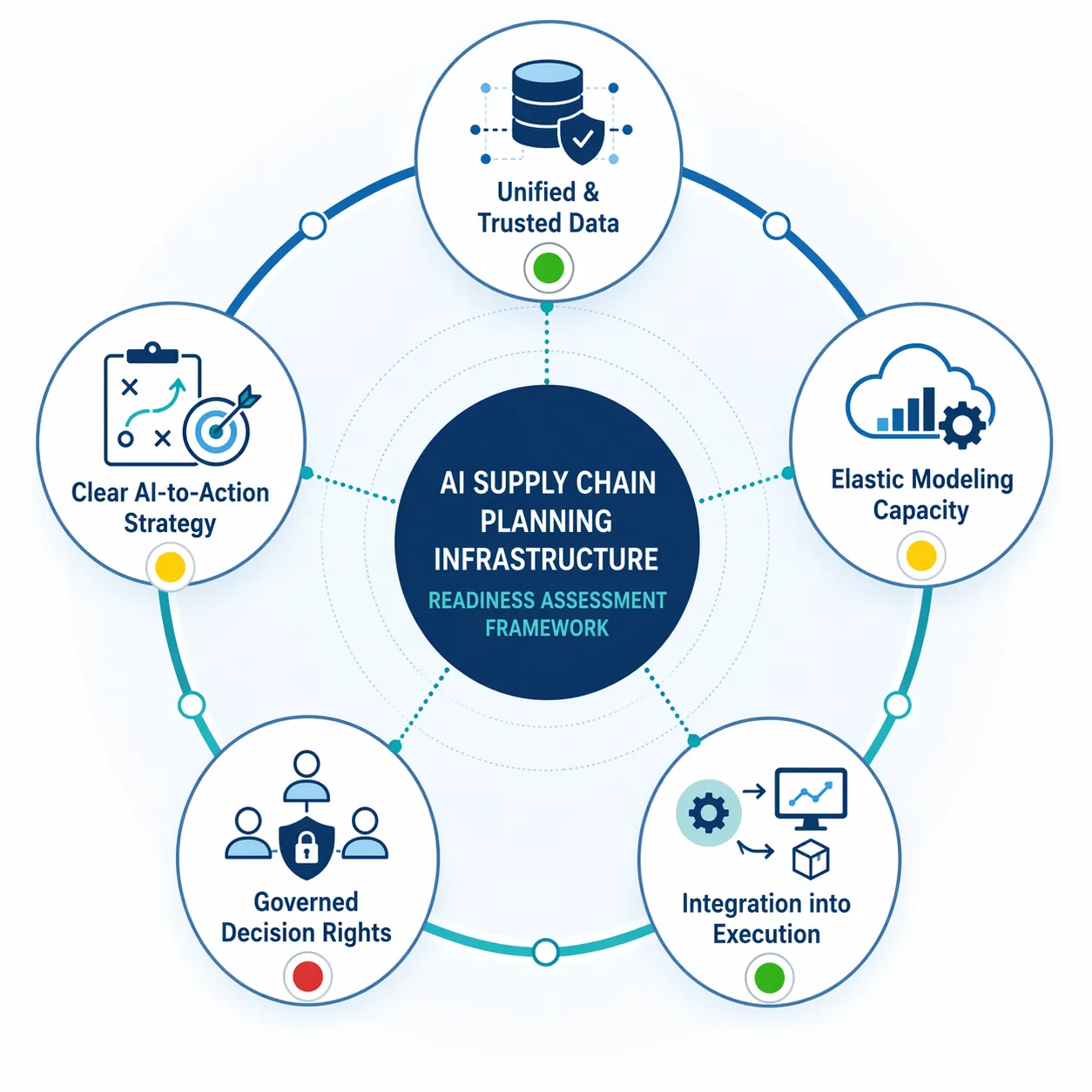
A readiness assessment should be blunt enough to change investment priorities. If the answer to every question is “partially,” the organization may still be able to run useful pilots, but it should not pretend it has production AI planning infrastructure.
| Readiness area | Production-ready question | What weak readiness looks like |
|---|---|---|
| Unified and trusted data | Do planners have governed, timely, semantically consistent data for demand, inventory, supply, capacity, orders, shipments, and constraints? | Teams still reconcile exceptions manually before trusting the system. |
| Elastic modeling capacity | Can the platform run forecasting, optimization, simulation, and scenario workloads at the cadence planning decisions require? | Models finish outside the planning window or cannot scale beyond pilot scope. |
| Integration into execution | Can approved recommendations create controlled updates or work items in ERP, TMS, WMS, planning suites, and approval workflows? | AI produces advice, then planners retype or reinterpret it elsewhere. |
| Governed decision rights | Are automation thresholds, approval rules, audit trails, and exception escalations defined before agents act? | Nobody can clearly say which decisions AI may make, recommend, or never touch. |
| AI-to-action strategy | Is there an explicit roadmap from insight to decision workflow to execution and feedback learning? | The company has pilots, dashboards, and vendor demos, but no operating model. |
The strategy question deserves special attention because the Gartner AI strategy gap is not just a governance statistic; it is an architecture warning.[1] Without a formal strategy, teams often buy disconnected capabilities: a forecasting model here, a control tower there, an optimization engine somewhere else, and an integration backlog nobody budgeted honestly. For more on that pattern, see Why 77% of Supply Chain Machine Learning Deployments Have No Strategy.
Planning teams do not need to solve every layer before any AI use case begins. They do need to know which layer is carrying risk. A demand forecasting pilot can proceed while master data cleanup continues, as long as the limitations are explicit. An inventory optimization rollout should not proceed if inventory visibility is unreliable and parameter write-back is uncontrolled. An agentic replenishment workflow should not go live before decision rights, auditability, and rollback paths are settled.
The cloud infrastructure worth funding is the infrastructure that reduces the distance between recommendation and responsible action. That means unified and trusted data, enough compute for real planning workloads, integration into the systems where work happens, and governance strong enough to let AI become operational without becoming unaccountable.
References
- Gartner Predicts 70% of Large Organizations Will Adopt AI-Based Supply Chain Forecasting to Predict Future Demand by 2030, Gartner, 2025
- Supply Chain AI Statistics, OpenSky Group
- AI Cannot Solve Supply Chain’s Big Data Problems — Foundation Must Come First, TraxTech
- AI in the Supply Chain: From Architecture to Execution, Logistics Viewpoints, 2026
- What Is Supply Chain Decision Intelligence and Why It Matters Now, Logistics Viewpoints, 2026
- Gartner Forecasts Supply Chain Management Software with Agentic AI Will Grow to $53 Billion in Spend by 2030, Gartner, 2026
- Gartner lists top eight trends in supply chain technology, DC Velocity
- Gartner Predicts Half of Supply Chain Management Solutions Will Include Agentic AI Capabilities by 2030, Gartner, 2025
- AWS Connect Decisions, Amazon Web Services
- Supply Chain and Logistics Solutions, Google Cloud
- Understanding Supply Chain in the Cloud, COAX Software
- AI in Supply Chain Planning Software Comparative Analysis, Flowlity
Comments
Join the discussion with an anonymous comment.