
The smallest operational difference is the one that changes the risk surface: earlier AI in supply chain planning usually advised; agentic AI can execute. A demand-sensing model that recommends a replenishment change creates one kind of review problem. An agent that reads the same signal, updates a planning record, messages a supplier, and triggers a procurement workflow creates another.
That distinction matters because planning systems are not clean laboratories. They are stitched together from ERP records, supplier portals, spreadsheets, exception queues, approval hierarchies, EDI messages, transportation constraints, and human workarounds that everyone knows are imperfect but still uses. When an agent is allowed to act inside that environment, a bad premise does not remain a bad answer. It can become inventory, capacity, spend, or a supplier commitment.
Adoption is already moving faster than many control models. Deloitte reported in March 2026 that more than half of surveyed supply chain executives had already deployed AI agents to automate workflows, while risk mitigation, trust, and security-by-design practices remained underdeveloped.[1] That is not an argument to stop deployment. It is a warning that the vocabulary of “model risk” is too narrow for agentic AI supply chain planning risks.

Why Planning Workflows Are Exposed
Supply chain planning is unusually vulnerable to action risk because the work is sequential and interdependent. Forecast changes shape supply plans. Supply plans shape purchase orders. Inventory positions shape allocation. Allocation shapes customer promises. Supplier responses shape revised plans. A weak decision at one point can be corrected if it remains visible, local, and reversible. It becomes harder to contain when agents pass it along as an input to the next workflow.
This is also where weak governance from earlier AI programs becomes more consequential. A team can survive a strategy gap when a model only produces recommendations that planners ignore, override, or inspect. The same gap becomes more expensive when agents can change records or initiate external communications. ChainSignal has covered the broader governance problem in Why 77% of Supply Chain Machine Learning Deployments Have No Strategy; agentic AI raises the cost of leaving that gap unresolved.
This does not mean every planning agent is dangerous. It means a planning agent’s risk category changes when it can call systems, communicate externally, or modify planning data. A flawed answer is one governance problem. A flawed action with downstream dependencies is another.
Six Risk Categories That Change Under Agentic AI
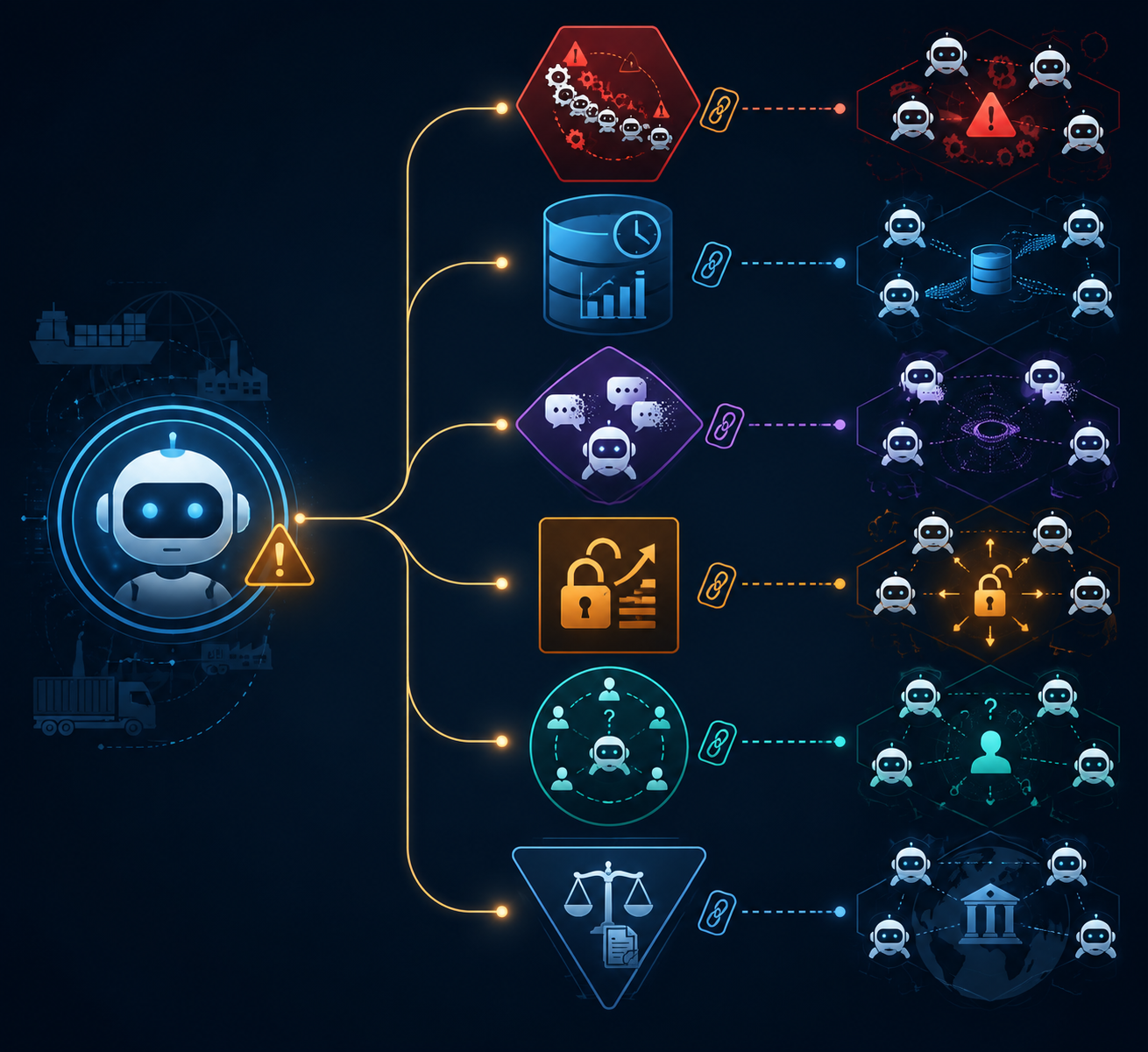
A useful taxonomy starts with how a planning error moves. In conventional analytics, the common question is whether a model output is accurate enough to trust. In agentic planning, the sharper question is where the output can travel, what it can touch, and who can still interrupt it.
| Risk category | What changes under agentic AI |
|---|---|
| Cascading multi-agent failures | One agent’s error becomes another agent’s operating premise. |
| Stale-ERP-data decisions | Old or incomplete system data becomes the basis for executed planning changes. |
| Hallucination chains | Unverified assumptions are repeated across agents until they look operationally settled. |
| Privilege escalation | Agents gain or misuse access paths that were not intended for autonomous action. |
| Accountability diffusion | Decision ownership becomes unclear across model, agent, workflow, vendor, and human approver. |
| Regulatory exposure | Automated actions create legal or compliance consequences that cannot be defended as mere advice. |
1. Cascading Multi-Agent Failures
The cleanest illustration is a simulation, not a documented production incident, and it should be treated as such. Kanerika describes a supply chain simulation in which one planning agent hallucinated an inventory figure, downstream agents treated that figure as real, and the workflow reordered excessive stock, creating systemic disruption inside the simulated environment.[2]
The value of the example is not that it proves this failure is common in live supply chains. It does not. Its value is that it shows the shape of the failure: the first agent is wrong, the second agent does not know it is inheriting a false premise, and the third agent converts the false premise into an operational move.
Older planning AI could certainly mislead a planner. Agentic AI can mislead another agent. That difference matters because agents may not bring the same contextual suspicion a planner brings when a number feels wrong for the season, the supplier, the SKU family, or the last-minute promotion everyone remembers but the system does not.
Cascading failure is most likely to hide in handoffs that look routine: demand agent to supply agent, supply agent to procurement agent, procurement agent to supplier communication agent, allocation agent to customer-service workflow. Governance has to inspect those handoffs, not just the individual model outputs.
2. Stale-ERP-Data Decisions
Planning teams have always lived with stale ERP data. The difference is that human planners often know which fields to distrust. They know the supplier lead time is aspirational, the safety-stock parameter was set during a different service policy, the plant calendar is late, or a substitute material is coded correctly but operationally unavailable.
An agent may read those same records as authoritative unless the workflow is designed to recognize data freshness, lineage, confidence, and exception status. If it then changes a replenishment plan or sends a supplier message, the stale data has moved from background defect to executed decision.
This is not a generic “bad data in, bad data out” problem. It is a timing and authority problem. The agent may be acting faster than the organization’s data correction cycle. A planner might have waited for the late goods receipt to post before changing the plan. An agent may not wait unless waiting is part of the policy.
The control question is therefore specific: which planning fields are allowed to trigger autonomous action, and how fresh must they be before the agent can rely on them? Without that distinction, data quality becomes a general complaint instead of an operating boundary.
3. Hallucination Chains Across Planning Agents
A hallucination in a planning memo is irritating. A hallucination that becomes a planning assumption is more serious. The risk is not only that one agent invents a supplier constraint, demand explanation, inventory exception, or policy interpretation. The risk is that later agents incorporate the invented claim as context and make it harder to see where the unsupported statement entered the workflow.
In planning operations, narrative matters. Planners do not only ask what changed; they ask why it changed. If an agent explains a shortage as supplier nonperformance when the real issue is a delayed internal transfer, that explanation can shape the next action: expedite the wrong order, escalate the wrong supplier, or override the wrong inventory policy.
This is where traceability has to cover more than the final transaction. It has to preserve the intermediate claims that led to the transaction: the data read, the assumptions made, the policy invoked, the exception class assigned, and the agent or human that approved the next move. Otherwise, the audit trail will show what happened without showing why the system believed it should happen.
4. Privilege Escalation
Agentic planning systems need access. That is the source of their usefulness and their security exposure. An agent that can only summarize demand variance is limited. An agent that can query ERP, call a supplier portal, draft an exception response, update a planning parameter, or initiate a purchasing workflow is materially different.
Cisco’s State of AI Security 2026, as reported by Help Net Security, found that multi-turn prompt injection attacks achieved up to 92% success rates across eight open-weight models, and that only 29% of organizations felt prepared to secure agentic deployments.[3] The model list and test conditions were not independently verified in the briefed material, so the number should not be stretched beyond its scope. It is still a useful pressure point: multi-step agents expand the number of places where an instruction can be smuggled, reinterpreted, or acted on.
McKinsey reported in October 2025 that 80% of organizations had already encountered risky behaviors from AI agents, including improper data exposure and unauthorized system access.[4] In a planning environment, unauthorized access is not only a confidentiality issue. It can become an execution issue if the agent reaches functions that change orders, inventory status, supplier records, or planning parameters.
The practical boundary is least privilege by action, not least privilege by application. An agent may need to read a purchase order without being able to modify one. It may need to draft a supplier message without being able to send it. It may need to recommend an inventory adjustment while a human still posts the adjustment. Role design has to reflect those separations.
5. Accountability Diffusion
When a planner changes a supply plan, the organization usually knows where to start the conversation. The planner may have used a system recommendation, but the approval path, business role, and exception note provide a recognizable line of accountability. Agentic workflows can blur that line unless ownership is designed before scale.
The confusion often appears after the fact. A supplier asks why a forecast commit changed. Finance asks why working capital increased. Customer service asks why allocation shifted. IT says the agent operated as configured. The vendor says the workflow followed the policy. The planning team says the exception never reached its queue. None of those answers is adequate if the organization cannot identify who owned the decision threshold.
Accountability diffusion is not solved by adding a human somewhere in the loop. A human approver who sees only a polished recommendation, without the agent’s data lineage, rejected alternatives, confidence signals, and intended downstream actions, is not meaningfully accountable. The approval design has to match the consequence of the action.
6. Regulatory Exposure
Regulatory exposure changes when an AI system acts in a business process rather than merely informing one. Koley Jessen noted in April 2026 that Utah had enacted legislation prohibiting AI involvement as a legal defense, and that the EU AI Act’s prohibited-use list serves as a baseline for global compliance.[5] For supply chain leaders, “the agent did it” is not a governance position.
Planning workflows can touch regulated areas even when they do not look like classic compliance systems. Supplier communications may affect contractual obligations. Allocation decisions may affect customer commitments. Inventory decisions may affect safety-critical availability. Cross-border data access may create privacy or localization questions. A planning agent does not need to be the legal department’s system of record to create legal evidence.
The legal risk is not that every agentic planning action is highly regulated. It is that organizations may discover the regulatory character of a workflow only after the agent has already created records, messages, or decisions that need to be defended.
The Governance Shift: From Output Risk to Action Risk
Traditional AI governance asks whether an output is accurate, explainable, fair, secure, and appropriately used. Agentic AI governance still needs those questions, but they are no longer enough. The additional question is what the system can do with the output before a person notices.
That is why cancellation risk is a governance signal, not just a budgeting signal. Gartner forecast in 2025 that more than 40% of agentic AI projects would be canceled by the end of 2027 because of escalating costs, unclear business value, or inadequate risk controls.[6] The forecast does not say agentic AI has no value. It says many programs will fail the operating discipline required to scale it.
Palo Alto Networks frames the distinction directly by separating agentic AI governance, with its action risk, from traditional AI governance, with its output risk. Its lifecycle runs from design to development, pre-deployment impact assessment, runtime controls, continuous monitoring, and decommissioning.[7] For supply chain planning, that lifecycle is useful because it forces governance to begin before the agent is connected to planning systems and to continue after go-live.
The practical mistake is to treat governance as a launch gate. A pre-deployment review can catch obvious design problems, but planning risk changes with volume, seasonality, supplier disruption, data drift, organizational restructuring, and exception backlogs. Runtime control is not an enhancement. It is part of the system.
Controls That Match Planning Consequences
SupplyChainBrain and Altimetrik describe three disciplines that fit the planning environment: tiered use-case risk classification, immutable traceability beyond explainability, and runtime guardrails such as variance triggers, throttled autonomy, and challenger testing.[8] Those disciplines are more useful than a blanket rule that all agents need human approval, because they distinguish between low-consequence assistance and high-consequence action.
| Governance discipline | Planning question it should answer |
|---|---|
| Risk-tiered use cases | Which workflows can tolerate autonomous action, and which require approval before execution? |
| Immutable traceability | Can the team reconstruct the data, reasoning, agent handoffs, approvals, and system calls behind a planning change? |
| Runtime guardrails | Will the workflow stop, slow down, or escalate when variance, spend, volume, or policy exceptions exceed defined boundaries? |
| Throttled autonomy | Can autonomy expand or contract by SKU, supplier, geography, planner group, or exception type? |
| Challenger testing | Can an independent model, rule set, or human review detect when the agent’s proposed action diverges from acceptable planning behavior? |
Risk-tiering should be based on consequence, not novelty. An agent that drafts a planner’s morning summary may be low risk even if it uses advanced reasoning. An agent that changes supplier release quantities may be high risk even if the logic is simple. The important unit is the business action the agent can complete.
Traceability has to be designed for the planning director who inherits the cleanup. The record should show the source data the agent used, the age of that data, the policy it applied, the agents it called, the tools it invoked, the exception thresholds it checked, the human approvals it received or bypassed, and the transaction it created. Explainability that stops at “why the model recommended this” is too thin when the system has already acted.
Runtime guardrails should be tied to planning variance. If an agent proposes an order quantity far outside recent patterns, increases spend beyond an approved band, changes supply for a constrained item, or touches a supplier under dispute, the workflow should slow down or escalate. The right guardrail is not always a hard stop. Sometimes it is a reduced autonomy level, a second agent challenge, a planner review, or a temporary limit on transaction volume.
Challenger testing is especially important because agentic systems can appear calm while compounding small errors. A challenger does not need to be more sophisticated than the primary agent. It needs to be independent enough to ask whether the action is plausible under current planning rules, historical behavior, and known constraints. In some workflows, a deterministic rule check may be the better challenger precisely because it is less creative.
What Planning Leaders Should Decide Before Scaling
The decision is not whether to use agentic AI in supply chain planning. The decision is where autonomy is earned. A sensible deployment path lets agents observe first, recommend next, draft actions after that, and execute only where the organization can tolerate the consequences and reconstruct the reasoning.
Before expanding autonomy, leaders should be able to answer a few plain questions. Which systems can the agent read? Which systems can it write to? Which external parties can it contact? Which planning records can it change? Which thresholds force escalation? Which human role owns the decision when the agent acts within policy but the outcome is still damaging?
Those questions do not slow adoption as much as unclear ownership does. Teams lose time when pilots need to be unwound, audit trails are incomplete, security reviews arrive late, or planners refuse to trust a workflow they cannot interrogate. The taxonomy is not a reason to freeze agentic AI projects. It is the minimum vocabulary leaders need before they expand autonomy in systems that move inventory, spend, supplier commitments, and planning records.
References
- Resilient by design: The agentic supply chain, Deloitte, Mar 2026
- Agentic AI Risks in 2026, Kanerika
- Enterprises are racing to secure agentic AI deployments, Help Net Security, Feb 2026
- Deploying agentic AI with safety and security: A playbook for technology leaders, McKinsey, Oct 2025
- Agentic AI and Related Risks: A Practical Guide for Business Leaders, Koley Jessen, Apr 2026
- Gartner Forecasts Supply Chain Management Software with Agentic AI Will Grow to $53 Billion in Spend by 2030, Gartner, Apr 2026
- A Complete Guide to Agentic AI Governance, Palo Alto Networks
- How Supply Chains Can Responsibly Implement Agentic AI at Scale, SupplyChainBrain, May 2026
Comments
Join the discussion with an anonymous comment.