
The awkward fact in AI-driven maritime supply chain risk is not that companies lack data. It is that many leaders believe they have enough of it, and still take losses when the route, port, supplier, or trade lane stops behaving like yesterday’s plan.
Sphera’s 2026 supply chain risk survey reports that 98% of leaders express confidence in their risk data, while 73% still report financial or operational losses from disruptions; the survey covered 800 CPOs and CSCOs across the US, UK, Germany, and Canada.[1] WTW’s 2025 global supply chain risk report adds a second pressure point: only 8% of firms say they feel in full control of risk exposure, even as 63% report higher-than-expected losses.[2]
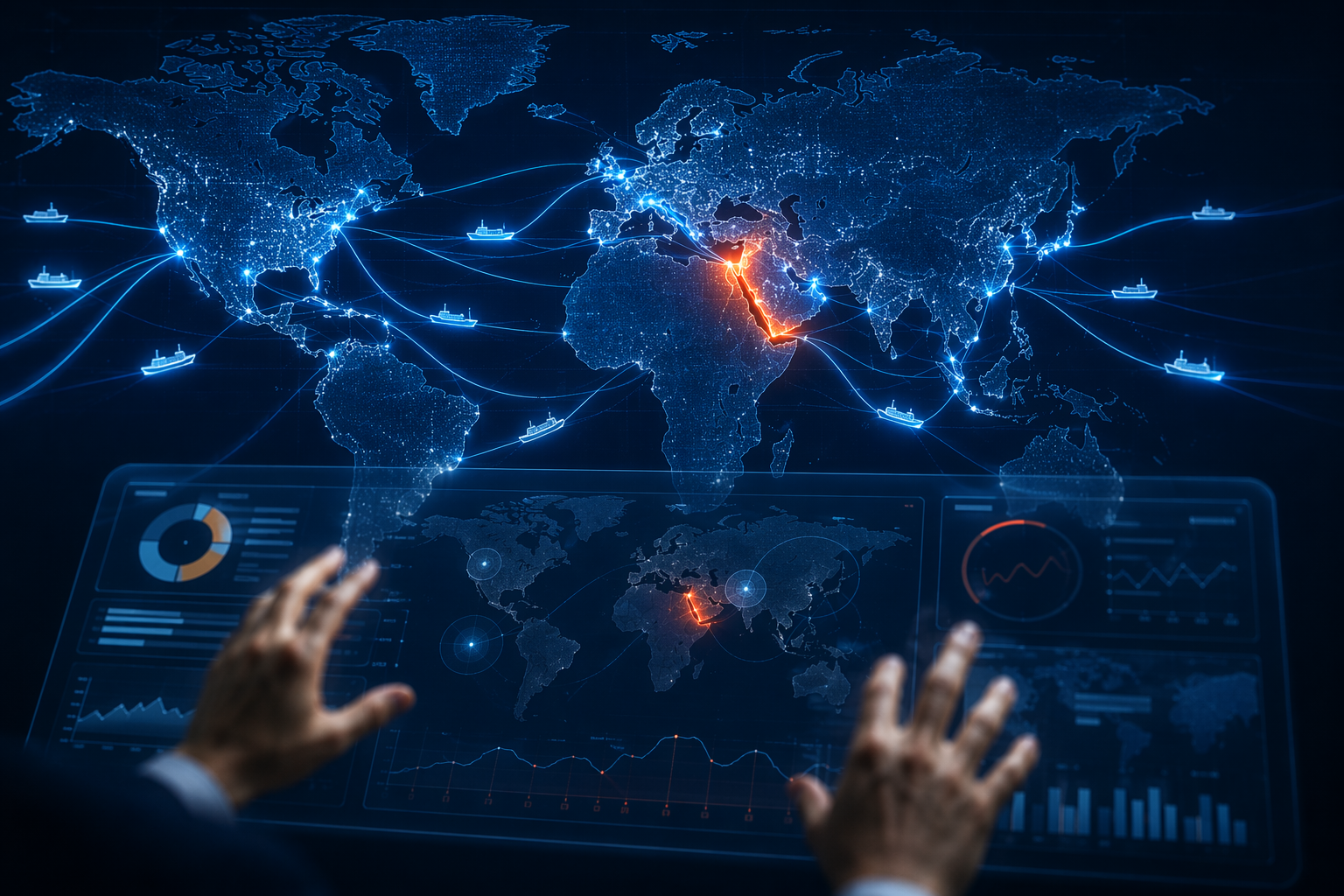
That is the useful starting point. If executives already trust their risk data, why are disruption outcomes still this poor? The answer is not that every dashboard is fake or every AI system is overhyped. It is that risk visibility and supply chain resilience are adjacent capabilities, not the same one. A team can see a vessel approaching a chokepoint, know a trade restriction is likely, and still lack the contracted capacity, margin room, inventory policy, customer authority, or executive permission to move differently.
What the strongest evidence actually says
The best anchor for the AI resilience claim is not a vendor case study. It is Dong, Zhao, Mangla, and Song’s 2025 study in Transportation Research Part E, which examines Chinese listed firms and finds that AI is positively correlated with supply chain resilience, while geopolitical risk is negatively correlated with resilience.[3]
The important part is the mechanism. The study finds that AI’s resilience effect operates through increased firm profit.[3] That should slow down the easy boardroom sentence that says AI makes supply chains resilient. A more defensible sentence is narrower: AI is associated with stronger resilience, and part of that association appears to run through firm profitability. In plain operating terms, healthier firms can absorb shocks, invest in alternatives, carry more optionality, and act before a disruption becomes a public scramble.
That does not make AI incidental. Better forecasting, anomaly detection, supplier-risk sensing, routing analysis, and planning automation can improve the quality and speed of decisions. But the study’s profit mediation matters because it puts money and organizational capacity back into the story. If an AI tool identifies a safer routing plan but the firm cannot tolerate the working-capital hit, cannot authorize a premium lane, or cannot renegotiate delivery promises, the recommendation stays trapped in the system.
The same study also finds the effect concentrated in high-tech industries and highly competitive markets.[3] That concentration is plausible. High-tech supply chains tend to have expensive disruption consequences, shorter product cycles, more pressure to maintain continuity, and stronger incentives to invest in decision systems. Highly competitive markets punish slow response more quickly. In those settings, AI has a better chance of being connected to urgent managerial action rather than remaining a reporting upgrade.
The caveat is not cosmetic. The research uses Chinese listed-firm data and a general equilibrium model.[3] The finding should not be lifted whole into North American or European operating environments without adjustment for governance, capital markets, supplier contracting norms, disclosure expectations, and the practical authority of regional supply chain teams. It is still serious evidence. It is not a universal conversion rate from AI spend to resilience.
Confidence in risk data is not control
The survey gap makes more sense once “risk data” is separated from the decisions that must follow it. Leaders may be confident that their systems show supplier locations, shipment ETAs, lane exposure, inventory positions, and news signals. That is useful. It is also incomplete.
| Capability leaders may have | What it does not prove |
|---|---|
| A dashboard showing vessels, suppliers, and alerts | That alternate routes are contracted and financially approved |
| A geopolitical risk score for a country, port, or lane | That purchasing can switch suppliers without violating terms or quality constraints |
| An AI-generated rerouting recommendation | That customer service, finance, logistics, and sales have agreed on the trade-off |
| A control tower escalation workflow | That someone has authority to spend, delay, expedite, or allocate scarce inventory |
This is where many resilience programs become brittle. They invest in knowing sooner, then underinvest in deciding sooner. A team may detect that a Red Sea routing pattern is deteriorating or that a port is becoming politically risky, but the shipment still moves under old assumptions because the alternative is more expensive, capacity is not reserved, or no one wants to explain the margin impact before the disruption becomes undeniable.
That distinction also changes how AI investments should be judged. A platform that improves alerting may be worthwhile, but it should not be described as resilience unless it changes actions: earlier booking changes, pre-approved carrier substitutions, cleaner supplier allocation, faster customer reprioritization, or fewer emergency freight decisions. The same logic applies to control towers. The useful question is not whether the tower sees more; it is whether it can trigger an authorized response. That is the practical divide explored in control tower models that actually deliver ROI.
Where maritime disruption tests the claim
Maritime disruption is a hard test because the physical network does not care how elegant the risk model is. Ships are slow to reposition. Port slots are constrained. Insurance, carrier schedules, customs rules, and inland capacity can turn a clean recommendation into a messy operating compromise. Chokepoints such as the Red Sea and Bab el-Mandeb force that compromise into the open.
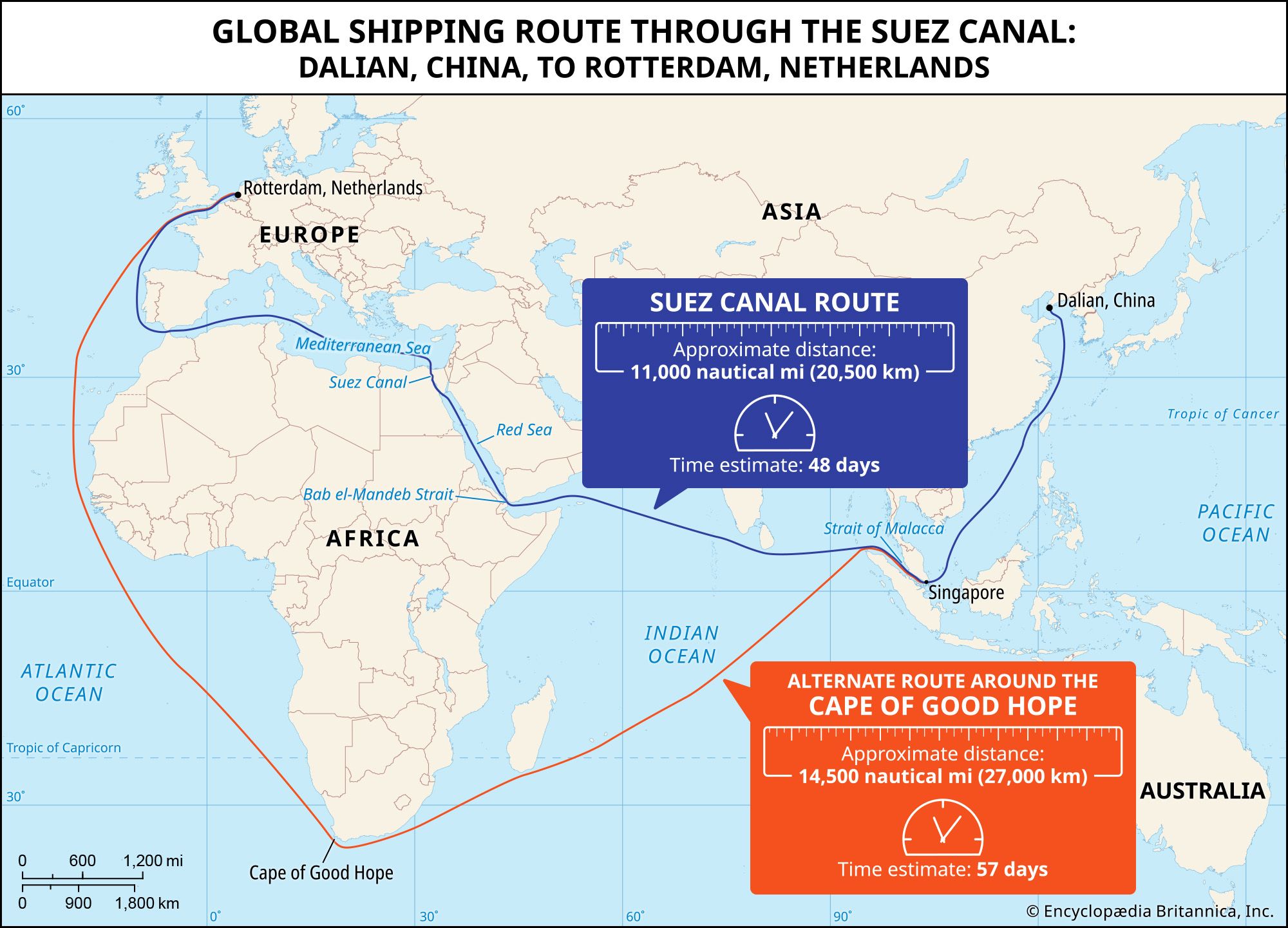
The Sensos example is useful because it is operationally specific. In a 2026 case illustration, one unnamed automaker reportedly avoided $220 million in losses during the Red Sea crisis by using AI to reroute shipments through 12 pre-mapped alternative ports scored on political stability.[4] The number should not carry more weight than it can bear: the automaker is unnamed, and the figure is not independently audited. Still, the underlying pattern is the right one. The AI did not merely observe a crisis. It worked against a pre-modeled set of alternative ports, with political stability already built into the routing decision.
That is a different maturity level from alerting a planner after the route is already compromised. Pre-mapped options reduce the number of decisions that have to be invented under pressure. Port scoring narrows the debate. If finance has already modeled the cost range and logistics has already checked service feasibility, the system has somewhere to send the recommendation. Without that preparation, the same AI signal becomes another urgent email in an already crowded incident channel.
The Siemens and Portcast example points in the same direction, though it also comes from a vendor source. In a 2025 Siemens Digital Logistics post, AI ocean visibility platforms are reported to reduce detention charges by 15%, manual tracking by 80%, and expedited freight by 5%.[5] Those figures are directional, not independent benchmarks. They should be read as evidence that better ocean visibility can reduce friction in specific workflows, not as a general promise that AI will neutralize geopolitical exposure.
The difference matters most when a chokepoint decision moves from logistics into enterprise trade-offs. Rerouting around Africa may protect cargo continuity but add time, consume capacity, change emissions profiles, and affect working capital. Waiting may preserve cost assumptions but expose customer commitments. A procurement lead may want to shift suppliers, while quality and legal teams see a different risk. AI can improve the decision packet. It cannot, by itself, decide what the company is willing to sacrifice.
For teams looking specifically at maritime chokepoint exposure, the better use of AI is not a single geopolitical risk score. It is a chain of modeled options: affected SKUs, exposed suppliers, vessel and port dependencies, inventory cover, alternate ports, carrier availability, contractual constraints, customer allocation rules, and the financial cost of each path. That is also where a focused scenario such as AI prediction for Strait of Hormuz oil supply disruption can be more useful than a broad risk dashboard.
The 2026 AI capabilities that deserve attention
By Q3 2026, the more interesting supply chain AI discussion is moving beyond passive monitoring. The capabilities worth watching cluster around agentic workflows, digital twin simulation, and geospatial intelligence. Each can help close a different part of the gap between seeing risk and acting on it.
- Agentic workflows can assemble disruption playbooks, request missing inputs, compare options, and push recommended actions to the right owner instead of leaving planners to translate alerts manually.
- Digital twin simulation can test rerouting, supplier substitution, inventory allocation, and customer-service consequences before the decision has to be made live.
- Geospatial intelligence can monitor ports, lanes, chokepoints, weather overlays, and regional risk signals in a form that connects naturally to maritime execution.
The buying implication is straightforward: do not evaluate these tools only by how many risks they detect. Evaluate whether they reduce the number of manual handoffs between detection, scenario analysis, approval, and execution. A system that flags a port closure but cannot tell planning which orders are affected, finance what the cost range is, and logistics which alternatives are feasible is still mainly a visibility product.
This is where platform selection becomes less about AI branding and more about operating fit. A company choosing an AI platform for geopolitical supply chain risk should test data integration, scenario modeling, workflow authority, explainability, and the ability to preserve decision history. Those criteria matter more than whether the product demo shows an impressive world map. For a deeper selection lens, see choosing an AI platform for geopolitical supply chain risk.
What has to be true before AI becomes resilience
The Dong et al. finding on profit mediation is the guardrail for the whole debate. AI can contribute to resilience, but firms still need the economic and managerial capacity to act on what the model recommends. That capacity is not evenly distributed. It tends to be stronger where margins, competitive pressure, executive attention, and data infrastructure already support faster action.
A useful internal test is whether the company can answer four questions before the next geopolitical shock reaches the board deck:
- Who has authority to accept higher logistics cost, longer transit time, supplier substitution, or customer allocation changes?
- Which alternate ports, carriers, suppliers, and lanes have already been screened rather than merely identified?
- Which contracts, inventory policies, and service commitments prevent the recommended response?
- How quickly can finance compare the cost of acting early with the cost of waiting?
If those answers are missing, AI may still improve awareness, but the resilience claim is premature. The planner who receives the recommendation will spend the disruption negotiating permission instead of executing a prepared option.
The more credible implementation path is to attach AI to specific geopolitical disruption decisions. For one firm, that may mean Red Sea and Suez contingency routing. For another, semiconductor supplier exposure. For another, tariff escalation and supplier-country concentration. Broader frameworks such as AI supply chain resilience planning for geopolitical escalation are useful when they keep the work tied to decisions rather than general preparedness language.
So the answer is conditional. AI can strengthen supply chains against geopolitical disruption when it is connected to profitability, competitive urgency, data infrastructure, pre-modeled alternatives, and authority to act. It should not be sold as resilience by itself. Seeing the disruption sooner helps only if the company has already made room to move.
References
- Sphera Supply Chain Risk Report 2026. Sphera, 2026.
- Global Supply Chain Risk Report 2025. WTW, 2025.
- Can artificial intelligence improve supply chain resilience? The role of firm profit under geopolitical risk. Transportation Research Part E, 2025.
- Sensos automaker Red Sea crisis case illustration. Sensos, 2026.
- When Sea Freight Gets Smarter. Siemens Digital Logistics, 2025.
Comments
Join the discussion with an anonymous comment.