
The Tacoma Narrows Bridge problem is easy to misread if the question starts with “when does it reopen?” For freight, the better question is what happens when a bridge does not close cleanly, does not reopen cleanly, and keeps changing the amount of usable capacity on a corridor that dispatchers cannot simply avoid. That is the practical center of Tacoma Narrows Bridge reopening supply chain logistics in 2026.
SR 16 is the primary freight corridor from the Port of Tacoma toward Kitsap and the Olympic Peninsula, and the Tacoma Narrows Bridge carries about 45,000 vehicles per day. WSDOT’s truck restriction for SR 16 from Tacoma to Gorst matters more than a generic traffic-delay warning: there is no official detour for trucks over 105,500 pounds or overwidth loads on that restricted segment.[1]
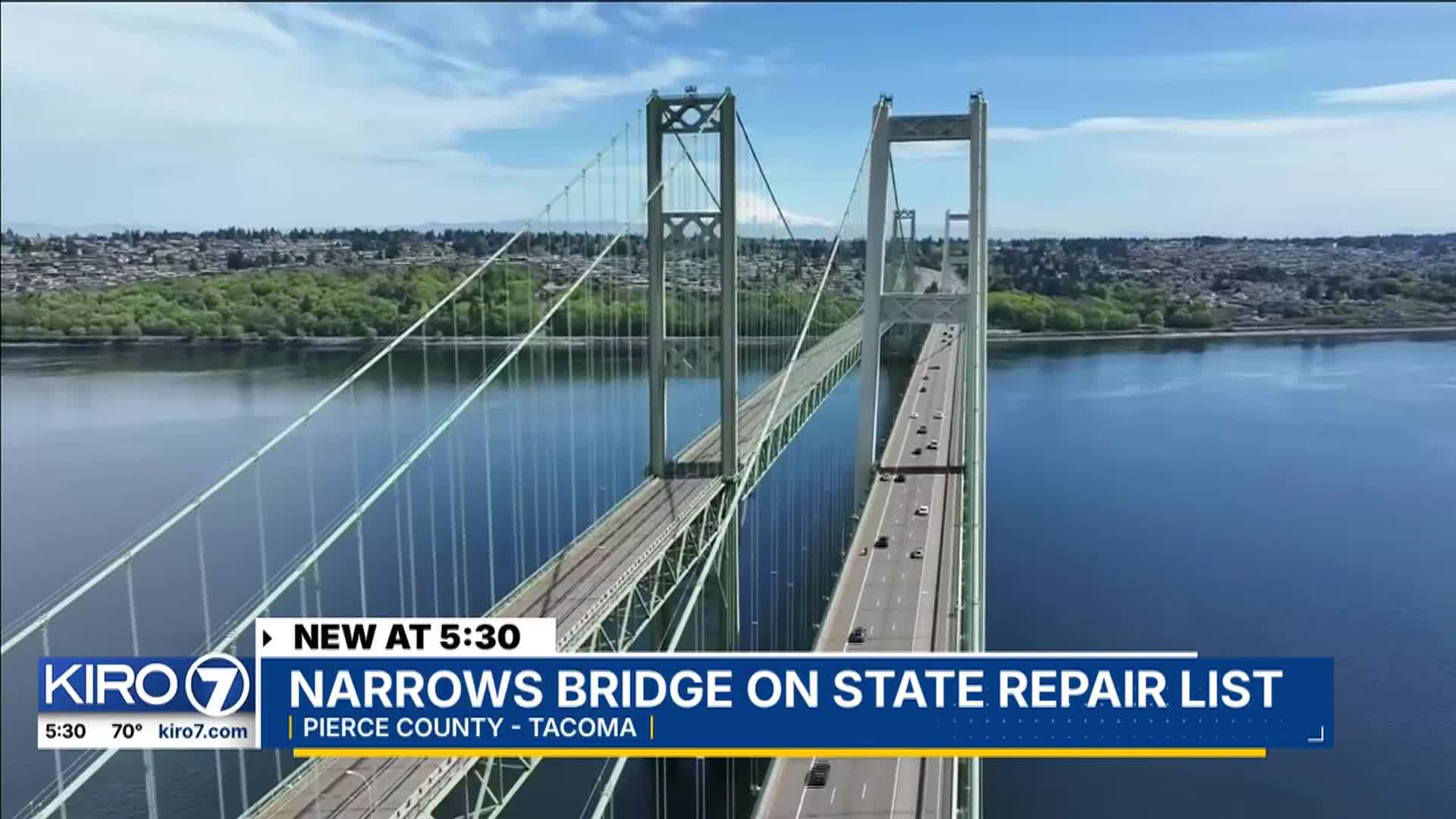
The westbound span is not facing a tidy maintenance weekend. WSDOT identified about $180 million in deferred repair needs on the 76-year-old westbound bridge, and regional reporting tied the repair program to major traffic delays and lane reductions that began in April 2026 and extend through at least 2027.[2][3][4] For carriers, that turns the bridge from a road condition into a planning condition.
A Variable Chokepoint Is Different From a Closure
A full closure at least gives operations a clean rule. Do not route there. Add the detour. Notify customers. Protect appointments where possible. A variable chokepoint is harder because yesterday’s decision can become wrong without looking reckless at the time.
A dispatcher may send a legal load over SR 16 in the morning because the lane configuration and traffic queue make it workable, then reject the same move later because an emergency restriction, incident, or temporary lane reduction changes the risk. A planner may build a weekly schedule around the assumption that the bridge is slow but passable, only to watch detention exposure rise when outbound trucks miss receiver windows on the peninsula side.
The port-region exposure is real, though it should not be exaggerated into a claim that every container depends on this bridge. The Northwest Seaport Alliance port complex moved nearly 3 million TEUs and 23.8 million metric tons in 2023.[5] Port of Tacoma economic reporting tied the broader port activity to 52,100 jobs, an average wage of $117,300, and $14 billion in business output.[6] The Tacoma Narrows constraint is one corridor problem inside that larger freight system, but it is the kind of corridor problem that punishes static planning.
Why Static Routing Starts to Fray
Traditional route rules can handle stable constraints: avoid a low bridge, honor a hazmat restriction, keep a driver inside hours-of-service limits, sequence stops by geography. Those rules are useful. They also become brittle when the live operating day depends on which lane is open, whether queues have backed into approach roads, whether a heavy load has any legal detour, and whether an appointment can still be protected after a delay compounds across three stops.
In a dispatch room, that brittleness shows up as repeated human rework. Someone checks WSDOT updates. Someone checks the TMS. Someone calls a driver. Someone asks whether the load can legally shift to an alternate path. Someone updates the customer with a cautious arrival estimate. Then the same work repeats after the next status change.
The cost is not only mileage. It is late tender decisions, broken appointment promises, driver idle time, detention fees, after-hours dispatcher escalation, and a growing habit of padding schedules because the system cannot distinguish a normal slow crossing from a bad day at the bridge.
What Dynamic AI Routing Would Actually Do
AI-powered route optimization is useful here only if it is treated as an operating system for changing constraints, not as a prettier map. The system has to ingest live closure and traffic feeds, understand equipment and load limits, compare route options against delivery commitments, and recalculate fast enough that the dispatcher is reviewing exceptions rather than rebuilding the day.
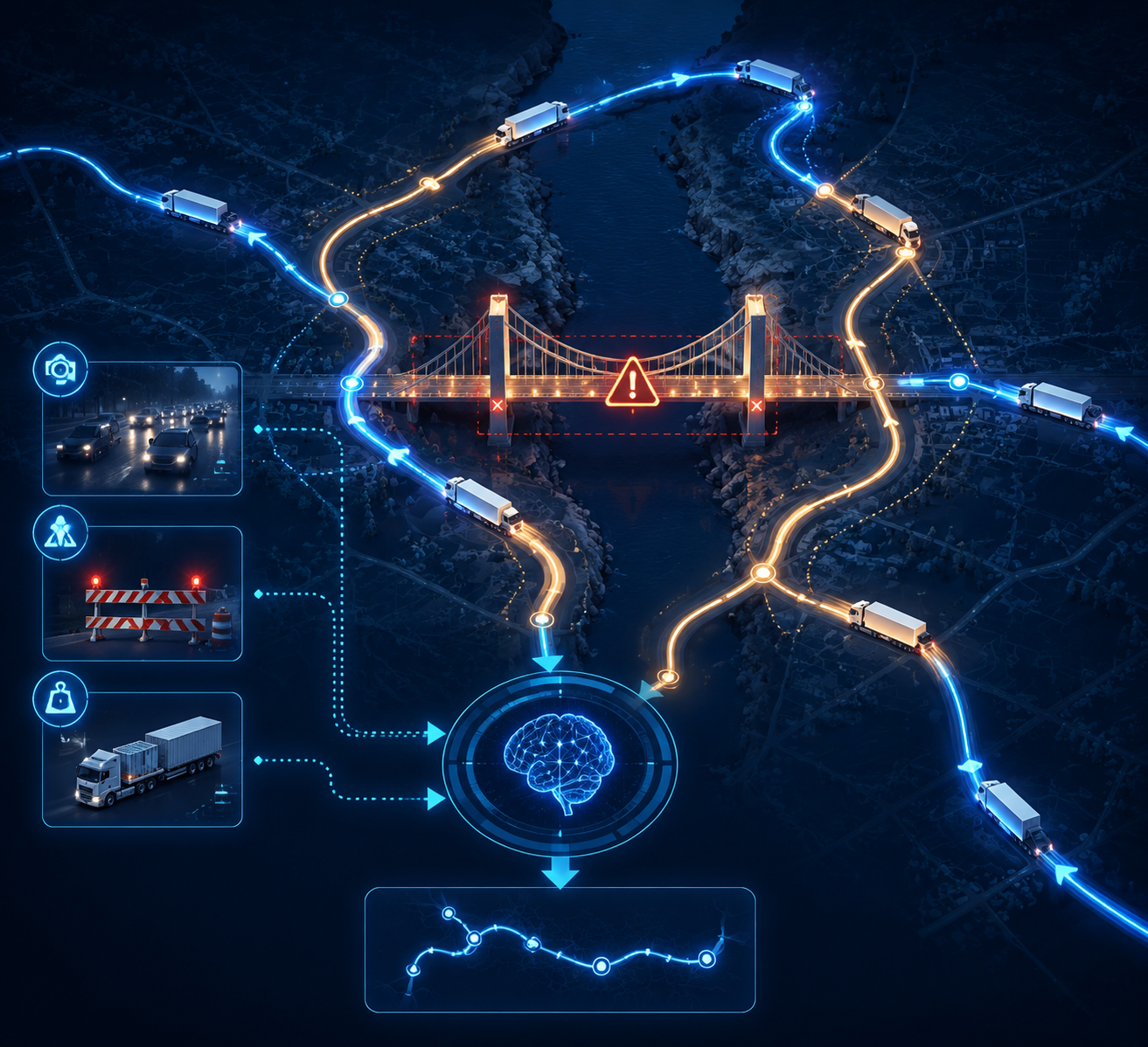
For the Tacoma Narrows Bridge, that means the routing engine cannot simply mark SR 16 as “open” or “closed.” It needs to treat the bridge as a capacity-sensitive segment whose condition affects different loads differently. A standard dry van with a flexible delivery window is not the same planning object as an overwidth move with no official detour. A truck already west of the bridge is not the same as one still waiting at a Tacoma yard.
The practical workflow looks more like this:
- The system receives road restriction, incident, closure, and traffic-speed updates for the SR 16 corridor.
- It checks each planned move against truck weight, width, equipment, customer appointment, driver hours, and delivery priority.
- It identifies which loads can absorb delay, which need resequencing, and which have no legal or practical alternate route.
- It recalculates ETAs and route choices, then surfaces the few decisions that require human approval.
- It writes the decision trail back to the TMS so customer service, billing, and operations see the same version of the day.
That last point is not administrative trivia. When a customer disputes a late arrival or detention event, the carrier needs to show why a route was changed, when the constraint appeared, and whether a load had any legal alternative. Good optimization should make the dispatch day calmer and more auditable.
The Difference Between Rules and Recalculation
A rule-based system might say: avoid the bridge if delay exceeds a threshold. A dynamic optimization system asks a more useful set of questions: which loads are affected, which customers can still be served in sequence, which drivers have enough available time, which alternate paths are legal, and whether delaying departure is better than sending the truck into a queue.
That distinction matters because a semi-permanent bridge constraint creates many small decisions, not one heroic workaround. If the system can remove the repetitive decisions and preserve human control over the unusual ones, it has a job worth doing.
The Data Has to Be Good Enough to Trust
The routing model is only as useful as the constraint data it can see. For this use case, that means more than GPS pings and traffic speed. The system needs WSDOT restriction data, closure and incident feeds, bridge-specific lane status where available, equipment profiles, load dimensions, appointment rules, service-time assumptions, driver availability, and TMS order data.
This is where many AI routing discussions get too clean. A regional fleet may have telematics data in one place, customer appointments in another, load dimensions in free-text notes, and dispatcher knowledge living mostly in people’s heads. If an overwidth restriction is buried in a note field or an appointment penalty is missing from the routing model, the software can optimize the wrong thing very efficiently.
A credible Tacoma Narrows deployment would start with a narrow integration target: loads that regularly use the SR 16 corridor, customers whose appointment windows create real penalty exposure, and equipment types where legal-route constraints are cleanly represented. Once that is working, the same pattern can extend to other disruption classes, including wildfire smoke routing and hurricane-driven route planning, where the constraint is different but the operating problem is similar.
Where the ROI Case Is Credible
The cleanest business case for AI routing does not come from saying the Tacoma Narrows Bridge is expensive. It comes from tying the bridge constraint to cost categories that finance can recognize: miles avoided, driver time recovered, service failures reduced, detention exposure lowered, and dispatcher productivity improved.
McKinsey’s reported benchmark that AI route optimization can reduce total logistics costs by 5% to 20% is a useful range for framing the opportunity, not a promise that every fleet crossing SR 16 will land inside it.[7] The spread is doing important work. A high-volume fleet with clean order data, integrated telematics, recurring lanes, and disciplined exception handling has a different ROI profile than a smaller carrier with irregular loads and manual customer appointment updates.
Enterprise cases show that the pattern is real at scale. Walmart reported eliminating 30 million unnecessary miles annually through AI routing, and C.H. Robinson reported a 40% productivity increase using more than 30 AI agents.[8][9] Those are not copy-and-paste results for a regional carrier. They are evidence that large networks can turn routing intelligence into measurable operating leverage when the data, process, and integration base are already strong.
Detention is another place where the Tacoma Narrows use case becomes concrete. Transport Works cited DocShipper’s 2025 finding that dynamic rerouting can cut detention fees by up to 18%.[9] For a carrier serving customers west of the bridge, the point is not that every detention bill disappears. The point is that better sequencing and earlier ETA correction can reduce the number of trucks arriving after the useful part of the appointment window has already been lost.
For teams building the full investment case, the useful comparison is not “AI versus no AI.” It is AI routing versus the current cost of manual rework during repeated infrastructure disruption. A fuller cost model belongs in a dedicated transportation logistics ROI analysis, but the Tacoma Narrows case supplies the operational test: if the system cannot show fewer manual touches, better protected appointments, and cleaner exception records on this corridor, the broader savings claim deserves skepticism.
For a more formal finance structure, see the AI ROI playbook for transportation and logistics. For a broader set of comparable deployments, the measured-results catalog at 14 AI in logistics deployments that delivered measurable results is the better next stop.
The Adoption Gap Should Make Buyers More Specific
The market appetite is not in doubt. ABI Research reported that 65% of supply chain professionals say AI is important for technology purchase decisions in 2026.[10] BCG’s 2026 finding is the necessary counterweight: 94% of logistics providers plan AI investment, but only 13% report measurable financial value.[11]
That gap is not an argument against AI routing. It is an argument against buying a broad transformation story when the operating problem is specific. A Tacoma Narrows deployment should be judged on whether it improves decisions around a known chokepoint with recurring capacity changes. If the vendor cannot explain how weight limits, overwidth restrictions, appointment logic, driver constraints, and real-time closure feeds enter the recommendation, the demo is probably showing software theater.
The architecture may eventually look like a broader control tower, especially for shippers combining port flows, regional distribution, telematics, and customer service workflows. But buyers do not need to start with a grand architecture diagram. They need to know which decision the model is allowed to make, which decision remains with dispatch, and how exceptions are recorded. For terminology around that wider architecture, supply chain control tower AI is a useful reference point.
A Practical Test for Tacoma Narrows Routing
A carrier or shipper using the Tacoma Narrows Bridge as a pilot corridor can keep the test grounded by asking for proof in the operating record, not only in the model output.
| Question | Why it matters |
|---|---|
| Does the system distinguish legal, constrained, and impossible moves? | The no-official-detour condition for some heavy or overwidth trucks changes the routing decision, not just the ETA. |
| Can it recalculate around live lane reductions and incidents? | The bridge constraint is recurring and variable, so a weekly static route plan will miss part of the problem. |
| Does it preserve appointment logic? | A route that saves miles but misses a receiver window may increase total cost. |
| Can dispatchers override and explain decisions? | Human control is still needed for exceptions, customer commitments, and judgment calls the data cannot infer. |
| Does the TMS retain the decision trail? | Auditability matters when detention, service failures, or customer penalties are disputed. |
The most useful pilots will not try to optimize the whole Pacific Northwest network on day one. They will pick a repeatable set of bridge-exposed lanes, measure manual intervention before and after, track ETA accuracy, and compare detention and service outcomes across enough trips to avoid being fooled by one unusually good or bad week.
AI does not solve the Tacoma Narrows Bridge disruption. The bridge still has the lanes it has, the restrictions it has, and the repair schedule it has. For operators with enough route volume, clean enough data, and integration discipline, dynamic optimization can turn recurring closures and lane reductions into scheduled variability instead of recurring crisis. For smaller fleets or teams still running critical constraints through manual notes and phone calls, the same technology may be promising but not yet bankable. That is a less exciting answer than a clean reopening date, but it is closer to how freight actually moves.
References
- WSDOT truck restrictions page, SR 16, Tacoma to Gorst — WSDOT. Source link not provided in research brief.
- What will it cost to fix 76-year-old Tacoma Narrows Bridge? — The Olympian. Source link not provided in research brief.
- Narrows Bridge Repairs Trigger Major Traffic Delays — Tacoma Weekly. Source link not provided in research brief.
- Tacoma Narrows Bridge Lane Closures Ahead for Emergency Repairs — PNW Daily, April 23, 2026. Source link not provided in research brief.
- NWSA Economic Impact page — Northwest Seaport Alliance. Source link not provided in research brief.
- Port of Tacoma economic page — Port of Tacoma. Source link not provided in research brief.
- AI Route Optimization: Everything You Need to Know — RTS Labs. Source link not provided in research brief.
- AI Use Cases in Logistics: 7 Real ROI Success Stories — Master of Code. Source link not provided in research brief.
- AI in Logistics 2026 — Transport Works. Source link not provided in research brief.
- Supply Chain Disruptions 2026 — ABI Research. Source link not provided in research brief.
- BCG 2026 logistics AI investment finding. Source title and link not provided in research brief.
Comments
Join the discussion with an anonymous comment.