
The ROI Landscape: Why Logistics AI Is Different
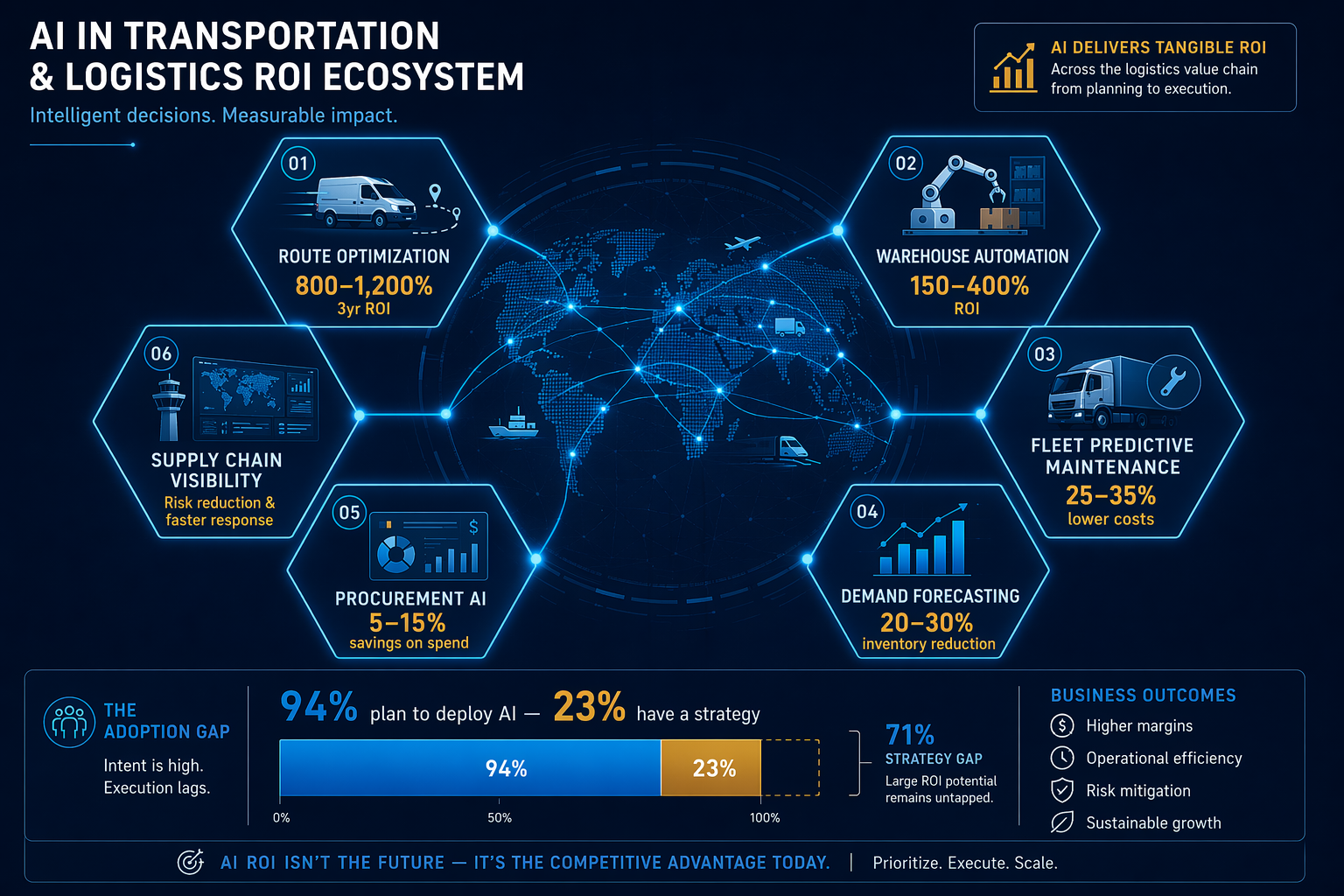
Every supply chain function can benefit from AI, but transportation and logistics occupy a distinct position on the ROI curve. Unlike procurement or demand planning — where returns are real but often incremental — logistics AI investments average 190% ROI across all use case categories, according to The Thinking Company's 2025 analysis. That headline number, however, masks a wide variance: route optimization for a 500-vehicle fleet can return 800–1,200% over three years, while a standalone warehouse automation project might land at 150–250%. The difference is not just about which vendor you pick — it is structural.
Logistics AI returns compound in ways that other domains do not. A route optimization model that learns traffic patterns feeds directly into demand forecasting, which improves warehouse slotting, which reduces last-mile complexity. Each use case generates data that makes the next one more accurate. That network effect is the reason portfolio-level returns are 40–60% higher than the sum of individual point solutions.
For CFOs and COOs building a business case, the key takeaway is this: logistics AI is not a single investment decision. It is a portfolio decision. The organizations that treat it as such — modeling shared infrastructure costs, sequencing use cases to maximize data reuse, and applying conservative, risk-adjusted projections — are the ones that capture the full 190% average. Those that pursue isolated point solutions leave 40–60% of potential portfolio ROI on the table.
ROI by Use Case Category: Where the Returns Concentrate
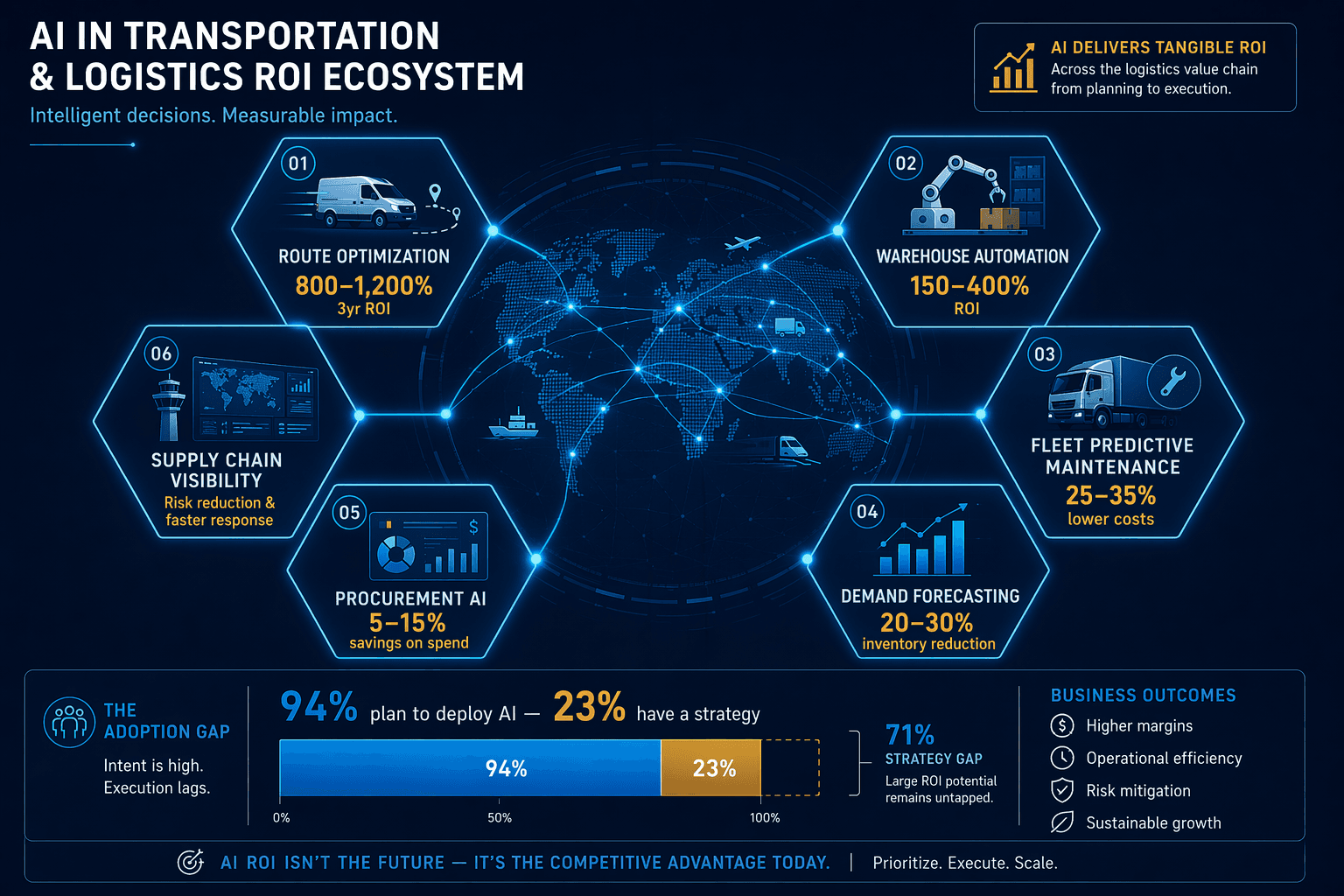
Not all logistics AI use cases are created equal. The table below organizes the major categories by three-year ROI range, typical investment size, and payback period, drawing primarily on The Thinking Company's 2025 analysis of EU-based logistics operators and cross-referenced with McKinsey's 2024 benchmarks for logistics cost reduction.
| Use Case Category | Three-Year ROI Range | Typical Investment (EUR) | Annual Savings (EUR) | Payback Period | Key Source |
|---|---|---|---|---|---|
| Route optimization (500-vehicle fleet) | 800–1,200% | 80K–150K | 1.5M–3M | 2–4 months | The Thinking Company 2025 |
| Predictive fleet maintenance | 300–500% | 60K–120K | 400K–800K | 3–6 months | The Thinking Company 2025; Intangles 2026 |
| Last-mile optimization | 250–400% | 40K–100K | 200K–600K | 4–8 months | The Thinking Company 2025 |
| Warehouse AI (directed picking) | 250–400% | 100K–300K | 300K–1M | 6–12 months | The Thinking Company 2025 |
| Warehouse AI (computer vision sorting) | 200–350% | 150K–400K | 250K–800K | 8–14 months | The Thinking Company 2025 |
| Demand sensing / forecasting | 200–350% | 50K–200K | 150K–500K | 6–12 months | The Thinking Company 2025; McKinsey 2024 |
| Supply chain risk monitoring | 150–400% | 30K–100K | 50K–200K | 6–12 months | The Thinking Company 2025 |
| Inventory positioning (warehouse) | 150–250% | 50K–150K | 100K–300K | 8–14 months | The Thinking Company 2025 |
Comments
Join the discussion with an anonymous comment.