
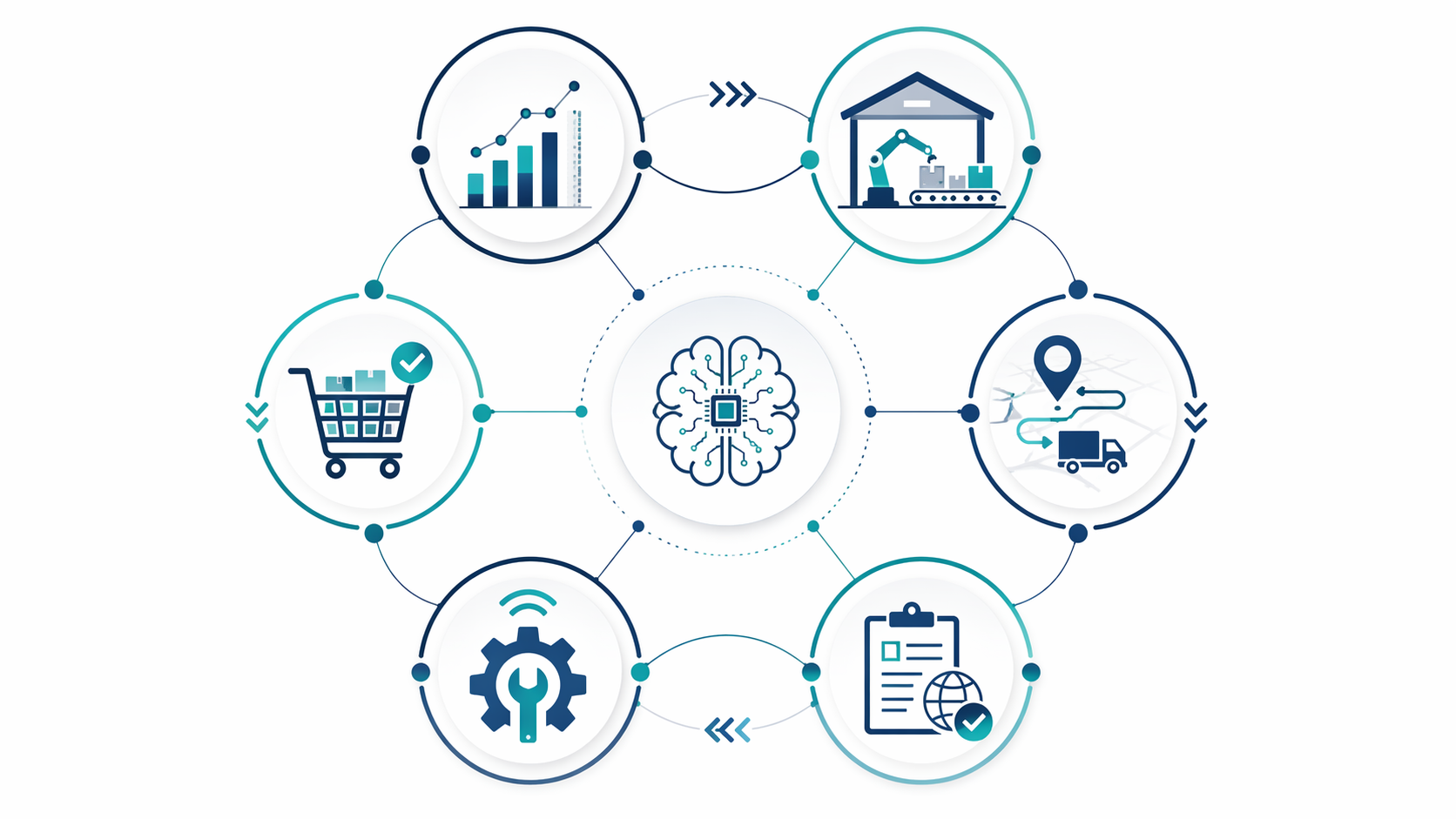
A useful list of ai in logistics examples should do more than prove that large companies are experimenting. It should show where the model entered the workflow, which operational decision it changed, and what KPI moved afterward. That is the standard used here: named-company deployments, organized by logistics function, with the source type visible so the examples can be used carefully in an internal business case.
One caution belongs up front. The available sources support strong, KPI-bearing evidence for 10 named deployments and include several additional named logistics AI references where the reviewed material does not include a concrete outcome metric. Those weaker entries should not be treated the same way in a budget deck. They are included below as context, clearly separated from the cases where a metric is attached.
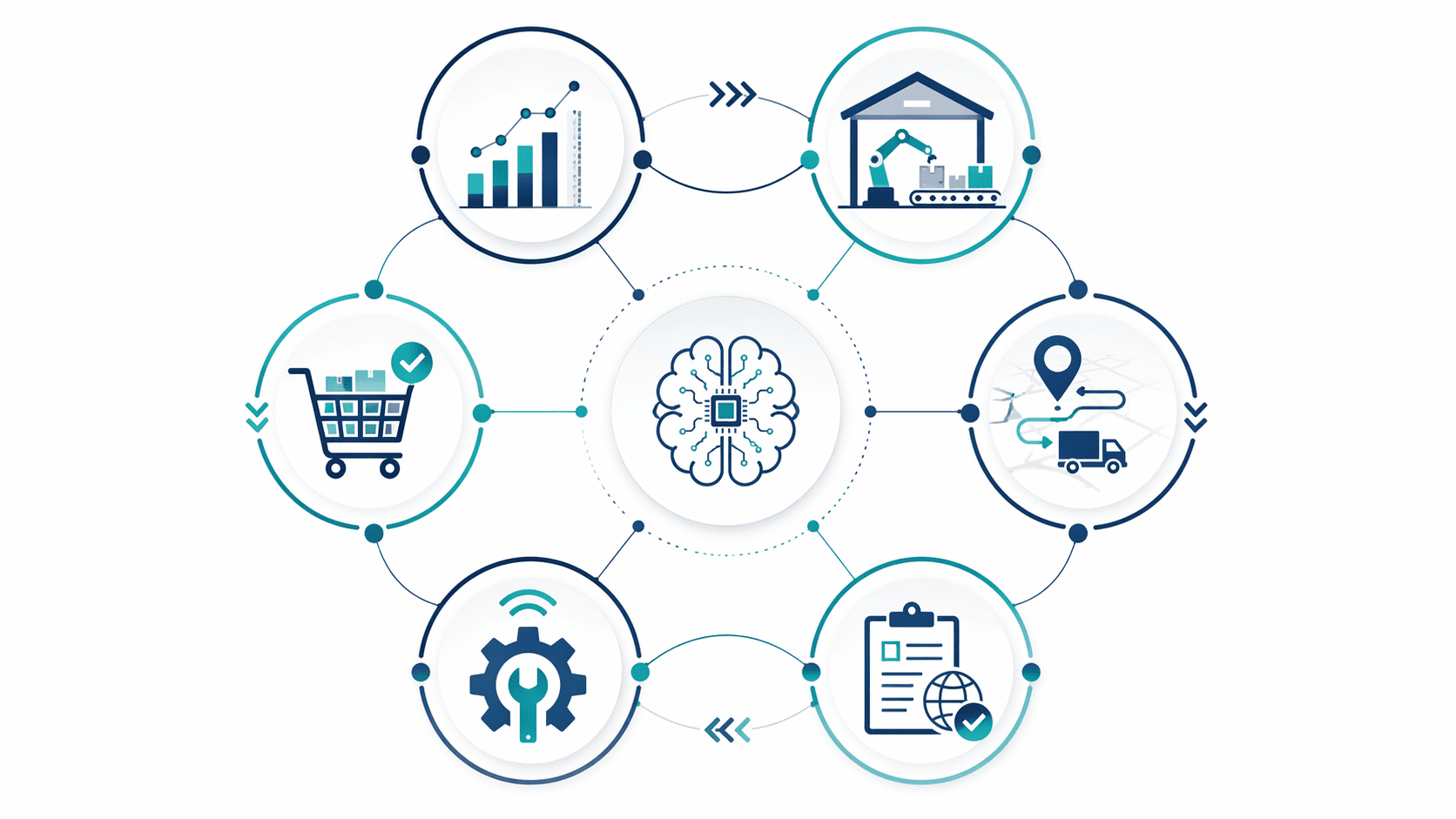
Scan table: named AI logistics deployments and the metric that matters
| Company | Function | AI application | Reported operational outcome | Source type |
|---|---|---|---|---|
| Amazon | Demand forecasting | AI-driven demand forecasting across a very large product catalog | Forecasting across 400M+ products with minimal human input | Vendor / industry article |
| Walmart | Route optimization | AI route optimization for transportation planning | Eliminated 30M driver miles and saved 94M lbs of CO2 | Company source |
| Uber Freight | Route optimization / network matching | Machine-learning routing and freight matching | Reduced empty miles from an approximately 30% industry average to 10–15% | Academic / MIT Sloan article |
| GXO | Warehouse automation | AI-enabled inventory scanning | Processes up to 10,000 pallets per hour | Company press source |
| JD Logistics | Warehouse optimization | AI warehouse optimization | Increased storage from 10,000 to 35,000 units and raised operational efficiency by 300% | Company blog |
| Ocado | Robotic fulfillment | AI-enabled robotic picking arms | Completes a 50-item grocery order in minutes | Company source |
| Fujitsu | Warehouse / supply chain operations | AI supply chain agents | Reduced warehousing costs by $15M and halved staffing needs | WEF MINDS case, reported by CIO |
| Frito-Lay / PepsiCo | Predictive maintenance | AI predictive maintenance | Achieved zero unexpected equipment breakdowns in the first year | Company / technology partner case |
| Lenovo | Predictive / prescriptive operations | AI supply chain agent for disruption detection | Detects disruptions up to two weeks earlier across 2,000+ suppliers | WEF MINDS case, reported by CIO |
| Metro Shipping | Customs and document AI | Machine-learning customs automation | Delivered 40% faster turnaround and 99% data accuracy | Vendor case study |
| DHL | Logistics innovation context | AI-powered warehouse robotics, smart video surveillance, and related trends | Trend-level evidence, not a KPI-bearing deployment outcome in the reviewed sources | Company thought leadership |
| Maersk | Named logistics AI reference | Additional named deployment referenced in reviewed sources | No concrete metric supplied in the reviewed sources | Secondary source reference |
| FedEx | Named logistics AI reference | Additional named deployment referenced in reviewed sources | No concrete metric supplied in the reviewed sources | Secondary source reference |
| Lineage Logistics | Named logistics AI reference | Additional named deployment referenced in reviewed sources | No concrete metric supplied in the reviewed sources | Secondary source reference |
The table is intentionally uneven. A hard operating metric, such as miles removed, pallets scanned per hour, or unexpected breakdowns avoided, carries more weight than a trend mention. For planning purposes, the strongest evidence comes from the cases where the AI output is directly connected to a physical or financial constraint: a truck route, a warehouse slot, a maintenance event, a customs document, or a supplier disruption.
Route optimization: when the model changes miles, not just maps
Walmart is one of the cleanest route optimization examples because the reported result is operationally legible. Its AI-enabled route optimization eliminated 30M driver miles and saved 94M lbs of CO2, according to Walmart’s 2024 corporate reporting as cited by Logistics Viewpoints.[1] The CO2 figure is useful, but the harder logistics signal is the mileage reduction. Driver miles sit close to labor utilization, fuel cost, equipment wear, delivery capacity, and network congestion.
That matters because route optimization can easily become a dashboard story: better ETAs, prettier maps, more visibility. Walmart’s reported outcome points to a more consequential loop. The system did not merely describe the route network; it supported planning decisions that removed distance from the network. For a transportation director, that is the difference between analytics and an operating lever.
Uber Freight’s case is different but equally relevant. MIT Sloan reports that Uber Freight uses machine learning to reduce empty miles, bringing them down from an approximately 30% industry average to 10–15%.[2] Empty miles are one of the most stubborn waste lines in freight because they reflect a coordination problem, not only a routing problem. A truck in the wrong place after delivery creates the next cost event before the next shipment is even tendered.
The useful lesson from these two examples is the scope. The AI is not being asked to “optimize logistics” as a whole. It is being pointed at a measurable transportation inefficiency: too many miles driven, or too much capacity repositioned without revenue. Readers evaluating fleet-specific economics may want to pair these cases with AI route planning ROI by fleet size, because the payback case changes sharply by route density, dispatch discipline, and stop complexity.
Warehouse automation: throughput, density, and labor pressure
Warehouse AI examples are easiest to overstate when the discussion stays at the level of “robots” or “computer vision.” The stronger cases show which bottleneck moved. GXO’s AI-enabled inventory scanning is reported to process up to 10,000 pallets per hour.[3] That metric is narrow, but that is exactly why it is useful. Pallet scanning throughput affects inventory visibility, dock flow, reconciliation work, and the amount of manual checking supervisors must schedule around.
JD Logistics provides a more dramatic storage and efficiency example. Its AI warehouse optimization reportedly increased storage from 10,000 to 35,000 units and improved operational efficiency by 300%.[4] The storage increase is especially important because it changes the physical economics of the site. A warehouse that can hold more units in the same operating footprint can defer expansion, absorb SKU growth, or improve service levels without relying only on overtime and temporary labor.
Ocado’s robotic fulfillment case sits closer to order-picking productivity. Ocado reports that AI-enabled robotic arms can complete a 50-item grocery order in minutes.[5] Grocery fulfillment is unforgiving: many SKUs, fragile products, freshness constraints, and a customer expectation that the order will be accurate. The relevant metric is not that a robot exists in the building; it is that robotic handling can be tied to the pace of assembling a real basket.
Fujitsu’s WEF MINDS case, reported by CIO, adds the finance line that warehouse leaders often need for approval. Its AI supply chain agents reportedly reduced warehousing costs by $15M and halved staffing needs.[6] This is a broader operating claim than a single scanner or robotic arm, so it should be read as a large-enterprise deployment rather than a plug-and-play benchmark. Still, the outcome connects AI agents to cost and staffing pressure, two items that usually decide whether a warehouse automation proposal survives finance review.
For teams building a warehouse-specific investment case, these examples are useful only after the bottleneck is named. A scanning problem, a storage-density problem, a picking-speed problem, and a labor-planning problem may all sit inside the same building, but they do not require the same AI system. A broader framework for that work is covered in how to build a business case for AI in warehouse management.
Predictive and prescriptive operations: earlier warnings only count if someone can act
Lenovo’s supply chain agent case is valuable because the metric is not a generic forecast-accuracy number. The WEF MINDS case reported by CIO says Lenovo detects disruptions up to two weeks earlier across 2,000+ suppliers.[6] Earlier detection is not automatically savings, but it creates time for the operating team to do something concrete: qualify an alternate supplier, expedite constrained parts, re-sequence production, or adjust customer promises before the shortage becomes visible downstream.
The phrase “up to” deserves discipline. It means the two-week figure should not be treated as the normal result for every disruption. It is still a meaningful business-case metric because the decision window in supplier risk is often the scarce resource. An alert that arrives after the production plan has already failed is reporting. An alert that arrives while procurement and planning still have options is operational intelligence.
Frito-Lay’s predictive maintenance example is even more direct. PepsiCo and Spotfire report that Frito-Lay’s AI predictive maintenance program achieved zero unexpected equipment breakdowns in the first year.[7] In maintenance, the difference between planned and unexpected downtime is not cosmetic. Planned work can be scheduled around production; unexpected failure creates line stoppages, urgent parts searches, overtime, and service risk.
These cases are often grouped under predictive analytics, but the operational value usually appears after prediction. Someone has to receive the signal, trust it enough to intervene, and have the authority or workflow to change the plan. For a deeper use-case library across forecasting, maintenance, and disruption management, see predictive analytics in logistics.
Demand forecasting: Amazon shows the ceiling, not the average starting point
Amazon’s AI-driven demand forecasting is impressive because of its scale: the available source describes forecasting across 400M+ products with minimal human input.[8] For most logistics organizations, that number is less a benchmark than a reminder of what mature data infrastructure makes possible. Amazon’s forecasting environment benefits from enormous transaction volume, a tightly instrumented fulfillment network, and the organizational ability to connect demand signals to inventory placement and execution.
The transferable point is narrower. Demand forecasting becomes a logistics ROI case when it changes inventory positioning, replenishment timing, capacity planning, or labor scheduling. A model that improves forecast visibility but leaves purchasing, transportation, and warehouse planning unchanged may be analytically impressive and operationally weak.
That is why forecasting examples should be evaluated with one extra question: what downstream decision did the forecast alter? The answer determines whether the AI sits in a planning report or in the operating system of the supply chain.
Customs and document AI: small workflow changes can carry large cycle-time value
Metro Shipping’s customs automation case is one of the more practical document-AI examples in the available evidence. WNS reports that machine-learning customs automation delivered 40% faster turnaround and 99% data accuracy.[9] The metric matters because customs work often sits at the intersection of delay risk, compliance exposure, and customer frustration. A shipment can be physically ready to move while paperwork keeps it effectively stuck.
The accuracy figure should be read alongside the turnaround improvement. Faster processing with weak data quality would simply move errors downstream. In customs workflows, the useful AI deployment is one that reduces manual rekeying, catches inconsistencies, and accelerates review without making compliance teams inherit a larger exception queue.
Procurement and supplier resilience: AI is strongest when it buys time
Procurement AI can look vague when it is described as “smarter sourcing” or “risk visibility.” Lenovo’s disruption-detection case gives it a sharper shape: earlier detection across a large supplier base creates room for sourcing and planning teams to respond before the constraint hits production.[6] The value is not simply that the model sees more data. The value is that procurement receives a usable warning while there are still commercial and operational choices left.
This is also where smaller organizations should avoid copying the enterprise example too literally. A company with fewer suppliers, weaker master data, or informal escalation rules may not need the same agent architecture. It may first need cleaner supplier records, consistent risk categories, and a decision process for what happens when the system flags trouble. For leaders still shaping the roadmap before tool selection, closing the AI logistics strategy gap is the more appropriate next read.
What to do with DHL, Maersk, FedEx, and Lineage Logistics in the evidence set
DHL’s logistics AI material is useful for framing where the market is moving. It identifies trends such as AI-powered warehouse robotics and smart video surveillance.[10] That is not the same as a named deployment with a before-and-after KPI. Trend evidence can help justify why a function deserves investigation; it should not be used as proof that a specific investment will reduce cost or raise throughput.
The same discipline applies to the additional named references to Maersk, FedEx, and Lineage Logistics in the reviewed sources. They may be relevant companies to investigate, but the available sources do not provide concrete deployment metrics for them. In an internal business case, they belong in a “further validation needed” appendix unless a primary source can tie the AI application to a measurable logistics outcome.
Market context is useful, but it is not deployment evidence
The market backdrop explains why these examples are appearing now. The available sources cite estimates that the logistics AI market was $9.94B in 2025 and is projected to reach $236B by 2035.[11] Open Sky Group also reports that 94% of supply chain companies plan AI deployment within two years.[12] Those numbers show momentum and executive attention; they do not prove that any individual deployment will pay back.
ROI benchmarks need the same care. A 190% average ROI figure appears through The Thinking Company, citing Gartner second-hand; the underlying Gartner report was not independently verified.[11] That makes it market context, not a central proof point. The stronger evidence for a logistics budget conversation remains the named operational cases above.
The pattern across the strongest AI logistics examples
Across the strongest cases, the result follows the scope. Walmart and Uber Freight targeted miles. GXO targeted pallet scanning throughput. JD Logistics targeted storage and warehouse efficiency. Frito-Lay targeted unexpected breakdowns. Metro Shipping targeted customs turnaround and data accuracy. Lenovo targeted earlier disruption detection. These are not abstract AI transformations; they are operating problems with a measurable before-and-after shape.
That is the practical test for any proposed deployment. If the model output cannot be connected to a routing decision, warehouse action, maintenance intervention, customs review, forecast-driven planning move, or procurement response, the business case is probably not ready. For a broader comparison of use cases, ROI patterns, and implementation risks, see AI in logistics: use cases, ROI, and implementation risks, or the companion evidence review on where AI in supply chain actually delivers ROI.
The evidence supports a disciplined conclusion: AI in logistics is already delivering measurable results, especially inside large enterprises with the data, process control, and operational scale to close the loop between prediction and action. The winning deployments are narrow enough to manage, close enough to the workflow to change behavior, and measurable enough for finance and operations to argue from the same page.
References
- AI in Logistics: What Actually Worked in 2025 and What Will Scale in 2026 — Logistics Viewpoints / ARC Advisory
- How artificial intelligence is transforming logistics — MIT Sloan
- AI in Logistics: What Actually Worked in 2025 and What Will Scale in 2026 — Logistics Viewpoints / ARC Advisory
- Real-World Examples of Companies Using AI In Supply Chains — Intellias
- Top 15 Logistics AI Use Cases & Examples — AIMultiple
- WEF highlights 32 AI case studies with real-world business impact — CIO / WEF
- Real-World Examples of Companies Using AI In Supply Chains — Intellias
- Real-World Examples of Companies Using AI In Supply Chains — Intellias
- 17 Best AI Use Case Examples in Logistics & Supply Chain — CloudTalk
- AI in logistics: 5 trends you need to know about — DHL
- AI ROI in Logistics & Supply Chain — 2026 Guide — The Thinking Company
- Supply Chain AI Statistics: 18+ Statistics You Should Know for 2026 — Open Sky Group
Comments
Join the discussion with an anonymous comment.