

The project stalls before the dashboard looks wrong
A global electronics manufacturer built sophisticated AI tools for inventory decisions, then watched them produce more noise, false alerts, and missed opportunities because the surrounding data could not support the output. That failure mode matters more than the model choice: the system looked advanced, but planners could not trust the recommendations once item records, feeds, and definitions stopped lining up.[1]

TraxTech's broader framing is blunt: it attributes 70% of AI project failures to data issues, pegs the average annual cost of poor data quality at $12.9M, and says data-first organizations see 3x better AI ROI than teams that rush straight into deployment.[1] Those numbers are directional, not courtroom evidence, but they point to the same operational problem. When the data layer is weak, AI does not become a smarter planner. It becomes a faster way to surface bad records.
The data layer decides whether inventory AI can move
For AI in an inventory management system, planning has to start with the state of the inventory and surrounding signals, not with the model shortlist. The broader adoption picture is covered in The State of AI in Inventory Management: Adoption, ROI, and the Strategy Gap, but for implementation work, the useful question is narrower: can the organization produce inventory, demand, supplier, and system data that is current enough, consistent enough, and connected enough to drive action?
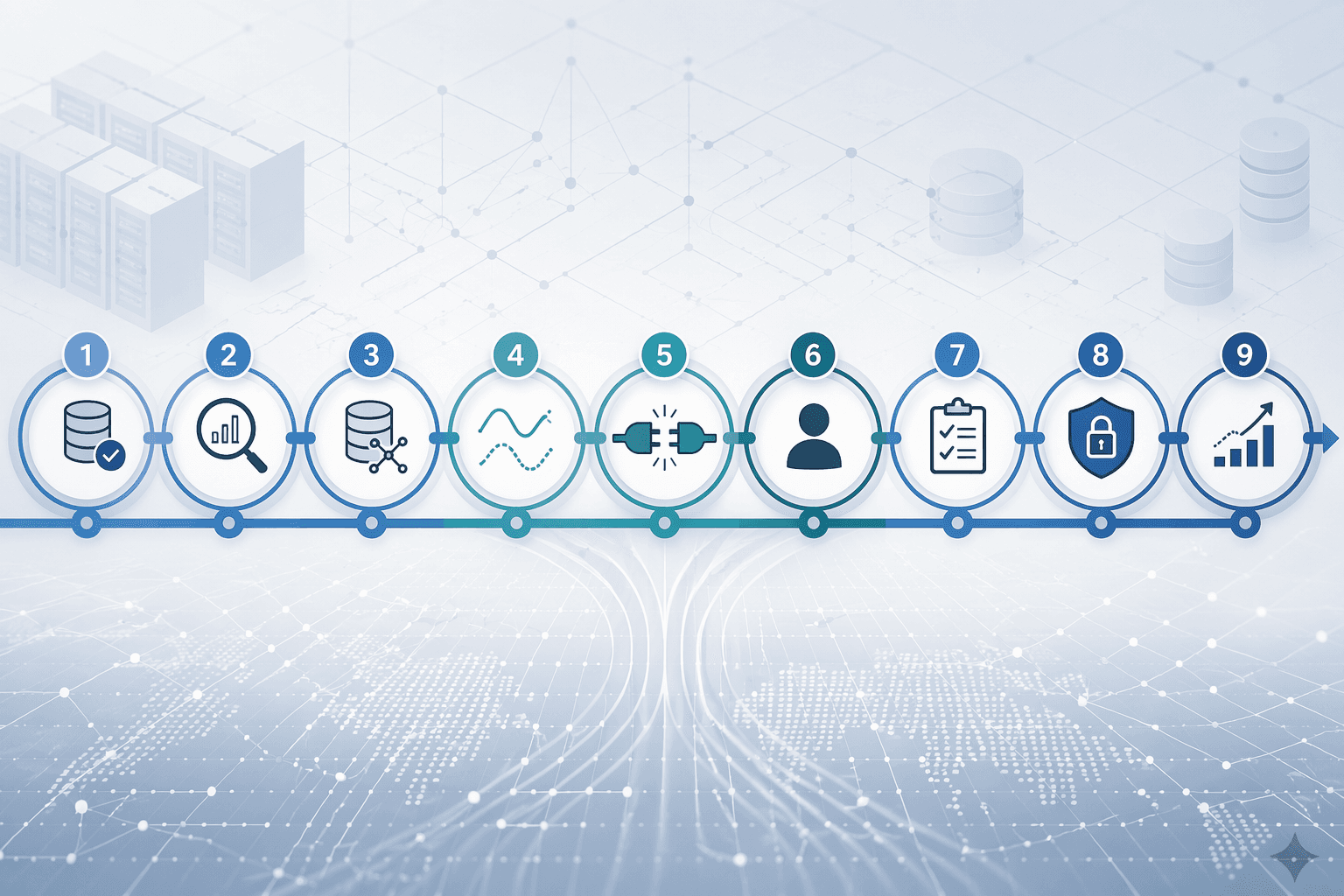
Netstock's nine-step readiness framework is useful because it treats AI inventory work as a sequence, not a feature purchase.[2] The steps do not need equal weight to be useful. The gates that usually decide whether a pilot survives are the ones below.
- Item master data and attribute ownership are clear enough that product, unit-of-measure, location, and lifecycle fields mean the same thing everywhere.
- Demand history is complete enough to distinguish signal from patchy capture, promotion spikes, and missing periods.
- Supply inputs such as lead times, supplier reliability, and inbound status are available in time to matter.
- ERP and WMS feeds arrive on a usable cadence and reconcile to the same record of truth.
- Someone owns ongoing data maintenance after go-live instead of treating cleanup as a one-time project task.
IBM's guidance lands on the same issue from the forecast side: incomplete, outdated, or siloed data produces flawed predictions, which then feed bad replenishment recommendations and planner distrust.[3] AI21's integration checklist adds the operational friction: legacy ERP and WMS environments rarely fail in one obvious place; they fail in the seams, where custom fields, brittle connectors, latency, and competing records of truth make a clean AI workflow harder than the demo suggested.[4]
What the readiness work usually becomes
In practice, that means the heavy lift is usually not tuning a model. It is cleaning ownership around the item master, aligning field definitions across regions, deciding which system wins when records disagree, and making sure planners are not maintaining shadow spreadsheets because the official feeds arrive late. The point is not perfection. It is enough consistency that the model's recommendation can survive the trip from training data to a work queue.
That is where a structured checklist helps. The Data Readiness Assessment for AI Inventory Optimization: Implementation Guide can sit directly beside the implementation plan, because the first deployment decision is usually whether the organization is ready to correct data at the source or whether it is still asking AI to compensate for unreconciled inputs.
Only after that should vendor evaluation start. How to Evaluate AI Supply Chain Companies: A Buyer's Framework for 2026 becomes useful once the team can ask whether a platform fits the data environment it will actually inherit, not the idealized one in the sales demo.
Read the timing realistically
The strategy gap shows up here too. Gartner's 2025 finding that only 23% of supply chain organizations have a formal AI strategy is a useful warning sign: a lot of teams are still moving into pilots without a decision sequence for data, governance, and ownership. Deloitte's 2025 view that satisfactory ROI usually arrives in the 2-4 year window, not the first year, is the right antidote to payback theater. The point is not that AI is slow; it is that readiness work has a longer runway than a software license cycle.
That is why The AI Strategy Gap in Supply Chain: Why Intent Outpaces Planning belongs in the same conversation as readiness. Strategy is not a slide that justifies the pilot; it is the sequence that decides what must be fixed before the pilot can become production.
Once inventory, demand, supplier, and system data are stable enough to trust, AI in inventory management workflows starts to look much less like dashboard theater and much more like a decision layer. That is the point where Agentic AI in Supply Chain: Where Autonomous Agents Are Entering Production Today stops being a speculative side topic and starts becoming a practical next step. Until then, the fastest way to scale confusion is to deploy models into an environment that cannot explain its own inventory.
References
- Why Supply Chain AI Projects Fail: The $100M Data Quality Problem — TraxTech — Why Supply Chain AI Projects Fail: The $100M Data Quality Problem
- Utilizing AI for Efficient Inventory Management Systems — Netstock — Utilizing AI for Efficient Inventory Management Systems
- AI inventory management — IBM — AI inventory management
- AI inventory management — AI21 — AI inventory management
Comments
Join the discussion with an anonymous comment.