

The uncomfortable part about AI in supply chain planning is that many pilots are not failing in the demo room. They are failing after the demo, when planners still have to reconcile the AI output with the demand review deck, the inventory policy spreadsheet, the exception queue, and whatever the commercial team changed after the last meeting.
One 2026 Supply Chain Brain/Innovecs survey puts the gap in blunt terms: only 12% of companies said AI was fully integrated into their supply chain processes, while 43% were still at pilot stage and 36% reported limited adoption.[1] That is not proof that every supply chain AI program is stuck. It is one survey. But it matches what many transformation teams recognize immediately: the organization can approve the pilot faster than it can change the work.
The same pattern shows up outside supply chain as well. Deloitte reported in 2026 that 84% of organizations had not redesigned jobs or ways of working around AI, and only 20% could attribute AI initiatives to revenue growth.[2] Gartner has also projected that 60% of supply chain digital adoption efforts will fail to deliver their promised value by 2028 because of insufficient investment in change management; that is a forecast, not a measured outcome, but it is directionally useful because it points to the real bottleneck.[3]

So the useful question is not whether AI can improve forecasting, allocation, replenishment, inventory optimization, or scenario planning. In the right conditions, it can. The useful question is why a model that performs well enough to impress a steering committee so often fails to become the way planning actually runs on Monday morning.
For readers who want the broader data backdrop on adoption and value claims, the numbers sit in more detail in AI in Supply Chain Planning: The Numbers Behind the Hype. This article stays with the implementation problem: how to get out of pilot purgatory without pretending the next model upgrade will solve organizational drift.
The pilot trap usually starts before the pilot starts
The most common mistake is not choosing the wrong algorithm. It is starting with the technology before the planning problem is defined tightly enough for the business to absorb the answer. A team says it wants “AI demand planning,” but the real pain may be forecast override discipline, promotion visibility, long-tail SKU noise, supplier constraint handling, or the fact that every region runs a different monthly planning rhythm.
Those differences matter. If three business units define forecast accuracy differently, treat outliers differently, and escalate exceptions differently, an AI pilot has nowhere clean to land. The model may produce a better signal, but the process around that signal still forces planners to translate, defend, and reformat it. That is not adoption. That is another layer of work.
This is where the better programs become less glamorous and more effective. They standardize the planning process before they automate it. They decide which planning decisions the AI is meant to improve, which data is authoritative, where exceptions are reviewed, who can override the recommendation, and how those overrides are tracked. Capgemini reported in 2025 that companies with formal AI change management were 2.7 times more likely to see ROI within 12 months.[4] The point is not that change management paperwork creates value by itself. The point is that someone has forced the organization to decide how work will change.
Three failure patterns show up repeatedly in practitioner discussions and vendor research: starting with technology before defining the business problem, bypassing data foundations, and treating AI as a technology upgrade rather than an organizational shift.[5] All three create the same symptom later: a pilot that can be demonstrated but not operated.
Standardize the decision before automating the calculation
Planning teams do not need every process to be identical everywhere. A fresh food replenishment process and an industrial spare parts process should not be forced into the same operating pattern. But they do need enough standardization that the AI output has a defined role in the decision.
Before a pilot is approved, the team should be able to answer a few plain questions without scheduling a workshop to interpret the workshop:
- Which planning decision will change if the AI works?
- Which current step will be removed, shortened, or governed differently?
- Which metric will prove the change mattered: forecast value add, service level, inventory, waste, planner touch time, expedite cost, margin leakage, or another agreed measure?
- Who is allowed to override the recommendation, and what reason codes are acceptable?
- Where will the recommendation appear in the normal planning workflow?
That last question is often the one that exposes the false pilot. If the answer is “in a dashboard,” the next question is whether planners already make that decision in a dashboard. If they do not, the program has created a parallel system and then called it innovation.
Embedding beats parallel adoption
The fastest way to lose planner trust is to ask for duplicate work. Keep the current process alive “just in case,” ask the team to check the AI output separately, and then measure adoption as logins. The surface looks active. The work has not changed.
Gartner’s 2025 findings on GenAI productivity are a useful warning here: GenAI was associated with about four hours of weekly individual time savings, but only 1.5 hours at team level, with no correlation to work quality.[3] That does not mean GenAI has no value. It means that individual assistance does not automatically become operating leverage. If one planner drafts commentary faster but the team still reviews the same exceptions, holds the same meetings, and reconciles the same conflicting numbers, the benefit gets trapped at the desk level.
Supply chain planning is full of these traps. A demand sensing model sits beside the demand planning system. A replenishment recommendation appears in a standalone portal. A risk alert lands in email while the constrained plan is still built somewhere else. A scenario tool generates options that are copied manually into the S&OP pack. Each tool may be useful in isolation. Together, they can make the planner the integration layer.
Embedding means the recommendation appears where the decision already happens, at the point where the user has authority to act. For a demand planner, that may mean AI-generated exception prioritization inside the forecast review workflow, not in a separate analytics environment. For an inventory planner, it may mean safety stock recommendations linked to service targets and replenishment policies, not a weekly extract. For an S&OP leader, it may mean scenario comparisons tied to the actual executive trade-off meeting, not a side model built by the analytics team.
A good embedding test is simple: if the AI recommendation is accepted, what existing work disappears? If nothing disappears, the organization has probably added insight without redesigning the job.
This is also why the first scaled use case should usually be specialized, not grand. A team may eventually want connected AI-enabled planning across demand, supply, inventory, and financial scenarios. But the first production move should change a high-value decision with a clear workflow owner. AI demand forecasting, for example, can be a sensible first target when forecast volatility is driving inventory or service pain; the use-case trade-offs are covered separately in AI Demand Forecasting vs. Traditional Methods. The implementation point is that the use case has to be narrow enough for process change to be real.
Named accountability is where many pilots quietly die
An AI pilot can survive for months with vague ownership. A scaled planning capability cannot. Once the tool starts affecting forecast approval, replenishment decisions, allocation priorities, or inventory targets, “the project team” is no longer a sufficient answer.
RELEX describes an AI-to-ROI accountability model with four roles: business owner, technology enabler, change champion, and value tracker.[5] It is vendor-originated, so it should not be treated as independent academic proof. But as an operating structure, it is practical because it separates the work that too often gets blurred into one overloaded program manager.

| Role | What they own | What goes wrong when the role is missing |
|---|---|---|
| Business owner | The planning decision, policy choices, adoption expectations, and business trade-offs | The model is optimized for a metric no one is willing to operationalize |
| Technology enabler | Data pipelines, system integration, model operations, access, reliability, and security | The pilot works in a controlled environment but breaks when connected to planning systems |
| Change champion | Planner engagement, training, process redesign, feedback loops, and local adoption | Users keep the old workflow alive because the new one never becomes normal work |
| Value tracker | Baseline, benefit logic, weekly performance tracking, and P&L linkage | Savings are claimed in slides but cannot be reconciled to operating or financial results |
The business owner is the hardest role to fake. This person cannot simply sponsor the pilot and appear at the kickoff. They have to decide, for example, whether the organization will accept a different service-inventory trade-off, whether planners are expected to follow the new exception logic, and which overrides require management review. If the business owner will not make those calls, the planner will make them manually later.
The technology enabler is equally exposed once the pilot moves beyond a curated data set. Planning AI depends on master data, transaction history, hierarchy logic, calendars, promotions, constraints, lead times, and system latency. A model that looks strong in a sandbox can become useless if planners cannot see why it recommended an action, if refresh cycles miss the planning cut-off, or if the output does not write back into the system of record.
The change champion protects the process from executive wishful thinking. Planners need to know what changes in their day, which judgment calls remain theirs, what the escalation path is, and how the organization will treat early misses. Without that work, the informal network takes over. Experienced planners build their own checks. Managers ask for the old report. The pilot remains technically live while behavior quietly reverts.
The value tracker is the antidote to soft benefit claims. If the use case is meant to reduce inventory, improve availability, cut manual planning time, or reduce expedites, the baseline has to be set before implementation. The tracker also has to distinguish between leading indicators and realized value. A better recommendation acceptance rate is useful. It is not the same as P&L impact.
A 30/90/12-month roadmap that treats the pilot as a learning stage, not a hiding place
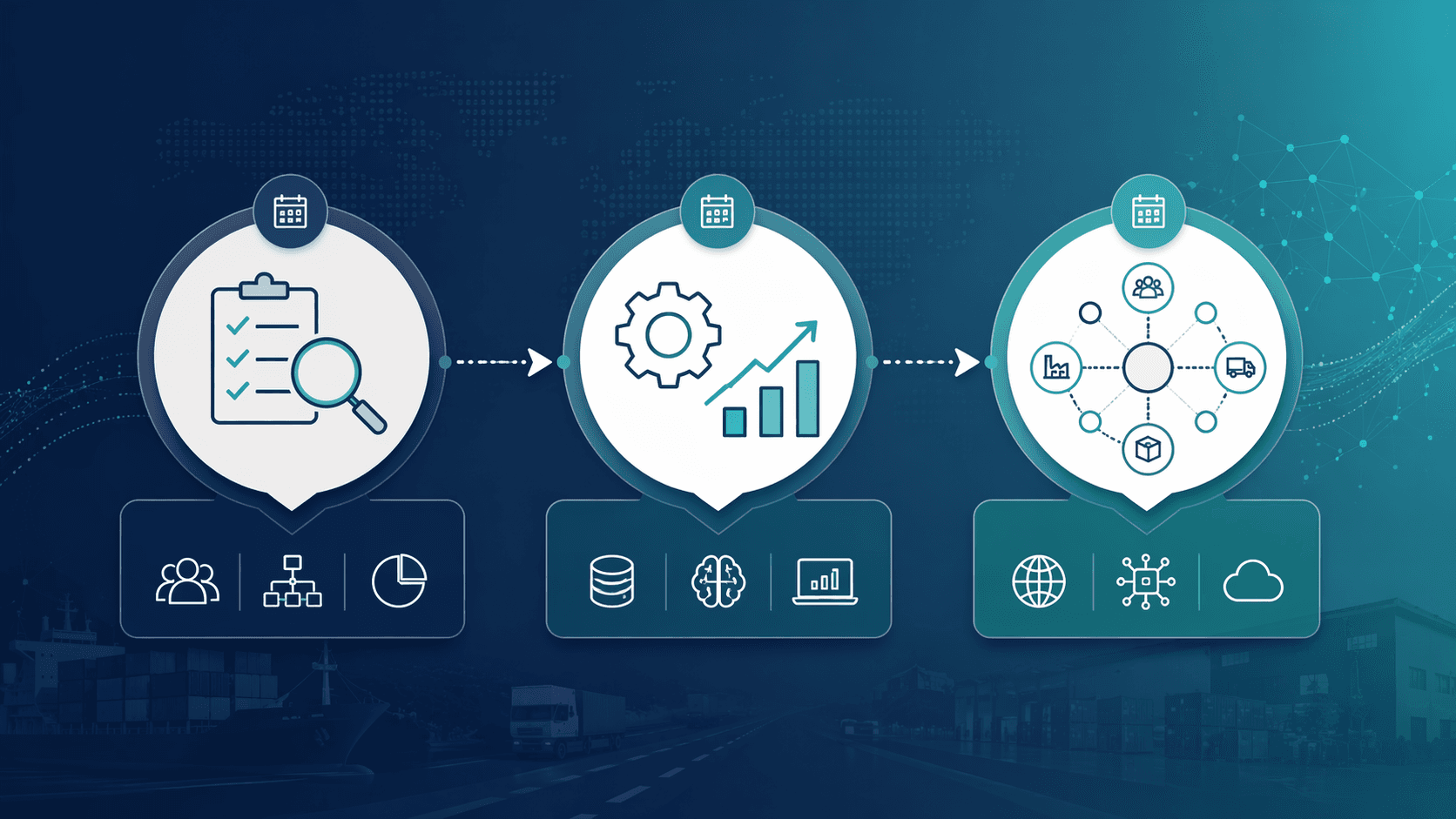
The roadmap does not need to be elaborate. It needs to force decisions early enough that the organization cannot mistake activity for progress.
| Timeframe | Primary objective | Minimum evidence of progress |
|---|---|---|
| First 30 days | Assess maturity, select 2–3 use cases, set baselines, assign named owners | A prioritized use-case backlog tied to process readiness, value baseline, and accountable roles |
| First 90 days | Implement one specialized, high-impact use case and track it weekly | A changed planning workflow, visible adoption behavior, and weekly movement against agreed measures |
| First 12 months | Scale across categories or sites and connect planning functions | Repeatable operating model, integrated workflows, and benefits that survive outside the pilot team |
First 30 days: decide whether the organization is ready to absorb the use case
The first month should not be spent admiring the art of the possible. It should be spent finding the few places where AI can improve a planning decision and where the organization is capable of changing the process around it.
A useful 30-day assessment looks at planning maturity by function, data readiness, workflow fragmentation, decision rights, and value potential. The output is not a 40-use-case catalog. It is a short list, usually two or three use cases, with one chosen for first execution.
- Maturity: Is there a stable process for the decision today, even if it is imperfect?
- Data: Are the required inputs trusted enough to support planner action?
- Workflow: Can the recommendation be embedded in the system or meeting where the decision is already made?
- Ownership: Are the business owner, technology enabler, change champion, and value tracker named?
- Baseline: Is current performance measured before the new capability is introduced?
This is also the right moment to reject attractive use cases. If the data foundation is poor, if the process differs wildly by site, or if no business owner will commit to changing decision rights, the use case may still be worth doing later. It is a poor first scaling candidate.
First 90 days: make one planning decision work differently
The 90-day phase is where many programs overreach. They try to prove enterprise potential instead of proving operational change. The better target is one specialized, high-impact use case with weekly tracking and enough organizational attention to remove friction quickly.
For a demand planning use case, that might mean narrowing the first deployment to a volatile category where forecast error drives real cost and where planners already review exceptions weekly. For inventory optimization, it might mean focusing on a group of SKUs where service and working capital trade-offs are visible and policy changes can be approved without months of debate. These are examples, not universal prescriptions; the correct first use case depends on the company’s planning pain and readiness.
Weekly tracking should include both operating metrics and behavior metrics. Operating metrics show whether the decision is improving. Behavior metrics show whether the work is changing. Recommendation acceptance, override reasons, exception aging, planner touch time, meeting cycle time, and write-back completion can be more revealing during the first weeks than a lagging financial metric.
The value tracker should also prevent a common accounting trick: counting theoretical time savings while planners still perform the old work. If the AI reduces manual analysis but managers still require the old spreadsheet pack, the savings are not real at team level. They are trapped capacity.
First 12 months: scale the operating model, not just the license count
Scaling across categories, business units, or sites should come after the organization has learned which parts of the workflow must be standardized and which can remain local. The mistake is to copy the pilot configuration and assume adoption will follow. A second site may have different planning calendars, master data quality, replenishment constraints, or commercial override behavior. The operating model has to travel, not just the model.
By the 12-month mark, the goal should be broader than one successful use case. The organization should be connecting planning functions: demand signals feeding supply plans, inventory policies reflecting service decisions, constraints appearing in scenarios, and financial impacts visible enough for S&OP or IBP trade-offs. That does not require a big-bang transformation. It does require that each scaled use case reduces fragmentation instead of adding another decision layer.
Logistics teams face a similar scaling problem when machine learning moves from model testing into dispatch, routing, capacity, or exception workflows; the phased deployment issues are covered in How to Implement Machine Learning in Logistics. The planning version has its own complexity, but the same rule applies: scale exposes process weakness that pilots can hide.
Timelines are useful, but maturity sets the speed limit
Cerexio’s 2025 implementation estimates place foundational improvements in a 3–6 month range and more advanced AI-enabled planning in a 9–18 month range.[6] Those are directional estimates, not audited benchmarks. A company with clean master data, stable planning governance, and an engaged planning organization can move faster than one still arguing over which forecast number is official.
The more important point is that readiness comes from discipline, not acceleration. A compressed timeline does not fix unclear ownership. A stronger model does not compensate for a workflow no one uses. A bigger platform contract does not standardize exception handling. These are operating choices, and they become more visible as the program scales.
For teams still selecting where to start, a use-case library can help compare planning opportunities before the 30-day assessment narrows the field. But prioritization should not be a popularity contest. The first use case should be valuable enough to matter, narrow enough to govern, and embedded enough that planners stop doing something old when the new capability goes live.
The practical test before calling a pilot scaled
A supply chain AI pilot has not scaled because more users can access it. It has not scaled because the dashboard is live, the model refreshes, or the steering committee saw a green status. It has scaled when the planning process changes and the business can see the consequence.
Before declaring success, ask three questions. Is the process standardized enough that the AI output has a defined role in the decision? Is the recommendation embedded in the workflow where planners actually act? Are the business owner, technology enabler, change champion, and value tracker named and active?
If the answer to any of those is no, the pilot may still be useful. It may even be promising. But it is still just a pilot.
References
- Supply Chain Brain/Innovecs 2026 survey, Supply Chain Brain/Innovecs, 2026.
- Deloitte 2026 AI job redesign and revenue attribution research, Deloitte, 2026.
- Gartner 2025 supply chain digital adoption and GenAI productivity research, Gartner, 2025.
- Capgemini 2025 AI change management and ROI research, Capgemini, 2025.
- RELEX AI-to-ROI framework, RELEX Solutions.
- Cerexio 2025 AI-enabled planning implementation timeline estimates, Cerexio, 2025.
Comments
Join the discussion with an anonymous comment.