

The cleanest way to understand artificial intelligence in procurement right now is to put two numbers next to each other: 94% of procurement executives use GenAI at least weekly, while only 4% of organizations have reached large-scale deployment.[1][2] That is not a small implementation lag. It is a 90-point gap between individual usage and operational scale.
The first number says procurement people have found useful work for the tools. They draft supplier emails, summarize contract language, classify spend, sketch RFP questions, and compress the document labor that has always made procurement transformation feel slower than the slide deck promised. The second number says most organizations have not turned that activity into production workflows with approved data inputs, process owners, audit trails, adoption metrics, and governance.

This distinction matters because procurement teams are already past the awareness stage. A buyer using ChatGPT every week is individual adoption. A sourcing team testing contract summarization on a handful of agreements is pilot activity. A governed workflow that routes AI-generated summaries to named reviewers, records exceptions, measures cycle-time change, and updates the standard operating procedure is meaningful implementation. Large-scale deployment means that pattern has moved beyond isolated teams and become part of how procurement actually runs.
The funnel narrows quickly. EY’s 2025 Global CPO Survey, as summarized by Art of Procurement, found that 49% of CPOs had piloted GenAI, but only 36% had moved to meaningful implementation.[1] Even that middle stage should be read carefully. Executive surveys tend to overrepresent early adopters and transformation-minded organizations. Usage statistics also measure activity, not value. A prompt written every week is not the same thing as a controlled workflow that changes sourcing throughput, contract review quality, supplier onboarding speed, or category-manager capacity.
The uncomfortable part is that standing still is not the safe option. Forbes, citing MIT’s 2025 State of AI in Business study, reported that 95% of enterprise AI pilots fail to deliver measurable ROI despite $30 billion to $40 billion in GenAI investment, and that 90% of employees use personal AI tools.[1] The MIT figure is second-hand in this research set, so it should not be treated as a procurement-specific failure rate. It does, however, describe a familiar operating risk: when formal deployment stalls, employees do not stop experimenting. They move the work into personal tools, outside procurement’s normal controls.
The Gap Is an Operating-System Failure
Most failed procurement AI programs do not fail because nobody can imagine a use case. They fail because the organization has not decided how AI work will be absorbed into procurement operations. The technology is introduced as a tool; the work requires a new operating system.
Data is usually where the hesitation starts. Gartner’s 2025 Leadership Vision for CPOs, as reported by Art of Procurement, found that 74% of leaders say their data is not AI-ready.[1] That concern is reasonable. Supplier masters contain duplicates, contract repositories are uneven, spend taxonomies drift, and ERP fields often reflect years of local workaround behavior. If an AI tool is asked to summarize unreliable records or classify spend from messy inputs, the procurement team still owns the consequences.
But data readiness can also become a waiting room. APQC’s finding, also summarized by Art of Procurement, that 8 out of 10 AI implementers see data quality improve as a byproduct of AI work creates a useful paradox.[1] It does not prove that AI automatically fixes bad data. Organizations that implement AI may also be investing in data hygiene, stewardship, and integration at the same time. The practical lesson is narrower and more useful: bounded AI deployment can expose which data fields actually matter, which supplier records are trusted, and which exceptions must be governed. Waiting for perfect data before starting often means the organization never learns which data deserves the cleanup effort.
Strategy is the next weak point. Gartner data cited by Art of Procurement indicates that only 23% of organizations have a formal AI strategy.[1] Without one, procurement teams choose scattered use cases based on local enthusiasm: one category team tests RFP drafting, legal experiments with contract review, finance asks for spend insights, and IT runs a separate tool evaluation. None of those activities is necessarily wrong. The failure comes when no one ties them to a shared outcome, data standard, approval path, or adoption measure.
That vacuum is where shadow AI grows. A procurement analyst pasting supplier notes into a personal assistant may be trying to move faster, not to bypass governance. A category manager asking a public tool to summarize a draft RFP may simply be tired of waiting for an enterprise rollout. The intent may be sensible; the architecture is not. Once supplier information, contract language, negotiation context, and pricing assumptions move through unmanaged tools, the organization loses visibility into what was used, what was generated, who reviewed it, and whether the output influenced a commercial decision.
Silos complete the pattern. Deloitte’s 2025 CPO survey identified siloed working as the top barrier, cited by 57% of procurement teams.[3] That matches what shows up in implementation meetings: procurement owns the process pain, IT owns platform constraints, legal owns acceptable risk, finance owns value measurement, and data teams own models or architecture. A pilot can survive that fragmentation because pilots are small and temporary. Production cannot. Production needs named handoffs, escalation rules, review rights, and shared definitions of success.
Start Where the Work Is Document-Heavy and the Risk Is Bounded
The best starting point is not the most futuristic workflow. It is the use case with enough volume to matter, enough structure to govern, and enough human review to prevent the organization from pretending autonomy has arrived before the operating model is ready.
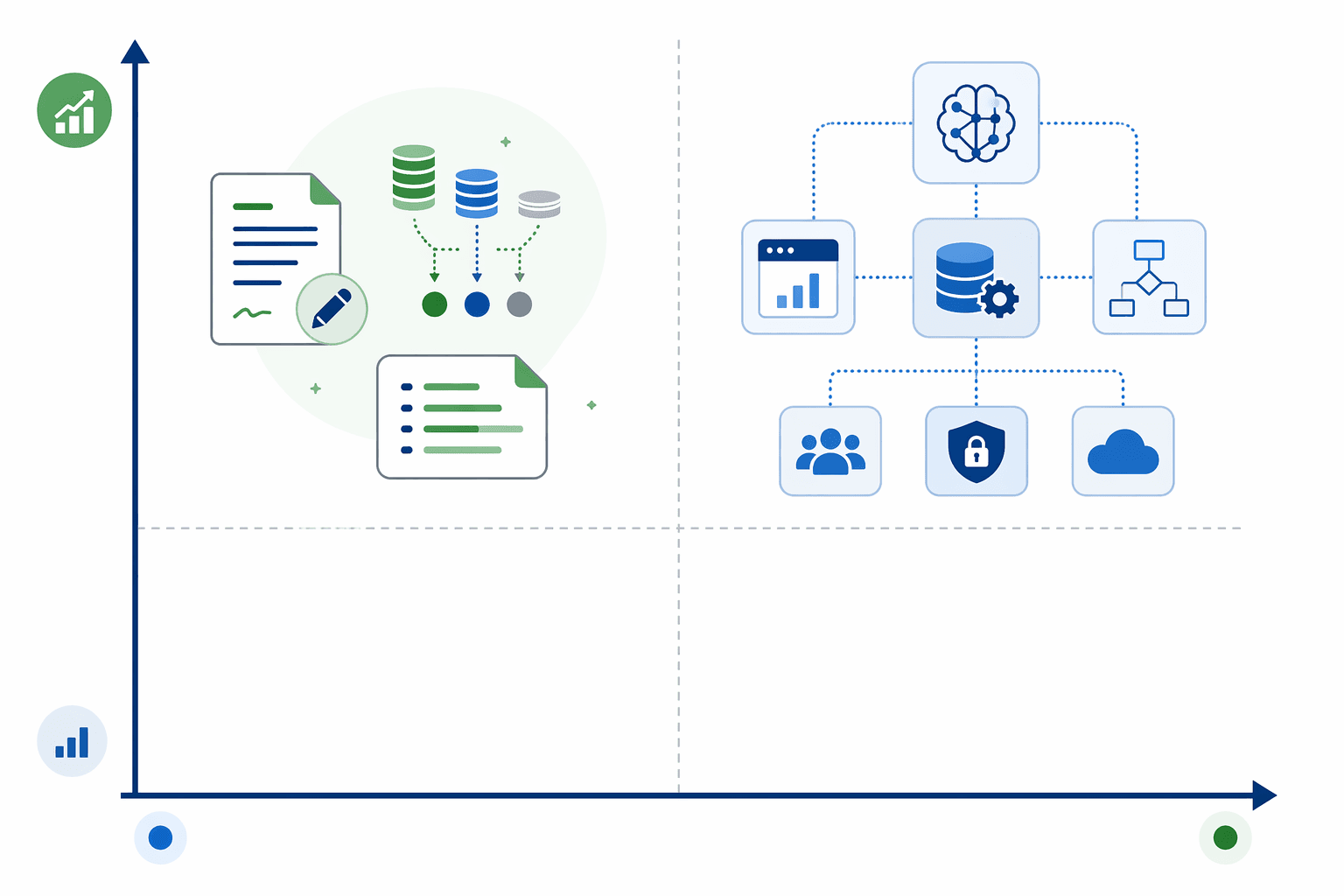
Deloitte’s 2025 CPO survey points to exactly that kind of starting map: GenAI-assisted drafting was cited by 53% of CPOs, spend classification by 47%, contract summarization by 42%, and RFP creation by 40%.[3] These are not minor use cases just because they are less glamorous than autonomous sourcing. They sit in the dense middle of procurement work, where teams spend hours turning imperfect inputs into documents, categories, summaries, and supplier-facing materials.
| Use case | Why it is a practical starting point | What should be measured |
|---|---|---|
| GenAI-assisted drafting | Reduces repetitive first-draft work for supplier communications, sourcing documents, and internal summaries | Draft cycle time, reviewer edits, reuse rate, policy exceptions |
| Spend classification | Improves visibility where taxonomy drift and inconsistent supplier records slow analysis | Classification accuracy, exception volume, category coverage, analyst rework |
| Contract summarization | Helps teams surface obligations, renewal terms, and risk clauses without replacing legal review | Summary accuracy, reviewer acceptance, missed-clause rate, review turnaround |
| RFP creation | Accelerates structured document production while preserving category and legal oversight | Time to draft, stakeholder review time, supplier clarification volume |
These use cases are also useful because they force the right operational questions early. Which contract templates are approved? Which spend taxonomy is authoritative? Which clause libraries can the tool use? Who signs off on an AI-generated RFP section before it reaches suppliers? A broader procurement AI use-case catalog can help teams compare options, but the selection discipline should remain simple: pick work that is painful, repeatable, measurable, and reviewable.
Three Pillars That Move AI From Pilot to Production
Apexanalytix frames AI readiness around three pillars: data readiness, process and adoption, and governance and explainability.[4] The value of that structure is that it keeps the conversation out of tool-demo territory. Each pillar changes something concrete about how procurement work is performed, measured, and controlled.

Data readiness: choose the trusted inputs before choosing the model
Data readiness does not mean every procurement record must be pristine before AI work begins. It means the first production use cases have defined input boundaries. For contract summarization, that may mean only executed agreements from the approved repository. For spend classification, it may mean a defined set of ERP fields, a current taxonomy, and a rule for handling suppliers with multiple legal entities. For RFP drafting, it may mean approved templates, category requirements, and policy language maintained by a named owner.
The operational work is not glamorous, but it prevents a predictable failure mode: teams blame the AI for outputs generated from records nobody had ever certified as usable. A focused data readiness assessment for AI procurement automation should identify authoritative systems, high-risk fields, data owners, exception paths, and minimum quality thresholds for each chosen workflow.
The data-readiness paradox is useful here because it shifts the question. Instead of asking whether the full procurement data estate is AI-ready, ask whether a specific workflow has enough trusted data to run under controlled conditions and enough feedback to improve the underlying records. That is a different bar, and it is usually a more productive one. The broader AI readiness paradox in supply chain follows the same pattern: readiness often improves through disciplined implementation, not through indefinite preparation.
Process and adoption: redesign the work, not just the prompt
A pilot can live as an extra tab in someone’s browser. A production workflow cannot. If AI drafts the first version of a supplier communication, the process must say who reviews it, what policy language is locked, what changes are tracked, and when the buyer is allowed to send it. If AI classifies spend, the process must define who reviews low-confidence categories and how corrected classifications feed back into the taxonomy. If AI summarizes contracts, the process must make clear that legal judgment has not been replaced by a generated paragraph.
This is where many executive pilots become nobody’s operational responsibility. The kickoff names a sponsor, the tool names a vendor, and the dashboard names usage. But the daily rhythm belongs to category managers, sourcing specialists, contract reviewers, supplier managers, and procurement operations. They need training, revised handoffs, and a reason to trust the new workflow when deadlines are real and exceptions are messy.
Adoption metrics should therefore measure more than logins. Useful measures include the share of eligible events using the AI-assisted workflow, the percentage of outputs accepted after review, rework rates, cycle-time movement, exception volume, and the number of users reverting to unmanaged tools. A change-management plan for AI procurement should treat those measures as operating signals, not communications artifacts. The people side of AI procurement transformation deserves as much attention as model capability, because procurement value is realized only when teams change how the work moves.
For more autonomous workflows, the adoption burden rises. The organization has to decide which decisions remain human-approved, which recommendations can be auto-routed, and which exceptions stop the process. A change management guide for autonomous procurement AI is most useful when it names the roles that will absorb the change, not just the communications that will announce it.
Governance and explainability: make review visible before scale makes it expensive
Governance is often treated as the brake. In procurement AI, it is more often the thing that lets the organization stop hesitating. A governed workflow tells users what data can be entered, which outputs require review, how decisions are documented, where exceptions go, and who is accountable when AI-assisted work affects a supplier, contract, price, or sourcing outcome.
Explainability does not require every user to understand model architecture. It does require enough transparency for a reviewer to know why an output was produced and whether it can be trusted for the task at hand. For spend classification, that may mean confidence scores, source fields, and a correction trail. For contract summarization, it may mean citations back to clause locations and clear labels for uncertain interpretation. For RFP drafting, it may mean separating approved boilerplate from AI-suggested category language.
Auditability should be designed before volume increases. Once AI-generated summaries, classifications, and drafts are embedded in procurement events, the organization will need to answer basic questions: what input was used, what output was generated, who reviewed it, what was changed, and whether the final decision relied on the AI-assisted work. If those answers are not captured in the workflow, they will be reconstructed later by people who already have too much work.
Why Moving Now Still Matters
The case for moving faster should not be built on market-size excitement. It is enough to note that procurement represents only 6% of enterprise AI use cases, according to ISG data summarized by Art of Procurement.[1] That low share can be read two ways. Procurement may be underrepresented because other functions have moved faster. It may also mean that organizations able to turn procurement AI into governed workflows still have room to create an operating advantage before practices harden into category norms.
The advantage will not come from announcing one more pilot. It will come from choosing a small number of bounded use cases and forcing them through production standards. That means an outcome before a tool, trusted inputs before broad access, named process owners before expansion, and governance before shadow usage becomes the default procurement architecture.
A practical sequence looks like this:
- Select a high-impact, lower-complexity use case such as drafting, spend classification, contract summarization, or RFP creation.
- Define the business outcome in operational terms: cycle time, review burden, classification accuracy, exception reduction, or user adoption.
- Name the trusted data sources, restricted inputs, reviewers, escalation paths, and process owner.
- Run the workflow with audit trails and adoption metrics, not just user testimonials.
- Use exceptions and corrections to improve the underlying data, taxonomy, templates, and governance rules before expanding.
For teams already stuck between pilots and scale, the complementary procurement AI adoption-chasm playbook goes deeper on root causes and execution steps.
Procurement leaders do not need to wait for perfect data, and they should not confuse scattered usage with deployment. The workable path is narrower: start with reviewable, document-heavy workflows; let implementation reveal the data cleanup that matters; redesign ownership around adoption; and govern the work before unmanaged AI becomes the operating model by default.
References
- State of AI in Procurement in 2026 — Art of Procurement
- Generative AI in Procurement 2025 — The Hackett Group
- CPOs steering GenAI in procurement through uncharted waters — Deloitte
- AI in Procurement: From Experimentation to Proven ROI — apexanalytix
Comments
Join the discussion with an anonymous comment.