

Agentic AI is already inside supply chain operations, but not in the clean, end-to-end form that conference decks like to imply. The useful signal in 2026 is more awkward: companies are letting agents rank quotes, flag exceptions, validate supplier responses, and recommend reroutes, while still hesitating to let the same systems own an entire planning or procurement process without a human in the loop.
That mismatch is visible in the market data. BCG analysis cited in Dataiku's 2026 supply chain AI trends report puts agentic systems at 17% of total AI value in supply chain in 2025, with a projection of 29% by 2028; the original BCG methodology is not directly available from that secondary source, so the figure is best treated as a directional value-shift signal rather than a cleanly auditable benchmark.[1] PwC's 2026 operations survey shows the same tension from another angle: 83% of operations leaders say AI agents will accelerate the breakdown of silos, but only 37% are comfortable assigning them to full end-to-end processes.[2]

For supply chain leaders, that is the real question now. It is not whether agents can participate in supply chain work. They already do. The harder question is which decisions deserve autonomy, which deserve recommendation rights only, and which still need a person accountable before action.
Production Is Clustering Around Bounded Decisions
The strongest production patterns have a common shape. They do not ask an agent to optimize the whole supply chain. They give it a narrow job, a defined data field, a constrained action set, and a path for human override. That is why quote ranking, supplier scoring, exception triage, disruption rerouting, inventory re-allocation, and anomaly resolution are moving faster than broad autonomous planning.
A supplier quote-ranking agent, for example, can compare incoming quotes against price history, lead-time requirements, supplier performance, risk flags, and contract constraints. The decision it produces is often a ranked recommendation, not a purchase order released into the wild. If the ranking is wrong, the buyer can see the inputs, challenge the weighting, and correct the next round. The blast radius is limited because the agent is operating before commitment.
Automated supplier scoring and quote validation sit in the same family. Dataiku and related secondary sources describe early adopters using agents in buyer workflows, supplier quote ranking, automated supplier scoring, and quote validation, including unnamed transportation and medical device manufacturing examples.[1] Those should not be dressed up as named case studies. Their value is more modest and more useful: they show where companies are finding enough structure to move beyond pilot work.
Quote validation is a good test of agentic usefulness because it contains tedious judgment. A buyer may need to notice that a quote has a mismatched unit of measure, a lead time that conflicts with the requested delivery window, a supplier term that violates policy, or a price movement that requires escalation. An agent can inspect those conditions continuously and push only the questionable items to a person. The human decision does not disappear; the queue changes.
Exception triage follows the same logic in logistics. When shipments miss milestones, ETAs move, carrier capacity changes, or warehouse constraints appear, coordinators often spend the morning separating noise from action. An agent can classify exceptions by urgency, customer impact, inventory consequence, and available recovery paths. In many operations, the first improvement is not that the agent fixes the disruption. It is that the transportation team stops treating every alert as if it has the same operational weight.
Disruption rerouting and inventory re-allocation are a step closer to real autonomy, but the same boundary discipline still matters. If a lane is disrupted, an agent may recommend or initiate rerouting within preapproved carrier, cost, service, and compliance limits. If demand shifts or a node becomes constrained, an agent may suggest moving available inventory to protect priority orders. These are not trivial actions, but they are still bounded when the organization defines what the system may change, what it may only recommend, and when escalation is mandatory.
| Production Pattern | Why It Is Moving Faster | Where Governance Usually Bites |
|---|---|---|
| Supplier quote ranking | The agent can order options before a buyer commits spend. | Weighting, supplier eligibility, audit trail, and override rights. |
| Supplier scoring and quote validation | Rules, documents, history, and exceptions can be checked repeatedly. | Policy interpretation, data freshness, and escalation thresholds. |
| Exception triage | The agent reduces alert noise and prioritizes human attention. | Severity classification and false reassurance on edge cases. |
| Disruption rerouting | Approved recovery options can be constrained by lane, carrier, cost, and service rules. | Customer impact, contractual limits, and total network consequences. |
| Inventory re-allocation | Available stock can be matched to changing demand and service priorities. | Allocation fairness, margin impact, and downstream shortages. |
| Anomaly resolution | Recurring deviations can be detected and routed faster than manual review. | Root-cause confidence and whether the fix is reversible. |
Logistics and Procurement Are Giving Agents the First Real Openings
The adoption signals are strongest where the daily work already has high decision volume and visible administrative drag. OpenSky Group cites ActivTrak data showing that 72% of logistics employees had already adopted AI tools in 2024, the highest rate across industries in that dataset.[3] The same OpenSky Group article cites AI at Wharton and Hackett Group findings that 94% of procurement executives use generative AI tools at least weekly, up 44 percentage points year over year.[3]
Those figures do not prove agentic effectiveness. Adoption of AI tools is not the same thing as safe autonomous decision-making. But they do explain why logistics and procurement are fertile ground. Users are already bringing AI into daily work, and the work itself is full of repeatable micro-decisions: compare, validate, classify, escalate, recommend, route, and monitor.
Procurement is especially suited to bounded autonomy because many early agent tasks sit before the point of legal or financial commitment. Ranking supplier quotes, identifying missing fields, checking policy compliance, summarizing supplier risk, or preparing negotiation context can save time without giving the agent unilateral authority to award business. The buyer still owns the decision; the agent compresses the review path.
Logistics has a different appeal. The clock is less forgiving. A delayed shipment, port disruption, carrier miss, or capacity shortfall creates a narrow window for action. Agents can help by monitoring signals, identifying feasible recovery choices, and pushing the best next action to the coordinator. The more urgent the operating environment, the more valuable it becomes to reduce the number of screens and judgment calls standing between detection and response.
The Trust Gap Is Not a Soft Concern
Supply chain leaders are not irrationally cautious when they hold back from end-to-end autonomy. A bad agent decision can strand inventory, trigger expediting costs, misallocate scarce supply, breach a customer promise, or push a supplier relationship into dispute. Someone still has to explain why the system was allowed to act.
That is why the 83% versus 37% PwC split matters more than broad enthusiasm.[2] Leaders can believe agents will break down silos and still refuse to assign them control over full processes. In fact, that is the mature position in many environments. Cross-functional visibility is useful. Autonomous execution across planning, procurement, logistics, inventory, and customer commitments is a different risk class.
RELEX's 2026 trust finding, discussed in ChainSignal's Agentic AI in Supply Chain: What Actually Works in 2026 — and What's Still Hype, is even sharper: only 10% trust AI for critical supply chain decisions without human review. That number fits what production teams are actually doing. They are not refusing agents. They are putting them where review, reversal, and containment are still possible.
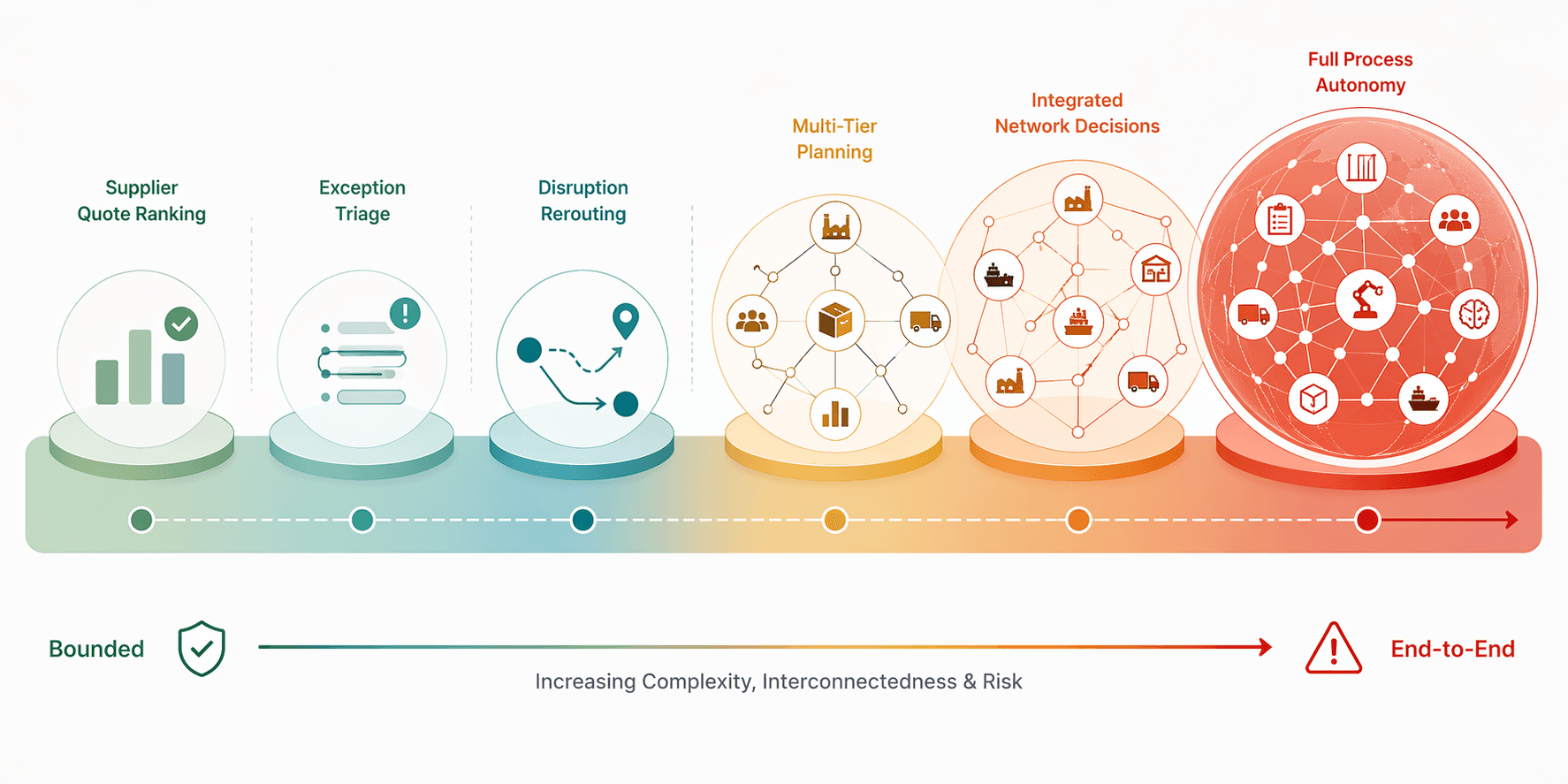
A quote-ranking error can be caught before award. A shipment reroute inside approved carrier and cost rules can often be reversed or corrected. A network-wide planning decision that changes production priorities, supplier releases, customer allocations, and transportation plans is harder to unwind. The governance model has to recognize that these are not different points on a marketing maturity curve. They are different accountability problems.
Authority Should Follow Reversibility and Blast Radius
The practical governance question is not whether an agent is accurate in a demo. It is what the agent is allowed to change when it is wrong. A supply chain organization can tolerate more autonomy when the action is reversible, financially bounded, operationally isolated, and visible in an audit trail. It should demand tighter review when the action commits spend, changes customer promises, reallocates constrained supply, or propagates across functions.
That logic creates a more useful autonomy ladder than the usual pilot-to-production language. Some agents should only observe and summarize. Some should recommend a ranked action. Some should execute within predefined limits. A much smaller group should coordinate across processes, and only after the organization has tested escalation rules, exception handling, auditability, and ownership.
- Low autonomy: monitor signals, summarize exceptions, prepare supplier or shipment context.
- Moderate autonomy: rank quotes, score suppliers, classify exceptions, recommend recovery options.
- Constrained execution: reroute shipments, trigger replenishment adjustments, or reallocate inventory inside approved limits.
- High autonomy: coordinate end-to-end actions across planning, procurement, logistics, inventory, and customer commitments.
The first three categories are where production credibility is building. The fourth is where the trust gap becomes binding. This is also where organizations with weak AI strategy, poor data ownership, or unclear process accountability tend to stall. If the business cannot say who owns a decision today, it will struggle to say what an agent is allowed to do tomorrow.
For a more implementation-focused treatment of graduated autonomy, ChainSignal's practitioner's guide to graduated autonomy lays out the operating model in more detail. The point here is narrower: production adoption is moving fastest where decision rights can be granted in small, inspectable increments.
Why End-to-End Autonomy Is Still a Hard Sell
End-to-end supply chain processes are full of coupled decisions. A planning change affects procurement releases. A procurement constraint affects production sequencing. A production delay affects allocation. Allocation affects transportation priorities and customer service. The more an agent is allowed to span that chain, the more difficult it becomes to isolate cause, assign responsibility, and reverse the action cleanly.
That does not mean autonomy will stay limited forever. OpenSky Group cites Gartner projections that 15% of daily logistics decisions will be made autonomously by AI agents by 2028 and that 60% of supply chain disruptions will be resolved without human intervention by 2031; because these are secondary citations rather than direct Gartner source documents, they should be read as directional projections rather than independently verified forecasts.[3] Still, the direction is consistent with what current production use already suggests: autonomy will expand from contained decisions before it expands into broad process ownership.
There is also a labor dimension that should be handled carefully. Many supply chain organizations are worried about losing experienced planners, buyers, and logistics coordinators whose judgment lives in habits, workarounds, and exception memory rather than clean process documentation. Agents can help capture parts of that decision logic if they are trained and governed around real workflows. But without a supply-chain-specific statistic in the available evidence, the retirement-cliff argument should remain a plausible accelerator, not a quantified driver.
The better near-term use of that concern is operational. If an experienced planner knows which shortages deserve escalation, which suppliers miss in predictable ways, or which customers cannot tolerate substitution, that logic should be made explicit before it disappears. An agent can only inherit judgment that the organization has bothered to observe, encode, test, and challenge.
Production Readiness Is a Governance Test
A serious production screen for agentic AI in supply chain starts with the decision, not the model. What action is being delegated? How reversible is it? Who reviews exceptions? What evidence does the agent expose? Which systems can it write to? What happens when data is missing, stale, or contradictory? Who is accountable when the recommendation is accepted and the outcome is bad?
This is where many pilots lose momentum. They prove that an agent can produce a plausible answer, but they do not prove that the organization can operate around that answer. Production requires thresholds, logs, escalation paths, override rules, model monitoring, and a clear distinction between recommendation and execution. Without those, every successful pilot becomes a negotiation with risk, legal, IT, and the process owner.
The supply chain AI strategy gap matters for the same reason. Organizations without a formal AI strategy may still launch useful pilots, but agentic systems force decisions about ownership, data access, exception handling, and operating control. ChainSignal's analysis of the supply chain AI strategy gap is relevant here because autonomous agents expose strategy weaknesses faster than traditional analytics projects.
In 2026, the credible path is not to wait for perfect trust or to grant broad autonomy on faith. It is to match authority to decision risk. Let agents take more responsibility where the decision is bounded, auditable, reversible, and economically contained. Keep humans closer where the decision commits the enterprise across functions. The serious question is no longer whether agentic AI belongs in supply chain. It is how tightly autonomy is matched to risk before governance becomes the constraint that slows everything down.
References
- Supply Chain AI Trends 2026, Dataiku.
- 2026 Digital Trends in Operations Survey, PwC.
- Supply Chain AI Statistics, OpenSky Group.
Comments
Join the discussion with an anonymous comment.