

The uncomfortable fact about artificial intelligence and machine learning in supply chain in 2026 is not that companies are ignoring it. They are not. The sharper problem is that 94% of supply chain companies say they plan to use AI for decision support within two years, while only 23% of supply chain organizations have a formal AI strategy in place, even among organizations already deploying AI.[1]
Those two numbers should not be read as a clean global census. The 94% figure comes from ABI Research’s 2025 survey of 490 professionals across four countries, and the 23% strategy figure is from a Gartner sample of 120 supply chain leaders who had already deployed AI.[1] The samples matter. They still point to the same management condition: organizations are moving toward AI faster than they are building the operating architecture that tells people how decisions will actually change.

That architecture is not a slide with use cases. It is the set of practical answers that planning teams need before a model recommendation enters the weekly rhythm: which forecast does the business treat as binding, who can override the system, what evidence is required for the override, who maintains the master data, and who is accountable when a recommendation is directionally right but commercially painful.
The gap is bigger than a reporting artifact
A generous interpretation would say the paradox is mostly language. One company calls a demand-sensing pilot “AI adoption.” Another reserves that phrase for an enterprise decision system embedded across planning, replenishment, logistics, and finance. On that view, the 94% and 23% numbers are not contradicting each other; they are measuring different points on the same road.
There is some truth in that. Adoption, piloting, integration, scaling, embedding, and autonomous decisioning are not interchangeable conditions. A model used by one planning team to improve a forecast is not the same as a governed decision process that changes inventory deployment, supplier commitments, exception handling, and service trade-offs across the network.
But the gap does not disappear when the language gets cleaner. RELEX reports that 67% of supply chain leaders are more confident in AI than they were last year, yet only 10% trust AI to make critical decisions without human review, and 54% prefer humans in the loop.[2] That is not anti-AI sentiment. It is a signal that confidence in the tool is running ahead of confidence in the decision system around the tool.
PwC’s operations survey points in the same direction from a different angle: 89% of operations leaders say their technology investments have not fully delivered expected results, while only 4% of companies report AI as fully embedded with no scaling barriers.[3] If AI were mainly a procurement problem, more software would close more of the gap. The survey evidence suggests the harder work is elsewhere.
“We have AI in operations” can mean very different things
The phrase sounds reassuring in a steering committee because it compresses a messy reality into one line. In practice, it can describe anything from an isolated forecasting pilot to a replenishment engine that planners use daily, to an embedded decision process where the model’s recommendation changes the operating plan unless a documented exception is approved.
RELEX’s maturity model is useful here less as a label exercise than as a way to stop treating unlike conditions as the same condition. Its stages run from exploring, to piloting, to scaling, to autonomous, and the operational questions change at each stage.[2]
| Maturity condition | What it usually means operationally | The decision question that matters |
|---|---|---|
| Exploring | Teams are evaluating tools, data availability, and possible use cases. | Which decision is worth improving, and who owns it? |
| Piloting | A model is being tested in a contained process or business unit. | What would have to change for people to rely on the output? |
| Scaling | The organization is trying to extend the capability across teams, categories, regions, or processes. | Can governance, data maintenance, and exception handling scale with it? |
| Autonomous | The system can make or trigger certain decisions with limited intervention. | Which decisions are safe to automate, and where must human review remain mandatory? |
This is where many AI conversations in supply chain become too loose. Forecasting, routing, inventory optimization, allocation, and supplier-risk sensing are all legitimate candidates for machine learning. They do not carry the same consequence if the model is wrong. A poor forecast may create inventory and service problems over a planning cycle. A bad transportation recommendation may create immediate cost and customer-service exposure. A supplier-risk signal may be useful as an alert but dangerous if it automatically changes sourcing decisions without commercial review.
That is why “human in the loop” is not a philosophical stance. It is an operating-design choice. The point is not to keep humans everywhere forever; it is to specify where human judgment adds control, where it merely adds delay, and what evidence would allow a decision to move from recommendation to automation.
The payoff exists, but it is easy to overread
The case for AI in supply chain is not weak. Accenture found that companies with AI-mature supply chains are 23% more profitable than peers and six times more likely to use AI and generative AI widely.[4] That is a useful maturity signal. It is not proof that AI alone caused the profitability gap.
The distinction matters because the companies mature enough to use AI broadly are often also mature in other ways. They tend to have cleaner data, more disciplined planning forums, clearer accountability, stronger process ownership, and leadership teams willing to change work rather than merely fund tools. AI may be part of the performance advantage, but it is probably entangled with a broader management system.
KPMG’s adoption benchmarks reinforce that caution. Its 2026 supply chain survey reports that 43% of supply chain organizations have implemented AI in at least one area, while only 23% are actively scaling.[5] PwC likewise reports that 57% of operations leaders say AI is integrated into operations, but only 27% have it fully embedded.[3] These are not trivial adoption levels. They are also not evidence that AI has become the way the operation is run.
The practical lesson is not to discount the upside. It is to stop using upside claims as substitutes for operating design. If a company cannot say how a model recommendation changes the monthly S&OP cycle, the replenishment planner’s exception queue, the transportation manager’s tendering choices, or the inventory trade-off between service and working capital, the ROI case is still mostly aspiration.
Why the strategy gap hurts inside the operation
The most damaging version of the AI strategy gap is not visible at the moment of purchase. It appears later, when planning teams are asked to trust outputs they did not help define, data teams are asked to support use cases that were never prioritized, and leaders discover that a technically successful pilot has no clear path into the management calendar.
Data quality is the first constraint that turns ambition into friction. PwC reports that 87% of operations leaders say poor data quality has affected their ability to achieve value from digital initiatives.[3] In a supply chain context, that does not simply mean a dashboard looks untidy. It means product hierarchies do not match across systems, lead times are not maintained, substitutions are invisible, customer-order behavior is misclassified, and exception codes do not tell the next planner what actually happened.
When that data is fed into a model, the result is not just lower analytical accuracy. The result is lower trust. Planners start checking every recommendation manually. Managers ask for parallel spreadsheets “just until we are comfortable.” The organization keeps the cost of the new technology and the cost of the old process at the same time.
Governance is the next failure point. Many supply chain AI efforts define the use case but not the decision right. A team may know that AI will support inventory optimization, but not whether the model can change safety-stock settings, who approves exceptions for strategic customers, whether finance can override working-capital recommendations, or how often the policy should be reviewed. In that environment, every difficult recommendation becomes a negotiation.
Workforce redesign is just as material. Deloitte reports that 84% of organizations have not redesigned jobs or ways of working around AI capabilities.[6] That statistic explains a familiar pattern: a company introduces AI decision support but leaves job descriptions, incentives, meeting structures, escalation paths, and performance metrics largely untouched. The model may be new, but the work is still organized around the old assumptions.
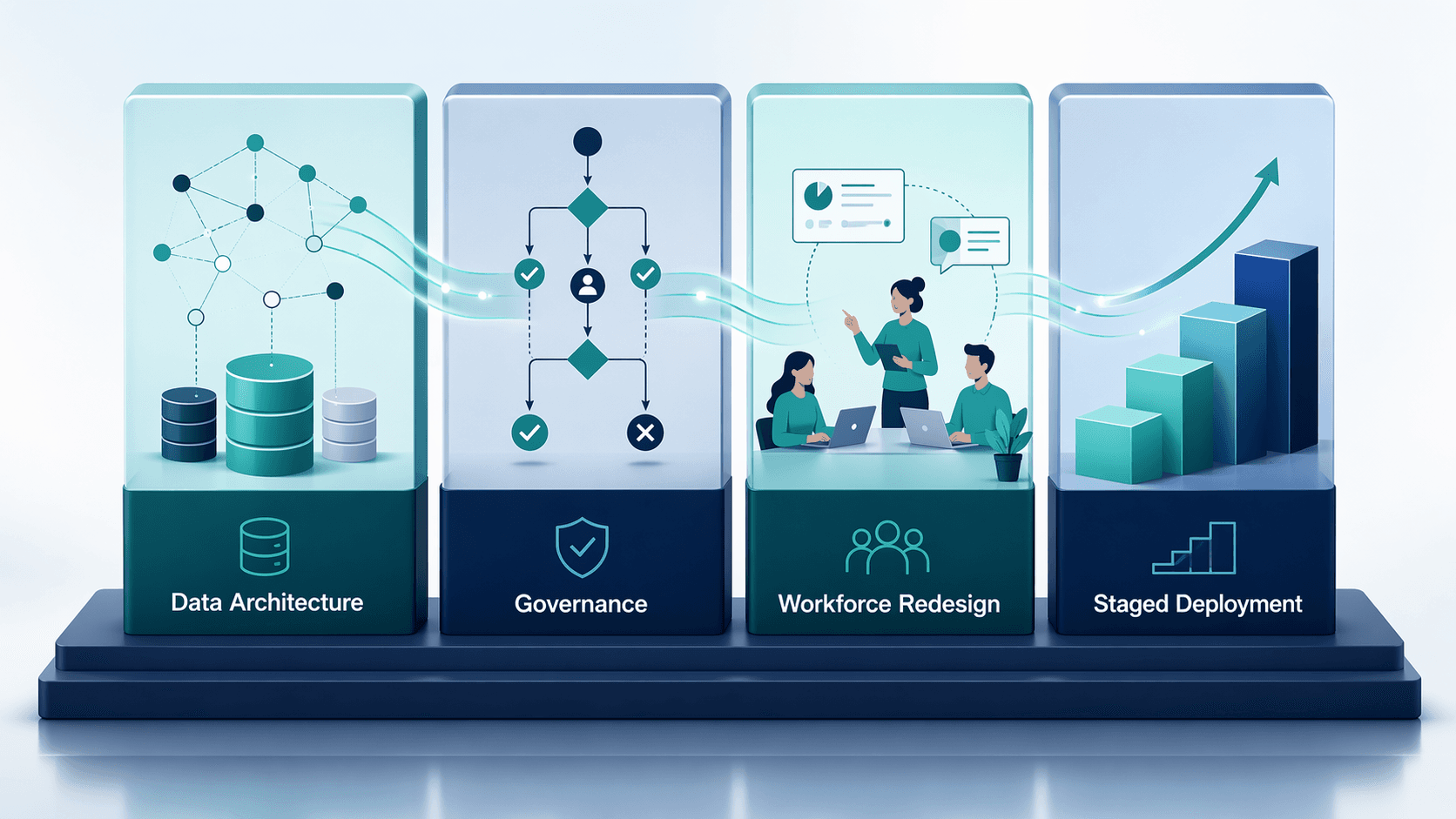
This is where budget can become a convenient excuse. Legacy systems, thin teams, and constrained capital are real limitations. Some organizations do not have the integration layer, data engineering capacity, or process discipline to move quickly. But those constraints make strategy more important, not less. When resources are limited, the organization has less room to run scattered pilots that cannot be maintained.
The organizations closing the gap are changing the operating rhythm
The more useful distinction in 2026 is not between companies that have AI and companies that do not. It is between companies that let AI sit beside the operating model and companies that use it to redesign the operating model.
The latter group tends to start with the decision, not the model. A demand-planning use case, for example, is not framed only as “improve forecast accuracy.” It is tied to who reviews the forecast, which forecast level matters for which decision, when the recommendation enters the planning calendar, how overrides are captured, and whether repeated overrides indicate model weakness, planner bias, or a policy conflict.
They also stage deployment around trust. Early pilots are allowed to prove technical usefulness, but scaling requires evidence that the process can absorb the recommendation. That means adoption metrics cannot stop at model accuracy or user logins. The more revealing measures are operational: fewer manual touches in exception handling, faster cycle time in planning reviews, cleaner override rationales, reduced duplicate analysis, and clearer accountability when recommendations are rejected.
This is also why autonomous supply chain language deserves restraint. Some decisions will become more automated. Others should remain supervised because the downside risk, commercial nuance, or cross-functional trade-off is too high. The mature move is not to promise autonomy everywhere. It is to decide, explicitly, which decisions can advance from advisory to supervised execution to automation, and what evidence is required at each step.
What a credible 90-day action signal looks like
A supply chain leadership team does not need to solve every AI implementation detail before approving the next phase of work. It does need to stop treating AI strategy as a procurement appendix. Within 90 days, the organization should be able to produce a short, decision-oriented strategy that answers four questions.
- Decision rights: Which decisions will AI inform, recommend, execute, or never touch without human approval?
- Data governance principles: Which data domains must be trusted first, who owns them, and how will quality issues be escalated when they affect model output?
- Use-case prioritization criteria: Which opportunities are valuable enough, feasible enough, and governed enough to deserve funding now?
- Staged investment logic: What must be proven in a pilot before the company scales it across teams, regions, categories, or decision processes?
That document should not be long. If it is useful, it will be specific enough that a planner, data owner, functional VP, and finance leader can each see what changes for them. Readers who need a deeper implementation view can use the companion analysis on why machine learning deployments in supply chain often have no strategy as a governance-focused next step.
The competitive divide in 2026 is not between supply chains interested in AI and supply chains ignoring it. Interest is already close to universal. The divide is between organizations that make AI part of an operating-system redesign and organizations that keep treating it as another technology purchase.
References
- Supply Chain AI Statistics: 18+ Statistics You Should Know for 2026, OpenSky Group
- Supply chain AI in 2026: The numbers behind the hype, RELEX
- 2026 Digital Trends in Operations Survey, PwC, 2026
- Accenture supply chain AI maturity research, Accenture, 2024
- Supply chain AI strategy: Scaling AI beyond pilots, KPMG, 2026
- Resilient by design: The agentic supply chain, Deloitte
Comments
Join the discussion with an anonymous comment.