
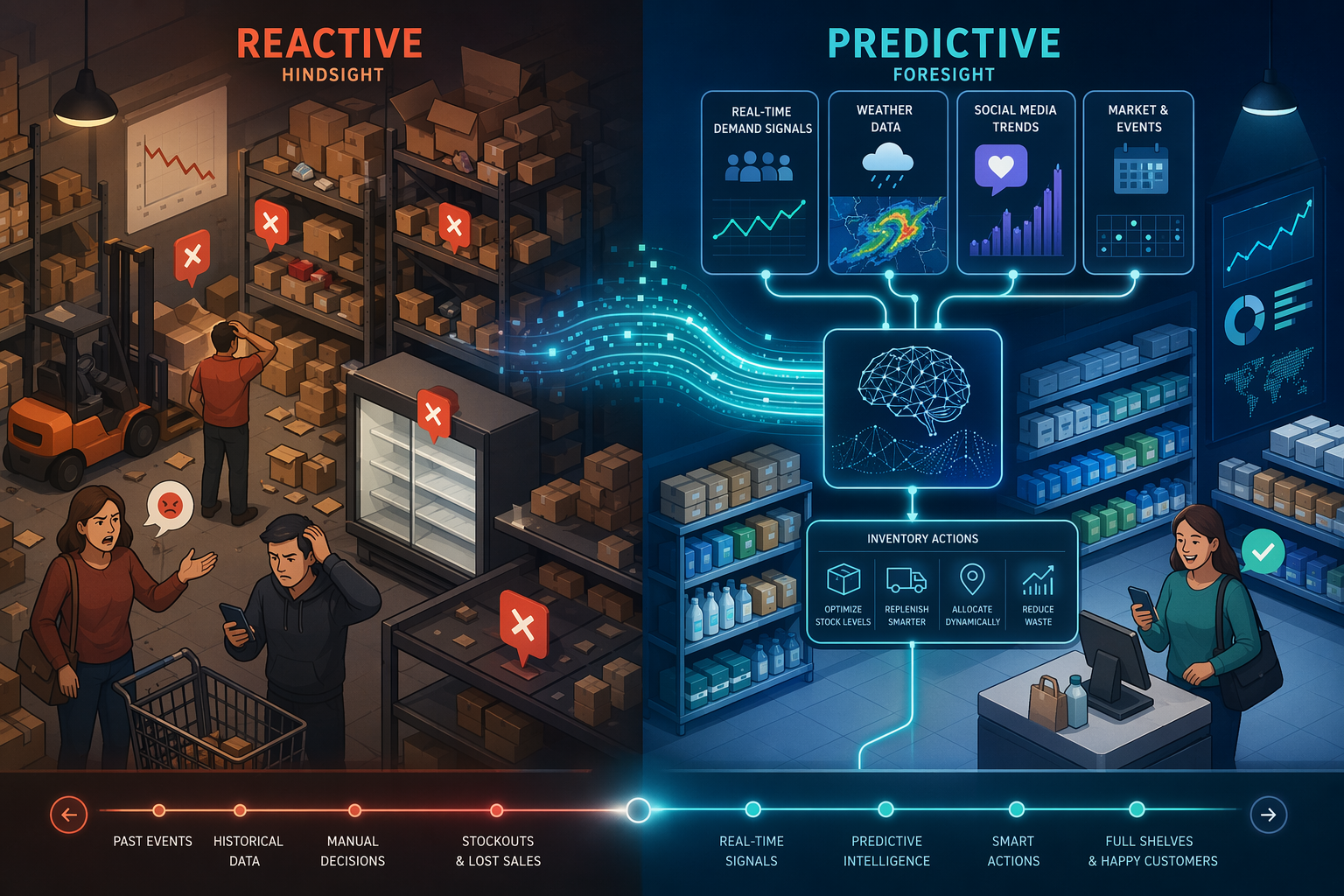
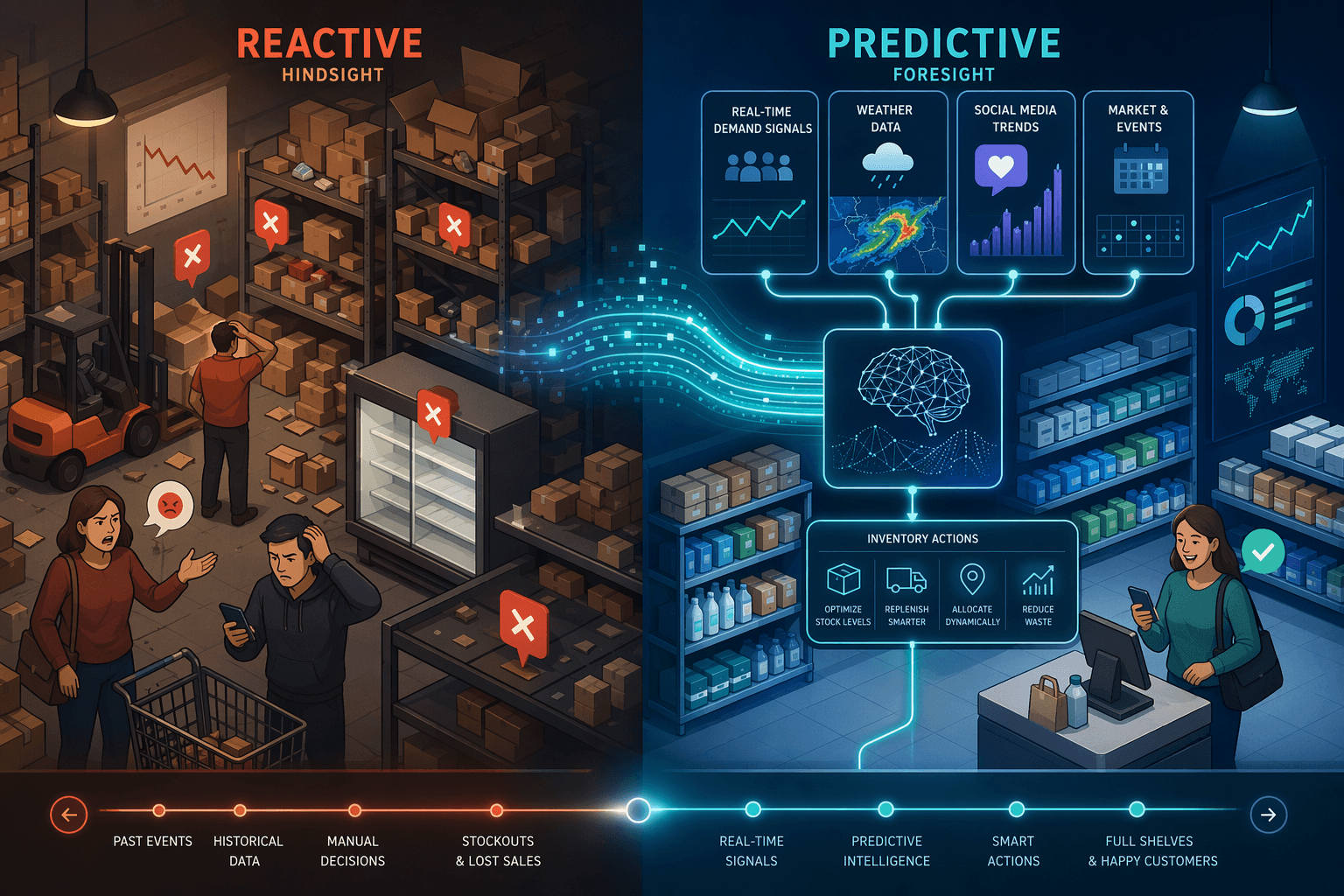
Retail supply chain leaders have heard the pitch: deploy predictive analytics, improve forecast accuracy by 20–50% (industry-reported ranges per McKinsey), and watch stockouts and overstocks vanish. The pitch is not wrong about the forecast piece. It is wrong about the outcome piece.
Research from r4.ai documents a pattern that should worry any VP of supply chain signing a six-figure software contract: implementations routinely improve forecast accuracy without improving operational outcomes. The model gets better at predicting demand, but the stockout rate does not budge. The overstock ratio stays flat. The reason is not model quality — it is decision velocity.
Decision velocity is the time elapsed between a predictive signal being generated and a coordinated operational response being executed across inventory management, merchandising, and logistics. When that loop takes days or weeks — as it does in most retailers — the improved forecast arrives after the replenishment cycle has already closed. The organization has already committed to purchase orders, allocated warehouse space, and set store-level inventory targets based on the old, less accurate forecast. The new, better forecast is informative but operationally inert.
The implication is uncomfortable for organizations that treat predictive analytics as a technology procurement decision. The model is rarely the bottleneck. The bottleneck is the operational architecture that surrounds it — the data pipelines, the system integrations, the decision workflows, and the organizational handoffs that determine whether a signal becomes an action or an artifact.
Data Readiness: The Foundational Gap Few Retailers Have Closed
Before any discussion of algorithms, platforms, or ROI timelines, there is a more basic question: does the organization have the data that predictive models actually require? For a majority of retailers, the answer is no.
A 2024 survey by Ecommerce News UK found that only 40% of retailers have historical records of stock quantities at each location during order placement. Just 36% monitor stock allocations across sales channels. These are not edge cases or small operators — the survey covers a cross-section of retail organizations, and the figures point to a structural data deficit that no machine learning model can work around.
| Data Readiness Metric | Retailers Meeting Threshold | Source |
|---|---|---|
| Historical per-location stock records | 40% | Ecommerce News UK (March 2024) |
| Multi-channel stock allocation monitoring | 36% | Ecommerce News UK (March 2024) |
| In-house AI/ML expertise available | 59% (41% lack it) | Ecommerce News UK (March 2024) |
| Executive backing for analytics initiatives | 65% (35% lack it) | Ecommerce News UK (March 2024) |
Comments
Join the discussion with an anonymous comment.