
For a supply chain CIO in Q3 2026, the hard AI question is no longer whether the technology matters. It is where the durable operating value will sit after the model demos, infrastructure spending, and vendor roadmaps settle into actual planning, production, and logistics work. That is what makes Thiel-linked AI investment patterns useful for supply chain leaders: not as celebrity-investor watching, but as a way to read capital allocation across the AI stack.
The most practical version of the framework comes through Joe Lonsdale’s six-layer AI stack, discussed with Thiel: energy, chips, data centers, frontier models, platforms, and applications. Lonsdale framed the key debate as whether “level 3 is going to eat level 4,” meaning whether frontier models absorb the value that might otherwise accrue to platforms above them.[1] For supply chain leaders, that is not an abstract venture-capital argument. It is the difference between funding model access and funding the operating layer that knows which plant is constrained, which supplier is late, which order is profitable, and which exception someone is actually allowed to override.
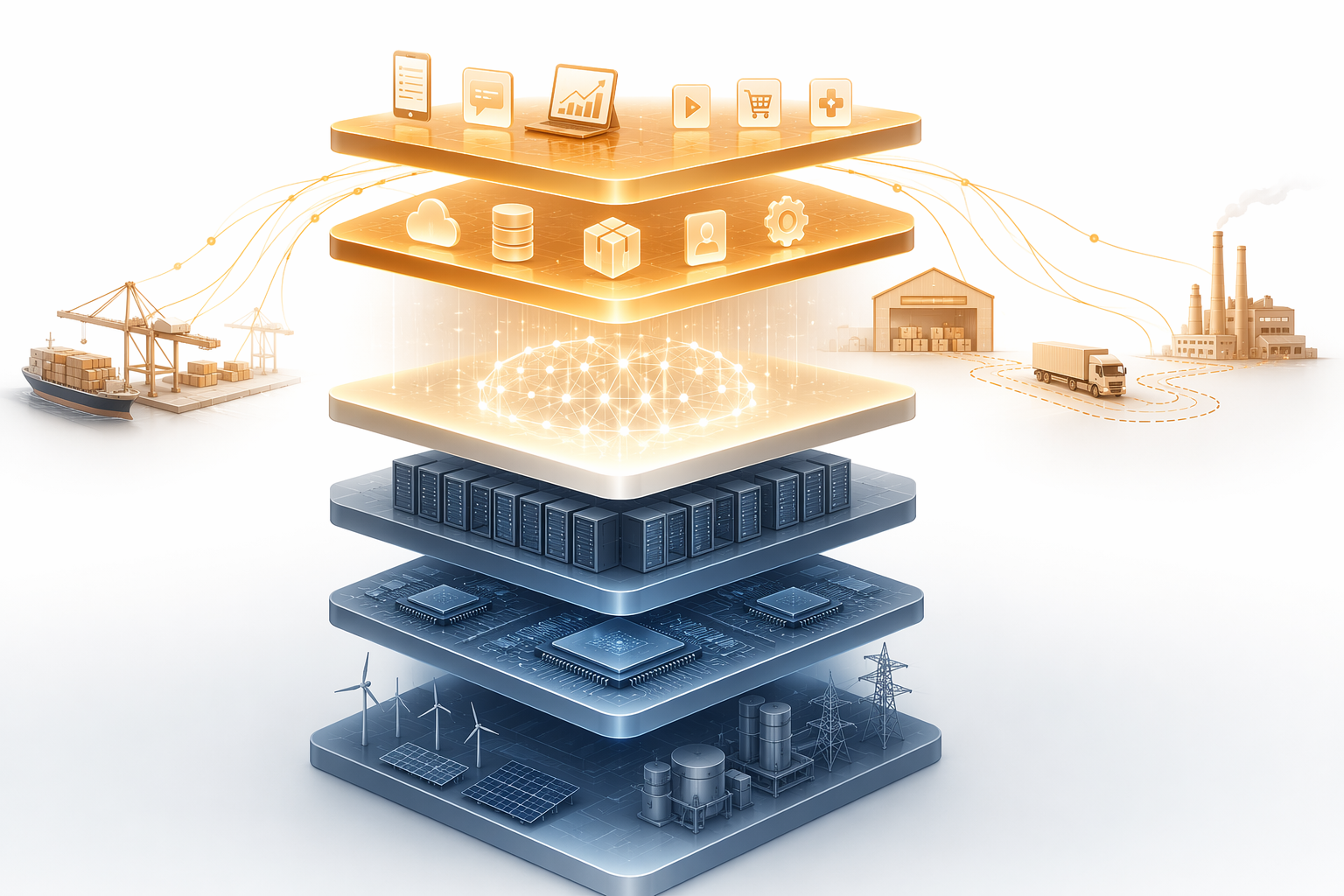
The lower layers matter, but they are rarely the operator’s edge
Energy, chips, and data centers explain why AI has become a capital-intensive industrial buildout. They also explain why many executives feel surrounded by infrastructure narratives that are only partly relevant to their own budget decisions. A manufacturer or retailer may benefit from cheaper inference, better GPU availability, or more resilient cloud capacity. But those layers usually do not become a supply chain capability unless the company is itself operating at hyperscale or building AI infrastructure as a business.
The same caution applies, with more nuance, to frontier models. Models are increasingly powerful inputs. They can summarize, classify, reason over text, generate plans, and support agents. But a model does not, by itself, know the difference between a forecast exception that procurement can absorb and one that will shut down a line. It does not automatically carry the permissions, master data, process constraints, cost-to-serve logic, or audit trail that supply chain decisions require.
That is why the framework becomes useful at the boundary between frontier models and platforms. If level 3 eats level 4, then buying the best model access becomes the strategic move. If level 4 remains durable, then value accrues to the systems that organize enterprise context and convert model capability into governed action. In supply chain, the second outcome looks more plausible because the difficult work is not only prediction or language generation. It is integration, constraint handling, exception routing, and operational accountability.
Palantir is the clearest layer-4 signal
Palantir is the strongest public-equity signal in this pattern because it sits exactly where supply chain AI becomes operational: above raw models, below the visible business application, and close to enterprise data. In a Foundry supply chain case study, Palantir describes a Fortune 100 consumer packaged goods company integrating more than seven ERP systems in five days, then using that integrated operating picture to drive a 1% to 2% production improvement with estimated annual savings of $100 million.[2]
Those numbers should not be generalized casually. The savings figure is estimated, the case is one company, and Palantir is the source describing the result. Still, the architecture matters. The case is not impressive because an LLM answered a question about inventory. It is impressive because the platform created a usable layer across fragmented ERP data, then connected that layer to production decisions. That is a different proposition from attaching a chatbot to a planning dashboard.
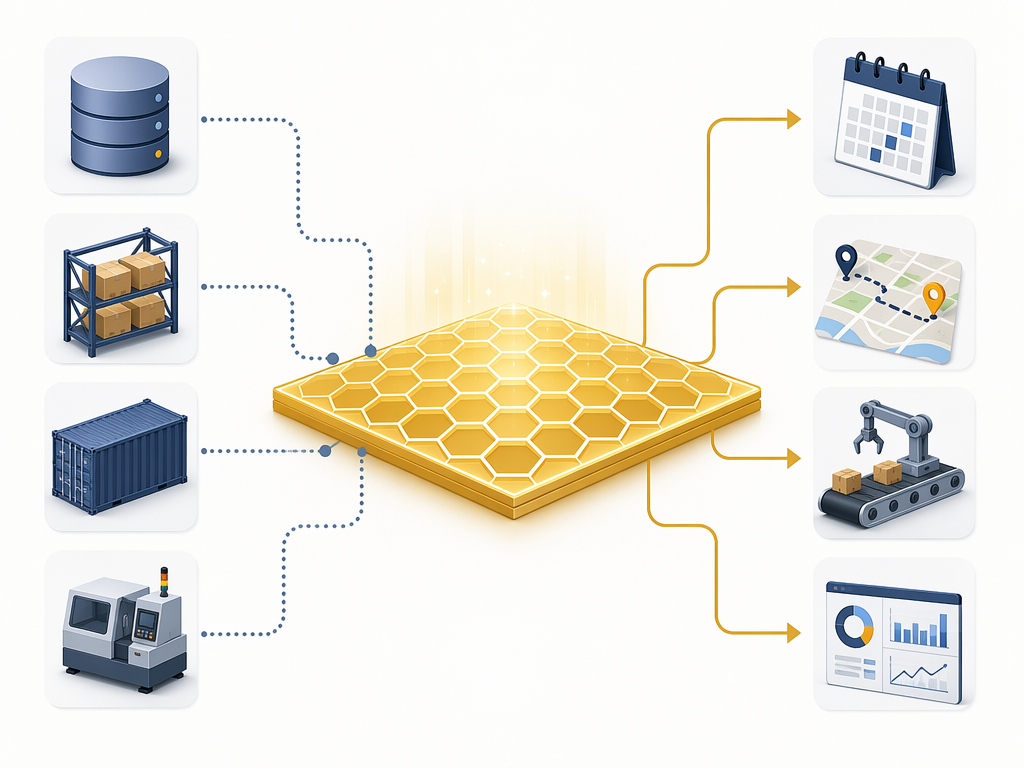
The word Palantir uses for this layer is ontology. In supply chain terms, that means the system is not merely collecting data fields. It is representing factories, orders, suppliers, inventory positions, assets, constraints, and relationships in a form that software can act on. Palantir’s supply chain materials describe this as a way to build a connected operating picture across planning, procurement, production, and logistics workflows.[3] Readers who have worked through supply chain visibility knowledge graph projects will recognize the underlying challenge: the graph or ontology is valuable only if it changes how decisions move through the organization.
This is where many AI pilots fail quietly. A model can produce a plausible recommendation, but the planner still has to reconcile it with an ERP record, a supplier commitment, a transportation constraint, and a finance rule. If the AI layer cannot see and update the operating context, the work returns to spreadsheets, meetings, and manual exception handling. Platform infrastructure earns its keep when it reduces those handoffs rather than adding another analytical surface.
That also explains why Palantir carries more weight than a generic “enterprise AI” example. Foundry is not just a model wrapper; it is an integration and decision-context layer. It can use models, but its strategic position does not depend on owning the frontier model. For supply chain technology leaders, that distinction is the center of the investment argument.
Domain applications become valuable when they own the bottleneck
The layer above platforms is where AI becomes more visibly tied to a workflow: quoting, dispatching, scheduling, yard moves, procurement follow-up, maintenance triage, or production control. These applications can look small compared with foundation-model companies, but they often sit closer to the operational bottleneck that determines whether AI changes cost, service, throughput, or revenue.
Emanate is an instructive but early example. The company, backed by Founders Fund and Andreessen Horowitz, is targeting the industrial materials distribution market with autonomous revenue agents. Fortune reported that Emanate described the market as $5 trillion and projected a 60% to 80% customer revenue lift, while also noting that the company had fewer than 10 employees and was not yet generating revenue at scale.[4]
The caveat is not a footnote; it is the point. A revenue-agent application for industrial distribution may become meaningful if it captures the messy commercial context of that market: product substitutes, fragmented catalogs, local relationships, margin rules, availability, customer timing, and quote follow-up. The projected lift is a startup claim, not an independently proven operating benchmark. But the bet itself is revealing because it is not on generic intelligence in isolation. It is on an application that tries to own a narrow, valuable workflow.
That is the difference between a thin LLM wrapper and a serious domain application. The thin version drafts emails or summarizes order history. The serious version understands which revenue action is allowed, profitable, timely, and connected to inventory reality. One may save keystrokes. The other can change the economics of a process if it is embedded deeply enough.
Hadrian shows the platform-application boundary in manufacturing
Hadrian sits near the boundary between layer 4 and layer 5 because it is not simply selling factory software and not simply running a traditional manufacturing service. CNBC reported that Founders Fund led Hadrian’s $260 million Series C for an AI-powered factory operating system in precision manufacturing, with the company planning a 270,000-square-foot Arizona facility and 350 jobs.[5]
The more interesting claim is operational rather than financial. Hadrian says it can train workers in 30 days to achieve 10 times productivity, and CEO Chris Power framed the approach as “supercharging the worker versus replacing them.”[5] Whether every facility reaches that productivity claim is a separate question. The strategic signal is that AI is being attached to work design, factory systems, and human capability, not presented as a model that magically replaces manufacturing expertise.
For supply chain leaders, this matters because manufacturing AI often fails when it is treated as an analytics overlay. A factory is a constrained system of people, machines, materials, quality rules, engineering changes, and customer due dates. If AI improves that system, it usually does so by changing how work is sequenced, how operators are guided, how exceptions are escalated, and how learning moves from one job to the next. That is platform logic expressed inside a domain workflow.
The same lens applies to advanced manufacturing and procurement programs beyond Hadrian. In production environments, AI earns budget when it compresses the distance between data, decision, and execution. ChainSignal’s earlier editorial on AI across manufacturing and procurement is useful here because the durable question is not whether AI appears in the workflow. It is whether the workflow itself becomes more responsive and governable.
ISEE is a narrower bet, and that is its strength
ISEE is smaller in strategic surface area than Palantir, but it is a clean example of layer-5 value. Business Insider reported that Founders Fund led a $40 million Series B for the autonomous yard-truck startup, which retrofits existing trucks in four weeks and had deployments at BMW and Maersk logistics yards.[6]
The retrofit detail matters. Yard automation is not valuable because autonomy is fashionable. It is valuable if it works inside an existing logistics environment without forcing the operator to rebuild the entire physical system first. Yard moves are repetitive, asset-intensive, labor-constrained, and tightly connected to warehouse and transportation execution. A domain AI system that can perform that work safely and integrate into yard operations has a clearer path to value than a broad agent that promises to “optimize logistics” from the outside.
This is also where the distinction between agentic AI and model-level AI becomes practical. A yard truck does not create value by producing text. It creates value by perceiving, deciding, moving, and coordinating in a constrained operating environment. That is closer to the kind of agentic deployment discussed in AI network outage supply chain planning, where the issue is not intelligence in the abstract but whether the system can act within a bounded operational problem.
The Nvidia signal is useful, but only if it is kept in proportion
Thiel’s public-equity moves add a counter-signal to the platform and application pattern, but they should not be overread. Yahoo Finance reported that Thiel Macro LLC sold 100% of its Nvidia position in Q3 2025 and reduced its Tesla position by 76%, while its portfolio remained concentrated in Palantir, Apple, and Microsoft.[7] Separately, Thiel called it “very strange” that 80% to 85% of AI money was concentrated in Nvidia.[8]
That does not prove a declared supply chain thesis. A 13F filing covers a hedge fund’s public equity positions, not Thiel’s full economic exposure, private investments, or Founders Fund commitments. It also does not say why a position was sold. The useful interpretation is narrower: the public signal is consistent with skepticism toward treating chip exposure as the only or best way to own AI value.
For operators, that distinction is important. Supply chain leaders do not need to make a call on Nvidia’s valuation to make a better AI investment decision. They need to avoid confusing macro AI infrastructure winners with the systems that will change their own forecast accuracy, plant throughput, working capital, logistics reliability, or commercial execution.
What the stack changes in an AI budget review
A useful investment review does not start with “Which model are we using?” It starts with where the organization is trying to accumulate advantage. The model may be important, but it is one component inside an architecture that must carry data, permissions, workflows, and accountability.
| AI stack layer | Supply chain investment reading |
|---|---|
| Energy, chips, data centers | Strategically important to the AI economy, but usually indirect for supply chain operators unless they are building or procuring infrastructure at unusual scale. |
| Frontier models | Powerful inputs for reasoning, language, classification, and agents, but not a sufficient operating layer for planning, production, or logistics. |
| Platform infrastructure | High-value zone when it integrates ERP, operational, and decision data into a governed context that applications can use. |
| Domain applications | High-value zone when the product owns a real bottleneck such as yard moves, quoting, scheduling, procurement follow-up, or production control. |
This reading does not mean every company should buy a large platform before it funds any application. Some organizations need a control tower, some need a planning agent, some need warehouse automation, and some need a data foundation before any AI business case is credible. The point is to test whether the proposed investment owns enough workflow context to compound.
A platform-led approach should be judged by whether it shortens integration time, reconciles conflicting sources of truth, represents the business in a usable ontology or graph, and gives operators a governed way to act. That is why Palantir’s ERP integration case is relevant even with the caveats around vendor-supplied savings. The operating claim is about context, not chat.
An application-led approach should be judged differently. It does not need to become the enterprise operating layer, but it does need a defensible grip on a specific workflow. Yard automation, quote follow-up, factory work guidance, exception management, or transportation execution can each justify a domain application if the product can integrate with the systems of record and change the daily work. ChainSignal’s piece on three control tower models and ROI is a useful companion because it separates broad visibility claims from operating models that actually change execution.
The practical test: context, integration, bottleneck
The framework leaves supply chain leaders with a disciplined test for AI spending. First, does the system own workflow context, or does it merely call a model? Second, can it integrate operational data without creating another reconciliation burden? Third, does it solve a bottleneck that finance and operations can both recognize?
Those questions are less glamorous than debating the next foundation model release, but they are closer to where payback lives. A model-dependent feature can be copied quickly if it has no data advantage, process integration, or domain control. A platform or application that becomes part of how decisions are made is harder to displace, even if the underlying model changes.
This does not make the six-layer stack a procurement rulebook, and it should not be treated as a direct instruction from Thiel to supply chain executives. It is a lens, sharpened by capital allocation patterns around Palantir, Hadrian, Emanate, and ISEE. Used carefully, it points away from foundation-model dependency as the strategic differentiator and toward AI systems that integrate operational data, preserve decision context, and own a domain-specific constraint.
References
- Peter Thiel Debates 6-Layer AI Future With Palantir Cofounder, Benzinga
- Optimizing Production With ERP Data Across the Supply Chain, Palantir
- Supply Chain, Palantir
- Exclusive: Peter Thiel and Alexis Ohanian back new AI industrial startup Emanate, Fortune, February 9, 2026
- Hadrian funding round Thiel Founders Fund, CNBC, July 17, 2025
- Peter Thiel's Founders Fund leads investment in self-driving startup ISEE, Business Insider, November 2022
- Palantir Billionaire Peter Thiel Sells, Yahoo Finance
- Palantir's Peter Thiel Says Very Strange, Yahoo Finance
Comments
Join the discussion with an anonymous comment.