
At 9:00 AM, the alert looks useful. Copper moves outside the band. A public supplier’s share price drops hard enough to trigger a financial-risk flag. The dashboard is right to raise its hand. Then the real work starts: someone checks which suppliers are exposed, pulls open contracts, looks for open purchase requisitions, asks whether the buyer can accelerate or delay a PO, sends a screenshot to sourcing, and eventually retypes the outcome into SAP.
That is where AI stock price alerts for supply chain companies usually lose their value. The signal is early; the action is late. Predflow describes a common gap of more than five hours between a 9 AM commodity-price alert and a buyer acting on it in SAP, by which time the price window may already have closed.[1] The irritating part is not that the alert was wrong. It is that the workflow asked the people closest to execution to become middleware.

For procurement finance, stock and commodity alerts matter only when they change a controlled business object: a purchase requisition, supplier review status, sourcing event, hedge recommendation, approval queue, payment hold, or forecast assumption. If the alert ends as an email, it may improve awareness, but it has not yet changed procurement behavior.
The alert is not the workflow
Most stock analysis tools are built to surface market movement. That is a valid job. Bloomberg, Kensho, AlphaSense, and similar signal-oriented platforms can help teams see price action, company news, filings, and sentiment sooner. The problem is that supply chain finance does not get paid for seeing a chart sooner. It gets paid when procurement, FP&A, and operations can defend a decision later.
A stock-price alert on a logistics provider, semiconductor supplier, packaging company, or chemical producer can support supplier financial-risk monitoring. A commodity alert can support timing decisions for buying, contracting, or escalation. But the procurement question is always narrower than the market question: which supplier, which category, which contract, which PO, which approval path, and which financial exposure?
That narrowing step is where dashboards tend to leak work. A category manager sees the alert in one system. The commodity analyst keeps the model in another. The buyer works in SAP. FP&A wants to know whether the decision changed the cash forecast. Internal audit later asks why a PO was accelerated, delayed, split, or escalated. If the only durable record is a screenshot in a chat thread, the company has created a reconciliation problem and called it intelligence.
What has to happen between signal and SAP
An execution-connected workflow does not begin with a smarter alert. It begins with the assumption that the alert is useless until it is mapped to procurement context. The architecture usually needs seven jobs to happen in sequence, and the weak links are the handoffs between them.
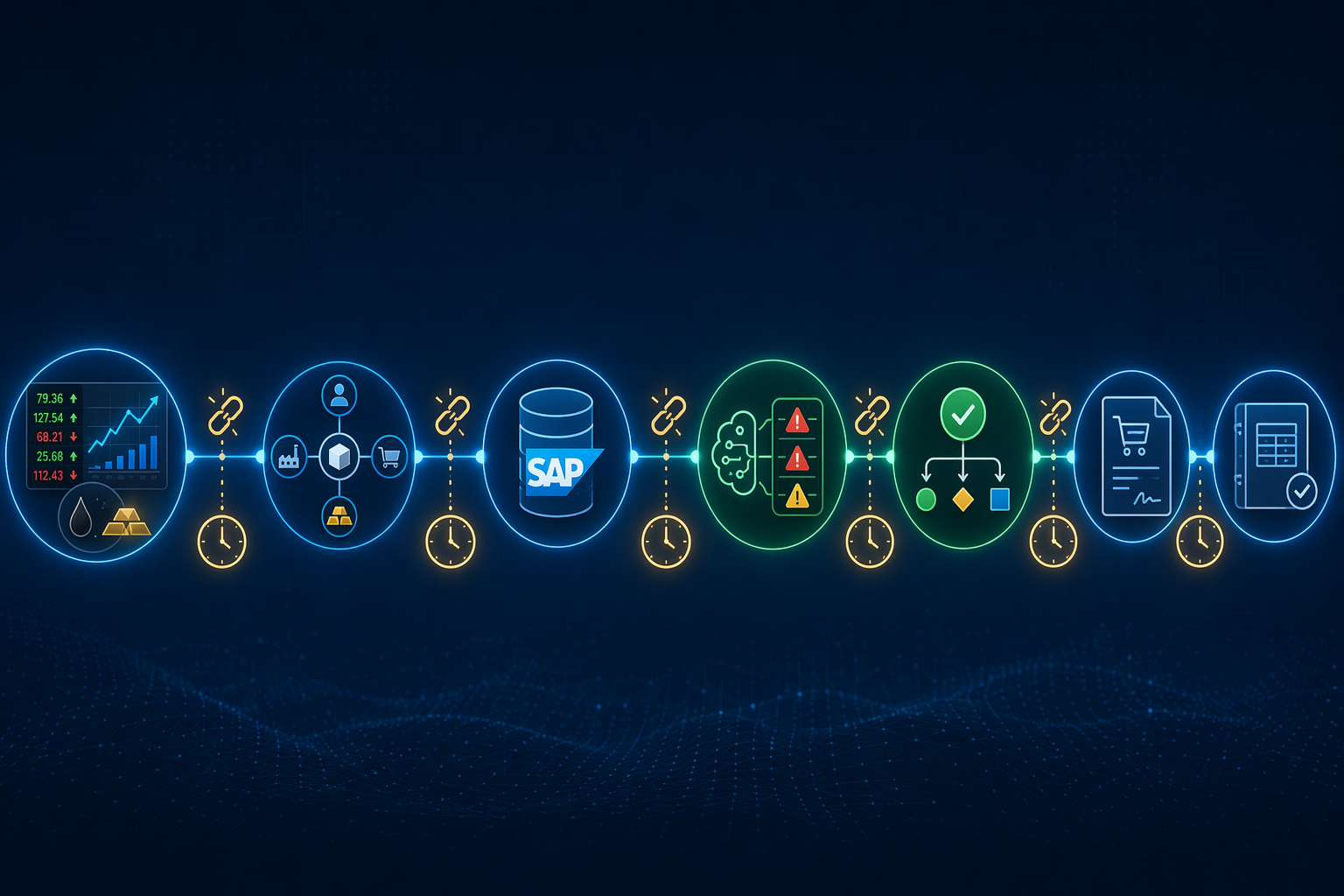
| Workflow layer | What it must resolve | What goes wrong when it is manual |
|---|---|---|
| Market signal ingestion | Stock-price movement, commodity movement, supplier news, credit or insurance signal | The alert lands in a dashboard with no assigned owner |
| Supplier or commodity mapping | Which legal entity, supplier group, category, plant, or contract is exposed | Analysts manually match names across market data, vendor masters, and spreadsheets |
| ERP context | Open POs, requisitions, contract terms, inventory, lead times, budget owners | The decision is made without the current SAP picture |
| Recommendation or exception | Whether to accelerate, delay, reroute, review, or simply watch | Every alert looks urgent because no operational threshold is attached |
| Approval logic | Who can act, who must approve, and what policy applies | The buyer waits while finance and sourcing clarify authority |
| SAP execution | The actual change to a PO, requisition, sourcing event, supplier status, or forecast input | Someone retypes the decision and risks losing context |
| Audit and reconciliation | Why the decision happened and which signal supported it | Month-end review reconstructs the story from messages and files |
The supplier-mapping layer is less glamorous than the model, but it is often where the workflow starts to fail. Public-market data tracks listed entities. SAP vendor masters track operating entities, pay sites, parent-child relationships, and sometimes outdated naming conventions. A share-price move at the parent company is not automatically a procurement risk for every subsidiary, and a commodity move is not automatically material for every open PO. The system has to know where the exposure actually sits.
ERP context is the next filter. A resin-price move means something different if the buyer has an expiring contract, no inventory buffer, and large open demand than it does if the category is already locked for the quarter. A supplier-price shock means something different if the supplier has a critical open order than if it is an approved alternate with no current volume. Without that context, finance receives a market story instead of an operational exception.
Approval logic is where many AI pilots become manual workflows with better vocabulary. If the buyer is not authorized to change the PO, the alert needs to route to the approver. If policy requires finance review above a threshold, the agent should attach the relevant exposure and proposed action. If the answer is “watch only,” that should be recorded too. Silence is not an audit trail.
Signal-only platforms and action-oriented agents are not the same purchase
It is tempting to compare tools by asking which one has the better signal. That is not enough for this use case. Signal platforms are useful when the team needs coverage, discovery, and earlier awareness. Action-oriented AI agents are useful when the team needs the signal to become a governed procurement action. Those are different jobs, and buying one while expecting the other is how companies end up with a polished dashboard and a larger manual queue.
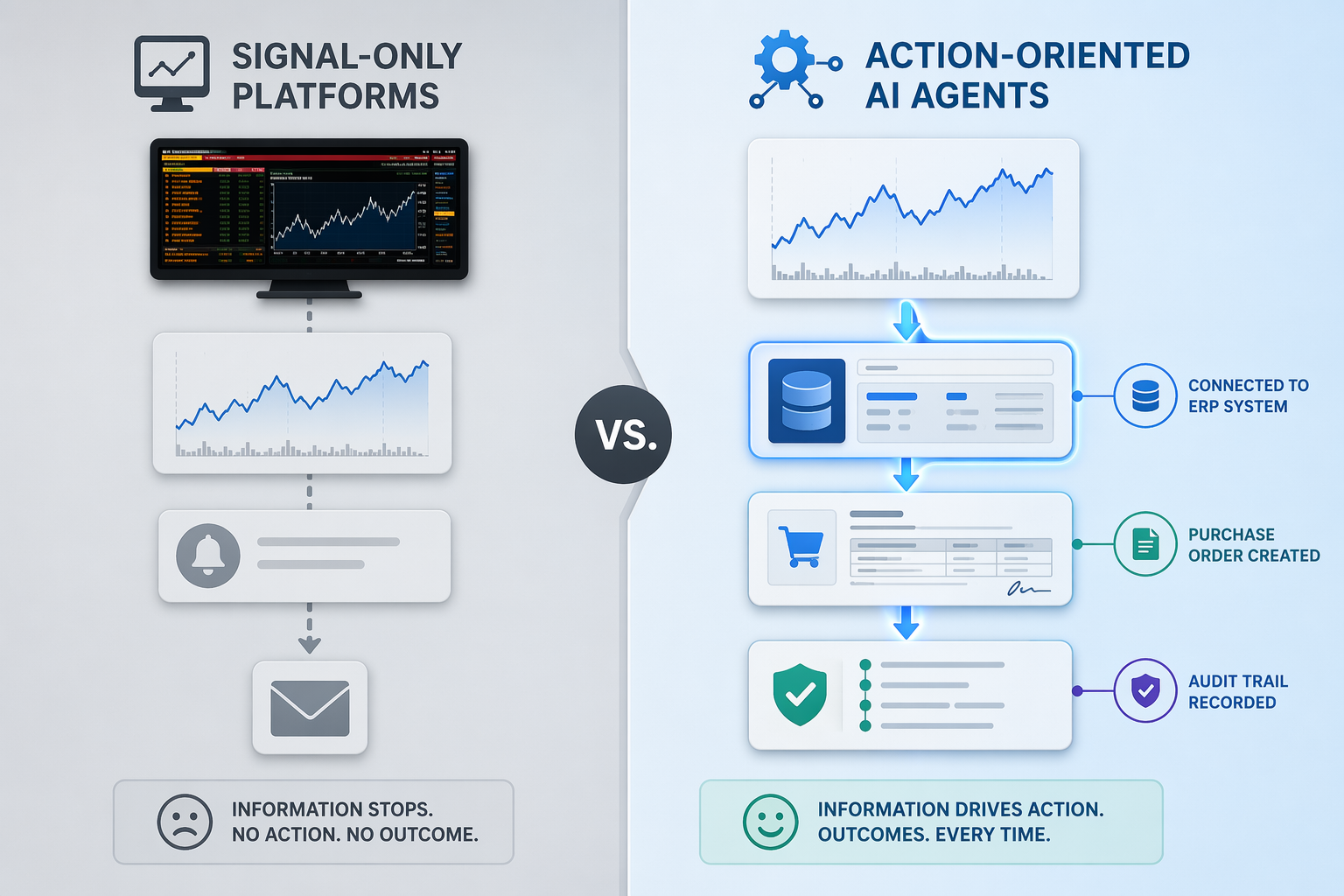
Predflow is useful as an example because it frames the market around this signal-to-SAP gap rather than around retail-style stock picking. It describes AI-assisted workflows that connect stock analysis outputs directly to SAP procurement data and reports reconciliation-time reductions of 40–70%.[1] That figure should be treated as a vendor-reported claim, not an independent benchmark. Still, it points to the right measurement area: not how impressive the alert looked, but how much month-end cleanup disappeared.
The same caution applies to reported procurement cost and forecast impacts. Predflow says finance teams connecting SAP sourcing workflows to real-time commodity monitoring report procurement cost variance improvements of 3–8% and cash-flow forecast accuracy improvements of 10–25%.[1] Those are commercial claims from a vendor article. They are not proof that every connected workflow will deliver those ranges. They are, however, more procurement-relevant than generic claims about AI accuracy because they tie the signal to variance, cash timing, and reconciliation.
For teams evaluating this category, the buying question should sound operational: can the tool write back to the workflow, or does it only notify someone who then does the work elsewhere? A good evaluation of agentic AI in procurement should inspect the boring parts early: SAP S/4HANA compatibility, SAP BTP connectivity, ETL latency, permission models, exception handling, and audit logging. The demo can wait until the integration path is credible.
Supplier stock prices are only one risk signal
Stock-price monitoring is cleanest when the supplier is public and the procurement exposure maps clearly to that listed entity. Many important suppliers are private, privately held subsidiaries, or regional operating entities with no useful public share price. In those cases, the monitoring stack has to shift toward credit reports, payment behavior, trade credit insurance status, bank and liquidity signals, delivery behavior, and internal purchasing patterns.
JAGGAER’s supplier financial-risk framework is helpful here because it does not pretend that supplier distress has one indicator. It identifies 25 financial risk signals across balance sheet and liquidity, profitability and margin, credit and payment behavior, operational and behavioral indicators, and market or external signals.[2] That is a broader lens than stock price, and it fits procurement better because the practical question is not “did the market react?” but “is this supplier still able to perform?”
Some signals deserve more weight because they already contain another party’s risk decision. Trade credit insurance withdrawal is one of them. JAGGAER cites AU Group’s 2025 view that withdrawal by Allianz Trade, Atradius, or Coface — carriers representing more than 65% of global capacity — is among the most precise external distress signals procurement systems can receive.[2] That does not mean a supplier will fail. It does mean another institution has decided not to keep insuring exposure on the same terms, which is operationally relevant if the supplier is critical.
The same framework points to conventional financial thresholds that procurement teams can use as exception triggers, including current ratio below 1.0, Altman Z-score below 1.81, and interest coverage below 2.0x.[2] These are not AI discoveries. They are standard financial warning signs. The AI value is in connecting them to supplier criticality, open obligations, lead-time exposure, and the workflow owner who can do something about them.
Latency is a control issue, not an IT footnote
A five-hour lag after a market alert is not just an inconvenience. It changes the decision set. The buyer may lose the opportunity to accelerate a purchase before a price move flows through. Finance may update the forecast after procurement has already acted. Sourcing may begin a supplier review without knowing that open POs were already adjusted. The organization still responds, but in pieces.
ETL latency matters because procurement context ages quickly. Open PO quantities, release status, inventory coverage, budget availability, and approval limits can shift during the day. If a market signal is real time but ERP context is refreshed overnight, the recommendation can be precise and stale at the same time. That is a dangerous combination because it looks more authoritative than a spreadsheet while carrying a similar timing flaw.
This is also why audit logging belongs in the first design conversation. If an AI agent recommends accelerating a PO because a commodity price crosses a threshold, the record should show the signal, timestamp, SAP objects considered, approval path, user decision, and final action. If the user overrides the recommendation, the override should be captured. Later reconciliation depends on knowing not only what changed, but why the change was reasonable at the time.
Teams building from a broader AI procurement software buyer’s guide should treat these requirements as gating items, not implementation details. If the tool cannot preserve the link between the external signal and the ERP action, finance will eventually rebuild that link manually during variance analysis.
Where the use case works best
AI stock price alerts are most useful in procurement when three conditions line up. First, the company has meaningful exposure to public suppliers or public parent companies. Second, the supplier or commodity movement can be mapped to active procurement objects in SAP. Third, the organization has already defined what action is allowed when a threshold is crossed.
A public supplier’s share-price decline may justify a supplier-risk review, a credit-limit check, or a closer look at open commitments. A commodity-price movement may justify accelerating a requisition, delaying a spot buy, or revisiting a forecast assumption. A credit-insurance withdrawal may justify escalating the supplier for continuity review. None of these actions should be automatic in the simplistic sense. They should be routed, permissioned, and recorded.
The use case is weaker when the alert cannot be tied to a controllable procurement decision. A stock alert on a broad market index may be interesting for strategy, but it rarely belongs in a buyer’s SAP queue. A public-company move may be too far removed from the operating subsidiary that supplies the plant. A private supplier may show stress first through late shipments, stretched payment terms, credit downgrades, or insurance changes rather than anything visible in equity markets.
This boundary matters because many teams already have access to market intelligence. The missing capability is not another place to watch supply chain companies or another list of AI stock signals. It is the ability to convert a relevant signal into a governed procurement workflow without asking an analyst to bridge the gap by hand. Teams comparing broader supply chain AI stock ideas should keep that distinction clear: an investable signal and an executable procurement signal are not the same artifact.
A practical standard for 2026 procurement teams
The cleanest test is to follow one alert from arrival to reconciliation. Who receives it? Which supplier or commodity does it map to? Which SAP objects does the system inspect? What recommendation is generated? Who can approve it? What changes in SAP? What does finance see at month-end?
If the answer depends on screenshots, chat messages, manual exports, or rekeyed fields, the company has a signal workflow, not an execution workflow. That may still be useful. It may improve awareness and help teams prepare. But it should not be sold internally as procurement automation, and its ROI should not be measured as if the action layer already exists.
AI stock price alerts drive procurement action only when they are embedded into ERP workflows with latency control, approval logic, SAP execution, and auditability. Without that architecture, they remain another market signal that finance notices too late and procurement has to clean up manually.
Comments
Join the discussion with an anonymous comment.