
The expensive mistake in an AMR vs AGV warehouse automation comparison usually happens before anyone talks about navigation software or payload charts. A team compares the robot quote, likes the newer-looking option, and only later asks whether the work is actually variable enough to justify autonomy — or stable enough that a fixed path would have been cheaper, tighter, and easier to defend.
The better starting point is the process map: how often routes change, how predictable the volume is, how much positioning error the task can tolerate, and how long the business case has to hold up. AMRs and AGVs solve different warehouse problems. Treating one as the modern replacement for the other is how automation programs end up overpaying for flexibility in one zone and underestimating precision in another.
The Decision Frame That Should Come Before the Quote
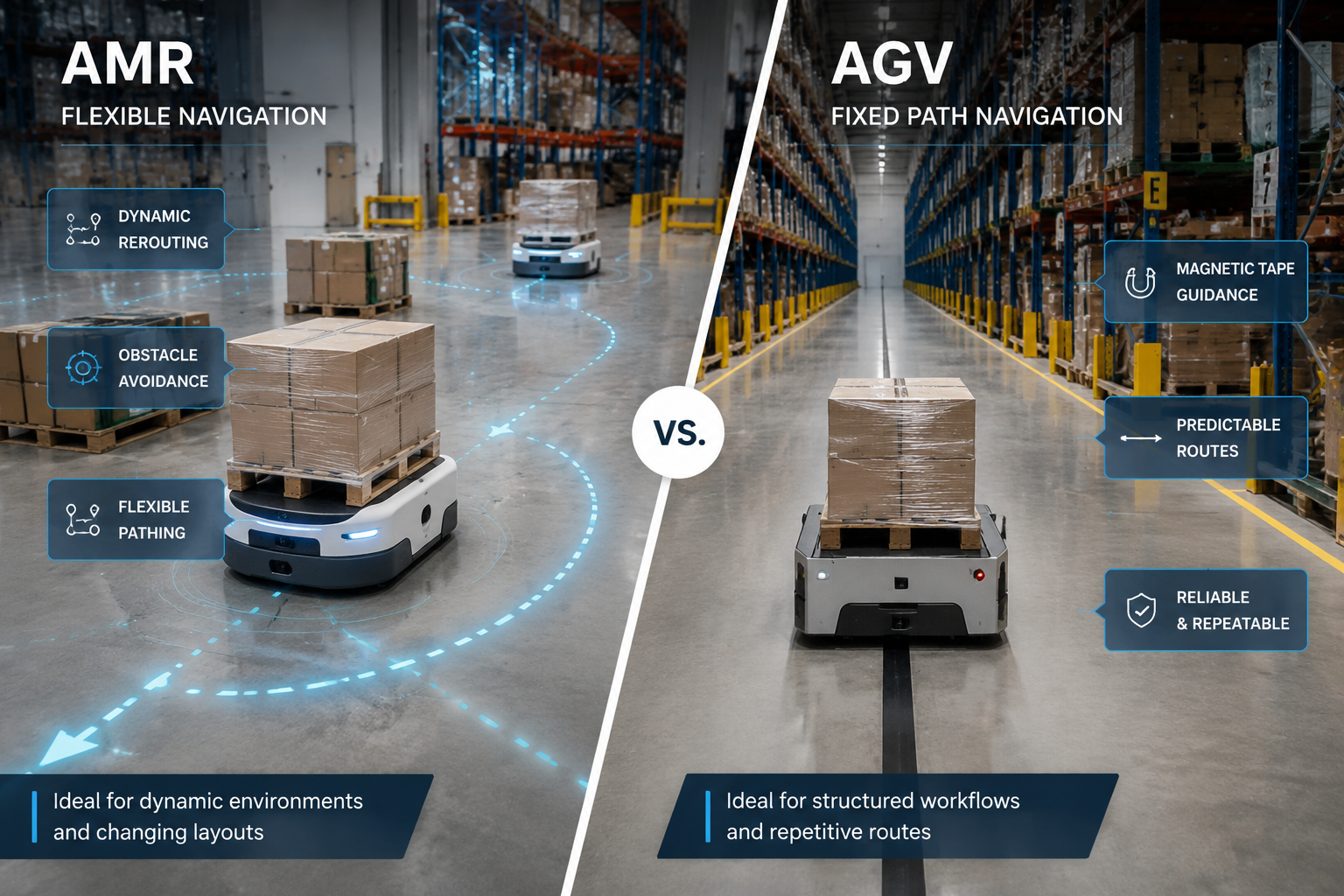
AMRs use natural navigation, commonly SLAM-based systems supported by LiDAR or 3D cameras, to understand their environment and reroute around obstacles. AGVs follow fixed guidance such as magnetic tape, embedded wire, or reflectors, and they generally stop when an obstacle blocks the path until the condition is cleared.[1]
That distinction is not a definition for a brochure. It is the operating trade-off. AMRs buy the warehouse freedom from some facility work and day-to-day route rigidity. AGVs buy repeatability, controlled movement, and, in the right application, better positioning discipline.
| Operating condition | AMR fit | AGV fit | Procurement judgment |
|---|---|---|---|
| Layout changes often, aisles are re-slotted, or temporary congestion is common | Strong | Weak to moderate | AMRs are usually easier to justify when the route map cannot be treated as permanent. |
| Stable high-volume transport between fixed points | Moderate | Strong | AGVs can be the cleaner choice when the work repeats and the route is not expected to move. |
| High-SKU picking, variable replenishment, or changing work queues | Strong | Weak | AMRs fit better when task assignment and travel paths shift throughout the day. |
| Heavy repetitive pallet movement on controlled routes | Moderate | Strong | AGVs deserve serious consideration when throughput and repeatability matter more than rerouting. |
| Precision docking or high-rack pallet placement | Depends on model and added sensing | Strong | Do not buy autonomy if the task really needs the tighter accuracy envelope. |
| Facility has both dynamic picking areas and fixed transport lanes | Strong in variable zones | Strong in fixed lanes | A hybrid design may be more defensible than forcing one platform across unlike work. |
For a broader technology-to-problem mapping exercise, the same discipline applies beyond mobile robots: start with the warehouse constraint, then match the automation class. That is the same logic used in Matching AI Technologies to Warehouse Problems.
Navigation Is Where Deployment Speed Becomes Operational Risk
The headline difference is real: AMRs can often be deployed in hours to days, while AGV installations are more commonly measured in weeks to months because fixed guidance requires facility work and commissioning.[2] That gap matters when the site cannot give up aisles, maintenance windows are tight, or the automation program needs to prove value before the next budget cycle.
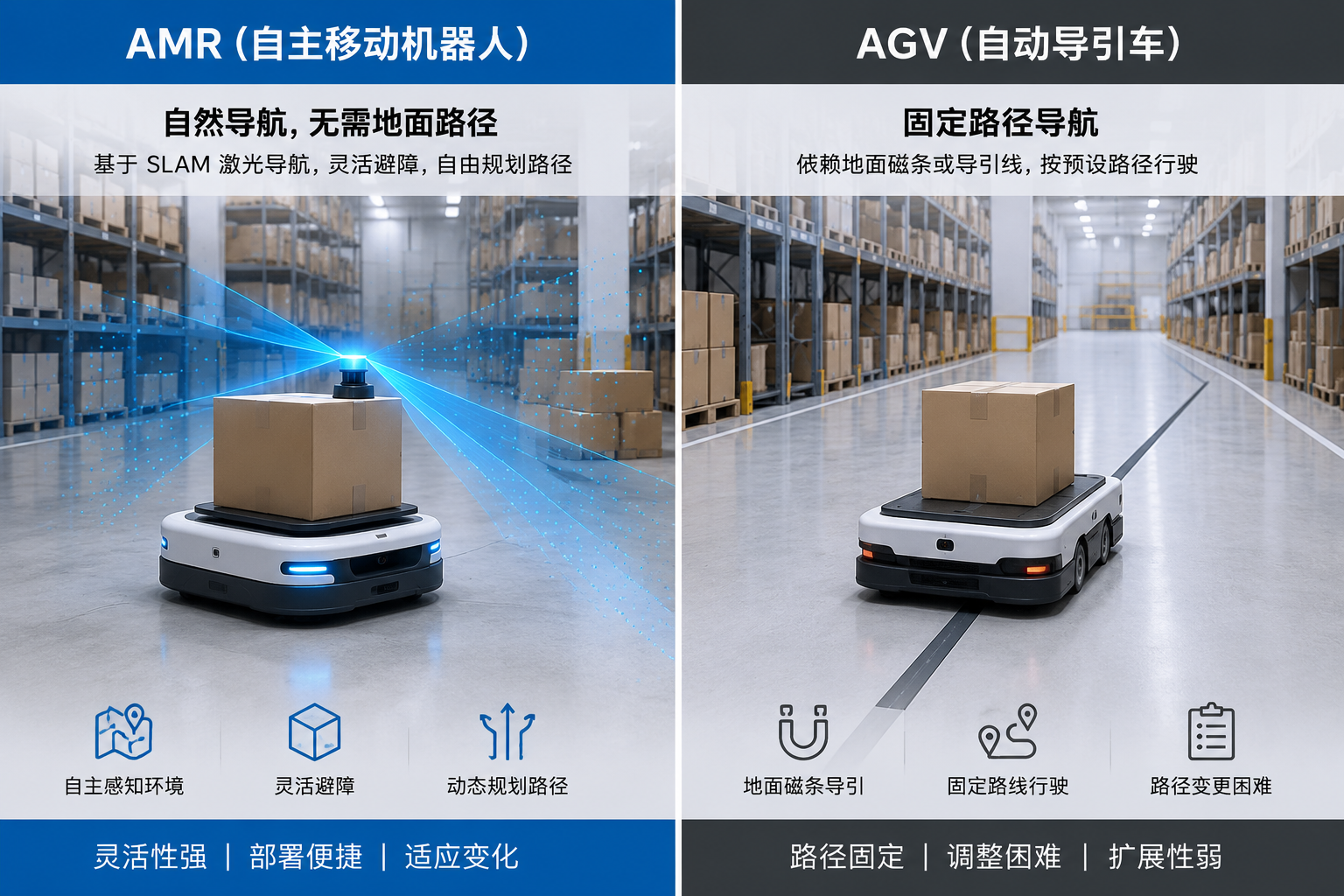
Fast deployment is not the same as effortless deployment. An AMR still has to be mapped, tested against the real traffic pattern, integrated with work release logic, and tuned so supervisors are not constantly resolving exceptions. But the disruption is different. The site is not pulling up tape every time a route changes, cutting floors for wire, or reworking reflector layouts just because a staging area moved.
That is why AMRs are attractive in facilities with seasonal SKU churn, changing pick modules, temporary staging, or frequent aisle blockage. A blocked aisle is not automatically a work stoppage; the robot can evaluate another path, provided that path is allowed, safe, and not already overloaded. In a live DC, that kind of obstacle handling can be worth more than a lower hardware price.
AGVs impose more discipline up front. The route has to be engineered. Intersections, crossings, charging areas, speed zones, and human interaction points need to be settled before go-live. That can feel slow, but in a stable transport loop it is also the point. Once the path is correct, the system behaves predictably, and the operation can train around it.
The painful installations are the ones where the buying team treats a changing workflow as if it were fixed, or treats a fixed workflow as if it needed full autonomy. The first case creates recurring engineering changes. The second pays for flexibility the warehouse rarely uses.
Where AGVs Still Win Without Apologizing
AGVs are easy to underrate when the conversation is dominated by flexible automation. In a controlled, repetitive material flow, fixed-path guidance can be a feature, not a limitation. A receiving-to-storage lane, a production-line replenishment loop, or a finished-goods transfer route may not need a robot to improvise. It needs the vehicle to arrive, align, transfer, and repeat.
Accuracy is the clearest example. Laser-guided AGVs are reported at around ±2 mm positioning accuracy, compared with typical AMR accuracy ranges of roughly ±11–20 mm in available specifications.[3][4] Those figures are not perfectly standardized across manufacturers, and some higher-end AMR forklifts can narrow the gap with QR codes or additional sensing. Still, the practical distinction is hard to ignore when the use case involves precision docking, high-rack pallet placement, conveyor handoff, or automated load transfer.
A few millimeters do not matter when a tote robot is bringing work near a person. They can matter a lot when forks need to enter a pallet cleanly at height, when a conveyor transfer has little tolerance for misalignment, or when a machine interface expects the load in the same place every time. In those applications, the “legacy” technology may be the less risky one.
AGVs also fit environments where the value of stability is already proven. If the same route runs all day, the load is heavy, the endpoints rarely move, and throughput is easier to forecast than labor availability, a fixed-path system can be simpler to operate and easier to explain to finance.
Where AMRs Earn Their Premium
AMRs earn their keep when the warehouse has too much day-to-day variation for fixed guidance to stay cheap. That can mean changing slotting, waves that shift labor demand by zone, replenishment that does not follow the same route twice, or a 3PL operation where the next customer onboarding changes the floor plan again.
The strongest AMR business cases usually contain one of three operating realities: the facility cannot tolerate weeks of infrastructure installation, the route network changes often enough that fixed guidance would become a maintenance burden, or blocked paths would create too many manual resets for an AGV fleet. In those cases, paying more for the vehicle may reduce the hidden cost of keeping the automation relevant.
There is also a labor-management reason AMRs often move faster through pilot approval. A site can start with a constrained workflow, adjust the map, add missions, and expand without making every change feel like a construction project. That does not remove integration work, but it lowers the threshold for learning inside a real operation instead of a demo aisle.
The caveat is localization. AMRs depend on their ability to interpret the environment. Visually uniform corridors and environments with too few distinguishable features can disrupt localization, according to Hy-Tek’s discussion of AMR limitations.[5] That is not a reason to avoid AMRs; it is a reason to test them in the dullest, most repetitive-looking part of the building, not only in the vendor’s cleanest path.
The Cost Comparison Has to Move Past Unit Price
On platform price alone, AGVs can look cheaper. Published ranges put AGV platforms around $15,000–$30,000 per unit, while AMRs are commonly cited around $25,000–$80,000 per unit, depending heavily on payload, configuration, region, and vendor.[6][1] That comparison is useful only as a first screen. It is not a business case.
AGVs carry infrastructure cost. CHG-MERIDIAN reports AGV infrastructure adders at more than 30% of hardware cost, reflecting guidance installation and related facility work.[7] If a route later changes, that infrastructure can also become a change-order problem rather than a sunk one-time cost.
AMRs carry their own lifecycle premium. CHG-MERIDIAN’s 2026 analysis gives an example of a $50,000 AMR reaching about $84,000 in five-year total cost of ownership, a 68% premium over purchase price.[7] That premium can include items such as software, service, support, batteries, maintenance, and lifecycle costs that are easy to underweight when the approval deck focuses on the robot price.
| Cost item | AGV consideration | AMR consideration |
|---|---|---|
| Platform price | $15,000–$30,000 ranges are cited for AGV platforms | $25,000–$80,000 ranges are cited for AMRs |
| Facility work | Infrastructure can add more than 30% of hardware cost | Usually less facility modification, but mapping and integration still matter |
| Five-year ownership | Route changes can create additional engineering or installation cost | A $50,000 AMR example reaches about $84,000 five-year TCO |
| Financing | Forklift AGV leases are cited at $1,200–$3,200 per month on 48–60 month terms | AMR leases are cited at $600–$900 per month |
Lease comparisons need the same caution. CHG-MERIDIAN cites AMR lease payments of $600–$900 per month and forklift AGV lease payments of $1,200–$3,200 per month on 48–60 month terms.[7] Those numbers are financing inputs, not proof that one technology is cheaper in every payload class. A forklift AGV and a smaller AMR may be doing very different work.
The useful procurement model separates cost into four buckets: vehicle, infrastructure, integration, and lifecycle support. Then it tests those costs against the actual rate of change in the building. If a fixed route will stay fixed for years, AGV infrastructure can amortize cleanly. If the route will be revised every quarter, the cheaper platform can become the more expensive system.
For teams building the financial case, it is worth treating robotics ROI as a range of assumptions rather than a single payback slide. The same caution applies across warehouse automation programs, as covered in What Supply Chain AI ROI Actually Looks Like.
ROI Windows Are Useful, But Only With the Assumptions Showing
Published ROI windows favor AGVs in the right repetitive workflows. FlexQube cites AGV ROI in the 6–12 month range for stable, repetitive applications.[6] For AMRs, Armstrong cites 12–18 months in single-shift applications, while Associated Solutions cites a more typical 18–30 month range.[8][9]
Those ranges should not be flattened into a rule that AGVs always pay back faster. They describe conditions. A fixed-path vehicle looks very good when utilization is high, the route is stable, and labor substitution is clear. An AMR may have a longer modeled payback and still be the better investment if it avoids infrastructure rework, absorbs route changes, or expands into multiple workflows over time.
Labor-savings claims need even more discipline. FlexQube reports AMR annual savings of up to $68,000 per replaced forklift.[6] That “up to” matters. A site running multiple shifts with high travel waste and hard-to-fill roles is not the same as a single-shift operation where the robot mostly waits for work. Vendor-adjacent labor and pick-rate claims can be useful for scenario building, but they should not be treated as independent guarantees.
A practical ROI model should show at least three cases: conservative utilization, expected utilization, and constrained utilization after real-world exceptions. The constrained case is often the one that exposes the technology fit. If the AGV is frequently stopped by blocked paths, the payback stretches. If the AMR is spending too much time recovering localization or waiting for human help at edge cases, its flexibility is not turning into throughput.
Safety Depends on Standards and Floor Behavior
Both AMRs and AGVs fall under relevant mobile robot safety standards. ISO 3691-4:2023 applies to driverless industrial trucks and their systems, while U.S. references commonly distinguish B56.5 for AGVs and R15.08 for AMRs.[3] Compliance is the starting point, not the whole safety case.
The worker experience can differ. AGV paths are deterministic: people learn where the vehicle will travel, where it will stop, and which crossings deserve attention. That predictability can feel safer in a facility where pedestrians, lift trucks, and automation share space.
AMRs behave differently around exceptions. A good AMR does not simply stop and wait every time someone parks a pallet in the wrong place; it can reroute. That improves flow, but it also means the site has to train people for a vehicle that may take a different allowed path than yesterday. The safety review has to account for that probabilistic movement, especially near blind corners, dock congestion, and manual picking zones.
This is where implementation detail matters more than category labels. Speed limits, right-of-way rules, audible and visual signals, blocked-zone logic, human crossing points, and exception ownership determine whether the floor trusts the system. A robot that is technically compliant but operationally confusing will create workarounds.
A Procurement-Ready Selection Test
Before shortlisting vendors, put the candidate workflow through a simple operating test. The answers will usually narrow the field faster than another demo.
- Choose AMR first when routes change, obstacles are common, deployment speed matters, and the task can tolerate the platform’s positioning accuracy.
- Choose AGV first when routes are stable, loads are repetitive or heavy, positioning accuracy is decisive, and infrastructure can be amortized over a long operating horizon.
- Model a hybrid when picking areas are dynamic but long-haul pallet movement, conveyor handoff, or production replenishment follows fixed lanes.
- Reject unit-price comparisons that exclude guidance infrastructure, integration, software, maintenance, batteries, support, and change-order exposure.
- Pilot in the ugliest real workflow: blocked aisles, dull corridors, mixed pedestrian traffic, shift change, and the highest-volume handoff point.
The market is still early enough that many sites are making this decision for the first time. A 2025 Modern Materials Handling survey cited by CHG-MERIDIAN reported that only about 10% of warehouse operators were using AGVs or AMRs, while 30% planned to evaluate them within two years.[7] That is not a warning against adoption. It is a reminder that the buying process should be more specific than the category hype.
If the warehouse is evaluating mobile robots as part of a broader automation roadmap, the readiness issues are often bigger than the vehicle choice: work release, exception handling, WMS/WES integration, maintenance ownership, and supervisor trust. Those execution gaps are covered in more detail in Why Warehouse AI Deployments Fail.
The defensible answer is not that AMRs beat AGVs, or that AGVs are the safer old choice. Choose AMR when change, deployment speed, and obstacle handling carry the business case. Choose AGV when stable routes, heavy repetitive throughput, and positioning accuracy dominate. Model hybrids when the same building contains both kinds of work.
References
- AGV vs. AMR, KUKA
- AMR deployment resources, Vecna Robotics
- AGV safety standards analysis, AGV Network
- MiR robot specifications, MiR
- 9 Key Differences Between AGVs and AMRs, Hy-Tek Intralogistics
- AGV and AMR cost and ROI resources, FlexQube
- The Real Cost of AGV and AMR Adoption, CHG-MERIDIAN, 2026
- AMR ROI analysis, Armstrong Ltd
- AMR ROI and warehouse automation benchmarks, Associated Solutions
Comments
Join the discussion with an anonymous comment.