
The January 2025 Los Angeles wildfires were a supply chain planning stress test before they were a procurement story. The event burned 55,082 acres, destroyed 16,251 structures, displaced more than 100,000 people, and left preliminary loss estimates between $76 billion and $131 billion, with UCLA Anderson Forecast estimating a $4.6 billion GDP decline in Los Angeles County. Those economic estimates are preliminary and model-based, so they should be treated as a serious early read rather than a final accounting. They are still large enough to expose a practical failure: many organizations had risk registers, but not enough had disruption plans wired to routing, suppliers, inventory, and workforce availability before the first evacuation order. [1]
For supply chain leaders, the useful question is narrower than “Was the fire predictable?” It is: which assumptions were sitting inside the plan untested, and which AI planning capabilities would have made those assumptions visible earlier? The answer is not an emergency chatbot or a heroic control tower operator. It is pre-event plumbing: mapped networks, monitored external signals, simulated diversion paths, calibrated buffers, and decision rights already approved.
The planning gap was not awareness; it was traceability
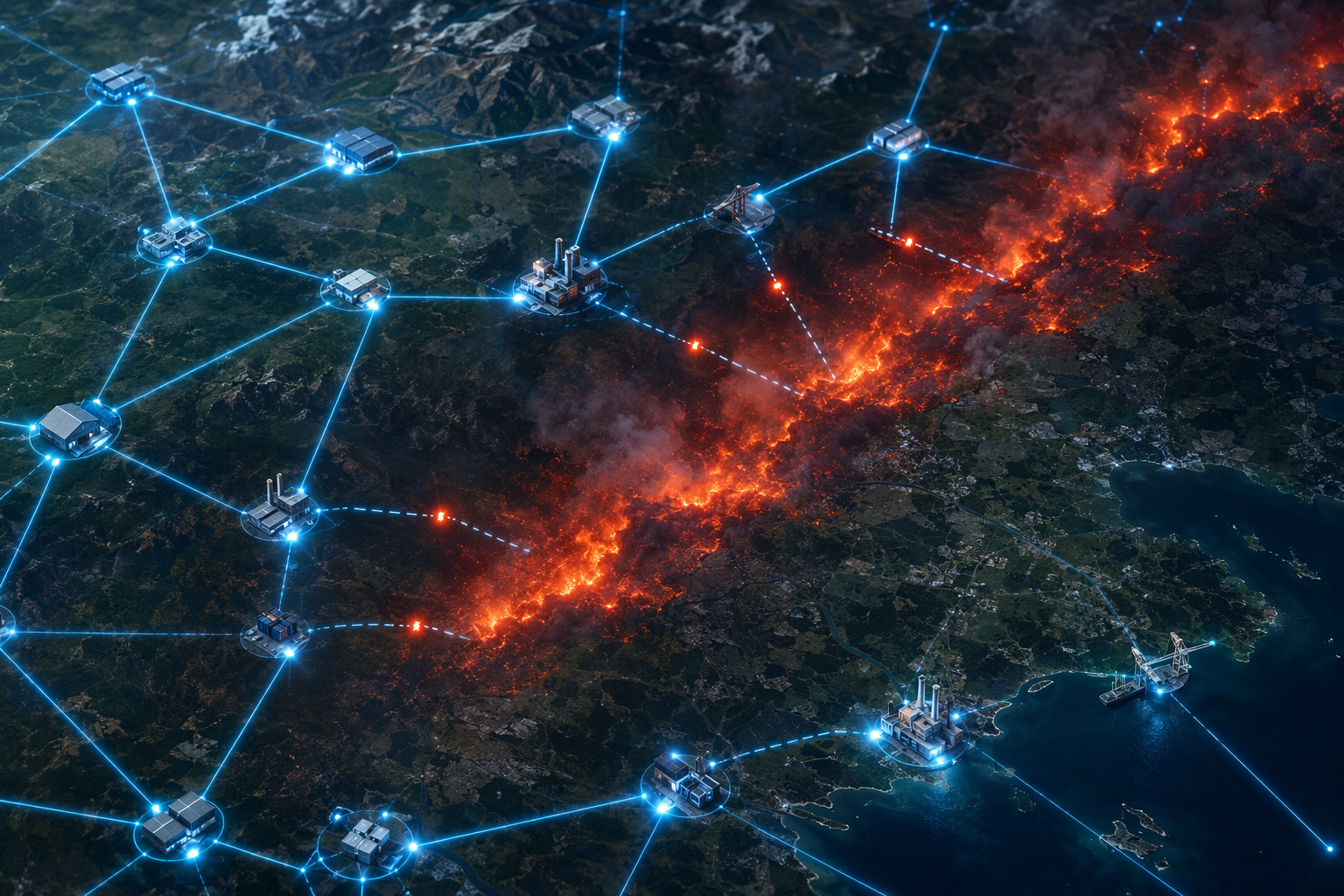
Most mature companies knew Southern California carried wildfire exposure. That is not the same as knowing which shipments would miss which handoff, which supplier family depended on the same sub-tier facility, which buffers were sitting on the wrong side of the disruption, or which planners would be unavailable because their own homes were inside evacuation zones.
A usable disruption plan connects four things: a signal, a planning variable, a decision owner, and a pre-approved action. A red-flag weather or satellite signal should change a lane plan, not just add an item to a dashboard. A supplier-location alert should trigger alternate sourcing review, not a manual spreadsheet hunt. A smoke or evacuation forecast should change staffing coverage, driver availability, and warehouse operating assumptions. Wildfire smoke itself can disrupt labor, transport, and facility operations well beyond the flame perimeter, which is why AI-based air quality risk planning belongs in the same operating conversation as freight rerouting.
| Planning gap exposed | What traditional risk management often misses | AI capability that helps before the event |
|---|---|---|
| Transportation routing blind spots | Alternate corridors exist on paper but are not modeled against real capacity, closure, and service constraints | Predictive route modeling, satellite and weather monitoring, traffic integration, digital twin simulation |
| Sub-tier supplier concentration | Tier-1 suppliers appear diversified while sharing the same Tier-2 or Tier-3 dependency | AI network mapping, sub-tier discovery, entity resolution, location-based exposure analytics |
| Inventory buffer miscalibration | Extra stock is held broadly, while critical buffers are missing near vulnerable nodes | Predictive risk scoring, dynamic safety-stock models, scenario-based inventory positioning |
| Workforce displacement | Plans assume planners, dispatchers, drivers, and supervisors remain reachable during evacuations | Cognitive control towers, agentic exception handling, pre-governed escalation workflows |
Transportation routing: the alternate route cannot be invented during the closure
Transportation disruption is the easiest failure for executives to recognize because it becomes visible quickly: a corridor closes, drivers wait, dispatch starts calling, customers ask for revised ETAs. During a regional wildfire, that visible problem is already late-stage. If the first serious alternate-route work begins after a closure, the organization has moved from planning to improvisation.
The Los Angeles fires put that problem in a familiar geography. Closures and rerouting pressure around corridors such as Pacific Coast Highway and I-405 forced companies to make fast choices about freight paths, delivery windows, driver hours, and facility access. California had already seen the scale of transportation exposure: Caltrans estimated $3 billion in wildfire damage to California transportation infrastructure in 2020, a figure cited by GEP in its analysis of wildfire supply chain impacts. [2]
Traditional continuity plans tend to list alternate carriers and backup lanes. That is useful only if the alternatives have been stress-tested against the same disruption. A backup route that also crosses the burn-probability zone, relies on the same constrained interchange, or adds enough dwell time to break a cold-chain or appointment window is not really a backup route. It is a line in a plan.
AI planning tools help when they turn the alternate-route question into a pre-event model. Satellite imagery, weather forecasts, traffic data, facility geocodes, shipment priority, carrier capacity, and service commitments can be combined to test which lanes degrade first and which diversions are operationally tolerable. The output should not be a beautiful map. It should be a short list of pre-approved diversion plays: which orders move first, which customers get constrained-service notices, which carriers are activated, and who has authority to override the baseline plan.
A useful exercise before the next fire season is blunt: take the top lanes through a region, remove one or two corridors, and force the planning system to reassign loads under real constraints. If the model cannot show cost, transit-time, capacity, service, and safety tradeoffs fast enough for an operations call, then the organization has not built an AI routing capability. It has bought a faster way to watch a closure happen.
Sub-tier concentration: Tier-1 diversity can hide the same fire-zone dependency
Supplier risk is where many post-mortems get uncomfortable. On a dashboard, three Tier-1 suppliers may look diversified. In the physical network, all three may depend on the same sub-tier processor, packaging supplier, warehouse, test lab, or local transportation node. A regional fire does not care that the procurement file has three vendor names if the hidden dependency sits inside the same disruption footprint.
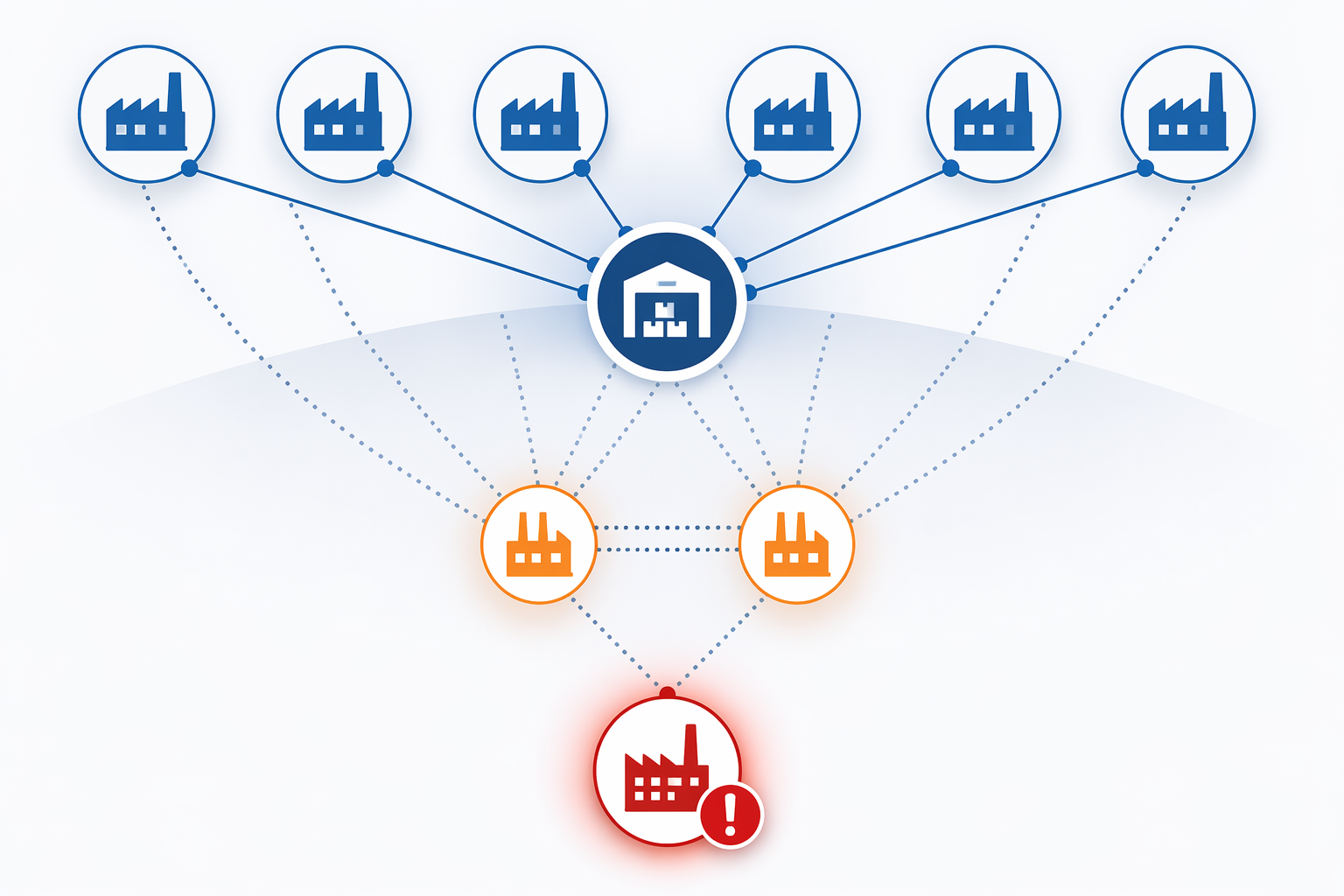
This is the planning gap that conventional supplier monitoring handles poorly. Tier-1 supplier scorecards usually capture financial health, quality incidents, delivery performance, and sometimes site-level risk. They do not reliably discover that several approved suppliers share the same Tier-2 raw material source, the same regional subcontractor, or the same logistics provider moving through the threatened corridor. The overlap is invisible until every “independent” option fails at once.
AI network mapping is valuable here because the work is too large and too messy for annual questionnaires alone. Entity-resolution models can connect supplier names that appear differently across purchase orders, bills of material, shipping records, public filings, and supplier disclosures. Location intelligence can then place those entities against fire perimeters, evacuation zones, transport closures, and smoke exposure. The point is not perfect omniscience. The point is to find enough likely shared dependency to ask better questions before disruption.
Factory-fire data reinforces why this cannot stay a one-tier exercise. Resilinc reported that factory fires ranked as the number one supply chain disruption for the fourth consecutive year, based on EventWatchAI monitoring of more than 5 billion data feeds. That finding does not prove wildfire exposure at every supplier site, but it does show how often fire remains a direct operational disruption rather than a remote environmental concern. [3]
The useful implementation question is: can the company draw a line from a threatened geography to the parts, products, suppliers, purchase orders, customers, and revenue at risk? If that line stops at Tier 1, the plan is not traceable enough. Sub-tier discovery should feed sourcing decisions, not just risk reporting. A supplier-family alert should be able to trigger alternate qualification work, controlled allocation, expedited inbound moves, or customer prioritization before the shared node fails.
What the model should expose before fire season
- Which Tier-1 suppliers share lower-tier dependencies in the same county, corridor, utility zone, or industrial cluster.
- Which critical parts have no qualified alternate outside the exposed region.
- Which supplier sites are near evacuation, smoke, or transport-risk zones, not only burn zones.
- Which customers and orders would be affected first if that shared dependency stopped shipping.
- Which mitigation actions are already approved, and which still require commercial, quality, or executive signoff.
Vendor-published benchmarks suggest why companies are investing here, but they should be read carefully. Everstream Analytics reports that risk-optimized procurement can reduce revenue losses from disruptions by 30% and cut impact assessment time by 50% to 70%. Those are useful directional benchmarks from a vendor, not independent guarantees that every implementation will achieve the same result. [4]
Inventory buffers: more stock is not the same as stock in the right place
Inventory is usually where resilience spending becomes visible on the balance sheet. The temptation after a regional disruption is to carry more of everything. That reaction is understandable, but it does not fix the planning error if the buffer sits upstream of a blocked corridor, downstream of a constrained supplier, or in a facility affected by smoke, labor shortages, or power disruption.
Everstream reports that supply chains not using AI supplier monitoring hold 14% excess buffer stock on average. Because this is vendor-reported, it should be treated as a benchmark from a commercial provider rather than a neutral industry average. The underlying point is still operationally familiar: blunt buffers are expensive, and they often compensate for poor visibility rather than true risk protection. [4]
Dynamic buffer logic changes the question from “How much extra should we hold?” to “Which node needs protection under which scenario?” A wildfire-risk signal may justify advancing inbound receipts to one facility, moving finished goods closer to unaffected demand, delaying noncritical replenishment into a threatened warehouse, or reserving scarce inventory for customers with the highest service or safety consequence. The calculation depends on probability, lead time, substitutability, margin, customer priority, and recovery time.
This is also where digital twins earn their keep. A simulation can test what happens if a supplier misses two shipments, a route adds a day, a warehouse loses a shift, and customer demand stays constant. The model does not need to predict the exact path of a fire to be useful. It needs to show which inventory policies fail under plausible regional disruption patterns, and which pre-positioning moves reduce service breaks without turning resilience into permanent overstock.
Workforce continuity: the planner may be inside the evacuation zone
The displacement figure belongs in the supply chain analysis, not outside it. More than 100,000 people displaced means planners, dispatchers, warehouse supervisors, drivers, maintenance technicians, customer-service teams, and supplier contacts may be handling evacuations, family care, property loss, smoke exposure, or interrupted communications at the same time the business is escalating exceptions. A plan that assumes the same people will be available to run the crisis has already made a fragile assumption. [1]
Cognitive control towers and agentic decision support can help, but only if they are not introduced as emergency theater. The control tower needs access to live shipment status, supplier alerts, inventory positions, workforce availability, facility constraints, and customer commitments before the crisis. It also needs rules: which exceptions can be auto-resolved, which require a planner, which require an executive, and which customer or safety commitments cannot be overridden.
A useful control tower does not replace judgment. It removes avoidable manual work when human attention is scarce. It can recommend rerouting a low-priority shipment through a pre-approved carrier, flag that a high-priority customer order will miss its window unless inventory is reallocated, or escalate a supplier outage because no qualified alternate exists. For a broader set of operating patterns, control tower AI use cases are most credible when they are tied to clear decision rights rather than vague real-time visibility.
The human side is also where formal emergency planning shows up in operating results. A Samsara SOCO study reported that 97% of organizations with formal emergency plans resumed operations within three days of a crisis. That figure does not isolate AI as the cause; it points to the value of having plans, roles, and response routines in place before the disruption. [5]
Buying AI is not the same as being ready
The market is clearly moving toward AI-enabled planning. ABI Research reported that 65% of supply chain professionals said AI or GenAI capabilities are important or very important in technology purchase decisions, based on a 490-respondent survey. That is a buying signal, not a readiness measure. A company can prioritize AI in procurement and still leave diversion routes unrehearsed, sub-tier data incomplete, buffers mispositioned, and escalation authority unclear. [6]
The difference shows up during the first operating call. If the control tower displays a fire-risk alert but nobody knows whether logistics can switch carriers without finance approval, the tool has not shortened the decision chain. If the supplier-risk model flags a site but procurement has never qualified an alternate, the alert only confirms exposure. If a digital twin identifies the best inventory reallocation but customer allocation rules are still political, the simulation becomes an argument starter rather than a response mechanism.
A pre-event framework for wildfire and regional disruption planning
The LA wildfires should push supply chain teams toward a rehearsed regional-disruption system. Wildfire may be the trigger in this case, but the operating pattern overlaps with other hazards: constrained corridors, inaccessible facilities, supplier clusters, labor disruption, inventory trapped in the wrong place, and overloaded decision channels. The same scenario-planning discipline applies to adjacent risks such as flood disruption prediction and downstream oil disruption planning, where the first visible incident is rarely the first planning dependency.
- Map the network at operating depth: supplier sites, sub-tier dependencies, lanes, warehouses, inventory nodes, workforce locations, and customer commitments.
- Monitor external signals that can change the plan: satellite imagery, weather, smoke, evacuation notices, traffic, infrastructure status, supplier alerts, and facility availability.
- Simulate regional scenarios before the season: corridor closures, clustered supplier outages, missed inbound receipts, warehouse labor loss, and simultaneous customer demand pressure.
- Pre-load response options: alternate routes, carriers, source substitutions, inventory moves, allocation rules, customer communications, and staffing coverage.
- Govern control-tower decisions: define which actions the system can recommend, which it can execute, who approves exceptions, and when authority shifts during evacuation or communications loss.
That framework also avoids a common AI mistake: treating every alert as equally important. A monitored wildfire signal matters when it is tied to a shipment, supplier, facility, inventory position, or person needed to keep the operation moving. Without that connection, risk intelligence becomes another feed for an already tired planner to refresh.
AI would not have solved the Los Angeles wildfires. It could have exposed brittle assumptions earlier: the corridor with no workable diversion, the supplier family with one hidden dependency, the buffer stock stranded in the wrong node, and the crisis workflow dependent on people facing evacuation themselves. Those gaps close only when AI planning tools are deployed before the event, connected to operational data, rehearsed in scenarios, and governed with decision rights that survive the first bad day.
References
- Economic Impact of Los Angeles Wildfires, UCLA Anderson Forecast
- Los Angeles Wildfire Impact on Supply Chains, GEP
- Factory Fires Rank #1 for Supply Chain Disruptions for the Fourth Consecutive Year, Resilinc
- How AI Transforms Supplier Risk Management, Everstream Analytics
- AI and planning key to addressing supply chain disruptions in the face of disasters: Samsara, T21
- Supply Chain Disruptions 2026: How to Build Resilience with AI and Automation, ABI Research
Comments
Join the discussion with an anonymous comment.