
A downstream oil disruption rarely arrives as a clean planning exercise. Refinery output drops before substitute barrels are fully confirmed. Demand rises in the wrong markets. A pipeline outage turns a normal transfer plan into a road-tanker scramble. Transport costs move while planners are still arguing over which constraint is binding.
That is the useful test for AI for oil supply chain disruption planning: not whether the software can draw a richer risk dashboard, but whether it can help a refinery, marketer, or distribution network choose a different executable movement plan under simultaneous pressure.

The strongest operating evidence comes from a November 2025 Scientific Reports study by Awan et al., which modeled a multi-echelon, multi-modal downstream petroleum network under four concurrent disruption types. In that modeled case, simultaneous shocks increased total network transport cost by up to 50%. A 40-42% refinery output reduction forced imports to rise by more than five times to compensate, while demand-side disruptions — a 22% increase in high-speed diesel and a 32% increase in petrol motor gasoline — produced the largest single cost impact. Pipeline failures pushed volume into road transport and raised transshipment costs.[1]
Those details matter because they describe the kind of week downstream planners actually recognize. A supply cut can be painful, but it still has familiar levers: import more, draw inventory where possible, reallocate from less constrained nodes. A demand spike is different. It pulls volume toward consumption points, tightens service expectations, and leaves less room to smooth the network quietly. When demand shocks in HSD and PMG outcost supply and transport escalation in the simulation, the practical message is not that demand forecasting is suddenly more important than refining. It is that a disruption plan built around supply recovery alone will miss where the cost actually lands.
Why Concurrent Shocks Change The Planning Problem
Single-variable stress tests are comfortable because they keep the meeting orderly. One team explains the refinery outage. Another explains demand. Logistics explains route capacity. Finance explains the cost impact. The network, however, does not experience those variables one at a time.
In the Scientific Reports model, the simultaneous nature of the disruptions is the point. A refinery output loss does not merely reduce available product; it changes the need for imports. A demand increase does not merely raise sales volume; it changes where product must arrive and how fast. A pipeline failure does not merely remove one asset; it forces flow into more expensive or capacity-constrained road movements. Transport cost escalation then compounds the penalty of those fallback moves.[1]
| Disruption in the modeled downstream network | Operational consequence |
|---|---|
| 40-42% refinery output reduction | Imports increased more than five times to compensate |
| 22% HSD demand increase and 32% PMG demand increase | Largest single modeled cost impact among the disruption types |
| Pipeline failure | Volume shifted toward road transport, increasing transshipment costs |
| Concurrent disruption combination | Total network transport cost increased by up to 50% |
This is where AI scenario planning earns attention, if it earns it at all. The model has to expose second-order consequences before the organization locks into a response. If refinery planners increase imports but logistics cannot move the additional volume through the usual pipeline corridor, the import decision may only move the bottleneck. If demand is rising in one product grade while transport fallback is most expensive on the same lane, the cheapest aggregate plan may still fail service where the commercial consequence is largest.
The study also deserves a boundary around it. It is a validated modeled case for a single import-dependent country’s downstream network, not a universal benchmark for every refinery system, national market, or integrated oil company. The 45-50% cost increase range is evidence that concurrent disruptions can materially magnify downstream transport cost in the modeled setting; it should not be lifted as a generic percentage for all oil supply chains.[1]
What AI Adds Beyond A Bigger Spreadsheet
The useful AI pattern is not a black-box forecast followed by a heroic planner override. It is a planning loop that can generate plausible disruption ranges, solve constrained allocation choices, and test whether the resulting flows still behave inside the physical network.
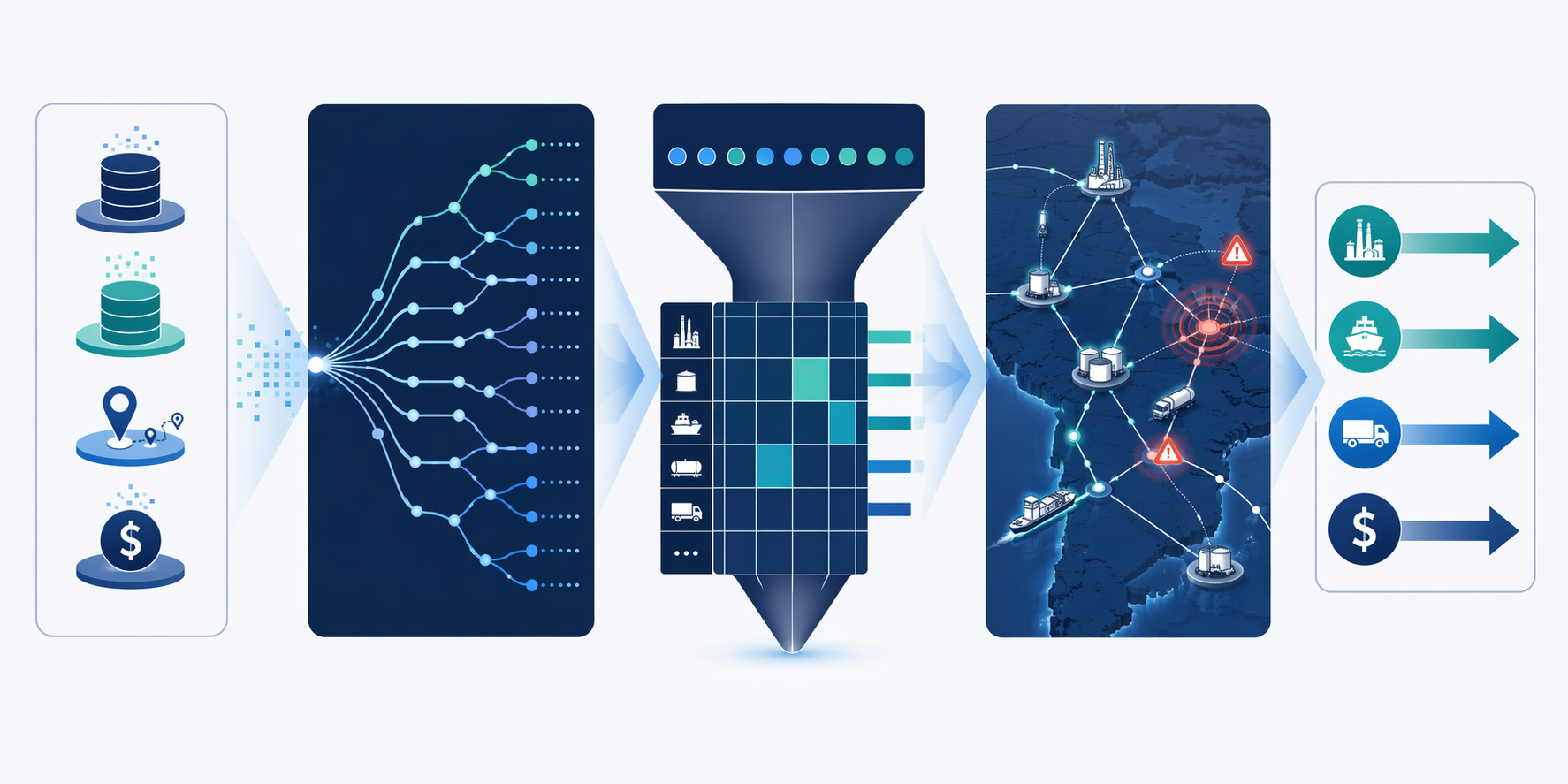
Monte Carlo simulation is the first piece. Instead of asking what happens if one refinery is down by one chosen amount, planners can run many probability-weighted versions of output loss, demand change, lane disruption, and cost escalation. In downstream oil, the output should not be a neat average. The useful output is a range of cases that shows when the plan flips: when imports become unavoidable, when a depot becomes the binding constraint, or when road transport stops being a tolerable exception and becomes the cost driver.
MILP optimization then turns scenarios into constrained flow allocation. The acronym matters less than the discipline it imposes: product must move from available sources to demand points through real routes, capacities, costs, and service requirements. A refinery distribution team does not need an elegant optimum that ignores terminal limits or truck availability. It needs a plan that says which volume moves, through which mode, at what cost, and which demand is still exposed.
Digital twin stress-testing is the third piece, and it is often the one that separates an analytical answer from an operational one. A replicated network model can test how a proposed response behaves before dispatchers and schedulers commit to it. If the optimized answer overloads a transshipment point, assumes a lane can absorb more road tankers than it realistically can, or creates a new service risk downstream, the plan should fail in the model rather than during execution.
Vendor labels are secondary, but the technique pairings are useful for orientation. Monte Carlo simulation commonly appears in planning environments such as Anaplan and Kinaxis. MILP-style flow allocation is associated with optimization-led platforms and services such as o9 and Trax. Digital twin stress-testing is still an emerging category in this specific downstream disruption context. None of those pairings, by itself, proves operational value; the test is whether the system changes the movement decision under constraint.
The Claimed Speed And Cost Gains Need Careful Reading
Industry benchmarks support the direction of the case, with an attribution caveat. Trax Technologies states that AI-powered scenario planning can achieve 35% faster disruption response times and 23% lower associated costs, citing MIT Center for Transportation & Logistics research. Because the directly linked original MIT publication is not available in the provided material, those figures are best treated as directional benchmarks reported by Trax, not as independently verified universal outcomes for downstream oil networks.[2]
Even read cautiously, the mechanism is plausible. Response time falls when planners do not have to rebuild the scenario tree manually after every new constraint appears. Cost falls when the organization can compare multiple constrained responses before committing to a high-cost fallback. In a pipeline failure, for example, the expensive move is not simply using trucks. The expensive move is discovering too late that trucking volume has been assigned without enough capacity, forcing premium moves, partial service failures, or repeated re-planning.
That distinction is easy to miss in executive demos. A platform that produces scenarios faster is not automatically reducing disruption cost. It reduces cost only if the scenarios are close enough to physical reality, visible enough to the right decision makers, and connected to authority over supply reallocation, import decisions, mode shifts, and customer service trade-offs.
Where The Planning Foundation Usually Breaks
The implementation problem is less glamorous than the modeling problem. In 2026 material, Anaplan argues that AI underdelivers in oil and gas planning when fragmented data, rigid models, and siloed workflows prevent the organization from acting on AI-generated recommendations. It frames four required capabilities: downstream-specific business context in the model, a real-time transparent calculation engine, integrated data and automated decision workflows, and decision intelligence tailored to the business.[3]
That is vendor-published guidance, not independent proof. Still, the failure mode is familiar. If refinery output data, terminal inventory, pipeline availability, demand signals, truck capacity, and cost assumptions sit in separate planning cycles, an AI scenario engine becomes another side analysis. It may produce a better answer, but the answer arrives in a room where nobody owns all the levers required to execute it.
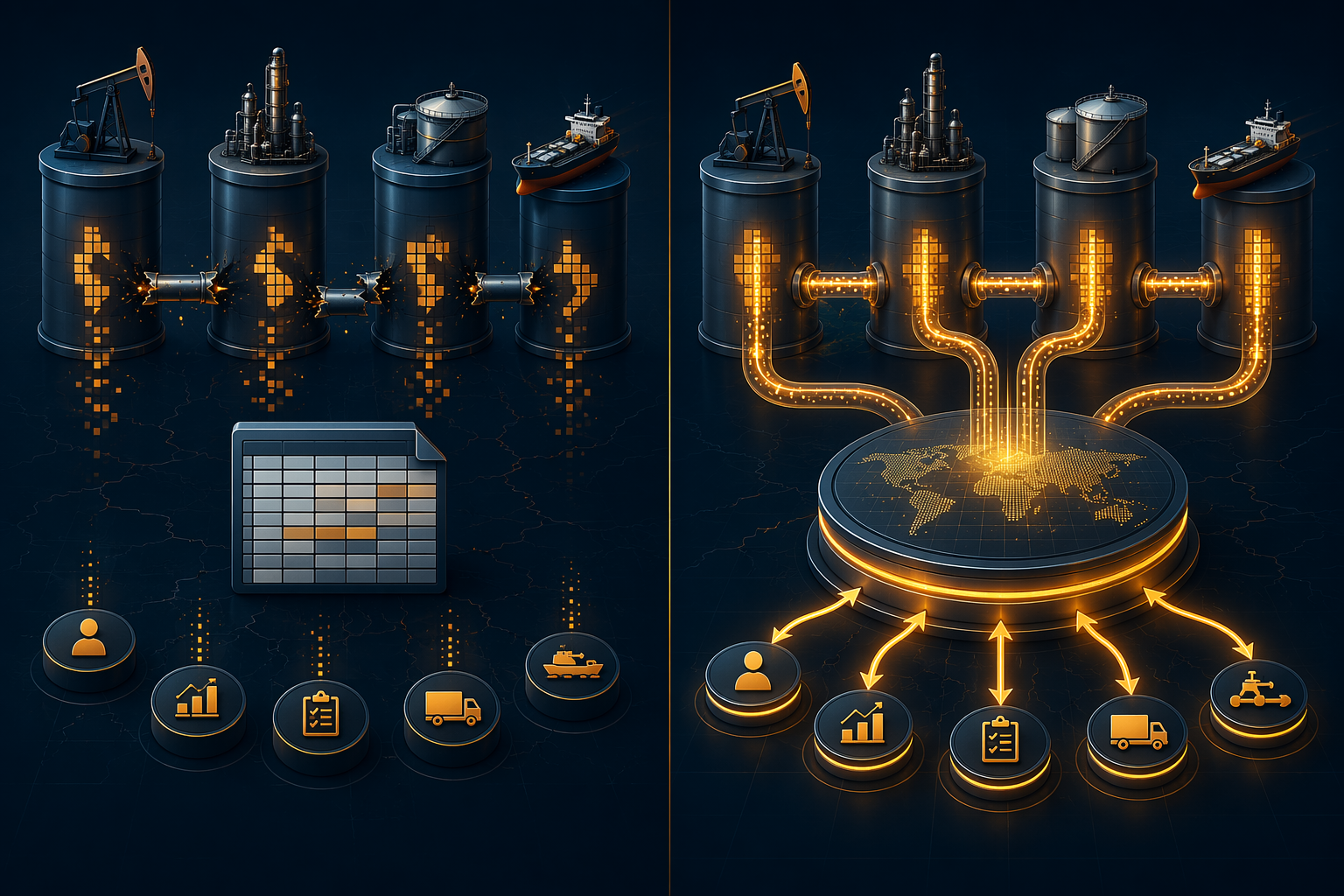
Rigid models create a different problem. Downstream disruption response often requires changing the plan structure itself: opening an import option, rerouting around a pipeline, shifting product through a different depot, or accepting a service trade-off in one market to protect another. If the planning model only supports the normal operating pattern, the AI can optimize yesterday’s network while the real network has already changed.
Siloed workflows are the final drag. The best disruption scenario is still weak if commercial, refining, logistics, and finance teams review different versions of the plan. A response recommendation has to show the cost and service consequence clearly enough that decision rights can move with speed. Otherwise, the organization spends the disruption validating the model instead of choosing the response.
How To Judge The Use Case In A Downstream Network
For downstream oil leaders, the evaluation should start with a plain operating question: what decision would the scenario planning system change during a disruption? If the answer is only “it gives better visibility,” the use case is still immature. Visibility matters, but disruption value appears when the planning loop supports an executable choice.
- If refinery output falls, the system should show when imports, inventory drawdown, or demand allocation becomes the least damaging response.
- If HSD or PMG demand spikes, it should identify which markets, depots, and lanes absorb the cost rather than burying the impact in a network average.
- If a pipeline fails, it should quantify how much volume can realistically shift to road transport and where transshipment cost begins to dominate.
- If transport costs escalate, it should compare service protection against cost absorption instead of assuming one default priority.
The same scenario-planning pattern shows up in other disruption domains. ChainSignal’s work on AI hurricane planning and AI flood disruption planning follows the same logic: early warning is only valuable when it connects to constrained response options. The control-tower question is similar; different control tower models create different levels of decision integration. Multi-tier visibility also matters where dependencies are hidden, which is why knowledge graph visibility becomes relevant when planners need to trace which assets, lanes, suppliers, and customers are connected through a disruption.
Downstream oil is less forgiving than many networks because physical movement options are large, expensive, and capacity-bound. A bad response is not just a bad forecast. It can mean overusing road transport, missing a regional demand surge, importing into the wrong bottleneck, or accepting a cost shock that could have been reduced with a different allocation.
AI scenario planning can help under those conditions, but the useful standard is narrow. The model must represent downstream-specific constraints, test concurrent shocks, show service and cost consequences, and sit inside workflows where people can authorize changes to supply, imports, transport modes, and customer allocation. The advertised sophistication of the algorithm is a poor proxy for that. The better test is whether the organization’s data, constraints, and decision rights are integrated enough for the model’s recommendation to become an executable disruption response.
References
- A resilient downstream oil supply chain model under disruption: a multi-echelon multi-modal petroleum network design using Monte Carlo simulation, Scientific Reports, November 2025, https://www.nature.com/articles/s41598-025-22678-9
- AI-Powered Scenario Planning, Trax Technologies, https://www.traxtech.com/ai-in-supply-chain/ai-powered-scenario-planning
- How fragmented planning erodes margins and AI aspirations in oil and gas, Anaplan, 2026, https://www.anaplan.com/blog/how-fragmented-planning-erodes-margins-ai-aspirations-in-oil-and-gas/
Comments
Join the discussion with an anonymous comment.