
Q3 2026 is already inside the execution window for agricultural supply chain policy change. The European Union Deforestation Regulation is scheduled to apply from Dec. 30, 2026 after prior delays; FSMA 204 compliance has moved to July 20, 2028, while the underlying traceability record model remains in place; and sustainability reporting teams are asking many of the same suppliers for origin, emissions, and sourcing evidence under CSRD-related Scope 3 workstreams.[1][2][3]
That timing creates a funding decision, not just a compliance calendar. A food, beverage, or agriculture company can build one project for deforestation due diligence, another for food traceability, and a third for sustainability reporting. Or it can fund a shared traceability data layer that records farm identity, supplier custody, lot movement, and evidence quality once, then formats the output differently for each regulator.
| Mandate | What the supply chain record must prove | Where the records overlap |
|---|---|---|
| EUDR | Covered commodities entering the EU need origin evidence, geolocation for production plots, and shipment-level due diligence documentation; penalties can reach 4% of annual EU turnover for non-compliance.[4][5] | Farm identity, supplier identity, chain of custody, deforestation risk evidence, shipment linkage |
| FSMA 204 | Foods on the Food Traceability List require Critical Tracking Event records with Key Data Elements, and records must be available to FDA within 24 hours when requested.[2] | Lot identity, transformation and shipping events, trading partner records, time-stamped custody |
| CSRD-related Scope 3 reporting | Reporting teams need supplier and origin data to support value-chain sustainability disclosures and emissions workstreams. | Supplier master data, origin records, production practices, evidence controls, audit trail |
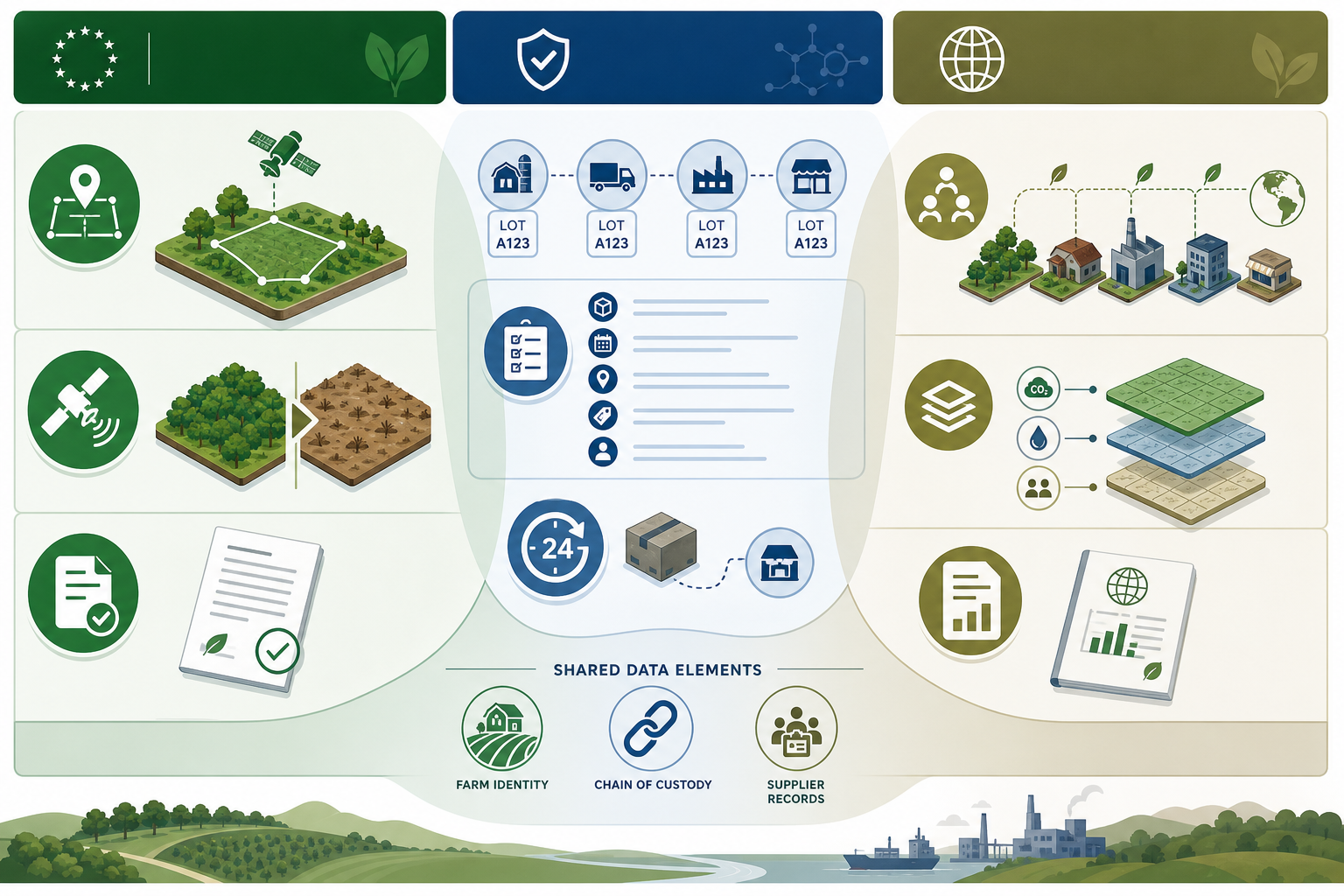
The Deadline Is Not the Hard Part
A deadline can be moved. A farm polygon that was never collected cannot be produced by policy memo. That is why the EUDR and FSMA 204 delays should be treated as planning risk, not permission to wait.
EUDR has already moved from its original application date, with the latest EU changes setting Dec. 30, 2026 as the relevant application date for many operators.[1] FSMA 204 has a later compliance horizon after the July 20, 2028 extension and non-enforcement window, but the recordkeeping architecture still revolves around Critical Tracking Events, Key Data Elements, and 24-hour retrieval.[2][3] Those are implementation facts. They determine database fields, supplier onboarding forms, event capture rules, and exception workflows long before the final enforcement week arrives.
For EUDR alone, the commercial exposure is not theoretical. Covered commodities represented $5.6 billion, or 44%, of total U.S. agricultural exports to the EU, according to the American Farm Bureau Federation.[4] The same analysis notes that the U.S. low-risk classification affects risk treatment but does not remove traceability obligations; covered commodity exports to the EU still declined 15% from 2022 to 2024 after EUDR passage.[4]
Low risk is not no record. It may change the scrutiny applied to a shipment, but it does not solve missing farm boundaries, incomplete supplier declarations, or weak links between an export lot and its production origin.
One Backbone, Three Different Outputs
The useful case for AI traceability is not that it produces a better dashboard. The useful case is that it can connect messy field evidence to regulatory outputs without asking three departments to rebuild the same supplier map in three incompatible systems.
The backbone starts with farm and supplier identity. For EUDR, that means GPS geolocation or polygon capture for production plots, linked to commodity, producer, and shipment records. For deforestation checks, the same origin record can be compared against satellite monitoring evidence. For FSMA 204, the farm or first receiver record becomes one node in a chain of Critical Tracking Events: harvesting, cooling, initial packing, shipping, receiving, transformation, or other events depending on the food and role involved.[2]
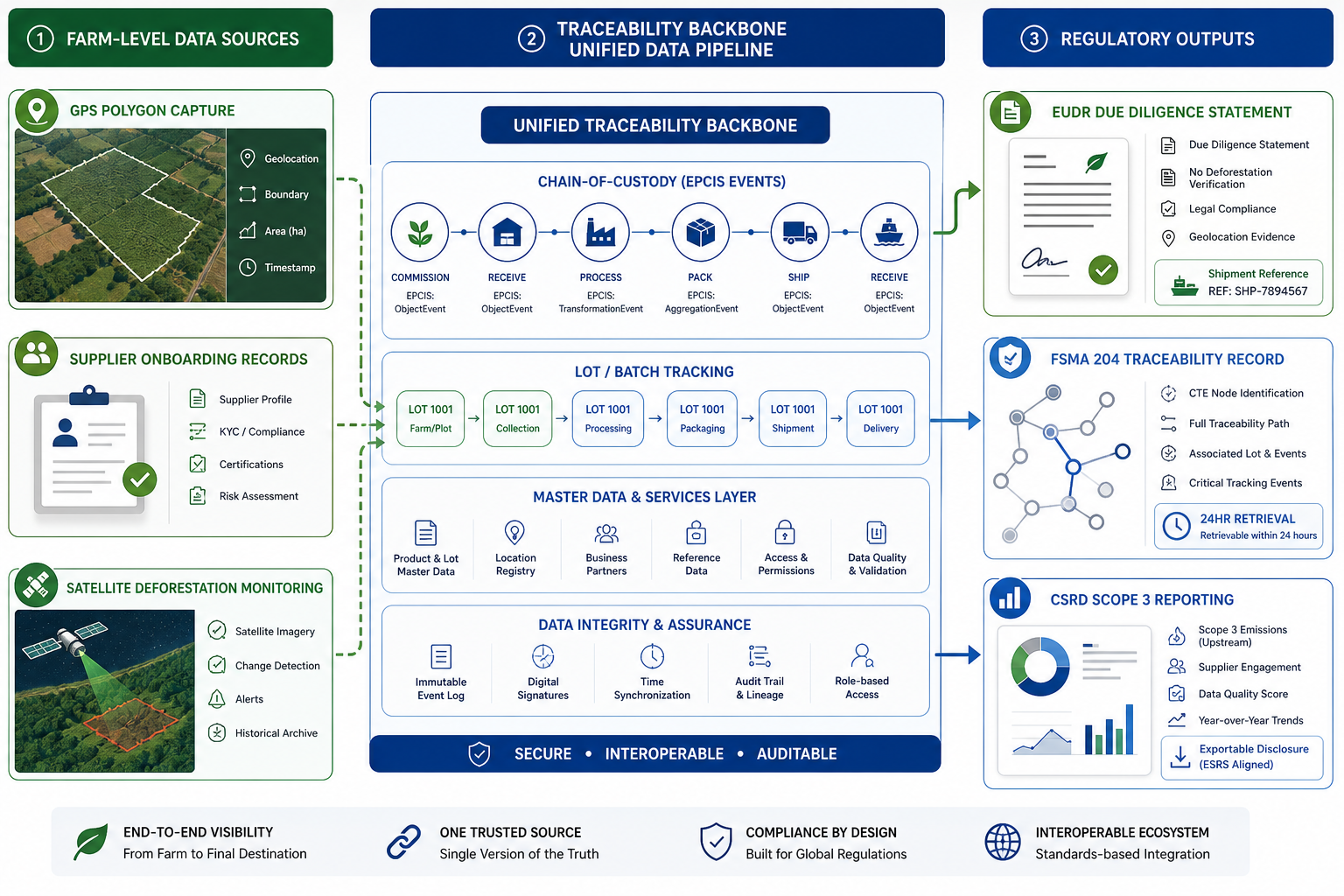
A lot-level event model matters because aggregation is where clean compliance diagrams usually start to break. A truckload of beans, cocoa, fruit, nuts, or leafy greens may combine material from multiple farms. The record after aggregation must still explain what entered, what changed, what lot code was assigned, who handled it, and which downstream shipment inherited the compliance status. If the platform cannot preserve that lineage through splits, blends, transformations, and re-packing, the final document may be polished but fragile.
This is where GS1 EPCIS becomes more than a standards footnote. GS1 US recommendations published in May 2025 map FDA Food Traceability Rule events into EPCIS event structures, which gives trading partners a more interoperable way to exchange FSMA 204-style traceability data.[6] The value is not the acronym. The value is that an event recorded by one company can be interpreted by another company without a custom spreadsheet translation every time product changes hands.
From the same evidence chain, the outputs diverge:
- For EUDR, the system assembles origin, commodity, geolocation, supplier, risk assessment, and shipment evidence into due diligence documentation before the product enters the EU market.
- For FSMA 204, the system retains CTE and KDE records so FDA-requested traceability information can be retrieved within 24 hours.[2]
- For CSRD-related work, the system gives sustainability teams supplier, origin, and chain-of-custody data that can support Scope 3 reporting assumptions instead of relying only on annual supplier questionnaires.
The same architecture can also reduce the number of times suppliers are asked to prove the same fact. A cooperative, exporter, processor, or broker should not have to submit one version of farm identity for deforestation compliance, another for food safety, and a third for sustainability reporting if the underlying record is the same. Different regulators need different fields and formats, but the supplier should not be forced to reconcile three versions of its own origin data.
Where AI Actually Helps
AI earns its place only if it reduces specific operating loads. In agricultural traceability, those loads are not abstract: checking farm boundaries, matching supplier names across systems, identifying missing fields, detecting inconsistent lot movement, screening satellite evidence, and preparing regulator-ready outputs without manually rebuilding the file for each shipment.
For EUDR, vendors describe platforms that combine GPS polygon capture, satellite deforestation monitoring, automated Due Diligence Statement generation, and TRACES NT API submission.[5] Those capabilities are relevant because they map to an official workload: a shipment cannot be treated as compliant simply because a supplier gave a verbal assurance. The operator needs evidence attached to the lot or shipment, and someone must be able to explain how that evidence was collected, checked, and preserved.
For FSMA 204, AI-assisted lot tracking can flag events that are missing a required KDE, identify unusual gaps between shipping and receiving records, and prepare retrieval packages faster than a team working across email, PDFs, and spreadsheets. A deeper treatment of this operational use case is covered in AI Traceability Turns FSMA 204 Compliance into an Operational Advantage, but the cross-regulatory point is simple: lot events are not just recall data. They are also the connective tissue between origin evidence and finished regulatory submissions.
For CSRD-related reporting, AI can help normalize supplier submissions, classify evidence by product, geography, and reporting period, and identify where Scope 3 assumptions rest on weak or missing primary data. That does not make sustainability reporting automatic. It gives reporting teams a stronger audit trail than a year-end questionnaire that cannot be tied back to shipments, farms, or purchase volumes.
The phrase “single source of truth” is overused in supply chain software. A better test is whether the system can answer uncomfortable questions: Where did this polygon come from? Who edited the supplier record after onboarding? Which lot inherited which farm claims after aggregation? Which shipments used a due diligence statement generated from incomplete data? Which trading partner failed to send a required event? If the AI layer cannot expose those exceptions, it is adding presentation, not control.
The Bottleneck Is Supplier Evidence
The hardest part of this implementation is not writing a due diligence statement or exporting a traceability file. It is building enough trustworthy source data before product is already moving.
Coffee shows the scale problem. TraceX cites FAO data indicating that 80% of global coffee supply originates from smallholder farmers, while fewer than 20% have any digital farm record.[5] That is not a software configuration issue. It is an onboarding, identity, connectivity, training, and verification issue spread across thousands of producers who may not have been asked for polygon-level documentation before.
Cocoa shows the custody problem. TraceX cites Trase data indicating that roughly 60% of cocoa from Côte d'Ivoire is indirectly sourced or of unknown origin.[5] In a direct sourcing model, the buyer can push data requirements through a known relationship. In indirect sourcing, the buyer may be dealing with aggregators, intermediaries, or mixed lots where the identity of the producing farm is not consistently preserved. GPS traceability in that setting is a fundamental operating change, not a form field.
AI can help with this bottleneck when it is used to triage and verify, not when it pretends the bottleneck does not exist. A practical implementation uses automation to find duplicate suppliers, detect missing farm records, compare polygons against satellite risk layers, and prioritize onboarding where export exposure is highest. It still needs people who can work with cooperatives, brokers, farmers, and local teams when records are incomplete or disputed.
Small suppliers and small businesses also need cost-sensitive paths into these systems. A platform that shifts the entire burden downstream may satisfy a buyer’s procurement checklist while creating failure at the edge of the supply base. For teams evaluating lighter-weight onboarding models, How Small Businesses Can Afford AI Supply Chain Compliance Now is the related implementation question: how to collect enough evidence without pricing smaller partners out of compliant trade.
Separate Projects Create Reconciliation Debt
The argument for one traceability backbone is strongest when a company follows the same shipment through three compliance desks.
The sourcing team needs to know whether the supplier is approved, whether farm records exist, and whether an indirect source can be accepted. The logistics or export team needs shipment documentation before goods move into an EU channel. The food safety team needs lot-level event records that can be retrieved quickly if FDA asks. The sustainability team needs supplier and origin data that can support Scope 3 reporting. If each group buys or builds separately, the first shared problem will be identity: one supplier, several names; one farm, several IDs; one lot, several transformations; one shipment, several compliance statuses.
That identity problem becomes rejection risk. EUDR penalties can reach 4% of annual EU turnover for non-compliance, but the day-to-day operational cost may show up earlier as delayed export release, missing due diligence files, supplier disputes, and manual rework before peak shipping periods.[5] FSMA 204 creates a different failure mode: when FDA requests records, the company has 24 hours to provide the required traceability information.[2] A beautiful sustainability report will not help if the lot history lives in a broker spreadsheet no one can reconcile under time pressure.
Interoperability is the practical control. If farm polygons, supplier approvals, lot events, transformations, and shipment documents use stable identifiers, then an EUDR due diligence file and an FSMA 204 retrieval package can draw from the same custody record. If those identifiers are different in every department, the organization is not implementing traceability; it is funding future reconciliation.
What to Require From an AI Traceability Platform
A vendor shortlist should start with regulatory evidence, not feature volume. The platform does not need to solve every agriculture problem. It needs to preserve the facts that regulators, customers, auditors, and internal teams will ask for when product is already committed to a market.
- Farm and production plot identity: GPS point or polygon capture, source metadata, change history, and linkage to supplier and commodity records.
- Deforestation evidence: satellite monitoring workflow, risk flags, review status, and traceable connection between the check and the shipment.
- Lot-level custody: event capture for harvesting, receiving, transformation, shipping, aggregation, splitting, and re-packing where relevant.
- FSMA 204 readiness: CTE and KDE support, 24-hour retrieval workflows, and interoperability with GS1 EPCIS-style event exchange.[2][6]
- EUDR output control: due diligence statement preparation, exception handling, and documented submission workflow for EU-bound shipments.
- Reporting reuse: supplier, origin, and shipment evidence that sustainability teams can reuse for Scope 3 work instead of launching a separate annual data chase.
The review should also ask what happens when the record is not clean. Can the system quarantine a shipment from an unverified origin? Can it show which lots are affected when a farm polygon changes? Can it distinguish supplier-declared data from independently checked satellite evidence? Can it preserve a manual override with the name, time, and reason? Those questions matter more than whether the dashboard has a convincing map view.
There is also a governance question that software cannot absorb by itself. Legal, sourcing, food safety, sustainability, and IT teams need to agree which system owns supplier identity, which evidence is mandatory before purchase order release, which exceptions require human review, and which markets are blocked when records are incomplete. AI can route the exception. It cannot decide the company’s risk appetite unless the company has written it down.
The Implementation Window Before 2028
The sensible sequence is to build around the earliest commercial exposure, then widen the data model before the later deadline arrives. For many exporters and brands, that means starting with EUDR-covered commodities and EU shipments because Dec. 30, 2026 is close enough that onboarding gaps will surface immediately.[1] FSMA 204 then supplies the lot-event discipline: every origin claim becomes more useful when it is attached to a traceable movement record that can be retrieved under the FDA’s 24-hour rule.[2]
A realistic first phase identifies covered commodities, suppliers, markets, and products where non-compliance would interrupt trade. The next phase captures or verifies farm and supplier identity, starting with the highest-volume and highest-risk origins. The third phase connects origin evidence to lot events and shipment documents. Only after that does automated filing become a serious efficiency gain, because the system is no longer generating forms from uncertain records.
This is also where procurement choices become technology choices. A buyer can continue accepting material from an intermediary that cannot provide origin records, but the platform should make that decision visible. It should show that the lot is blocked, conditionally accepted, diverted to a non-EU channel, or escalated for review. Without that operational connection, traceability remains a compliance archive instead of a supply chain control.
Organizations that act before the 2028 deadline can use one traceability investment to reduce manual reconciliation and lower shipment rejection exposure across EUDR, FSMA 204, and CSRD-related reporting. Organizations that wait may still buy software in time, but they are less likely to have supplier records, polygon coverage, lot-event discipline, exception governance, and interoperable identifiers in time. They are likely to discover that the hard part was never filing the forms. It was creating trustworthy, interoperable supply-chain evidence before a regulator, customer, or port process asked for it on a bad Tuesday.
References
- EU Adopts Changes to Deforestation Regulation, USDA Foreign Agricultural Service, Jan. 2026.
- FSMA Final Rule on Requirements for Additional Traceability Records for Certain Foods, U.S. Food and Drug Administration.
- FDA Proposes Extension to Food Traceability Rule Compliance Date, Covington & Burling, Aug. 2025.
- European Union Deforestation Rule Creating Administrative Hurdles and Market Barriers Rather Than Saving Forests, American Farm Bureau Federation, Dec. 2025.
- 7 Ways EUDR Impacts Global Supply Chains, TraceX, May 2026.
- AI Food Supply Chain Traceability — 16 Advances, Yenra, 2026.
Comments
Join the discussion with an anonymous comment.