
Cyclospora breaks the usual traceback playbook
The 2026 Cyclospora outbreak is already large enough to force attention: Reuters reported more than 1,645 confirmed cases, 5,100+ suspected cases, and 141 hospitalizations, while the CDC's reporting lag means the count was still moving when those figures were published.[1][2] The source trail pointed to Taylor Farms shredded iceberg lettuce from Mexico distributed through Taco Bell, but the harder operational truth is that Cyclospora cannot be cultured in the lab, whole-genome sequencing is unavailable, PCR was inconclusive in this event, and the 1- to 2-week incubation window makes patient recall a weak tool for investigators.[3]
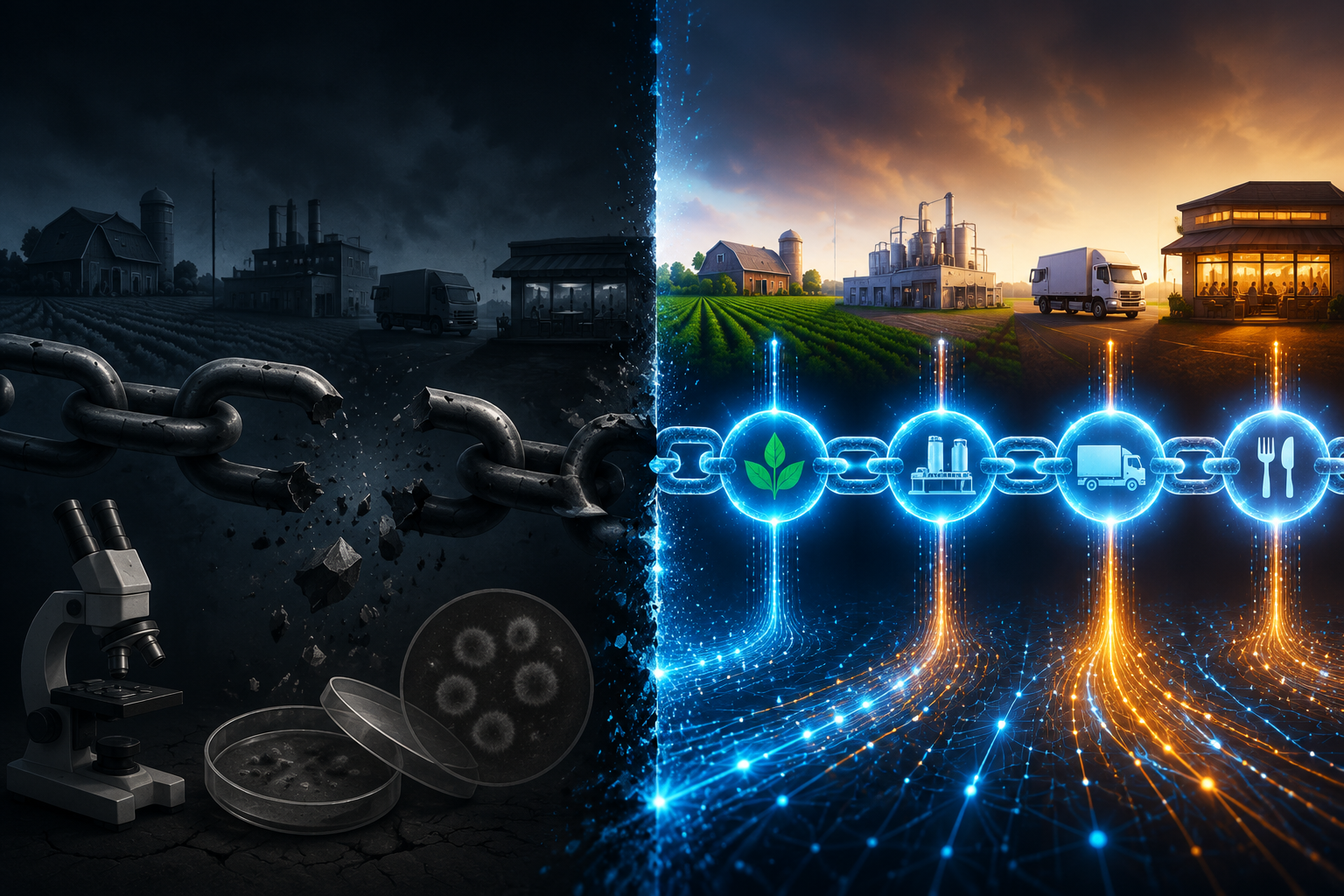
Where AI traceability helps
That is the point where AI-powered lot-level traceability becomes useful: it tightens the record trail investigators have to trust when the microbiology goes dark. The practical win is narrower search, fewer ambiguous lots, and faster answers about which product moved where.
- Predictive analytics can reduce unnecessary lot fragmentation, so a recall team has fewer mixed handoffs to unwind when the alert comes.[6]
- Computer vision can strengthen field-level QA by capturing conditions and exceptions before product is packed and dispersed.[6][7][8]
- Sensor-integrated cold-chain tracking preserves temperature history and other condition data that often decides whether a lot stays in scope.[6][7]
- Automated event record capture reduces the gap between a shipment moving and the record becoming usable in traceback.[6][9]
This is also where standardized event data matters. The GS1 EPCIS approach highlighted in the Yenra survey, along with the DineEquity/McLane example it cites, shows how lot and location data can make restaurant-level tracing precise without needing a pathogen fingerprint.[6] The broader AI-in-food-safety literature does not focus on Cyclospora specifically, but it does support the larger logic: machine learning, sensing, and automated record handling are already being applied across food safety problems that depend on data quality more than on organism detection.[7][8]
FSMA 204 is the build window
FDA's Cyclospora prevention, response, and research action plan treats the problem as prevention, response enhancement, and knowledge gaps rather than a single technology fix.[4] FSMA 204 fits that same frame: the rule's additional traceability records, key data elements, and critical tracking events are meant to be ready in electronic form, and the proposed compliance date is July 20, 2028.[5] A related walkthrough of the KDE/CTE side of the rule is covered in How AI Food Traceability Helps You Comply with FSMA 204, but the main point here is simpler: the work has to start before the deadline, because the value comes from the data model, not from waiting for the regulation to land.
Food Safety Magazine's readiness exercises found that supply chain coordination matters more than technology in practice, which is exactly what outbreak response usually exposes: farm, processor, distributor, and restaurant records only help if they line up quickly enough to answer who moved which lot where.[9] AI does not replace that coordination. It makes the coordinated version easier to execute under pressure.
The useful boundary
AI traceability will not detect Cyclospora in food, and it should not be sold as if it could. Its value is narrower and more practical: preserve usable event records, reduce lot fragmentation, surface condition history, and compress the time it takes to identify a source when culture and sequencing cannot carry the investigation.[6][7][8] In a Cyclospora event, that may be the difference between a sprawling recall and one that stops where the evidence actually points.
References
- What has made the cyclospora behind the US outbreak so challenging to trace? — Reuters, Jul 20, 2026, source
- What we truly know about the huge US Cyclospora outbreak—and what we don't — CIDRAP, University of Minnesota, source
- Surveillance of Cyclosporiasis — CDC, source
- Cyclospora Prevention, Response and Research Action Plan Release — FDA, source
- FSMA Final Rule on Requirements for Additional Traceability Records for Certain Foods — FDA, source
- AI Food Supply Chain Traceability: 16 Advances (2026) — Yenra, source
- AI-Powered Innovations in Food Safety from Farm to Fork — PMC, source
- How AI Is Reshaping Food Safety — IFT Food Technology Magazine, source
- FDA Traceability Rule Readiness Exercises Reveal Supply Chain Coordination Matters More Than Technology — Food Safety Magazine, source
Comments
Join the discussion with an anonymous comment.