
The hard part of food contamination traceability is not finding a nicer dashboard after a recall begins. It is compressing the hours when nobody is fully sure which lot moved where, which customer received it, which production run touched the same line, and whether the next decision should be a hold, a narrow withdrawal, or a broad recall. That is where AI for food supply chain contamination traceability is becoming operationally interesting: not because it makes traceability sound modern, but because it can shorten the distance between a weak signal and a defensible action.
The public-health stakes are not abstract. WHO estimates that unsafe food causes 600 million cases of foodborne illness each year globally.[1] Inside a company, that risk becomes a much smaller but more urgent problem: isolate the affected material fast enough to protect consumers, without turning uncertainty into unnecessary destruction of product that was never exposed.
That is why the Walmart and IBM Food Trust example still matters, even after years of overuse in blockchain presentations. In the reported test, tracing the origin of a food item fell from seven days to 2.2 seconds.[2] The important point is not that every company can reproduce that figure, or that blockchain is the main story. The point is that recall work changes when the first reliable answer arrives while operations leaders are still deciding what to do, rather than after teams have spent days reconciling paper records, emails, ERP extracts, and plant logs.
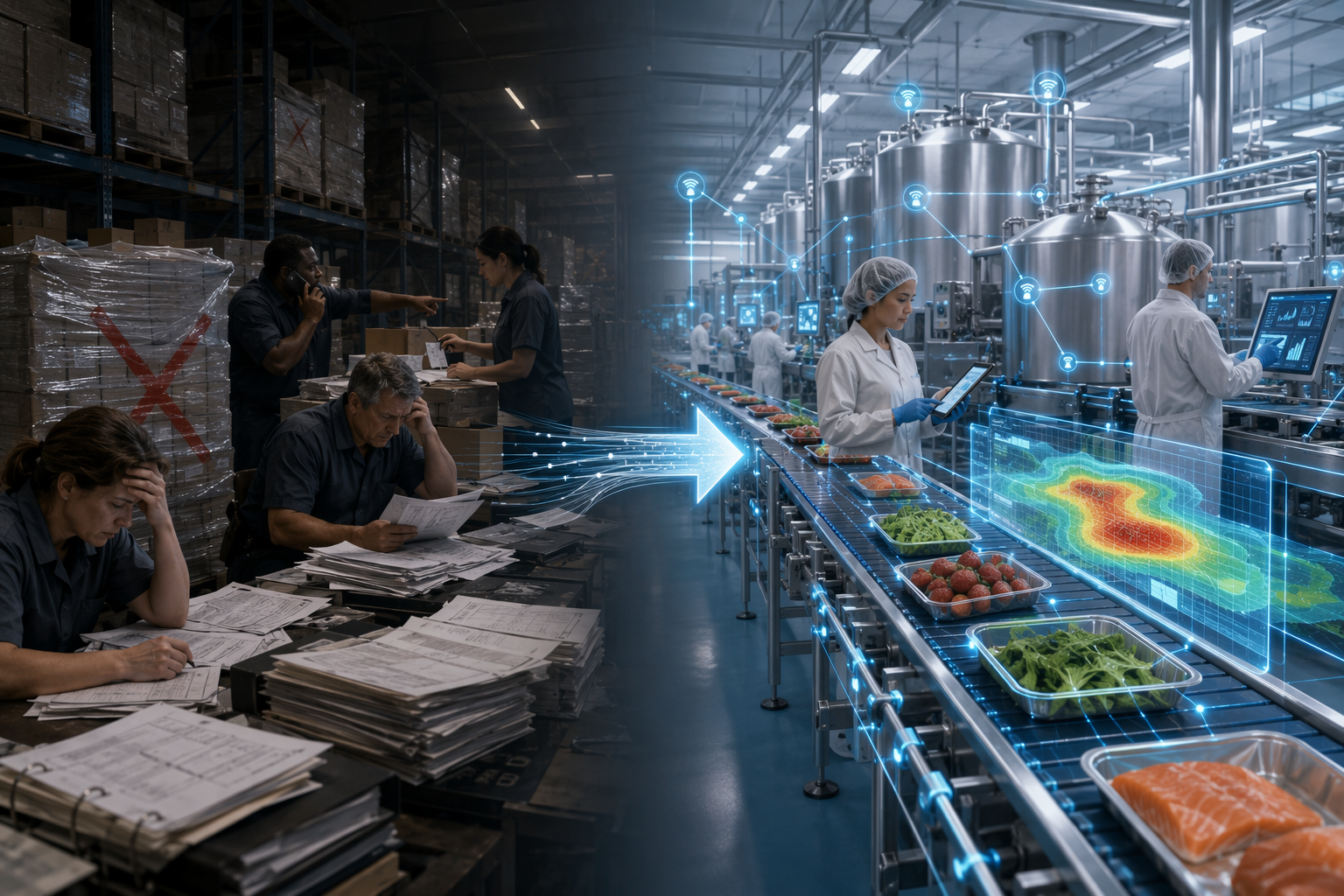
From Tracing Lots To Managing Risk Signals
Traditional traceability answers a backward-looking question: where did this lot come from, where did it go, and what else may have been connected to it? That remains necessary. A company that cannot reconstruct custody, transformation, and shipment events has no stable base for AI. But contamination management is beginning to shift from after-the-fact reconstruction toward earlier risk recognition.
The Institute of Food Technologists described a useful five-layer way to separate the work: Sense, Detect, Predict, Decide, and Prove.[3] The framework is valuable because it keeps very different tasks from being collapsed into one loose phrase, “AI traceability.” A temperature sensor, a computer vision model, a residue classifier, a risk forecast, a recall decision, and an audit trail do not fail in the same way. They should not be evaluated as if they were the same control.
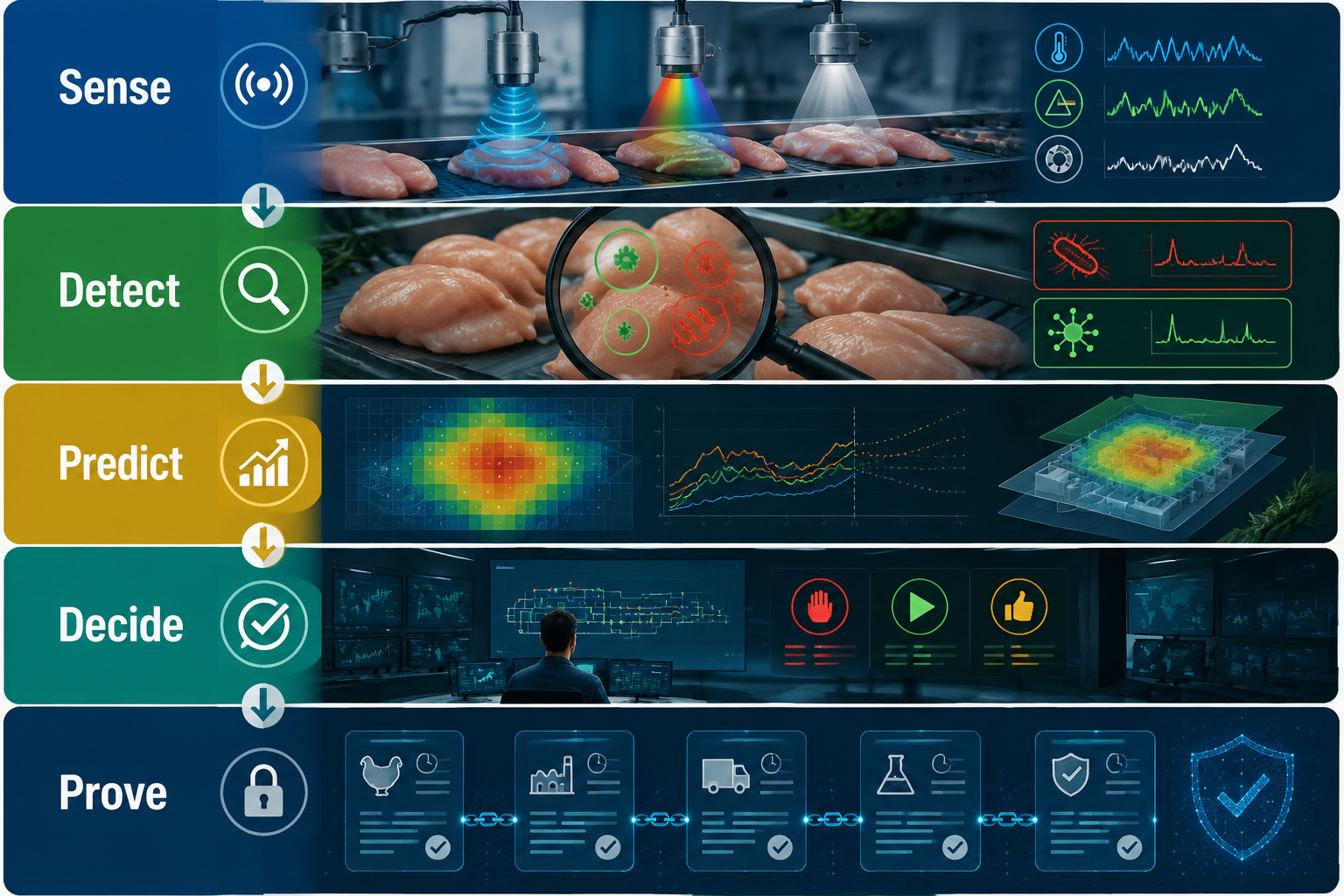
In a working contamination traceability system, the layers look less like a software architecture diagram and more like a chain of custody for evidence. A sensor records a condition. A model flags a deviation, defect, pathogen pattern, or residue signal. A prediction engine estimates whether that signal is likely to matter upstream or downstream. A person or workflow changes inspection, hold, release, sanitation, maintenance, or recall action. Then the company preserves enough proof to show what happened and why.
| Layer | Operational question | What must be trustworthy |
|---|---|---|
| Sense | What happened in the product, process, environment, or shipment? | Sensor readings, timestamps, lot identity, location, calibration, and event capture |
| Detect | Is there a defect, pathogen, residue, anomaly, or process deviation? | Model performance, sampling design, image or signal quality, and escalation thresholds |
| Predict | Where is risk likely to emerge next? | Historical event data, process context, supplier and route history, and uncertainty handling |
| Decide | Should material be held, released, inspected, cleaned, rerouted, or recalled? | Workflow authority, documented rules, exception handling, and human review |
| Prove | Can the company show what it knew and what it did? | Audit trail, provenance, critical tracking events, and change history |
What AI Adds Before A Recall Starts
The first gain is better sensing. Food safety teams have always relied on observations: lab results, line checks, sanitation records, shipment temperatures, receiving inspections, complaints, and supplier documents. AI becomes useful when those observations are captured as structured signals tied to batches, equipment, locations, and time. If the signal cannot be connected to a real event or lot, it may still be interesting analytics, but it is weak traceability.
Detection is where the strongest technical evidence sits. Peer-reviewed work has shown that sensor-based machine learning using colony fingerprinting identified 15 bacteria species at 96% accuracy in 10 hours, compared with 24 hours for traditional culture methods.[4] Other studies cited in the same research stream reported 93.65% accuracy for veterinary drug residue detection in mutton using hyperspectral imaging with CNN-SSAE, and 99.62% accuracy for pesticide residue on fruit surfaces using SERS plus CNN.[4]
Those numbers should be read as feasibility evidence, not a guarantee that a plant can simply install a model and reduce contamination risk. Lab and controlled-study performance depends on sample design, food matrix, lighting, sensor condition, contamination level, and how ambiguous cases are handled. Still, the direction is important. Faster detection gives quality teams a chance to hold suspect product closer to the line, before it is mixed, shipped, repacked, or distributed through more nodes.
Vendor-reported operating outcomes point in the same direction, with the usual caution that they are not the same as independently audited research. Nestlé has reported 80% fewer manual inspection checks through computer vision, while PepsiCo has reported 95% defect detection accuracy.[5][6] Those claims are most useful when treated as examples of where automation can reduce inspection burden or improve consistency, not as universal benchmarks for food safety performance.
Prediction Depends On The Boring Data
Prediction is the layer most likely to be oversold. A model can rank risk, surface unusual patterns, or estimate where exposure may have spread. It cannot compensate for missing receiving records, inconsistent lot naming, unlinked rework, undocumented line changeovers, or sensor data that sits outside the traceability record. Predictive contamination traceability is only as strong as the event trail it reads.
A useful prediction might be modest. A chilled shipment with repeated temperature excursions, a supplier lot associated with abnormal inspection findings, and a production run that shared equipment before sanitation verification may deserve earlier hold-and-test treatment. A route, product type, or facility may need tighter sampling for a period. These are not dramatic “AI prevents recall” moments. They are operational adjustments that reduce the chance that weak signals remain scattered until a complaint or lab result forces a larger response.
The decision layer is where the system either earns trust or loses it. Food safety directors do not need a black-box score that says “high risk” without explaining the input events. They need to know whether the score came from a pathogen screen, a temperature breach, a supplier certificate mismatch, a sanitation deviation, a machine vision defect cluster, or a shipment history pattern. They also need a way to override, confirm, escalate, and document the action.
Interoperability Matters More Than The Label On The Infrastructure
A traceability program usually breaks at handoffs. Supplier to processor. Processor to co-packer. Plant to warehouse. Distributor to retailer. If each party describes products, locations, transformations, and shipments differently, an AI layer spends too much of its time translating messy records instead of recognizing risk.
That is why standards-based event data deserves more attention than branded infrastructure. GS1 EPCIS gives companies a common way to represent traceability events such as what happened, when it happened, where it happened, and why it happened. The IFT Traceability Driver has been reported to cut seafood traceability deployment time by about 60%.[7] That kind of reduction matters because implementation time is not just an IT metric; it is the period during which plants, suppliers, and customers are still operating with partial visibility.
Blockchain can be part of a system, but it is not the discipline itself. If the underlying events are incomplete, late, duplicated, or poorly mapped to lots, putting them on a blockchain does not make them operationally useful. Clean critical tracking events, consistent identifiers, and reliable provenance across transformations are the part that food safety teams will depend on when a recall clock starts.
The Regulatory Clock Is Slower Than The Operating Need
The FDA has extended compliance for the FSMA Food Traceability Rule to July 2028.[8] That extension may reduce immediate compliance pressure, but it does not change the basic work. Companies still need to capture and exchange the critical tracking event data that will let them identify where covered foods moved and how they changed form across the supply chain.
For AI projects, the extension creates a practical sequencing question. A company can wait for the deadline and then rush to document minimum records, or it can use the same data model as the backbone for higher-value QA and risk workflows. The second path is harder, but it is the one more likely to produce operational value before the next compliance review.
Market forecasts add some context, but they should not drive the buying decision. Estimates for the AI food supply chain opportunity vary widely, from $13 billion to $34.35 billion depending on scope, with Supply Change Capital citing a mid-range estimate of $28.4 billion by 2030.[9] That spread says investment is rising. It does not say whether a specific plant has the event discipline, equipment readiness, or inspection workflow maturity to benefit.
What Makes Production Deployment Hard
The constraint is rarely model ambition alone. AI QA equipment can cost 5–8 times more than traditional equipment, and typical OEE before AI deployment sits around 65–72%.[10] In a plant already fighting downtime, labor gaps, sanitation windows, and throughput pressure, another inspection station or sensor layer has to fit the operating rhythm. If it creates holds that nobody can resolve, alerts that supervisors learn to ignore, or data that quality cannot defend, the system becomes noise.
The practical implementation test is simple: can the company connect a signal to an action? A residue flag should identify the product, lot, sample context, equipment, supplier, and disposition path. A computer vision defect cluster should trigger a known review process, not just populate a dashboard. A temperature excursion should connect to shipment identity, receiving decision, and downstream exposure. The audit trail should show not only that an alert fired, but who reviewed it and what changed.
Mid-size manufacturers do not have to start with a full predictive traceability buildout. COA and HACCP automation may be a more realistic first move, especially where records still arrive as PDFs, spreadsheets, emails, or scanned forms. IONI AI, for example, has advertised an AI food safety stack starting at about $199 per month, but that is a specific vendor price, not a market benchmark.[11] The broader point is that document automation, certificate checks, HACCP record review, and exception routing can create cleaner event data before a company asks AI to predict contamination risk across the network.
Predictive maintenance can also be a faster first return than full contamination prediction. Equipment failure, worn parts, lubrication issues, and unstable process conditions can create quality and safety exposure before they appear as finished-product defects. If maintenance signals are already being captured with reasonable reliability, linking them to QA holds, sanitation verification, and line-release decisions can build the same habit that traceability needs: events are recorded, interpreted, acted on, and preserved.
A Buyer’s Test For AI Traceability
A credible AI traceability system should survive a recall-room line of questioning. Which critical tracking events does it capture? How does it preserve lot identity through receiving, transformation, rework, packing, storage, and shipment? Which sensors or inspection systems feed it? How are false positives and uncertain results handled? Who has authority to hold or release product? Can the company prove the timing and basis of each decision after the fact?
The strongest near-term use cases are likely to appear where event data, QA automation, and inspection workflows are already disciplined. In those environments, AI can make contamination signals visible earlier, narrow the scope of investigation, reduce manual record reconciliation, and support faster, better-documented decisions. In weaker environments, the first project may need to be less glamorous: standardize event capture, automate supplier documentation, clean up lot genealogy, and connect existing inspection results to real disposition workflows.
AI-enabled traceability is already credible as a food supply chain use case. The mistake is treating predictive prevention as something bought in the algorithm layer. It is assembled from sensing, detection, prediction, decision rights, standards-based data exchange, and proof that holds up after the pressure has passed.
References
- Food safety, World Health Organization.
- Walmart and IBM Food Trust food traceability reporting, IBM.
- Food Technology Magazine, June 2026, Institute of Food Technologists, June 2026.
- Foods, PMC/Foods, 2025.
- Nestlé computer vision inspection case study, Nestlé.
- PepsiCo defect detection case study, PepsiCo.
- Traceability Driver, Institute of Food Technologists and Supply Change Capital.
- FSMA Final Rule on Requirements for Additional Traceability Records for Certain Foods, U.S. Food and Drug Administration.
- Supply Change Capital food supply chain AI market estimate, Supply Change Capital.
- OEE benchmark reporting, KAIZEN Institute, 2026.
- AI food safety stack pricing, IONI AI.
Comments
Join the discussion with an anonymous comment.