
For a small manufacturer or importer, supply chain compliance rarely arrives as a neat strategic project. It shows up as a customer questionnaire due Friday, a missing certificate holding up an order, a forced-labor due diligence request from a larger buyer, or a tariff classification problem no one has time to own. That is why the practical question around ai for small business supply chain compliance is not whether the technology sounds impressive. It is whether it can remove enough repeated work that a company without a compliance department can keep shipping, keep customers, and avoid hiring a specialist before the business can support one.
The answer is now plausibly yes, if the first move is narrow. The strongest case is not that AI can run a whole compliance program for a small business. It is that supplier screening, document classification, document validation, supplier outreach, and regulatory monitoring have become repetitive enough for targeted automation to pay back in hours rather than in theory.
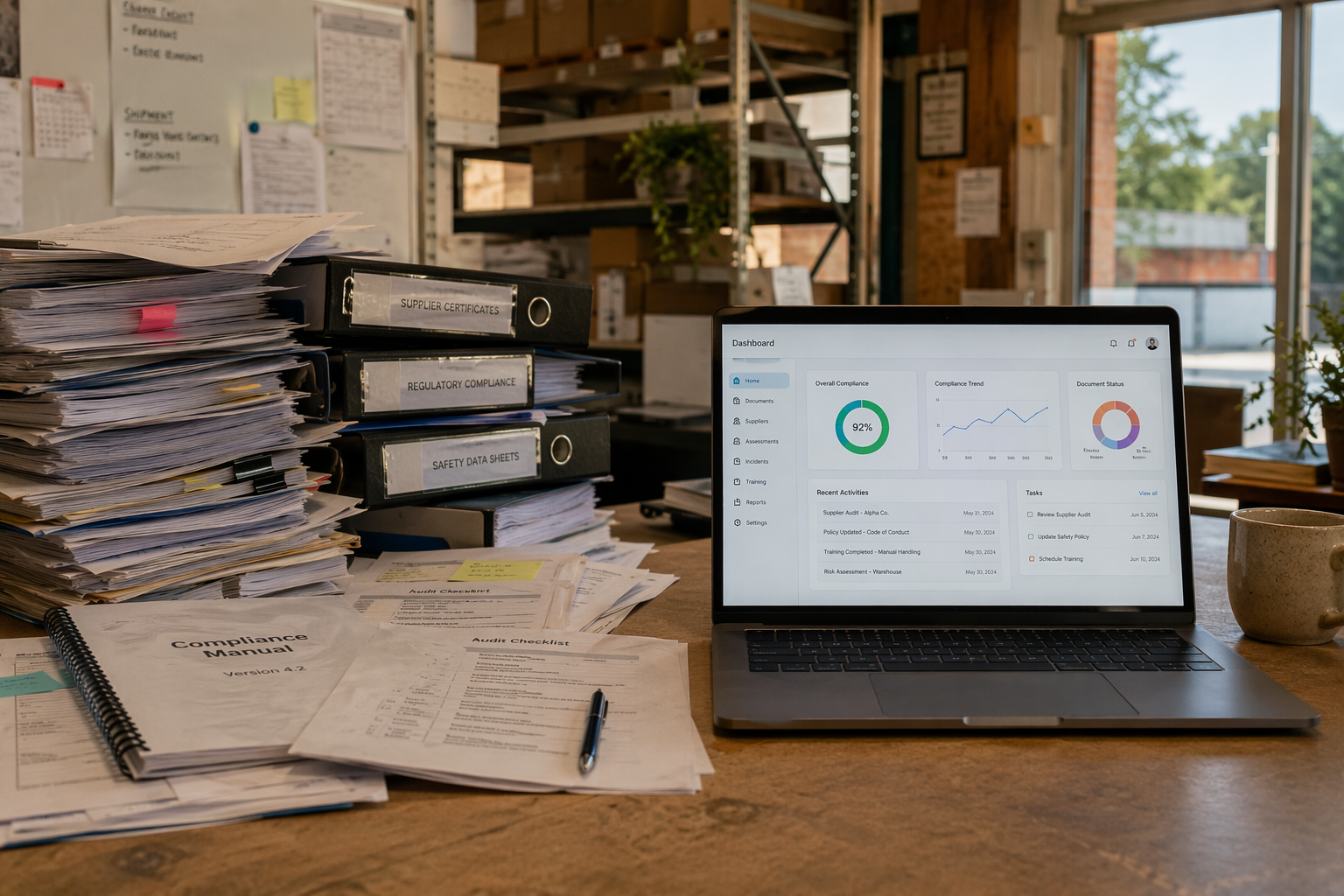
Manual Compliance Has Become the Expensive Option
The old advice to “build a compliance program” can sound reasonable until the bill is put next to a small company’s payroll. Certivo estimates that traditional compliance programs for small manufacturers cost about $265,000 per year across staff, audits, software, and travel, before hidden costs are counted.[1] The figure is useful because it makes the scale of the problem visible, though it should be treated carefully: it comes from a vendor blog, and the underlying methodology is not fully transparent.
Even when a business avoids that formal spend, the work does not disappear. Tradeverifyd reports that 69% of compliance and supply chain teams spend more than 11 hours each week on manual data translation for regulatory submissions.[2] In a 60-person supplier, that time is usually not sitting inside a dedicated compliance function. It is taken from purchasing, operations, quality, customer service, or the person who knows where the supplier folders are saved.
That hidden labor matters because compliance pressure is moving downstream. Large customers are asking smaller suppliers for traceability, certifications, sanctions checks, country-of-origin documentation, ESG attestations, and forced-labor due diligence. Regulators are adding pressure from the other side: Tradeverifyd reports that UFLPA enforcement has stopped more than $1 billion in suspect shipments, and that 73% of supply chain leaders expect to hit their tariff absorption wall by the end of 2026.[2] The EU Corporate Sustainability Due Diligence Directive adds another reason large buyers will push supplier due diligence deeper into their networks, with fines described as reaching up to 5% of annual revenue.[2]
For SMBs, the bind is obvious. Doing nothing risks customer loss, shipment delays, and last-minute remediation. Building a multinational-style compliance operation can be financially unrealistic. The useful space for AI sits between those two bad options.
Why AI Is No Longer Only an Enterprise Compliance Tool
AI in compliance used to be packaged for companies with global procurement teams, legal departments, and implementation budgets that could absorb long projects. That is changing because many of the tasks now being automated are not glamorous. They are document reading, field extraction, supplier matching, questionnaire routing, web monitoring, translation, and exception flagging.
Broad adoption data supports the direction of travel, though not every figure should be read as an SMB benchmark. Thomson Reuters reports that 40% of organizations now use generative AI for compliance, up from 22% the prior year.[3] Tradeverifyd reports that 48.7% of organizations have adopted AI-powered predictive analytics for daily workflows.[2] These are cross-market signals, not proof that every small importer is already using AI for trade compliance. Still, they suggest that AI-assisted compliance workflows are moving out of the experimental corner.
The affordability claim is strongest when the scope is specific. Certivo says its platform can reduce manual compliance work by 70–80%, cost up to one-tenth the price of legacy compliance solutions, and maintain 100% data accuracy.[1] Those are vendor-published claims, not independently audited industry averages. Used correctly, they are still helpful benchmarks: they show what vendors are now promising for the exact work small teams struggle to finish manually.
A broader small-business proxy points in the same direction. Fluer reports that small businesses using AI across supply chain operations see average cost reductions of 10–20%.[4] That is not a compliance-only result, so it should not be treated as a guaranteed compliance ROI. But it is a reasonable range to keep in mind when a small business is deciding whether automation can reduce total operating friction, not just produce a cleaner dashboard.
The First Use Cases Should Be Boring
The easiest way to waste money on AI compliance is to buy a broad platform before naming the bottleneck. A small business does not need to automate “compliance” in the abstract. It needs to identify the piece of work that repeats, consumes hours, and creates customer or shipment risk when delayed.
| Pain point | AI use case | Why it is a good first move |
|---|---|---|
| New supplier approval is slow or inconsistent | Automated supplier screening | The system can collect public signals and flag risks before a buyer spends hours reviewing the supplier manually. |
| Certificates, declarations, and forms sit in email or folders | Document classification and validation | The work is repetitive, rule-based, and easy to measure in hours saved. |
| Suppliers ignore questionnaires or respond in the wrong format | Automated supplier outreach | The system can send reminders, translate outreach, and track responses without one employee chasing every supplier. |
| Regulatory updates are noticed too late | Regulatory monitoring | The system can watch for changes and route likely relevant updates for review. |
These are not the only possible use cases, but they are the ones most likely to create credible savings without requiring a full enterprise governance buildout. They also match the daily pain of the unofficial compliance owner: finding documents, checking documents, asking suppliers for missing answers, and noticing rule changes before a customer does.
Supplier Screening Before the Purchase Order
Automated supplier screening is a strong first candidate because it reduces the amount of research needed before onboarding or renewing a supplier. IntegrityNext describes AI screening that analyzes public supplier data, including websites, ESG reports, certifications, and news, then generates risk signals in minutes.[5] That does not replace a purchasing decision or a human review. It changes where the human starts.
For a small importer, the practical gain is triage. A supplier with missing public information, adverse news, expired certificates, or unclear sourcing claims can be moved into a review queue. A lower-risk supplier can proceed with standard documentation. The buyer is no longer treating every supplier as if it needs the same level of manual investigation.
A company that already uses scoring logic can compare SMB-focused tools against more advanced AI supplier risk scoring approaches, then keep only the parts it can actually maintain.
Document Validation Is Where the Hours Become Visible
Document work is usually the best place to test an AI compliance tool because the baseline is easy to see. How many certificates arrive each week? How many supplier declarations need review? How often does someone retype data from a PDF into a spreadsheet? How many customer requests are delayed because a form exists somewhere but has not been matched to the right supplier or product?
Certivo gives one of the more concrete examples in the available material: a cardiac device manufacturer cut document validation time from 30 hours per week to 4 hours using automated document validation.[1] That case deserves attention because the mechanism is plain. The system did not need to “transform compliance.” It reduced a known recurring task by 26 hours a week.
That kind of reduction can matter more to an SMB than a sophisticated analytics feature. If the same operations lead is handling production scheduling, supplier follow-up, customer audits, and certificate review, reclaiming even part of that time changes what gets done before the end of the week. It can also reduce the risk of rushed reviews, stale certificates, and documents accepted because no one had time to check them properly.
A sensible pilot would not begin with every document type. It would start with a small set: certificates of origin, supplier declarations, product compliance certificates, or customer-required forms. The test is whether the tool can classify the document, extract the fields that matter, flag missing or expired information, and route exceptions for review. If it cannot do that on existing files, a sales demo is not enough.
Supplier Outreach Is Often the Cheapest Bottleneck to Remove
Many compliance delays are not caused by difficult legal interpretation. They are caused by waiting. A supplier has not answered the questionnaire. A certificate is missing. A factory contact changed. The email went to a sales inbox. Someone promised to send the declaration after a holiday and never did.
Certivo reports that modern AI systems achieved a 92% supplier response rate in 8 days using multilingual automated outreach, compared with 55% manually.[1] Again, this is a vendor-published benchmark, but it points to a real operational lever. If automated reminders, translation, status tracking, and escalation improve supplier response, the compliance owner spends less time chasing and more time reviewing the exceptions that actually need judgment.
The best outreach tools for an SMB are not necessarily the most complex. They should make it clear which suppliers have not responded, which responses are incomplete, which documents are attached, and which requests are approaching a customer deadline. A small team should be able to see the queue without building a reporting layer of its own.
Regulatory Monitoring Should Feed a Review Queue, Not Panic
Regulatory monitoring is attractive because the world is moving quickly: forced-labor enforcement, due diligence laws, tariff changes, sanctions, and customer-specific standards all affect supply chain decisions. But this is also where small companies should be careful. A tool that floods a small team with alerts can become another inbox to ignore.
The useful version is filtered monitoring. SupplyChainBrain, discussing Zycus, describes AI-supported supplier compliance as enabling continuous monitoring rather than relying only on periodic audits.[6] For an SMB, continuous monitoring should mean the system watches for relevant supplier, product, geography, or regulatory changes and sends a manageable number of items for review. It should not mean the operations lead receives every policy update from every jurisdiction.
Companies exposed to forced-labor enforcement may also need specialized trade-compliance tools. For context on that narrower problem, see this profile of Altana for trade compliance and forced-labor risk. The lesson for small businesses is not to buy the most advanced tool first. It is to match the monitoring scope to the risks that can actually block shipments or customers.
What Savings Are Realistic?
The cleanest savings target is hours, not dollars. If a team spends 11 or more hours a week translating data, rekeying supplier information, checking PDFs, and chasing documents, a pilot should measure whether those hours fall.[2] If document validation drops from 30 hours to 4 in a comparable workflow, the result is visible before anyone builds a complicated ROI model.[1]
Cost savings are harder to generalize. The 70–80% manual-work reduction claimed by Certivo is plausible for repetitive compliance tasks, especially document and outreach workflows, but it should not be applied to every compliance activity.[1] Human judgment is still needed for supplier decisions, customer negotiations, exception handling, and policy choices. The 10–20% cost reduction reported by Fluer is a useful small-business supply chain benchmark, but it covers AI across supply chain operations broadly, not compliance alone.[4]
A grounded target for an SMB is therefore narrower: reduce manual compliance administration first, then see whether the saved labor prevents overtime, avoids outside consulting, improves customer response times, or delays the need for a dedicated hire. That is still a serious financial result, even if it does not show up as a simple software-versus-salary comparison.
How to Start Without Buying an Enterprise Program
The right adoption path for a small business is deliberately modest. Start with one bounded pain point, use existing documents and supplier records to test vendors, and expand only after the tool proves it can reduce manual work without creating a new cleanup project.
- Name the bottleneck in operational terms: supplier onboarding delay, certificate review time, missing questionnaire responses, regulatory update tracking, or customer audit preparation.
- Collect a real test set: recent supplier records, certificates, declarations, questionnaires, and examples of bad or incomplete submissions.
- Ask vendors to process that test set before purchase, not a polished demo set.
- Measure the baseline and the result: hours spent, documents processed, exceptions flagged correctly, supplier response rate, and customer turnaround time.
- Keep a human review point for exceptions, rejected documents, supplier risk decisions, and regulatory interpretations.
- Expand only after the first workflow saves time consistently for the person who actually owns the work.
This approach also protects against bad source data. AI can classify and compare documents quickly, but it cannot fix supplier records that are duplicated, outdated, or missing basic identifiers without some cleanup. If a company has five names for the same supplier, expired certificates stored under old folders, and no standard product-to-supplier mapping, the first phase may need to include data housekeeping. That is not a reason to avoid AI; it is a reason to keep the pilot small enough to control.
Vendor selection should also stay practical. A small business should look for clear pricing, fast setup, exportable records, audit trails, support for the documents it actually uses, and workflows that non-specialists can operate. If the tool requires months of configuration, a dedicated administrator, or a consultant to interpret every result, it may recreate the enterprise burden it was supposed to remove.
The Affordable Version Is Targeted, Measured, and Slightly Skeptical
Small businesses can now realistically use AI for supply chain compliance, but the affordable version is not a miniature copy of a Fortune 500 compliance program. It is a focused workflow that removes repeated work: screen suppliers faster, validate documents faster, get suppliers to respond faster, and monitor the few regulatory changes most likely to affect shipments or customer demands.
The strongest targets are manual-work reductions in the 70–80% range for bounded tasks and broader cost improvements in the 10–20% range where AI reduces supply chain operating friction.[1][4] Those numbers are better treated as plausible targets than promises. The company still has to choose the right workflow, test the vendor against real records, preserve human review, and measure saved hours before expanding.
For the overextended operations lead or procurement manager, that is enough to change the decision. The question is no longer whether to build a full compliance department or keep patching the process by hand. The first question is which recurring compliance task can be automated this quarter, measured next month, and improved before the next large customer asks for proof.
References
- AI in Supply Chain Compliance Management, Certivo, 2025.
- Supply Chain Statistics, Tradeverifyd, 2026.
- The Future of Trade Compliance: How AI Is Transforming Global Trade Management, Thomson Reuters, 2026.
- Optimizing Supply Chain With AI for Small Businesses, Fluer, 2024.
- AI Screening for Supply Chain Due Diligence, IntegrityNext, 2026.
- Streamlining Supply Chain Regulatory Compliance With AI, SupplyChainBrain.
Comments
Join the discussion with an anonymous comment.