
An AI-augmented supply chain ransomware response plan has to start with an uncomfortable possibility: the first compromised system may not be yours. The incident bridge opens, the ransomware checklist comes out, and the security team starts asking which internal endpoint, account, or server was the point of entry. Meanwhile, the path that matters may run through a supplier portal, a managed service provider console, an OAuth token, a file-transfer dependency, or a vendor tool that operations has trusted for years.
That is where clean incident response diagrams usually break. They assume asset ownership is obvious, access can be cut inside one perimeter, and communications can be controlled by one organization. Supply chain ransomware does not respect those assumptions. It turns trust relationships into attack paths, and it turns vendor uncertainty into operational delay.
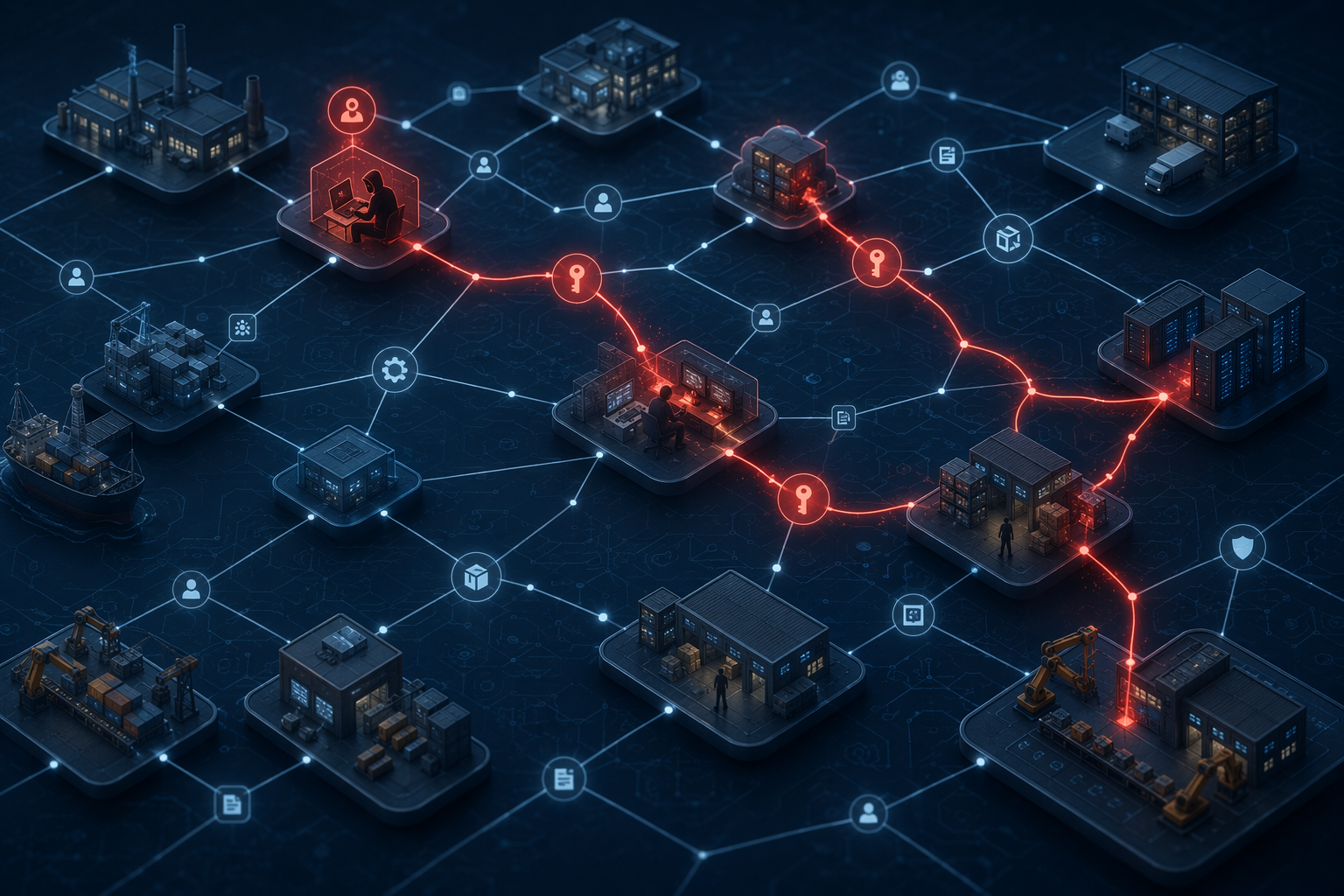
The practical consequence is not limited to encryption. A ransomware event in a physical supply chain can become a production, fulfillment, logistics, and customer-commitment problem before anyone has a complete forensic answer. The Fairlife ransomware case study is a useful reminder because the harm is not abstract: when digital access and supplier operations are entangled, response delays show up in the plant and in the delivery schedule.
The Old Plan Fails Before Containment Starts
Traditional ransomware response usually starts by isolating affected assets, disabling suspect accounts, preserving evidence, restoring from backups, and communicating with stakeholders. Those actions still matter. The failure is that the plan often assumes the organization can identify the affected assets and accounts without first reconstructing the external relationship that carried the attack.
A supplier risk manager inherits a different problem. A vendor says it is “still investigating.” An MSP cannot yet confirm whether its remote management tooling was abused. Procurement owns the contract, IT owns the integration, operations owns the outage, legal owns notification language, and nobody owns the full dependency map. By the time that ownership gap is visible, the attacker may already have used the trusted channel for lateral movement, data theft, or extortion.
The visibility numbers are blunt. In SecurityScorecard’s 2026 supply chain cybersecurity survey, 78% of organizations reported that their programs cover less than half of their vendor ecosystem. The same report says 60% take eight or more days to remediate high-severity issues, with manual email and phone communication identified as a key reason. It also found that 90% of leaders express confidence in their programs while 67% still rely on static security audits.[1]
That confidence gap is the working problem. It does not prove those organizations were breached; the survey is self-reported. But it does show why the response plan has to move away from annual assurance and toward live evidence. A questionnaire that looked acceptable last quarter cannot tell the incident bridge whether a vendor token was used at 2:17 a.m., whether an MSP session touched a production subnet, or whether a vulnerable dependency is present in the fulfillment application that now cannot be taken offline casually.
Rebuild The Plan Around Trusted Relationships
The response plan should treat vendors, MSPs, SaaS integrations, open-source components, and managed file-transfer services as part of the incident surface. That does not mean every supplier receives the same monitoring or the same emergency process. It means the plan cannot wait until an outage to learn which relationships have privileged access, operational impact, or dependency concentration.
| Failure Mode | What The Plan Must Be Able To Answer | AI-Augmented Capability |
|---|---|---|
| Vendor or MSP access abuse | Which trusted accounts, tools, sessions, and tokens touched critical systems? | Continuous behavioral monitoring and anomaly detection |
| Unknown dependency exposure | Which applications, packages, SBOM entries, file-transfer systems, or supplier tools are implicated? | Automated dependency and SBOM scanning |
| Slow cross-company coordination | Who must approve containment, who must be notified, and what evidence supports the decision? | Agentic response workflows with human approval |
| Static vendor assurance | Which supplier risk records, contracts, and escalation paths are outdated? | Post-incident governance updates |
IBM’s 2025 Cost of a Data Breach Report gives the structural reason this matters: supply chain compromise averaged $4.91 million and took 267 days to identify and contain, the longest lifecycle among breach vectors in that report. That is not a ransomware-only benchmark and should not be used as one. It is still a warning about the shape of the work: third-party compromise is slow because evidence and authority sit across organizational boundaries.[2]
Continuous Monitoring Before The Call Comes
The first redesign is pre-incident monitoring. Supply chain ransomware response improves when the organization already has a live picture of supplier behavior: normal login sources, usual API usage, expected MSP maintenance windows, standard file-transfer patterns, typical privileged actions, and the applications each vendor is allowed to touch. Without that baseline, every anomaly becomes a debate after the fact.
AI helps here because humans are poor at continuously watching relationships that are quiet until they are not. A model can flag a vendor account authenticating from an unusual geography, an MSP tool starting sessions outside its normal change window, an OAuth token calling new APIs, or a supplier integration suddenly moving a larger-than-usual volume of files. None of those signals proves ransomware. They help narrow the investigation before the blast radius is defined by rumor.
The useful monitoring design is not “watch every vendor equally.” It tiers suppliers by operational consequence and access. A janitorial vendor in the payment system deserves different treatment than a packaging supplier with no network access. An MSP with remote administrative tooling deserves emergency containment procedures before a low-risk vendor questionnaire gets another formatting pass. The AI layer should inherit that risk model instead of treating every third party as the same kind of node.
- Monitor vendor and MSP accounts against expected access paths, maintenance windows, and privileged action patterns.
- Correlate identity, endpoint, network, SaaS, and file-transfer logs so a supplier alert is not trapped in one console.
- Maintain an emergency access matrix showing which vendor connections can be suspended, rate-limited, token-rotated, or moved to manual approval.
- Pre-assign business owners for critical supplier relationships so containment does not wait for contract archaeology.
Procurement security teams evaluating this layer can use an AI supplier risk monitoring vendor directory as a starting point, but tool selection is the easy half. The harder question is whether the organization has defined what the tool is allowed to do when it sees risky supplier behavior. Alerting without authority only creates a faster inbox.
During The Incident, Monitoring Becomes Triage
When ransomware is suspected, continuous monitoring should immediately answer a short list of operational questions. Which supplier identities authenticated recently? Which MSP tools executed commands? Which vendor-owned integrations touched production, inventory, order management, finance, or warehouse systems? Which tokens are still valid? Which privileged sessions are active now?
Those answers change containment. Instead of issuing a broad instruction to “disable third-party access,” the response team can suspend the specific remote management route, rotate the implicated token, require step-up approval for a supplier integration, or isolate the network segment that actually received vendor-originated activity. Operations teams need that precision because an overbroad shutdown can create a second incident in the name of containing the first.
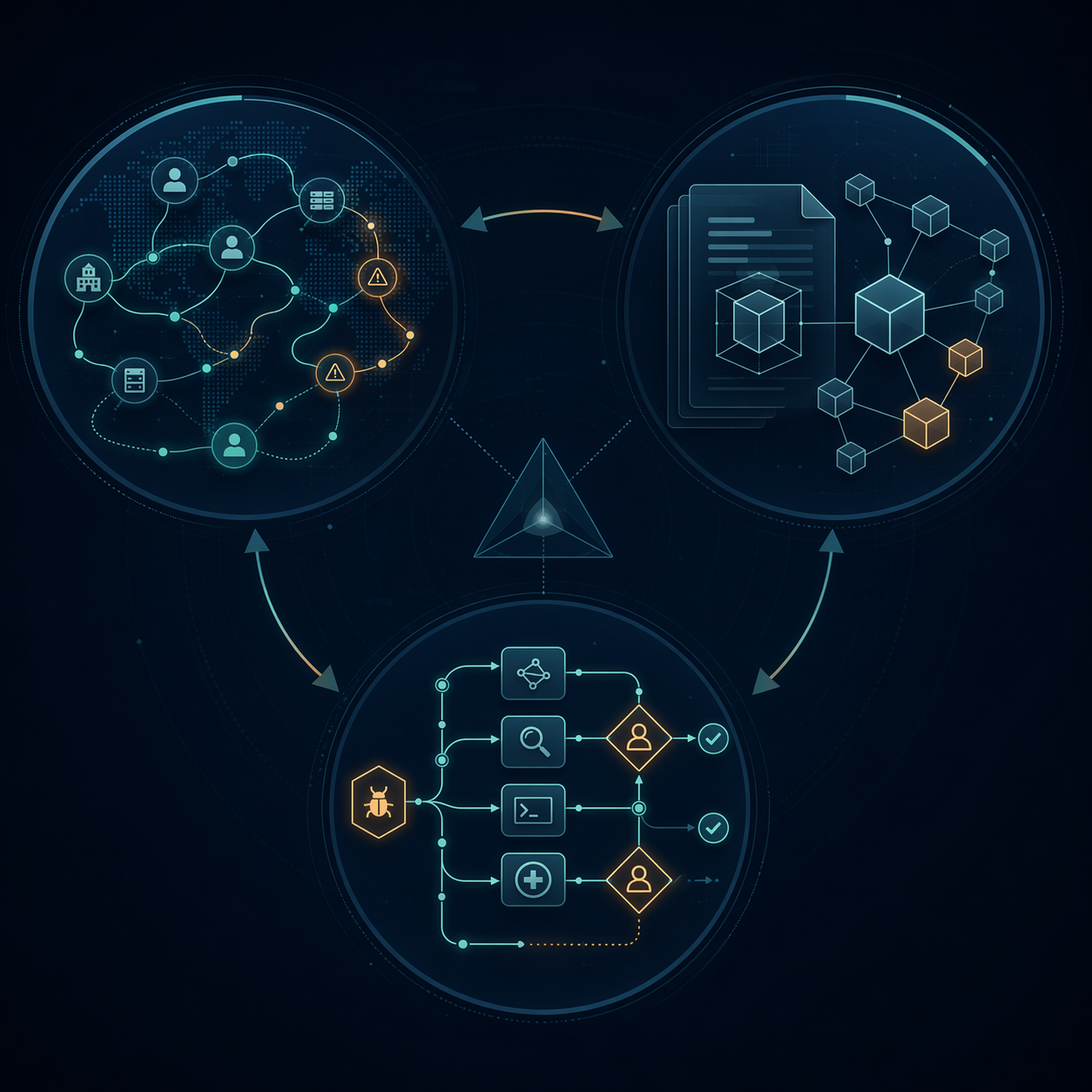
Dependency Scanning Is The Other Half Of Containment
Vendor monitoring tells the team who behaved abnormally. Dependency scanning tells the team what may be exposed even if no one logged in directly. This is where many ransomware plans are still too endpoint-centered. They can find encrypted laptops and servers, but they cannot quickly answer whether a compromised supplier tool, file-transfer system, package, library, container image, or SaaS connector sits inside a critical workflow.
Automated SBOM and dependency scanning should be wired into the response plan before the emergency. The plan needs current inventories of software components, supplier-provided applications, managed integrations, internet-facing transfer systems, and the business processes they support. When a vendor, product, package, or service is implicated, the response team should be able to search exposure by dependency and operational owner, not by asking each application team to manually check a spreadsheet.
IBM’s report notes that 30% of incidents involving AI models and applications involved supply chain compromise, and that 44% of zero-day attacks targeted managed file-transfer systems. Those figures are not a reason to panic about every integration. They are a reason to stop treating supplier-hosted tools and transfer services as administrative plumbing outside the response plan.[2]
The dependency scan should produce an action view, not a technical inventory dump. A useful response output says: this package appears in these applications; these applications support these plants, warehouses, customer portals, or finance processes; these owners must approve downtime; these compensating controls are available; these suppliers must provide status; these records need to be preserved.
- Search SBOMs, package manifests, container images, and vendor application inventories for the implicated component or product.
- Map technical exposure to business processes, sites, shipment flows, customer commitments, and regulatory obligations.
- Prioritize containment by exploitability, privilege, network reachability, and operational criticality.
- Preserve scan results, timestamps, vendor notices, and containment decisions as part of the incident evidence trail.
This is also where AI can be useful without pretending to be magical. It can normalize supplier product names, match advisories to internal components, identify likely duplicate records, cluster exposed systems by owner, and draft an initial impact map. A human still decides whether to shut down a line, block a vendor tunnel, or accept temporary manual processing.
Agentic Workflows Need Guardrails, Not Theater
Agentic incident response workflows are attractive because supply chain incidents create a large number of small, urgent tasks. Someone has to triage alerts, connect supplier activity to internal assets, draft outreach, open tickets, compare vendor statements against observed telemetry, prepare executive updates, and keep an evidence trail. That is exactly the work that gets messy when the incident bridge is waiting for “one more confirmation.”
A bounded agentic workflow can help by gathering context and proposing actions. For example, when a critical MSP account shows unusual command execution, the workflow can pull recent sessions, identify affected assets, retrieve the contract owner, draft a supplier escalation note, recommend token rotation or session termination, and prepare the change ticket. The important word is “recommend.” Suspending a supplier integration that supports production or fulfillment is a consequential decision, not a chatbot convenience.
| Workflow Task | AI Can Do | Human Must Own |
|---|---|---|
| Alert triage | Cluster related vendor, identity, endpoint, SaaS, and network signals | Confirm incident severity and business impact |
| Supplier mapping | Identify connected vendors, contracts, business owners, and affected systems | Decide escalation priority and communication posture |
| Containment preparation | Draft token rotation, access suspension, segmentation, or monitoring recommendations | Approve actions that disrupt supplier operations or internal production |
| Outreach | Draft vendor questions, status requests, and evidence preservation instructions | Send legally and commercially sensitive communications |
| Evidence trail | Log timestamps, data sources, decisions, and pending approvals | Validate completeness for legal, insurance, regulatory, and board reporting |
Claims that AI sharply compresses response timelines should be handled carefully when they come from vendors. They may be useful for product evaluation, but they should not substitute for testing the workflow against the organization’s own supplier access model. A tool cannot approve a production-impacting containment step if the company has never assigned who has that authority.
The more credible use of agentic response is narrower and more valuable: reduce the time wasted finding owners, reconciling records, drafting repeatable communications, and assembling evidence. The incident commander should see the proposed action, the supporting signals, the affected business process, the supplier contact, the rollback path, and the approval required. If any of those are missing, the workflow is not ready to operate under pressure.
Contain Supplier And MSP Access Without Creating A Blind Shutdown
A supply chain ransomware plan needs specific containment procedures for supplier and MSP access. Generic language about disabling accounts is not enough. The plan should separate access paths by function: remote administration, API integration, file transfer, SaaS delegation, service accounts, OAuth grants, VPN tunnels, privileged break-glass accounts, and shared operational portals.
Each access path needs a containment menu. Some can be suspended immediately. Some should be limited to read-only access. Some require token rotation. Some need temporary IP allowlisting. Some can be shifted to manual exchange for a short period. Some are so tied to plant, warehouse, or shipment execution that the response team must involve operations before acting.
- For MSP tools, predefine when to terminate active sessions, disable remote execution, require step-up approval, or move to monitored emergency access.
- For OAuth and API integrations, predefine token rotation, scope reduction, grant revocation, and temporary manual approval procedures.
- For file-transfer services, predefine quarantine, hash review, transfer suspension, alternate channel approval, and recipient notification steps.
- For supplier portals, predefine account suspension, password reset, MFA re-enrollment, session review, and transaction audit steps.
AI can support this by matching the alert type to the relevant containment menu and checking whether the affected supplier has an exception, contract requirement, or operational dependency. It should not flatten the decision into “block the vendor.” In supply chains, containment has to reduce attacker access while preserving enough operational function to avoid unnecessary secondary disruption.
Recovery Has To Assume Extortion, Not Just Encryption
Backup restoration remains necessary, but it is not a complete supply chain ransomware response. If the attacker used a vendor channel, the organization must know what data or operational records the channel could access. Purchase orders, shipment schedules, product specifications, customer records, payment files, quality documentation, and supplier pricing may all sit in systems that are operationally boring until they are stolen.
The recovery plan should therefore run two tracks. One restores systems and business processes. The other reconstructs access and exposure: which supplier identities were used, which repositories or applications they reached, which files moved, which logs are missing, and which downstream parties may need notice. The second track is where legal, privacy, procurement, customer account teams, and regulatory owners enter earlier than many technical playbooks assume.
AI-assisted log review can help prioritize likely data access events, group similar file movements, and compare supplier statements with internal telemetry. It should also mark uncertainty. “No evidence found” is different from “logs unavailable,” and both are different from “vendor has not confirmed.” Those distinctions matter when executives are deciding what to tell customers, regulators, insurers, and downstream partners.
Post-incident reporting also has a policy dimension. Organizations watching government activity around AI and supply chain security can track broader context through coverage of Homeland Security’s growing role in AI supply chain security, but the operational point is immediate: incident records must connect technical findings to supplier accountability, contract obligations, and any required notifications.
What The Revised Response Plan Should Contain
The mature version of this plan is not a thicker ransomware binder. It is a set of live capabilities tied to authority. The organization should be able to move from a supplier-originated signal to a containment decision without first rebuilding its vendor map by hand.
- Continuous vendor and MSP behavioral monitoring that baselines trusted access and flags abnormal identity, API, session, file-transfer, and privileged activity.
- Automated dependency and SBOM scanning that maps supplier tools, packages, transfer services, and software components to business processes and owners.
- Supplier and MSP access containment procedures with preapproved options for token rotation, grant revocation, session termination, scope reduction, segmentation, and monitored emergency access.
- Agentic response workflows that triage alerts, map affected vendors, draft outreach, recommend containment actions, and maintain evidence trails while keeping human approval over disruptive decisions.
- Data-theft-aware recovery that investigates exposure, not only restoration, and separates confirmed access, unavailable evidence, and unverified supplier claims.
- Post-incident governance that updates vendor risk records, contract requirements, access approvals, escalation contacts, dependency inventories, and regulatory reporting obligations.
The AI defense analysis of the Fairlife ransomware attack is worth reading in that light: the useful question is not whether AI would have made the incident disappear, but which weak signals, access paths, and operational dependencies could have been surfaced sooner.
AI does not solve supply chain ransomware. It changes the response plan’s center of gravity from periodic trust to live verification. A credible plan can answer, quickly and with evidence, which trusted relationships are affected, what access must be cut or constrained, which dependencies are exposed, and who is accountable for remediation across organizational boundaries.
References
- 2026 Supply Chain Cybersecurity Trends Report, SecurityScorecard.
- Cost of a Data Breach Report, IBM, 2025.
Comments
Join the discussion with an anonymous comment.