
Every shortlist now seems to include AI, but that no longer tells a buyer much. The more useful question is whether the software is making real planning decisions in production, or just wrapping familiar workflows in new language. Deposco reports that 46% of organizations already use AI in supply chains, with early adopters reporting 5–10% transportation cost reduction, up to 15% logistics cost cuts, and up to 20% improvement in delivery reliability [1]. That proves the category is real. It does not prove that a specific platform will hold up once procurement, finance, IT, and the planning team all look at the same contract.
The four signals that separate production AI from packaging
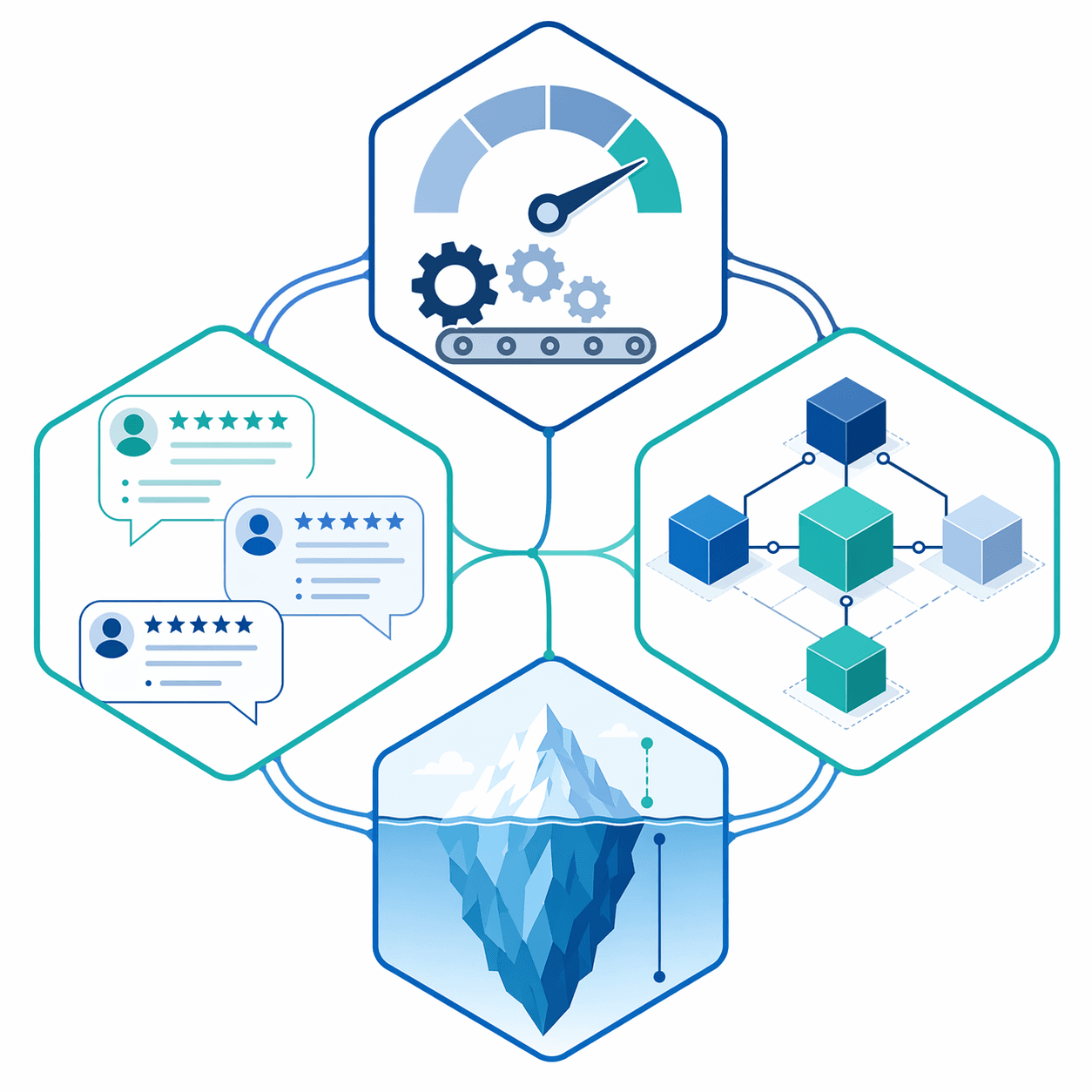
| Signal | What to ask | What should trigger more questions |
|---|---|---|
| Decision share | Which planning decisions are actually AI-driven in production? | The answer stays at 'assisted' or 'autonomous' without numbers, examples, or override paths |
| Architecture coherence | Do planning, execution, and analytics share a unified platform and data model? | The platform is stitched together across acquisitions or separate modules |
| Independent user reviews | Do users name the AI feature they rely on every day? | The feedback praises innovation but never identifies a specific function in use |
| Real TCO | What does the first 6–18 months actually cost, including implementation and support? | The budget conversation stops at license price |
1. Start with decision share, not the feature list
The fastest way to cut through AI washing is to ask a narrow question: how much of forecasting, replenishment, inventory positioning, or exception handling is actually driven by the model in production? That is a different test from whether the demo can show an attractive scenario animation. A vendor that cannot explain which decisions are generated by AI, which are still rule-based, and where planners override the output is not selling autonomy yet; it is selling possibility.
That is where independent review trails become more valuable than product pages. In Flowlity's comparative analysis of SAP IBP, Blue Yonder, Kinaxis, o9, ToolsGroup, Slim4, and others, the most telling evidence came from the language customers used: Blue Yonder was described as making 'magical AI/ML promises' without technical detail or clear customer adoption, SAP IBP users said they wished the platform 'would be adaptable to emerging AI technologies,' and Kinaxis showed little AI beyond forecasting enhancements [2]. None of that is a final verdict, but it is exactly the kind of signal that changes diligence behavior.
The useful follow-up is practical rather than philosophical. Ask for the live exception queue, not the polished scenario. Ask which recommendations are accepted automatically, which are reviewed, and which are routinely reversed. If the answer keeps drifting back to broad language, the buyer is still looking at packaging. For a closer look at why ROI stays hard to pin down when the operational loop is unclear, see Why AI ROI in Logistics Remains Unclear and How to Fix It.
2. Architecture decides whether AI survives contact with reality
A planning tool can have credible AI modules and still be hard to defend if the platform is assembled from disconnected parts. The question is not whether the vendor has a roadmap across planning, execution, and analytics; it is whether those parts share a coherent data foundation and workflow logic. The comparative analysis cites a McKinsey finding that integrated data foundations spanning planning, execution, and analytics can produce 2–3 times greater ROI than disconnected solutions [2]. That is less a slogan than a warning about how much value can leak when the architecture is fragmented.
This is where many demos become misleading. When the workflow is split across acquisitions, integration layers, or separate modules, the AI feature may be real but the operational path is still long. That matters because every handoff adds data reconciliation, permissioning, and governance work. A planner feels that friction immediately. Finance feels it later in the program budget. The architecture may still be worth buying, but only after the buyer has traced where the decision actually travels.
TCO is where the same issue shows up in numbers. The comparative analysis puts license fees at only 20–30% of true total cost and implementation timelines at 6–18+ months, which is a useful reminder that the expensive part of AI adoption is often the setup around the model rather than the model itself [2]. If the price discussion stops at seats or subscription tiers, the buyer is not seeing the full operating burden.
If the data side is not ready, the platform comparison can be distorted by optimism. The internal review on readiness, The AI Readiness Paradox, is useful precisely because it treats readiness as a buying constraint, not a slogan.
MCP belongs in this architecture conversation, but as a late differentiator rather than a headline requirement. For enterprises with heterogeneous, multi-vendor environments, Model Context Protocol support is a sign that external AI assistants can interact with the planning stack without custom glue. As of April 2026, only a handful of vendors offered MCP in production [2]. For smaller or simpler stacks, that is an openness signal worth noting, not a universal dealbreaker.
3. Look for user-reported features, not generic praise
Reviews matter most when they name the function, the workflow, and the outcome. A comment that says a platform is innovative is too vague to help a shortlist. A comment that identifies a specific forecasting enhancement, exception workflow, or replenishment feature is much more useful, because it shows the tool has moved beyond the demo environment and into a daily task.
Flowlity's analysis is useful here because it looked at G2 reviews and documentation rather than only at product pages. The pattern it surfaced was not 'who says they have AI,' but 'who can be described by users as doing something concrete.' In several cases, the clearest signal was still a gap: users wanted the platform to be more adaptable to emerging AI technologies instead of describing regular use of advanced AI functions [2].
That does not make the comparison neutral. Flowlity is a commercial vendor, so its reading of competitors should be treated as a useful signal, not final truth. The right response is to use the comparison to sharpen reference calls, then verify the claim against customer workflows, release notes, and the live exception queue. If the signal points toward adoption gaps, the deeper question is often whether the organization itself is ready for the tool; Why 70% of Supply Chain AI Projects Fail is a useful companion read on that point.
4. Treat total cost as a product signal, not just a finance line
A lot of AI evaluation goes wrong because the buyer compares licenses and ignores the work needed to make the platform usable. In supply chain software, the bill usually expands in integration, data cleanup, workflow design, training, and the internal effort required to keep the model honest after go-live. That is why the 20–30% license share matters [2]. It is not a trivia point; it shows how much of the real cost sits outside the subscription.
Implementation windows of 6–18+ months tell the same story [2]. They do not automatically mean the product is bad. They do mean the buyer should expect value to arrive later, and should check whether the architecture justifies that delay. A tool that looks efficient in procurement can still become expensive if every exception requires a custom bridge or a separate governance layer.
For teams building a business case, the useful habit is to treat cost as part of the evidence trail rather than as a separate negotiation. If the implementation burden looks heavy, the platform may still win, but only if the decision share, architecture, and user adoption signals are all strong enough to absorb the extra work. A practical template for that kind of modeling is in How to Build a Business Case for AI in Warehouse Management.
What to ask before a demo becomes a decision
- Which planning decisions are AI-generated in production today, and which still rely on rules or manual overrides?
- Show one real exception queue and walk through where the model recommendation was accepted, changed, or rejected.
- Which parts of planning, execution, and analytics share one data model and one workflow, and where do the handoffs still happen?
- Which customer review or reference can name the specific AI function they use every week?
- What is the expected first-6-to-18-month cost, including implementation, support, and internal effort?
- If the stack is multi-vendor, does MCP support exist in production today?
References
- “7 Leading AI Supply Chain Platforms” — Deposco
- “AI in Supply Chain Planning Software Comparative Analysis” — Flowlity
Comments
Join the discussion with an anonymous comment.