

The most awkward AI meeting in logistics is not the one where the model fails. It is the one where the model appears to work, the operations team can point to better route suggestions or cleaner exception alerts, and finance still cannot see where the money moved.
That is now the central problem for AI in the logistics industry. BCG’s 2026 survey of more than 180 logistics experts found that roughly 40% of both logistics service providers and shippers cite unclear ROI as the top barrier to AI adoption. The same research found that only 13% of LSPs and 7% of shippers can point to measurable value or measurable improvements from embedded AI, even as adoption advances in areas such as transport planning, execution, tracking, and visibility. Because the survey is global, the exact implications may vary by region, but the pattern is hard to ignore.[1]

This is not just a logistics-sector mood swing. PwC’s 2026 operations survey found that 89% of operations leaders say their technology investments have not fully delivered expected results.[2] Deloitte, looking at AI investment more broadly in supply chain and manufacturing contexts, reported that 85% of organizations increased AI investment over the prior year, while only 6% saw ROI in under a year; most organizations that achieved satisfactory returns did so over a 2–4 year window.[3]
The uncomfortable conclusion is not that logistics AI has no value. It is that many companies are asking finance to approve AI programs using operational evidence that has never been translated into financial evidence. A pilot can reduce planner touch time, improve load-building discipline, or surface exceptions earlier and still fail a budget review if nobody has agreed how those movements affect freight cost, labor utilization, accessorials, service penalties, working capital, inventory, or cost-to-serve.
The problem starts when “the model worked” becomes the ROI argument
In a logistics AI pilot, the first evidence usually comes from operating metrics. The model recommended better routes. Dispatchers saw fewer low-quality alerts. Planners spent less time reconciling exceptions. Visibility teams found late shipments earlier. Those are useful signals, but they are not yet ROI.
Finance does not book “better recommendation quality.” Finance books lower purchased transportation cost, fewer premium shipments, reduced overtime, avoided penalties, lower inventory buffers, higher asset turns, or a margin improvement by lane, customer, site, or business unit. If the pilot team did not define that bridge before deployment, the post-pilot review becomes a reconstruction exercise. That is where many AI business cases lose credibility.
This is the same trap discussed in Why Most Supply Chain AI Investments Miss the P&L Impact — and Where to Invest Instead: teams often measure whether the tool improved the workflow, while the CFO is looking for a defensible P&L path. Both sides may be right about what they are seeing. They are simply not looking through the same measurement system.
BCG’s adoption data makes the issue sharper. Transport planning and execution leads AI adoption among LSPs at 64%, while tracking and visibility sit at about 50%.[1] These are not peripheral use cases. They sit close to the everyday economics of freight movement. If measurable value is still scarce in these areas, the issue is not only whether AI can touch important workflows. It is whether the organization can trace that touch into financial outcomes.
Separate three questions before approving the next pilot
A cleaner ROI discussion starts by separating three questions that are often bundled together:
- Did the AI perform the task better than the prior process?
- Did the operating process actually change because of the AI output?
- Did that process change create a financial result the company can attribute with reasonable confidence?
The first question belongs mostly to product, data science, and operations. The second belongs to operations leadership. The third has to involve finance from the beginning. When all three are treated as one question, a technically successful pilot can be misread as a failed investment, or a noisy operational improvement can be oversold as a financial gain.
A transport planning model, for example, may produce more efficient recommendations. That alone does not prove savings. The company still has to know whether planners accepted the recommendations, whether carriers were tendered differently, whether service stayed within agreed tolerances, whether savings were retained or offset elsewhere, and whether the result appeared in the freight ledger rather than only in a dashboard.
The same discipline applies to visibility. Earlier exception detection can be valuable, but the financial question is more specific: did earlier detection reduce expediting, prevent service credits, improve customer retention, reduce manual chasing, or allow inventory buffers to come down? If the answer is “we think so,” the ROI case is still unfinished.
Build the financial bridge before deployment
The business case should not begin with a generic claim that AI will improve planning, visibility, or productivity. It should begin with a value thesis narrow enough to measure. A useful thesis has four parts: the operational behavior expected to change, the metric that will show the change, the financial account or management measure affected, and the time horizon over which the effect should appear.
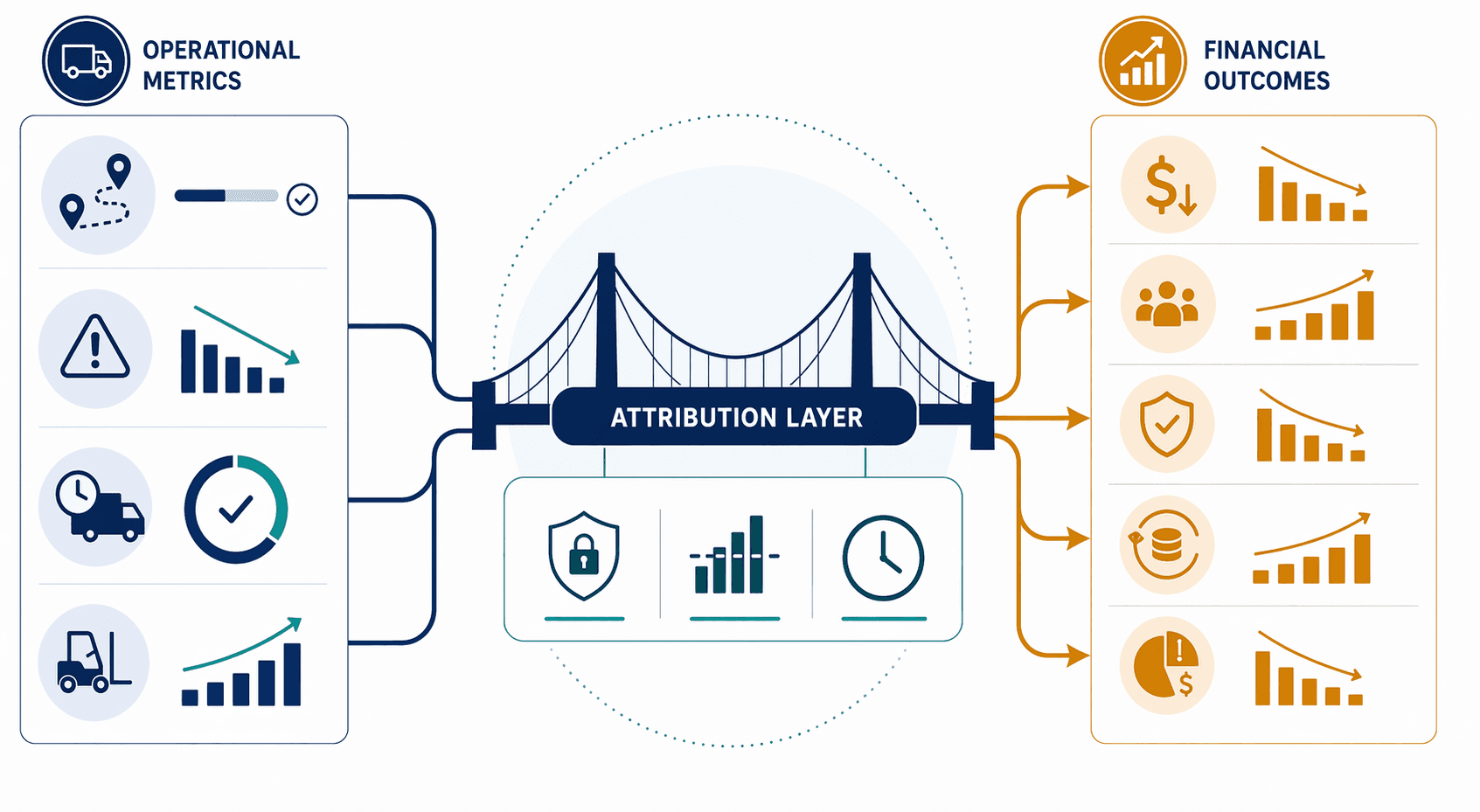
| AI use case | Operating metric | Financial outcome to test | Measurement owner |
|---|---|---|---|
| Transport planning and execution | Plan acceptance rate, route adherence, load consolidation, tender sequence quality | Purchased transportation cost, premium freight, accessorials, planner labor, asset utilization | Transportation operations with finance validation |
| Tracking and visibility | Exception detection lead time, false alerts, unresolved exceptions, manual follow-up volume | Service penalties, expedited freight, customer service labor, claims, customer-level cost-to-serve | Control tower or visibility team with commercial finance |
| Inventory and replenishment support | Forecast error, inventory positioning accuracy, stockout signals, safety stock changes | Working capital, inventory carrying cost, lost sales exposure, warehouse handling cost | Supply planning with finance and inventory accounting |
| Warehouse labor optimization | Pick path efficiency, task sequencing, labor plan accuracy, overtime triggers | Direct labor cost, overtime, throughput per labor hour, service-level penalty exposure | Warehouse operations with site finance |
The important move is not the table itself. It is the agreement it forces. If a routing model is supposed to reduce freight cost, finance needs to know which cost lines count, which movements are excluded, how seasonality will be handled, and what baseline will be used. If the value is labor productivity, operations has to say whether capacity will actually be removed, redeployed to higher-value work, or absorbed as service improvement. Those are different financial stories.
This is where many logistics AI programs are too vague. “Improved planner productivity” may mean fewer hours worked, more shipments managed by the same team, faster onboarding, less escalation, or fewer errors that drive downstream cost. Each version has a different proof standard. A CFO can defend any one of them more easily than a blended productivity claim that never lands in a budget line.
The strategy work has to come first. Closing the AI Logistics Strategy Gap: Why Planning Precedes ROI is relevant here because ROI clarity depends on knowing which logistics constraint the company is trying to relieve. A network fighting premium freight leakage needs a different AI value thesis than a network trying to reduce inventory buffers or stabilize customer-level service cost.
Use a baseline finance can audit
A weak baseline turns every post-pilot number into an argument. Before launch, teams should agree on the comparison period, excluded events, treatment and control groups where practical, and the level at which value will be measured. A lane-level improvement may disappear at network level if volume shifts. A site-level labor gain may not matter financially if staffing does not change and the freed time is not redeployed.
The baseline also needs to distinguish avoided cost from booked savings. Avoiding a premium shipment is not the same as reducing a contracted freight rate. Preventing overtime is not the same as reducing headcount. Improving inventory placement is not the same as lowering total inventory. These distinctions are not accounting pedantry; they decide whether the ROI claim can survive review.
Track adoption as a condition of value, not as value itself
Usage metrics matter, but they are only intermediate evidence. If planners ignore a routing recommendation, the model’s theoretical value does not enter the operation. If dispatchers accept the recommendation but override it later because carrier capacity is unavailable, the operating effect is weaker than the model log suggests. If the recommendation changes execution but the freight invoice cannot be connected back to the decision, the value may exist and still remain invisible.
For that reason, the measurement design should follow the decision path. Who received the AI output? Who accepted, rejected, or modified it? What operational action changed? Which system recorded the action? Which financial record later reflected the consequence? If that chain breaks, the ROI discussion becomes opinion-heavy even when the operating team did real work.
Why pilots stall before they become measurable ROI
Some AI disappointments are genuinely technical. Models can be brittle. Data can be incomplete. Integrations can be harder than expected. But in logistics, those problems often become ROI problems because the pilot was designed as a tool test rather than an operating model change.
The isolated pilot is the common failure pattern. A team tests a planning or visibility model on a controlled workflow, using a clean subset of data and a motivated group of users. The results look promising. Then the program moves toward scale and runs into live ERP, WMS, TMS, order management, carrier, customer, and invoice realities. Shipment statuses do not line up neatly. Cost data sits in a different cadence than operational data. Master data rules vary by site or business unit. Manual workarounds that everyone tolerated during the pilot become measurement gaps at scale.
A data readiness checklist will not make the ROI case by itself, but it prevents avoidable ambiguity. The practical questions in The CSCO's Data Readiness Checklist for Supply Chain AI Implementation matter because financial attribution depends on connected records. If shipment, order, inventory, labor, and cost data cannot be joined at the right level, the organization may only be able to prove activity, not value.
Process redesign is the next stall point. An AI tool may recommend better consolidation, but if the transportation team is measured on shipment-by-shipment responsiveness, planners may keep making local decisions that protect service at the expense of network cost. A visibility model may identify exceptions earlier, but if customer service, transportation, and warehouse teams have no redesigned escalation path, early warning simply creates earlier anxiety.
Workforce readiness is part of the same chain. If users do not trust the recommendation, do not know when to override it, or are punished for following it when a shipment goes wrong, adoption will stay shallow. That is not a soft change-management footnote. It is a direct threat to ROI because unrealized process change produces no financial movement.
The budget calendar adds another distortion. Deloitte’s finding that satisfactory AI returns often appear over a 2–4 year period sits awkwardly against annual budget reviews.[3] A VP of logistics may be asked to defend next year’s AI spend before the program has had enough time to change process behavior, retrain users, integrate cost data, and show durable financial movement. That does not excuse vague ROI claims. It means the business case needs staged evidence instead of a single payback promise.
What a staged ROI case should show
A defensible logistics AI business case does not have to show full P&L impact in the first quarter. It does have to show that the company knows what it is testing and how operational evidence will mature into financial evidence. The stages should be explicit.
| Stage | What to prove | Evidence that helps | What not to overclaim |
|---|---|---|---|
| Before deployment | The value thesis is financially specific | Named cost lines, agreed baseline, accountable owners, measurement cadence | Do not claim ROI from model capability alone |
| Pilot | The AI changes a decision or workflow | Recommendation acceptance, override reasons, changed planning actions, exception response changes | Do not treat usage as savings |
| Early scale | The workflow change affects operating performance | Reduced premium moves, better consolidation, fewer manual escalations, improved service recovery | Do not assume every operational movement reaches the P&L |
| Scaled operation | The financial outcome is visible and attributable enough to manage | Freight cost movement, labor utilization, penalty reduction, working capital effect, customer-level margin or cost-to-serve movement | Do not blend unrelated benefits into one unauditable number |
This staged approach is also a better way to communicate with finance. Instead of saying, “The model improved planning,” the executive can say, “In the pilot, planners accepted the recommendation in the agreed workflow, the accepted recommendations changed tender behavior on the measured lanes, and the next scale phase will test whether that behavior reduces premium freight and accessorial exposure against the agreed baseline.” The second version is less glamorous and more useful.
It also protects the operations team from being judged by the wrong clock. If the company knows that full ROI may take more than one budget cycle, it can still require concrete interim proof: clean adoption data, fewer avoidable interventions, tighter exception closure, better adherence to planning rules, and early financial indicators. The point is not to lower the standard. It is to stop pretending that a mature financial return should appear before the operating system has actually changed.
Benchmarks help, but they do not replace attribution
External benchmarks are useful because they keep the discussion from becoming too timid. Accenture research found that companies with AI-mature supply chains are 23% more profitable and six times as likely to use AI and generative AI widely.[4] McKinsey has reported that AI-enabled distribution can deliver 5–20% logistics cost reduction and 20–30% inventory reduction.[5]
Those numbers should not be mashed into a universal promise. They come from different research contexts and should not be treated as directly comparable or guaranteed. Their value is directional: well-governed AI in supply chain and logistics can matter financially. They do not tell a specific shipper or LSP which cost line will move, how fast, or who owns the proof.
For a company building its own case, benchmarks belong in the outer frame. The inner frame has to be internal: current cost structure, operating constraints, data availability, process authority, user adoption, and finance-approved attribution rules. A company with fragmented transport data and no authority to change carrier tendering behavior should not expect the same return profile as one with integrated TMS, invoice, and service data and a transportation team empowered to redesign the planning process.
A practical measurement framework for logistics AI ROI
The framework can be simple, but it has to be governed. For each AI use case, require five definitions before deployment.
- Value thesis: State the financial outcome the use case is meant to influence, such as lower purchased transportation cost, reduced premium freight, fewer service penalties, better labor utilization, lower working capital, or lower customer-level cost-to-serve.
- Operational lever: Identify the specific decision or workflow expected to change, such as load consolidation, route selection, tender sequencing, exception escalation, labor scheduling, or inventory positioning.
- Attribution path: Map the records that connect the AI recommendation to the operational action and then to the financial result. This may require TMS, WMS, ERP, invoice, order, labor, and service data to be joined at a consistent level.
- Ownership model: Assign one operational owner for behavior change and one finance owner for measurement validation. If everyone owns ROI, nobody owns the bridge.
- Time horizon: Define which indicators should appear during the pilot, early scale, and mature operation. Do not force a one-year payback narrative onto a program whose credible return path requires process redesign and adoption maturity.
A useful test is whether the ROI claim can be read backward. Start with the financial result and ask: which operational metric moved, which behavior caused it, which AI output influenced that behavior, which users acted on it, and which systems recorded the chain? If the team cannot answer without relying on anecdotes, the measurement design is not ready for a major scale commitment.
What to put in front of the CFO
The finance-facing version of the business case should be shorter than the implementation deck and more precise than the vendor deck. It should show the baseline, the value thesis, the operating metric, the financial measure, the data source, the owner, the decision rights, and the time horizon. It should also state what will not be counted.
Exclusions are not a sign of weakness. They make the claim auditable. If a transport AI program is being measured on reduced premium freight, do not quietly include unrelated rate changes, volume mix effects, or procurement savings unless finance has agreed to the method. If a visibility tool is being measured on reduced manual follow-up, say whether the benefit is booked as labor reduction, capacity absorption, faster response, or service protection.
This is also where executives should separate committed savings from managed benefits. Some AI benefits will hit the P&L directly. Others improve resilience, service quality, or decision speed. Those may still be worth funding, but they should not be disguised as hard savings unless the organization can show the financial mechanism.
The fix is business-case discipline, not waiting for a perfect model
Technology cost, model quality, integration work, and data readiness all matter. They can slow deployment and weaken results. But the evidence points to a more immediate executive problem: logistics AI is being adopted faster than many organizations can explain its financial value. BCG’s measurable-impact figures are low enough to make that a boardroom issue, not a reporting nuisance.[1]
The organizations most likely to defend continued investment will be the ones that define value before deployment, connect logistics operating metrics to financial outcomes, assign measurement ownership, set time horizons that match the maturity curve, and communicate progress in terms finance can audit.
Unclear ROI does not prove that AI failed. It often proves that the company measured the pilot, the activity, or the operational improvement without building the governed path to financial attribution. That path is now part of the implementation work.
References
- AI Is Already Moving the Logistics Industry Forward, BCG, 2026
- PwC's 2026 Digital Trends in Operations Survey, PwC
- Agentic supply chain: The artificial intelligence revolution in manufacturing, Deloitte Insights
- Accenture research on AI-mature supply chains, Accenture, 2024
- McKinsey research on AI in supply chains, McKinsey, 2024
Comments
Join the discussion with an anonymous comment.