

The annual RFP stops where the market starts
Freight is one of those spend lines that looks procedural until it starts eating margin. Available estimates put freight costs at 10-20% of total product costs, which is why small lane mistakes can turn into large financial problems [1]. The problem with the annual RFP is not that it is slow in a generic sense; it is that it tries to freeze a market that keeps moving. One source notes that freight rates can swing 20% month over month, which means static rate cards can lose relevance within weeks [1].
That mismatch is what makes continuous intelligent sourcing worth attention. Instead of waiting for a yearly bid event to decide everything, the operating model keeps watching rates, carrier behavior, and lane conditions, then pushes exceptions into mini-bids or spot buys only when they need action.

What the strongest evidence is actually showing
The boldest ROI claims around AI in transportation and logistics should be read carefully, but they are not empty. Debales AI says AI-powered procurement can deliver 15-25% cost reduction and 90% faster RFQ cycles in documented Fortune 500 engagements [1]. Those are vendor-published figures, so they should be treated as directional rather than universal, but they point to the same conclusion procurement teams keep running into: if the process is repetitive, rate-sensitive, and full of exception handling, automation can remove a lot of manual cleanup.
C.H. Robinson’s own reporting gives the operational version of that story. The company says its AI agents have completed more than 3 million shipping tasks, and that AI-handled shipments were 11% faster to market with 42% fewer missed LTL pickups [2]. Even allowing for self-reported data, the signal is useful because it is not framed as a vague productivity win. It is tied to concrete freight outcomes that shippers recognize immediately: fewer missed pickups, faster movement, less time spent cleaning up the aftermath.
Why the model works when the annual bid does not
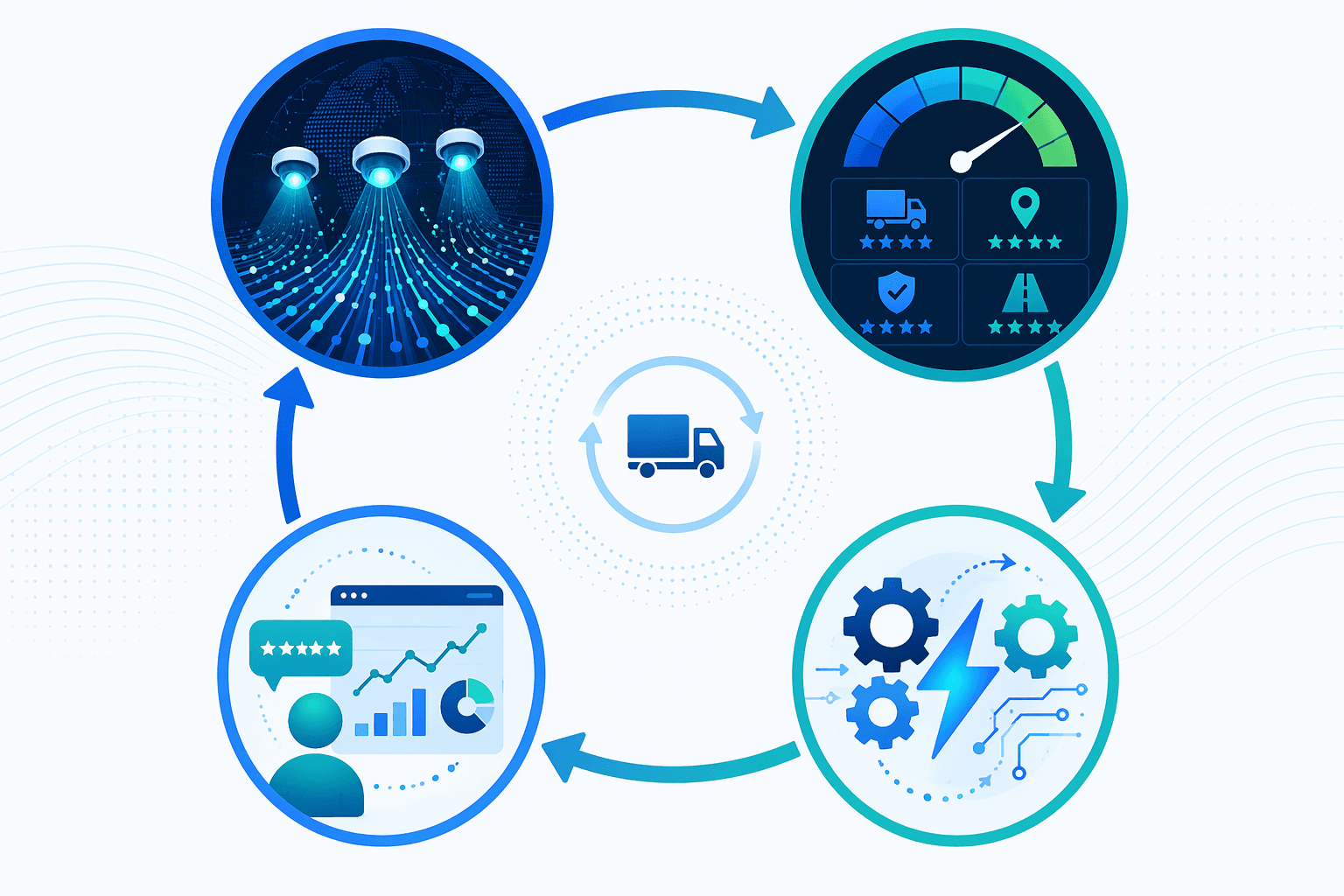
The mechanics matter more than the label. Arkestro describes a predictive procurement model that scores carriers on service, coverage, compliance, and lane fit [4]. That is the right direction because freight procurement is not a single-variable auction. A carrier can look cheap on paper and still fail on the actual lane, at the actual time, with the actual service constraints that matter to the shipper. Continuous intelligent sourcing gives the team a way to score that reality repeatedly instead of once a year.
In practice, the loop is straightforward. Market movement gets monitored. Carriers get scored across several dimensions. The system routes the award to the best-fit option or pushes the lane into a mini-bid or spot-buy process when conditions change. That is why this approach reduces rate drift and tender rejection pressure better than a calendar-driven event: it keeps the decision close to the market instead of far ahead of it.
The market is also starting to reward that capability from the buyer side. BCG’s January 2026 survey found that more than 40% of shippers now consider logistics providers’ AI capabilities when selecting partners, and nearly 80% say cost reduction is the primary reason they are pursuing AI [3]. The same survey says the biggest barriers are unclear ROI and internal capability gaps, not technology cost [3]. That fits the operational reality: most freight teams do not fail because the software is too expensive; they fail because the data is messy, the rate visibility is incomplete, or the team does not have the muscle to run a continuous process.
Readiness is the real dividing line
This is where a lot of AI freight stories get too neat. Continuous sourcing does not rescue weak master data, disconnected tender outcomes, or carrier records that cannot support consistent scoring. If the lane history is incomplete, the model can still generate activity, but it will mostly automate confusion. The teams that get the benefit are usually the ones that can already answer a harder question: which lanes should be watched continuously, which exceptions should stay with humans, and which carrier signals are reliable enough to trigger action?
That is why the capability issue matters more than the software line item. The tool may be the same across two shippers, but one team has clean rate visibility, disciplined exception handling, and a procurement workflow that can absorb automation. The other still depends on inbox triage and spreadsheet reconciliation. Only one of those teams will see the full benefit.
The next step is negotiation, but it is still early
The frontier idea is autonomous negotiation agents that can negotiate rates in real time between shipper and carrier systems [5]. That is a plausible next move, and it follows naturally from continuous sourcing, but it should still be treated as emerging rather than mature. The more immediate shift is not fully autonomous bargaining; it is making sure the shipper can monitor, score, and execute sourcing decisions continuously instead of waiting for the next annual event.
For freight procurement, continuous intelligent sourcing is the highest-ROI AI use case when the shipper has the data and the internal operating discipline to support it. It beats the annual RFP because it moves at the tempo of the market. The real divider is not software price; it is whether the team can actually run the model well enough to turn automation into savings.
References
- How AI Helps Manage Freight Procurement and Pricing — Debales AI
- Lean AI Growing Shipper Impact — C.H. Robinson
- AI Is Already Moving the Logistics Industry Forward — Boston Consulting Group, January 2026
- Carrier Procurement Revolution: How Predictive Intelligence Transforms Transportation Sourcing — Arkestro
- AI in Logistics — Thinking Company
Comments
Join the discussion with an anonymous comment.