

Warehouse leaders are no longer debating whether AI belongs in the operation. The money is already moving. McKinsey reports that 70% of warehouse operations leaders plan to invest more than $100 million in automation, while also warning that many automation efforts still get blocked by a lack of cohesive vision, poor leadership understanding of the technology, and organizational misalignment.[1] That combination should make any operator pause. It is possible to have budget, board approval, and an impressive vendor shortlist, and still be nowhere near ready for AI to make warehouse decisions.
The common failure is not that AI in warehousing is useless. Some of the best applications are practical and almost invisible: reallocating labor before one zone falls behind, reprioritizing work when a carrier cutoff is at risk, or routing tasks around congestion before a supervisor has to walk the floor and manually rebalance the day. The failure is earlier and less glamorous. The warehouse asks software to optimize a process it has not defined, using WMS data it does not trust, across a scope too wide to observe, with a workforce that has not been brought into the logic of the change.

That is the execution gap. It usually shows up after the purchase order, but it is created before vendor selection. The better question is not, “Which warehouse AI use case should we buy first?” It is, “Is this operation ready for AI to recommend or make decisions that supervisors and associates will actually follow?”
The failure usually starts before the model is switched on
A warehouse AI deployment is rarely defeated by one dramatic technical defect. More often, it is weakened by ordinary operational ambiguity. The slotting rules were never consistent. Replenishment priorities differ by supervisor. Location discipline has eroded. Exception codes are used loosely. Labor standards exist, but people do not believe they describe the actual work. The WMS is treated as the system of record until it becomes inconvenient, at which point the real operating logic moves into spreadsheets, radio calls, and tribal knowledge.
AI does not remove those contradictions. It exposes them faster. If the warehouse cannot say how a decision should be made today, it is not ready to automate that decision tomorrow. If the WMS says a pallet is available in a forward pick location but the floor knows it has been sitting in overflow for two shifts, a model can produce a recommendation that is mathematically neat and operationally wrong.
This is why the familiar boardroom framing is too narrow. AI in warehousing is not just a procurement category. It is a decision-rights change. Once the system begins sequencing work, reallocating people, or escalating exceptions, it is touching the operating rhythm of the building. The prerequisites deserve as much scrutiny as the software.
| Readiness prerequisite | What it protects against | Where failure becomes visible |
|---|---|---|
| Process clarity | Automating conflicting local practices | Different supervisors override the same AI recommendation for different reasons |
| WMS data quality | Optimizing against inaccurate locations, inventory, labor, or status data | The system recommends work that looks efficient in data but fails on the floor |
| Phased scope | Trying to prove too many use cases before inputs and ownership are stable | No one can tell whether poor results came from the model, the process, or adoption |
| Workforce involvement | Quiet bypass, low trust, and weak exception feedback | Associates and supervisors work around the system instead of correcting it |
Process clarity: AI cannot standardize what leadership has avoided deciding
Process clarity sounds basic, which is why it is often skipped. Nobody wants to hold up an AI initiative to argue about replenishment triggers, task interleaving rules, pick path exceptions, or who owns a late-wave recovery decision. Yet those are exactly the places where AI recommendations will land.
A labor-reallocation engine, for example, needs more than headcount and open work. It needs to know which work can be paused, which work must be protected, which skills are interchangeable, and which movements create more congestion than relief. If one shift treats packing support as flexible labor and another treats it as untouchable, the system will appear inconsistent even if the algorithm is behaving exactly as configured.
This is where McKinsey’s pilot blockers are useful as a pattern, not as proof of every failure. A lack of cohesive vision is not just an executive problem; it becomes a floor problem when different teams believe the system is optimizing for different outcomes. Poor leadership understanding of the technology becomes visible when leaders ask AI to “improve productivity” without specifying which constraints are real. Organizational misalignment appears when transportation, labor planning, inventory control, and warehouse operations each protect their own metric while the model is expected to optimize across all of them.[1]
Before AI is allowed to recommend a decision, the warehouse should be able to describe how that decision is made now, which exceptions are legitimate, which exceptions are just workarounds, and who has authority to change the rule. That exercise is not bureaucracy. It is the operating specification the model will otherwise infer from messy behavior.
The WMS problem: confidently optimizing the wrong things
The cleanest way to ruin warehouse AI is to connect it to an operational record that everyone already knows is unreliable. MODEX 2026 commentary from Made4net and GreyOrange put the problem bluntly: layering AI onto an aging or misconfigured WMS can “confidently optimize the wrong things.”[3] That sentence is worth sitting with because it names the mechanism, not just the symptom.

A model can only optimize the representation of the warehouse it receives. If that representation is distorted, the output may still look precise. It may assign tasks, calculate travel, rank orders, and recommend moves with confidence. The problem is that the confidence belongs to the math, not to the physical truth of the building.
Bad WMS data does not always look like an obvious data-quality crisis. It often looks like small, tolerated gaps: locations that are technically active but operationally avoided; inventory statuses that lag reality; units of measure that are correct in the item master but not in how the product is actually handled; task completion scans that happen after the work, not at the work; reason codes that are selected for speed rather than accuracy. Each compromise may be survivable for human supervisors because they carry the missing context. AI has no such memory unless the operation captures it.
Consider a hypothetical replenishment optimization. The system sees forward pick locations, open orders, inventory quantities, associate availability, and travel paths. It recommends delaying a replenishment because the WMS shows enough stock to cover the next wave. On the floor, the location is partially blocked, the last scan was late, and the experienced lead knows the SKU is often miscounted after breakpack activity. The AI recommendation fails, but the deeper cause is not necessarily the model. The operation asked the model to reason from a version of the warehouse that did not match the warehouse.
That is why WMS readiness has to be treated as part of the AI program, not as an integration detail. A modern API connection does not prove that the underlying data is fit for decision automation. Data freshness, location accuracy, inventory status discipline, task history, labor-event capture, and exception coding all matter because they become the evidence base for recommendations. Readers who need a deeper treatment of this foundation can continue with Supply Chain’s Data Readiness Crisis.
The practical test is simple to state and uncomfortable to run: select the operational decision the AI will influence, then trace every required input back to its source. Who creates it? When is it updated? How often is it overridden? Which fields are mandatory but unreliable? Which “temporary” workarounds have become permanent? Which reports do supervisors trust more than the WMS screen? If the answers are evasive, the model will inherit the evasions.
The data questions that matter before integration
- Does the WMS reflect the physical location, status, and availability of inventory closely enough for the use case being considered?
- Are task timestamps captured when work actually happens, or after associates and supervisors catch up administratively?
- Are exception codes specific enough to teach the system what went wrong, or are they broad labels used to close work quickly?
- Do supervisors rely on shadow spreadsheets, whiteboards, or informal rules because the WMS configuration does not match operating reality?
- Can operations, IT, inventory control, and labor planning agree on which system is authoritative for each input?
None of these questions requires an AI vendor to answer. In a healthy program, they are answered before demos become serious.
Phased scope is not caution; it is how the warehouse learns safely
The temptation is to justify investment by bundling use cases. Labor optimization, dynamic slotting, predictive maintenance, congestion management, intelligent wave planning, and yard coordination get placed into one transformation narrative. The deck looks coherent. The building does not.
A warehouse should start where the decision is bounded, observable, and reversible. Bounded means the system is influencing a defined process, not the entire operation. Observable means the inputs, recommendations, overrides, and outcomes can be inspected without guesswork. Reversible means a bad recommendation can be corrected before it damages the day.
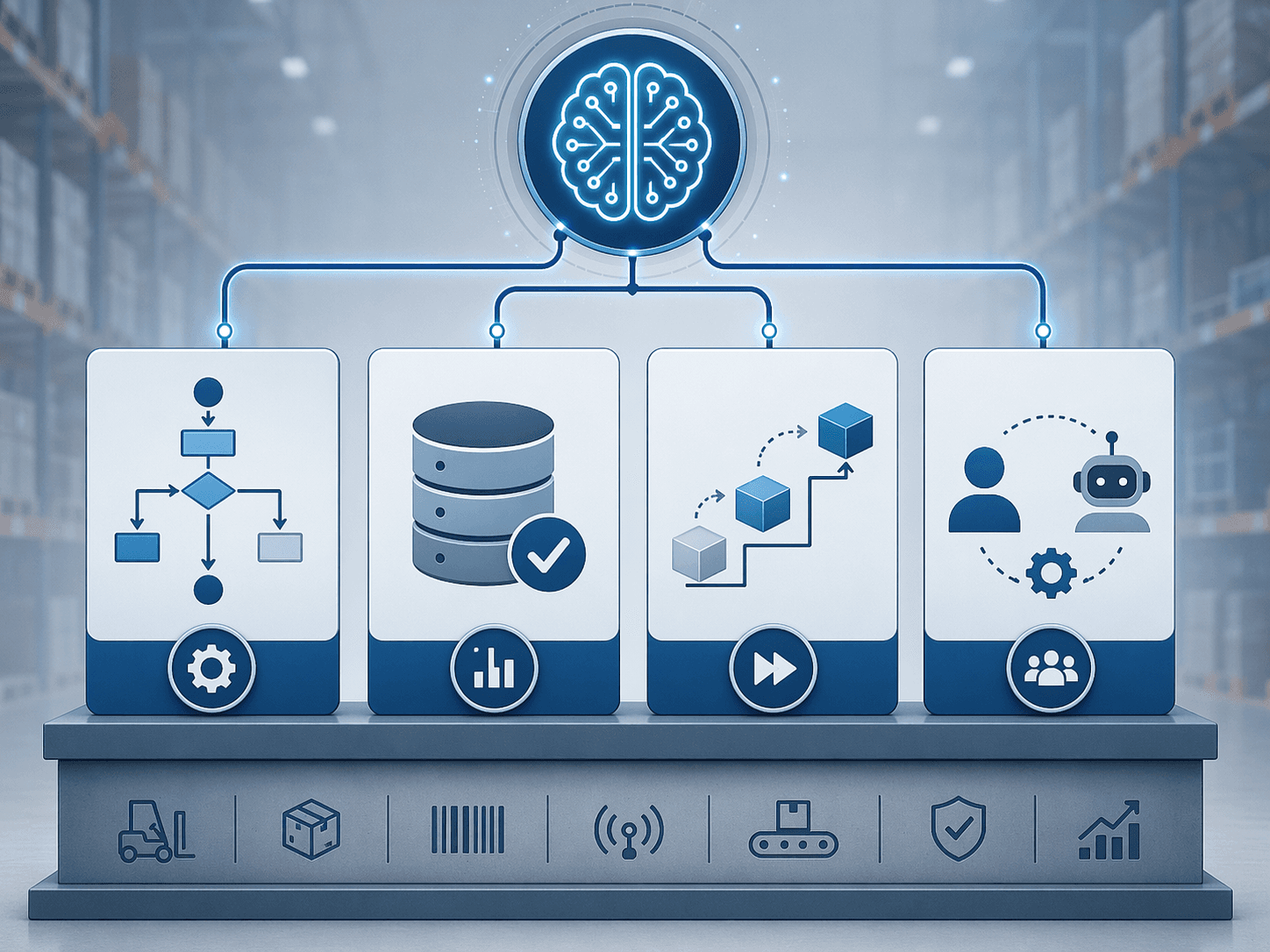
This is the appeal of invisible AI. It does not require the warehouse to pretend people disappear from the process. It fits into the operating moments where better sequencing, earlier warning, or faster reprioritization can help without handing the whole building to a black box. Labor reallocation within a shift, task reprioritization inside a constrained work area, or predictive routing around recurring congestion can all be good starting points if the underlying process and data are stable enough.
Phasing also protects the organization from false diagnoses. If a broad deployment disappoints, leaders can argue endlessly about what failed: the algorithm, the integration, the WMS, the supervisors, the associates, the training, the process design, or the metric. A narrow first scope makes the learning cleaner. The team can see whether recommendations were generated from valid inputs, whether supervisors understood them, whether associates followed them, and whether the measured outcome matched the intended improvement.
| Phase | Purpose | Readiness signal before expanding |
|---|---|---|
| Observe | Use AI or analytics to surface patterns without changing task execution | The team agrees that the data reflects recognizable operating reality |
| Recommend | Let the system suggest actions while supervisors retain decision authority | Overrides are reviewed and classified instead of ignored |
| Constrain and automate | Allow the system to execute selected decisions within defined guardrails | Exception handling, ownership, and rollback rules are stable |
| Expand | Add adjacent processes or facilities after the first decision loop is trusted | Performance gains can be tied to the changed decision, not just general effort |
A phased approach does not mean small ambition. It means the operation earns the right to expand. For readers looking for the positive execution model after the readiness screen, From Intent to Execution: A Phased ML Implementation Roadmap for Warehouse Management is the natural next step.
Worker augmentation is a sensible entry point, but strategy still matters
Zebra’s Warehousing Vision Study, as cited by Synkrato, reports that 77% of companies view worker augmentation as a preferred entry point for warehouse automation, while only 35% have a clear starting strategy.[2] The statistic should not be treated as a universal law; it comes through a vendor-adjacent channel and should be read as a directional signal. Still, the gap is recognizable. Many organizations like the idea of helping workers with better guidance, visibility, and prioritization. Fewer have decided where that assistance should begin, what decision it should improve, and how adoption will be measured.
Worker involvement is often mislabeled as change management, as if it were mainly about communications and training materials. In warehouse AI, it is a control mechanism. Associates and supervisors know which recommendations are impossible, which are merely inconvenient, and which are better than the old way. If the program does not capture that feedback, the system loses one of its best correction loops.
The worst version of adoption resistance is quiet. People do not protest the system; they route around it. A supervisor keeps a separate priority list. A lead tells associates which AI-generated tasks to skip. A picker learns that the recommended sequence creates congestion at a certain hour and informally changes it. Sometimes those workarounds are bad habits. Sometimes they are valid operational intelligence. The program has to know the difference.
That means involving the workforce before go-live in very specific ways: validating whether the process map matches the floor, reviewing recommendation logic in plain operational language, defining when overrides are allowed, and making sure exception feedback is not punished when it reveals a real flaw. Trust is built when the system is correct often enough to be useful and corrigible when it is wrong.
Use cases reveal readiness; they do not replace it
It is reasonable for leaders to ask where AI in warehousing can create value. Use cases matter. But each attractive use case carries a readiness demand that is easy to understate.
| AI use case | Readiness question that should come first |
|---|---|
| Labor reallocation | Are skills, productivity assumptions, work rules, and shift constraints accurate enough to move people without creating new bottlenecks? |
| Task reprioritization | Does the operation agree on what should outrank what when service, travel, congestion, and labor efficiency conflict? |
| Predictive congestion routing | Are location, equipment, task, and timing data granular enough to distinguish recurring congestion from one-off disruption? |
| Dynamic slotting | Are item movement patterns, handling constraints, replenishment behavior, and physical slot conditions captured reliably? |
| Exception prediction | Are exception codes and resolution histories specific enough to teach the system what actually happened? |
The use case list is not the strategy. The strategy is deciding which decision loop is mature enough to improve, narrow enough to observe, and important enough to justify the effort. Large-scale operators can eventually connect many such loops; Amazon Robotics offers one visible reference point for what scale can look like, though its model should not be casually generalized to every warehouse network. For that context, see the Amazon Robotics Warehouse Automation deployment case study.
A readiness screen before vendor selection
The point of a readiness screen is not to delay modernization. It is to keep the organization from outsourcing decisions it has not prepared itself to govern. Before comparing platforms, the leadership team should be able to answer four questions without resorting to slogans.
- Which operational decision will AI influence first, and how is that decision made today?
- Which WMS, labor, inventory, location, and exception data fields does that decision require, and how trustworthy are they?
- What is the smallest scope where recommendations can be observed, challenged, measured, and corrected?
- Which supervisors, leads, and associates will validate the logic, use the recommendations, and feed back exceptions?
If those answers are clear, vendor conversations become more useful. The team can ask how a system handles stale inventory status, supervisor overrides, confidence thresholds, exception learning, labor constraints, and rollback. If the answers are not clear, vendor demos tend to reward the wrong things: attractive dashboards, broad promises, and simulated flows that do not carry the friction of the real building.
This is also where ambition-versus-execution gaps in the broader supply chain become relevant. Organizations can be enthusiastic about AI and still lack the operating plan to use it. The related analysis in Why 94% of Supply Chains Plan to Deploy AI While Only 23% Have a Strategy covers that wider pattern; inside the warehouse, the same gap becomes visible in process rules, WMS discipline, and floor adoption.
Warehouse AI can be useful, especially when it improves the decisions people already struggle to make quickly under pressure. But the warehouse has to earn that automation. If the organization cannot define the process, trust the WMS data, limit the first scope, and involve the workforce, buying AI only moves the execution gap downstream.
References
- Getting warehouse automation right, McKinsey, https://www.mckinsey.com/capabilities/operations/our-insights/getting-warehouse-automation-right
- Warehouse Automation Statistics, Synkrato, https://synkrato.com/articles/warehouse-automation-statistics/
- 10 Tips for Turning AI and Automation into Real Warehouse Results, Made4net, https://made4net.com/knowledge-center/modex-26-ai-strategy-to-execution/
Comments
Join the discussion with an anonymous comment.