

The failure usually becomes visible after the impressive part is over. The model has produced a plausible demand forecast. The dashboard loads quickly. The pilot team can point to a few lanes, SKUs, or facilities where the output looks better than the current spreadsheet. Then a planner asks why the model used a discontinued promotion as normal demand. A logistics manager notices that the transportation system and the visibility platform disagree on when the same shipment arrived. Someone from compliance points out that required fields are blank in the records the AI is summarizing.
That is where AI’s impact on supply chain management either starts or stops. Not in the model demo, and not in the slide that says the organization is “AI-ready,” but in the moment an operations team decides whether it can act on the recommendation without creating more cleanup work than the recommendation is worth.

The easy explanation is that AI was overhyped. That explanation is convenient and often wrong. In many supply chain environments, the problem is more specific: the data feeding the AI is not trusted, current, governed, accessible, or consistent enough for the decision the model is being asked to influence.
The data readiness gap is no longer anecdotal
A 2025 global study from Precisely and Drexel University’s LeBow College of Business found that only 12% of organizations had data of sufficient quality and accessibility for effective AI implementation. The same survey found that 67% did not completely trust their data for decision-making, and 62% cited lack of data governance as their primary data challenge. The survey base was 565 data and analytics professionals, not a supply-chain-only sample, so it should not be treated as a precise measure of supply chain readiness. It is still a hard warning for supply chain leaders, because few functions depend more heavily on shared, cross-system operating data than planning, logistics, procurement, warehousing, and fulfillment.[1]
PwC’s 2026 Digital Trends in Operations survey lands in the same territory from a different direction. In that research, 87% of operations and supply chain leaders said poor data quality had impacted their ability to achieve value from digital initiatives. This is not a future concern about hypothetical AI projects. It is a reported drag on digital value that leaders say they are already experiencing.[2]
A third signal comes from First Page Sage’s 2026 agentic AI adoption report, which says 38% of failed agentic AI projects cited inadequate data quality as a primary cause. That figure should be handled carefully: the report aggregates across more than 30 reports and over 16,000 businesses, and “agentic AI” is used broadly in the market. It is not a supply-chain-specific failure rate. But it points in the same direction as the more directly relevant operations and data-readiness surveys: when AI projects stall, data quality is frequently not a side issue.[3]
These numbers should not be forced into a single false equation. The 12% figure measures AI-ready data in a data-professional survey. The 87% figure measures operations and supply chain leaders’ experience with poor data quality hurting digital value. The 38% figure concerns failed agentic AI projects across a broader business base. Different populations, different methods, different questions.
What they provide is convergent evidence. The organizations trying to scale AI are repeatedly encountering the same blockage: the model is only as usable as the operational data it can understand, reconcile, and update.
“Bad data” is too vague to be useful
In steering meetings, “data quality” can become a phrase that means everything and therefore changes nothing. The useful question is narrower: which decision is the AI supposed to improve, and what exact data would make that recommendation safe enough to use?
ARC Advisory Group’s analysis makes the problem concrete. It identifies incorrect demand forecasts caused by outdated sales data, unreliable shipment tracking caused by conflicting timestamps, and incomplete compliance reporting caused by missing data. Those are not cosmetic defects. They are operational failure modes.[4]
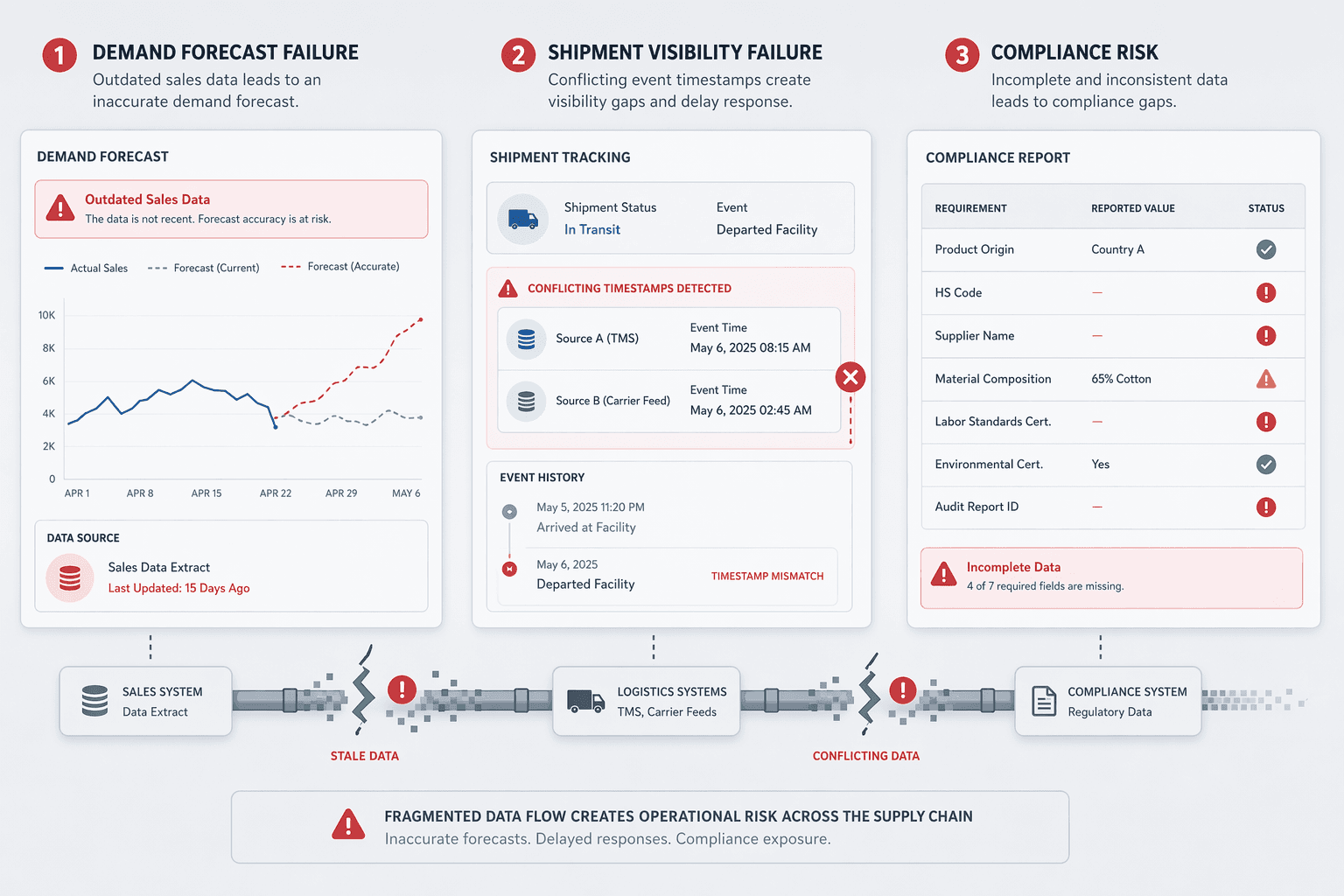
Outdated sales data does not merely make a forecast “less accurate” in some abstract statistical sense. It can cause planners to buy, build, or reposition inventory against demand that no longer exists. If promotional demand, channel shifts, discontinued items, or one-time orders are not identified correctly, the model can appear sophisticated while quietly reproducing a bad version of history.
Conflicting shipment timestamps create a different kind of damage. A visibility model may decide that a carrier, lane, or facility is performing one way, while the transportation management system records the same event differently. The dispatcher or logistics manager then has to determine whether the AI is seeing a delay, a system lag, a manual update, or a duplicate event. At that point, the AI has not reduced exception management. It has created another exception queue.
Incomplete compliance data creates still another problem: the output may look complete because the AI can summarize what it has, but the missing fields determine whether the answer is usable. A compliance report with gaps is not a near-success. It is a liability that someone in operations, trade compliance, quality, or procurement must resolve before the business can rely on it.
This is why data readiness is not a back-office hygiene project. It determines whether the AI recommendation reduces work or transfers risk to the planner, dispatcher, inventory analyst, data engineer, or compliance owner who has to defend the output after the pilot team has moved on.
Integration is part of the AI cost, even when the business case ignores it
Once the failure modes are visible, the cost discussion changes. Data integration is not a technical add-on after the “real” AI work. In logistics, The Thinking Company estimates that data integration consumes 30–40% of total AI project cost, yet is routinely omitted from initial business cases.[5]
That omission distorts three decisions at once. First, it makes the pilot look cheaper than production. Second, it makes vendor comparisons unreliable, because a tool that performs well against a prepared sample may be much harder to connect to live operating systems. Third, it weakens ROI measurement, because the organization cannot clearly separate model performance from data availability, data correction, and manual reconciliation.
Vendor selection should therefore include blunt questions about required data sources, master data assumptions, latency, exception handling, field mapping, and integration effort. A model that needs clean, synchronized, near-real-time inputs from systems that do not currently agree is not necessarily a bad model. It is a larger implementation than the sales cycle may suggest. Teams evaluating platforms can use a structured supply chain AI software buyer’s guide to pressure-test whether the vendor’s architecture fits the organization’s actual data environment.
The same discipline applies to ROI. If an AI logistics project claims savings from better routing, fewer stockouts, improved labor planning, or lower detention costs, the measurement system has to capture the baseline and the operating change consistently. Otherwise, poor data quality does not just weaken the model; it clouds the economic proof. That is why ROI work and data readiness work need to move together, not in separate committees. A practical AI logistics ROI framework is only as credible as the data used to establish the before-and-after view.
The answer is not to wait for perfect data
There is a real tension in the PwC findings, and it is the useful kind. The same research that found 87% of operations and supply chain leaders reporting damage from poor data quality also found that 89% agreed actionable data is more important than comprehensive data, and 73% agreed that data does not need to be perfect to drive value.[2]
That is not a contradiction. It is the difference between imperfect data and unmanaged data.
Imperfect data can still support good decisions when its limits are known, the relevant fields are governed, the data lineage is understood, and the use case is chosen carefully. Unmanaged data is different. It sits in disconnected systems, follows inconsistent definitions, arrives too late for the decision, lacks ownership, or cannot be reconciled when two records disagree. AI can tolerate some messiness. It cannot responsibly compensate for a business that has not decided which data is authoritative for the decision at hand.
The practical path is use-case-driven readiness. Pick an AI initiative with meaningful operational value, then assess the data required for that decision rather than trying to cleanse the entire data estate before anything moves. A demand-sensing project, a predictive ETA model, a warehouse labor optimization tool, and a compliance document assistant do not need the same data readiness work. They need different source systems, governance rules, latency thresholds, exception processes, and business owners.
| Use case question | Data readiness work that matters first |
|---|---|
| Can AI improve demand planning for a specific product group or channel? | Validate demand history, promotion flags, discontinued items, customer substitutions, and forecast override records. |
| Can AI improve shipment visibility or exception prediction? | Reconcile shipment milestones, timestamp definitions, carrier updates, location events, and system-of-record rules. |
| Can AI support inventory positioning? | Align on-hand balances, safety stock rules, lead times, purchase order status, transfer records, and item-location master data. |
| Can AI reduce compliance reporting effort? | Identify required fields, document sources, missing-data ownership, audit trails, and approval workflows. |
This is also where phased implementation matters. A team building logistics analytics does not need to solve every data problem before it learns anything. It does need a sequence that defines which sources are trusted first, which fields are required for the first decision, which exceptions remain manual, and when the model is allowed to influence operations. A phased logistics analytics roadmap can keep the work tied to decisions instead of letting it drift into an indefinite platform program.
Warehouse AI follows the same pattern. Labor, slotting, replenishment, and exception workflows can be improved in stages, but the implementation has to expose where the warehouse management system, labor system, inventory records, and operational scans agree or diverge. A phased machine learning roadmap for warehouse management is useful because it treats deployment and data improvement as linked work, not sequential fantasies.
Governance is the scaling mechanism, not a magic wrapper
Governance often gets introduced too late, after a pilot has already exposed that no one owns the disputed field, no one can explain the lineage of a data feed, and no one has authority to resolve conflicting definitions across systems. At that point, governance sounds like bureaucracy because the organization has waited until people are already frustrated.
The Precisely/Drexel research gives governance a more practical frame. Among organizations with data governance programs, 58% reported improved data quality, 58% reported better analytics, and 36% reported faster access to relevant data.[1]
Those outcomes map directly to supply chain AI blockers. Improved quality helps reduce avoidable forecast, visibility, inventory, and compliance errors. Better analytics helps teams compare model output against operational baselines. Faster access to relevant data matters because many supply chain decisions expire quickly; a late answer may be technically accurate and operationally useless.
But governance cannot be treated as a decorative layer over broken processes. It has to assign ownership, clarify definitions, set quality thresholds for specific use cases, document lineage, and decide what happens when systems disagree. For supply chain AI, governance is most effective when it is close to the operating decision. The owner of a shipment milestone definition, for example, should not be an abstract committee that never sees an exception queue.
What leaders should fund before the next pilot
The next supply chain AI business case should include data integration as a first-order cost, not a risk note. It should identify the source systems required, the fields that must be trusted, the owners who can resolve discrepancies, and the manual work that will remain until the data improves. If the business case cannot describe those items, the projected AI benefit is probably more fragile than it looks.
Vendor evaluation should change as well. The best product demo may not be the safest production choice if it assumes a cleaner data environment than the organization has. Leaders should ask vendors to explain their data requirements, integration dependencies, governance assumptions, and approach to missing or conflicting data. The distinction between a data-ready and data-poor organization is often the distinction between a credible ROI path and a long-running reconciliation exercise. That difference matters when comparing expected returns across high-impact machine learning supply chain use cases.
The important shift is from funding “data cleanup” as an indefinite IT effort to funding data readiness around specific AI use cases. For one initiative, that may mean reconciling shipment event data. For another, it may mean governing demand history and forecast overrides. For another, it may mean fixing product, supplier, or inventory master data. The work is still unglamorous. It is also where many AI initiatives become operationally real.
Data readiness is the prerequisite many organizations skipped. It is not a demand for perfection, and it is not a reason to pause every AI effort until the enterprise data estate is pristine. It is a demand for honesty about the data required for the decision the AI is supposed to improve. Move quickly where the data can be made fit for purpose. Budget the integration work upfront. Measure value against trustworthy baselines. Do not ask the model to outrun the data feeding it.
References
- New Global Research Points to Lack of Data Quality and Governance as Major Obstacles to AI Readiness, Precisely, 2025
- 2026 Digital Trends in Operations: How AI Reinvents Enterprise Performance, PwC
- Agentic AI Adoption Statistics for 2026, First Page Sage, 2026
- Challenges & Risks in AI for the Supply Chain, ARC Advisory Group
- AI ROI in Logistics & Supply Chain — 2026 Guide, The Thinking Company
Comments
Join the discussion with an anonymous comment.