
What Changes with Agentic AI in Procurement
The procurement function has been automating discrete tasks for years — running spend classification algorithms, flagging contract expirations, or routing invoices through approval workflows. Agentic AI represents a structural shift away from this task-level automation toward goal-driven, multi-step execution. Instead of a model that answers a single question ("What category does this spend belong to?") or triggers a single action ("Send this invoice to the next approver"), an agentic system maintains persistent state across a workflow, makes decisions under uncertainty, and executes sequences of actions to achieve a defined outcome — such as sourcing a category of indirect spend from scratch.
The operational difference is not subtle. Traditional AI tools in procurement act as co-pilots: they analyze data, surface recommendations, and wait for a human to act. Agentic AI acts as an operator: it drafts a sourcing strategy, issues RFQs to a shortlist of suppliers, evaluates responses against predefined criteria, negotiates within guardrails, and only escalates when the response falls outside its authority. This requires three capabilities that earlier generations of procurement technology lacked: multi-agent orchestration (different agents handling sourcing, negotiation, and contracting in sequence), persistent state (the system remembers context across steps without restarting), and goal-driven execution (the agent optimizes toward a target outcome, not just a single prediction).
For a broader survey of agent types across procurement — including sourcing agents, contract intelligence agents, and risk monitoring agents — see our companion article on autonomous sourcing, contract intelligence, and risk agents reshaping procurement operations. This article focuses specifically on what is working in production deployments in 2026, with quantified benchmarks and realistic timelines.
The Production Reality Check: MIT's 95% Failure Rate and What It Means for Procurement
Before examining what works, it is worth confronting the baseline. MIT's NANDA initiative, reported by Forbes, found that 95% of enterprise AI pilots deliver no measurable P&L impact. This is a cross-industry finding, not a procurement-specific indictment, but it carries direct implications for procurement leaders evaluating agentic systems. The same research found that AI tools built through external vendor partnerships succeeded roughly twice as often as internal builds — a pattern that aligns with procurement's own experience: the ISG 2025 study found that procurement represents just 6% of AI use cases across enterprise functions, meaning most internal teams lack the dedicated ML engineering resources that larger functions like marketing or supply chain planning can deploy.
The successful deployments documented in this article share a common pattern: they started with a narrow, bounded use case; they measured ROI against a clear baseline before expanding; and they redesigned workflows gradually rather than attempting a full source-to-pay transformation in a single quarter. This pattern is not accidental. The CASME analysis of procurement AI deployments identifies three consistent failure modes: no clear business outcome defined before the pilot, poor data governance that undermines model performance, and over-reliance on vendor demonstrations rather than hands-on testing against the organization's own spend data.
Six Agent Types with Production-Stage Proof Points
The following table summarizes six agent types that have reached production deployment at multiple organizations, with quantified benchmarks drawn from published research, analyst reports, and vendor customer data. Each entry distinguishes between current production measurements and forward-looking projections.
| Agent Type | Function | Production Benchmark | Source & Date |
|---|---|---|---|
| Intake Orchestration | Conversational front door for procurement requests; routes, classifies, and enriches requisitions before human touch | +40% NPS growth; +20% improvement in spend under management across 1,000+ users and 4,500+ suppliers | Zycus customer benchmarks (vendor-sourced, 2025) |
| Autonomous Sourcing | End-to-end category sourcing: strategy generation, supplier identification, RFQ issuance, bid evaluation | 12–20% savings on contact-center spend; 20–29% on BPO spend using linked AI agents | McKinsey-documented tech company (2025) |
| Autonomous Negotiation | Multi-round negotiation with suppliers within predefined guardrails; handles price, terms, and payment conditions | 68% supplier agreement rate; 3% average savings; 35-day payment term extension; 4× ROI; 75% of suppliers preferred AI to human negotiator | Harvard Business Review case study — Walmart (2024) |
| Contract Analysis & Redlining | AI-powered contract review, clause extraction, risk flagging, and negotiation support | 45–90% cycle-time reduction in contract review; up to 9% of total contract value eroded by inefficiencies (WorldCC) | Sirion, Deloitte (2024–2025) |
| Accounts Payable Automation | Touchless invoice processing, matching, exception handling, and payment execution | 21% of companies running agentic AI in AP production; best-in-class touchless rate at 52.8% (up from 29% in 2023); 3.5× higher productivity vs. peers | Hackett Group (2025) |
| Supplier Risk Monitoring | Continuous monitoring of supplier financial health, geopolitical exposure, and compliance status | AI-powered risk scoring integrated into procurement workflows; early warning signals reduce supply disruptions by 20–30% (industry range) | Multiple vendor platforms (2025–2026) |
Several observations emerge from this data. First, AP automation has the deepest production footprint — 21% of companies are running agentic AI in payables, per Hackett Group, and the best-in-class touchless invoice processing rate has climbed from 29% in 2023 to 52.8% in 2025. This is not a pilot statistic; it reflects live, scaled deployments. Second, autonomous negotiation, while less widely deployed, shows the most striking supplier acceptance data: Walmart's program, documented in Harvard Business Review, achieved 68% supplier agreement and 4× ROI, with three-quarters of suppliers preferring the AI to a human negotiator. Third, the McKinsey-documented tech company case demonstrates that linked agents — where a sourcing agent hands off to a negotiation agent — can produce savings in the 12–29% range on specific indirect categories.
The Compounding Effect: Coordinated Agents Across Source-to-Pay
The most compelling production evidence for agentic AI in procurement is not any single agent type — it is the compounding effect when agents coordinate across the source-to-pay (S2P) lifecycle. Hackett Group research finds that organizations deploying coordinated agents across S2P report 30% process efficiency improvement and attribute 25% of cost reduction specifically to orchestration, not to any individual agent's performance.
This compounding effect occurs because procurement workflows are inherently sequential. An intake agent that misclassifies a requisition creates downstream errors for the sourcing agent. A negotiation agent that agrees to terms outside the contract agent's acceptable clause library creates rework. When agents share a persistent state layer — a common data model and workflow context — each agent operates with full visibility into what the others have done. The result is not just faster execution but higher-quality outcomes: the sourcing agent can optimize for total cost of ownership rather than just unit price because it knows the contract agent's acceptable terms and the AP agent's payment cycle constraints.
The orchestration layer that enables this coordination is distinct from the individual agent capabilities. It requires:
- A shared event bus that tracks workflow state across agents
- Escalation rules that define when a human must intervene
- Audit logging that records every agent decision for compliance and post-hoc analysis
- Performance metrics that measure end-to-end cycle time and outcome quality, not just individual agent throughput
For detailed case studies of organizations that have implemented this orchestration pattern — including the specific workflow redesign steps and the measured outcomes — see our deployment guide on the pilot-to-production pattern.
Governance: The Glass Box Approach
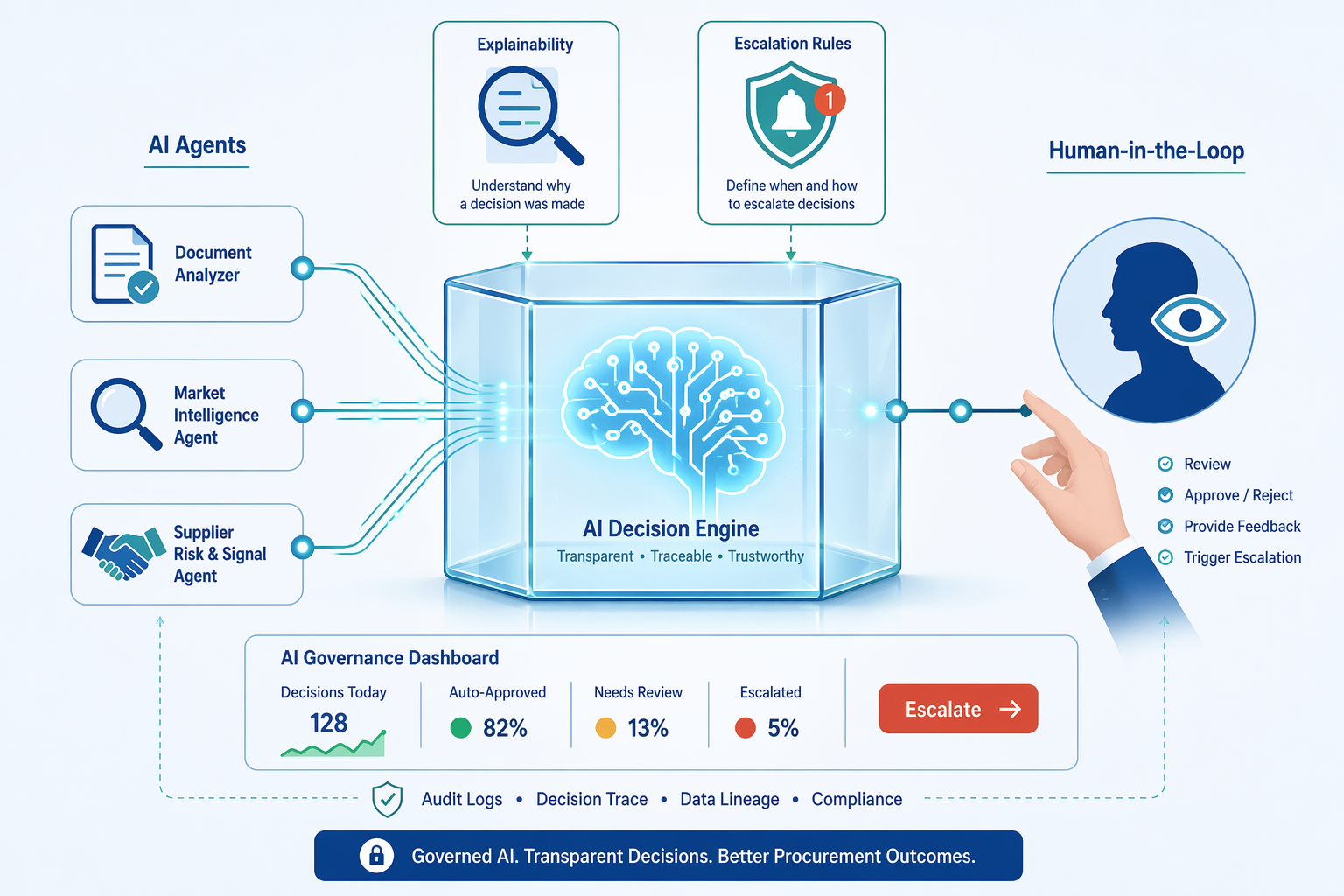
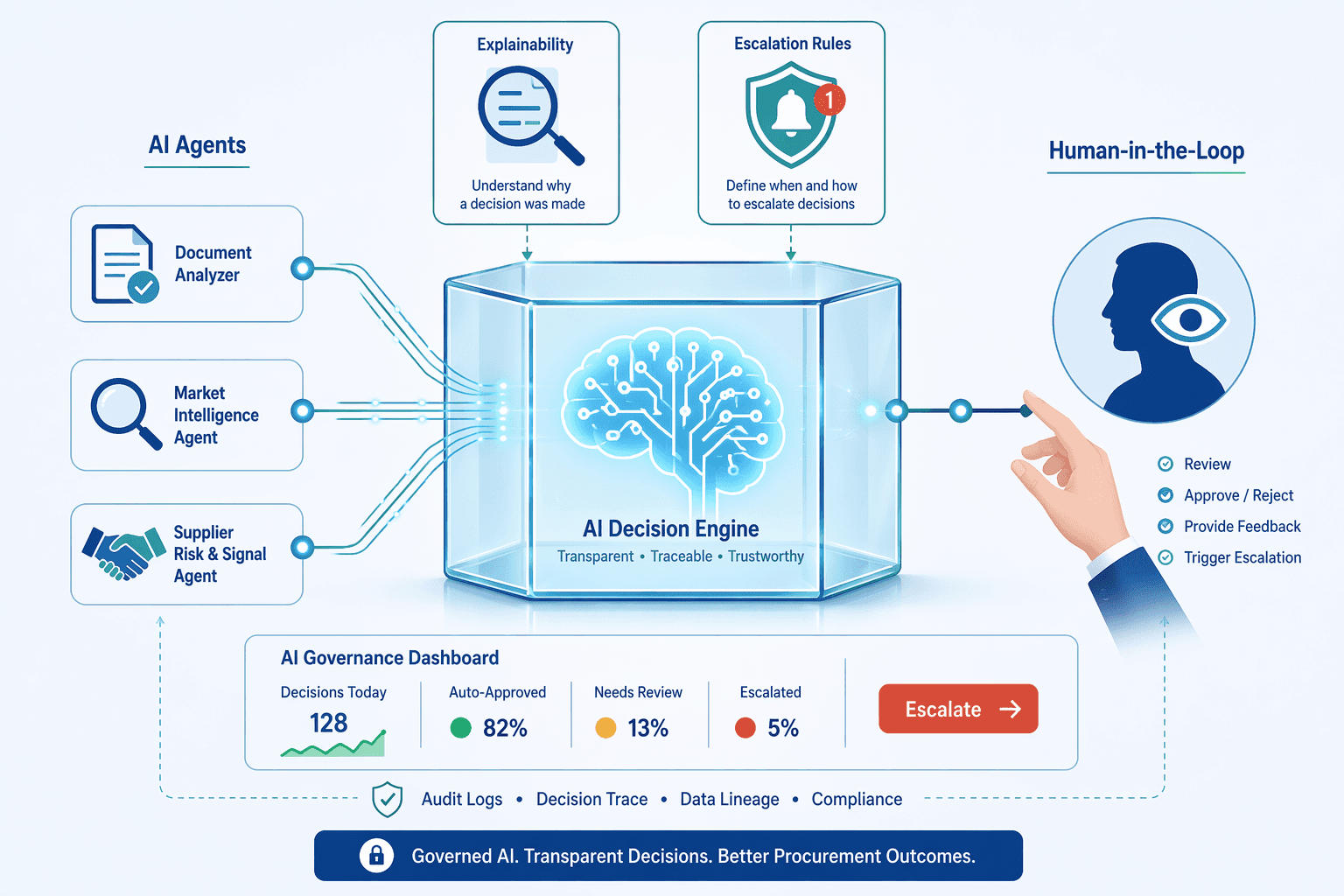
Agentic AI in procurement raises governance questions that task-level automation does not. When an agent executes a multi-step sourcing process without human intervention, the organization needs to know not just what decision was made, but why it was made, what alternatives were considered, and under what conditions a human should have been looped in. The "glass box" model — as opposed to a black-box autonomous system — addresses this by making every agent decision transparent, auditable, and subject to predefined escalation rules.
The core governance requirements for agentic procurement systems include:
- Explainability: Every agent decision must be traceable to specific data inputs and decision rules. If a sourcing agent rejects a supplier bid, the system must surface the exact criteria that triggered the rejection.
- Escalation rules: Define thresholds beyond which the agent must pause and request human approval — for example, any contract exceeding $500,000, any supplier from a restricted region, or any deviation from standard payment terms beyond 60 days.
- Human-in-the-loop design: Not every decision needs human review, but the system must have clear handoff points where a human can override, modify, or approve agent actions. The pattern is "human on the loop" (monitoring with override capability) rather than "human in the loop" (required for every step).
- Audit trail: Every agent action — every RFQ issued, every bid evaluated, every contract clause accepted or rejected — must be logged with timestamps, data snapshots, and decision rationale for compliance and post-hoc analysis.
The urgency of establishing these governance structures before scaling is underscored by the readiness gap in procurement teams. Our analysis of the AI readiness gap in procurement found that 83% of procurement teams lack formal AI governance frameworks — a gap that becomes critical when agents are making autonomous sourcing and contracting decisions. For a deeper implementation guide on human-in-the-loop design patterns, including specific escalation rule templates and audit trail architectures, see our dedicated human-in-the-loop implementation guide.
Adoption Pathway: From Pilot to Scaled Orchestration
The organizations that have achieved production-stage agentic AI deployments did not attempt a full source-to-pay transformation in a single initiative. They followed a four-step pathway that mirrors the pattern identified in the successful deployments documented earlier: narrow use case, measured ROI, gradual workflow redesign, and scaled orchestration.
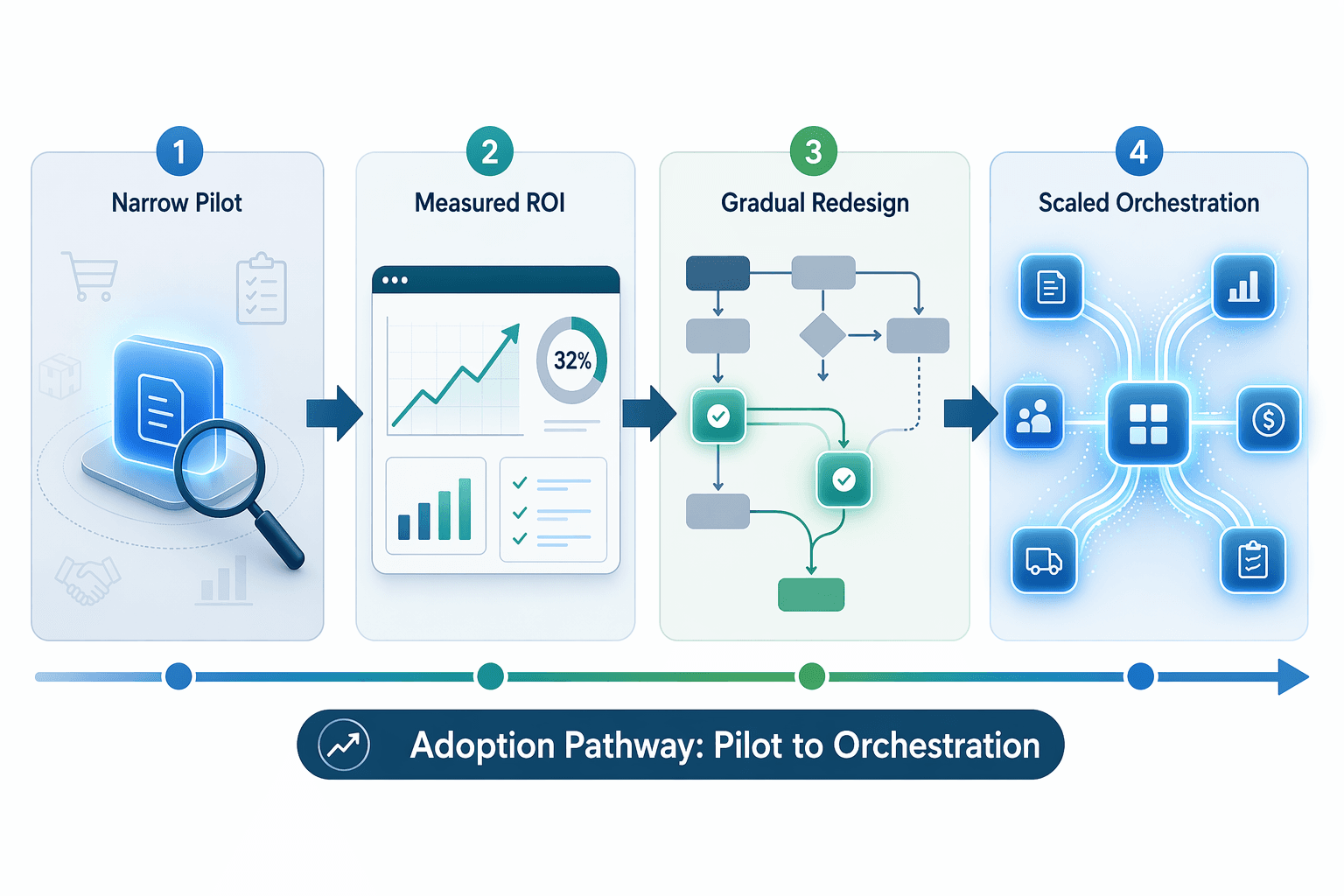
- Narrow pilot: Select a single, bounded use case with clear success metrics. The most common entry points are intake orchestration (conversational procurement front door) or AP automation (touchless invoice processing), both of which have established benchmarks and relatively low integration complexity. Limit the pilot to one category, one region, or one supplier group.
- Measured ROI: Define the baseline before deployment — current cycle time, error rate, cost per transaction, and stakeholder satisfaction. Run the pilot for a minimum of three months and measure outcomes against the baseline. The CASME analysis emphasizes that teams seeing measurable ROI start with outcomes, build adoption into the plan early, and learn from peers before investing further.
- Gradual workflow redesign: Use the pilot results to redesign the surrounding workflow, not just the agent's task. If the intake agent reduces requisition-to-PO cycle time by 40%, the approval workflow and supplier onboarding process may need adjustment to capture the full efficiency gain. This is the step where most deployments stall — they automate a task but leave the surrounding process unchanged.
- Scaled orchestration: Once two or three agent types are running in production with measured ROI, introduce the orchestration layer that coordinates them. This is where the compounding effect — 30% process efficiency improvement per Hackett Group — becomes achievable. The orchestration layer should be introduced as a separate project with its own success metrics, not as an afterthought.
Realistic timelines matter. SupplyChainBrain's analysis projects that agents will manage 60% to 70% of end-to-end transactional procurement by 2028 — a three-year horizon from the current 21% adoption in AP. This is not a slow adoption rate; it implies rapid scaling from current levels. But it also means that organizations starting their agentic AI journey in 2026 have a realistic window to move through the four-step pathway before the majority of their peers reach scaled orchestration.
For a current overview of the vendor landscape — including which platforms support agentic orchestration, which are limited to task-level automation, and how to evaluate them — see our Q2 2026 vendor landscape snapshot.
Risks, Realistic Timelines, and What to Watch For
Agentic AI in procurement carries risks that are distinct from those of earlier automation waves. The most commonly observed failure modes in production deployments include:
- Data readiness gaps: McKinsey reports that 21% of CPOs describe their data infrastructure maturity as low, with less than 70% of spend data stored in one place. Agentic systems that depend on clean, structured spend data will fail if the underlying data is fragmented across ERP instances, procurement systems, and spreadsheets.
- Change management resistance: 58.7% of respondents in S2P implementation surveys cite stakeholder alignment and change management as the most common challenge. Agentic AI, which shifts work from humans to systems, amplifies this resistance — particularly among procurement professionals who see their expertise being automated.
- Over-reliance on vendor demonstrations: The CASME analysis identifies over-reliance on sales demonstrations as a common failure reason. Vendor demos show best-case scenarios with clean data and simple workflows; production environments have dirty data, exception-heavy processes, and stakeholder politics that demos cannot replicate.
- The trough of disillusionment: Gartner has identified that generative AI in procurement has entered the "trough of disillusionment" — the phase where inflated early expectations give way to the reality of implementation complexity. Organizations that invest based on vendor projections rather than production benchmarks risk disappointment when the 70% productivity gains promised by PwC's future estimate do not materialize in the first year.
The realistic outlook for 2026–2028 is one of steady, measured progress rather than overnight transformation. The organizations that will capture the most value from agentic AI in procurement are not the ones that move fastest — they are the ones that move most deliberately: narrow pilots, rigorous measurement, gradual workflow redesign, and governance structures that keep agent decisions transparent and auditable. The production benchmarks documented in this article demonstrate that agentic AI works in procurement when deployed with discipline. The 95% failure rate from MIT's research is not a reason to avoid agentic AI; it is a reason to approach it with the same rigor that procurement professionals apply to any other strategic investment.
Comments
Join the discussion with an anonymous comment.