

The best artificial intelligence in supply chain management course is not the one with the most impressive logo or the longest list of AI buzzwords. It is the one that fits three things you cannot outsource: where you are in your career, what you can already do technically, and what outcome you need the course to support.
That sounds obvious until the course pages start blending together. One program promises generative AI for supply chain professionals. Another leans on digital twins and agentic systems. Another offers a certificate that looks useful on LinkedIn. A cheaper MOOC says it will teach the foundations. They are not interchangeable. A demand planner who lives in Excel and wants promotion into analytics needs a different path than a SQL-capable analyst trying to build GenAI workflows. A logistics director deciding how to upskill a team needs something different again.

The timing matters because this is no longer a speculative skill. Gartner reported in June 2026 that AI skill demand in supply chain surged 387% from Q1 2023 to Q1 2026, based on more than 35 million job postings across LinkedIn, Glassdoor, and Indeed through Coresignal data.[1] Scope Recruiting’s 2026 industry analysis found that workers with AI skills earn 25–30% more, while AI-related supply chain job postings rose 86% from December 2022 to December 2024.[2]
Those numbers are useful, but they do not mean every AI certificate deserves your tuition money. Scope’s same analysis notes that only 1.6% of supply chain job postings explicitly mention “AI,” while SQL, Power BI, ERP depth, and Python show up in nearly all analyst and planner postings.[2] In other words, the market is not simply rewarding people who can say “AI.” It is rewarding people who can connect AI to the work systems already used in planning, procurement, logistics, and operations.
Start with the course fit, not the course brand
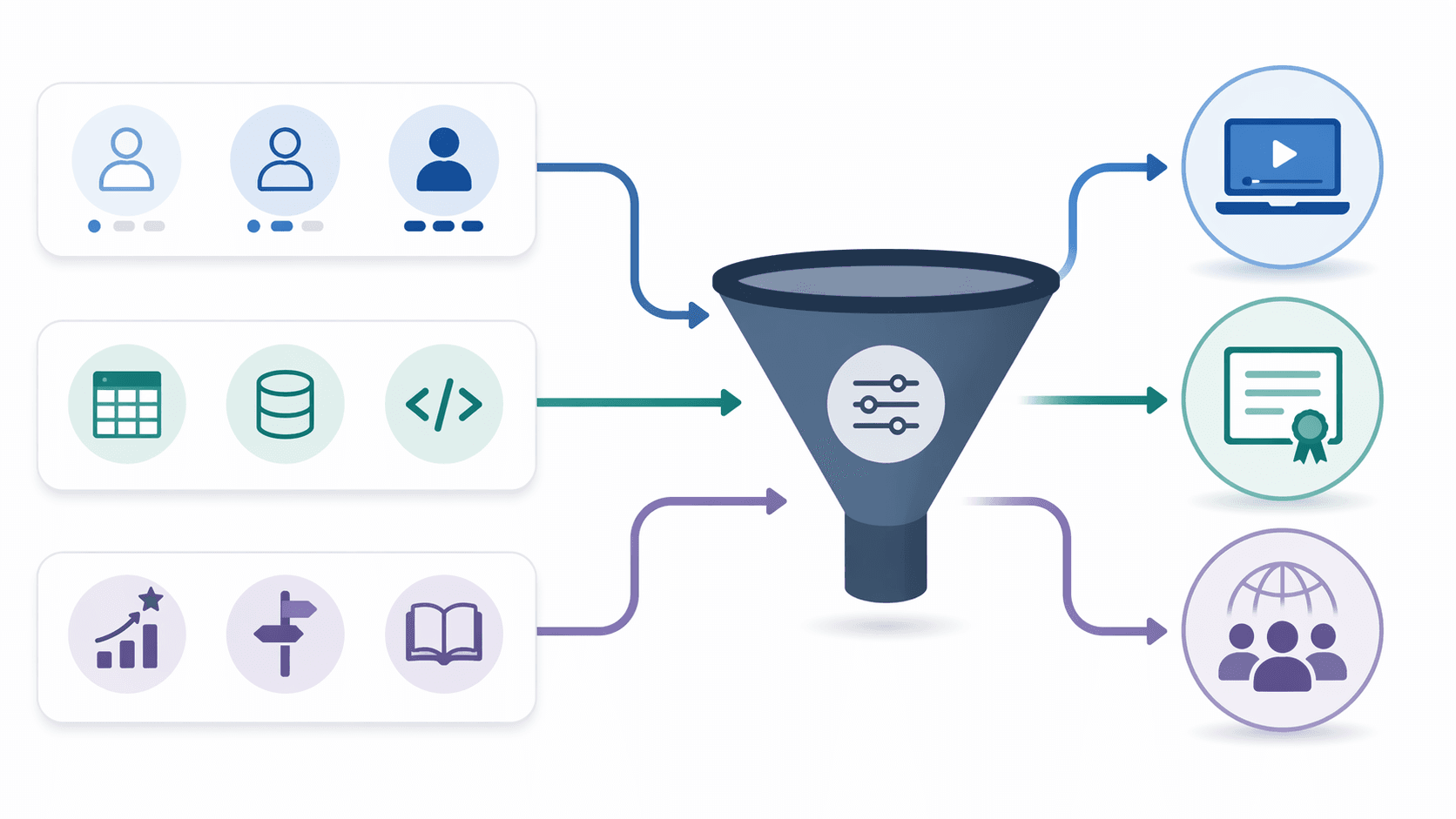
Before comparing programs, sort yourself through the same three filters you would use before buying software: current state, capability gap, and operating goal. If a course cannot survive that filter, its brochure does not matter.
| Filter | What to ask yourself | Why it changes the course choice |
|---|---|---|
| Career stage | Am I building credibility, moving into a higher-impact role, leading a team, or switching into supply chain? | Foundational courses, applied professional programs, and executive-level programs solve different problems. |
| Technical baseline | Am I Excel-only, SQL-capable, or already comfortable with Python and analytics workflows? | A course that is too light wastes time; a course that assumes too much turns into expensive frustration. |
| Desired outcome | Do I need promotion evidence, a lateral pivot, team upskilling, or hands-on workflow improvement? | Credential value, project work, live instruction, and technical depth matter differently depending on the goal. |
This is where many professionals make the expensive mistake. They buy the course that sounds most advanced, then discover it assumes a data background they do not have. Or they choose the safest introductory course, then realize it will not help them defend a business case, challenge model output, or explain why a forecast recommendation should be accepted or rejected.
The better question is not “Which course is best?” It is “Which course gets me from my current operating reality to the next credible level?”
What a useful AI supply chain course should actually teach
A course about AI in supply chain has to do more than explain machine learning concepts. The value shows up when the learner can apply those concepts to familiar failure points: demand volatility, inventory imbalances, supplier risk, transportation exceptions, warehouse labor constraints, and planning-cycle delays.
A strong program usually combines four layers:
- Supply chain domain grounding: planning, procurement, logistics, inventory, network design, or operations context, not generic AI examples.
- Applied technical fluency: enough SQL, Python, analytics, prompt engineering, or workflow design to work with real data and tools.
- AI output validation: practice checking recommendations, model assumptions, hallucinated explanations, exception logic, and business constraints.
- Credential signal: a certificate or institution that hiring managers, procurement leaders, or supply chain executives recognize.
The third layer is easy to underrate. Prompting an AI tool to summarize late shipments is not the same as knowing whether the output is operationally safe. A planner still has to know when historical demand is distorted by stockouts. A procurement specialist still has to check whether a supplier-risk summary is based on current evidence. A logistics manager still has to understand whether a routing recommendation violates service commitments or warehouse cutoffs.
That is why courses built around applied projects usually deserve more attention than courses built around lecture-heavy AI awareness. Formal training has its place, but Georgia Tech Supply Chain and Logistics Institute’s Chris Gaffney recommends a 70/20/10 learning model: 70% on-the-job application, 20% peer learning, and 10% formal training.[3] The course is the starting mechanism. The return comes when the work changes.
Use your technical baseline as a hard constraint
There is no shame in being Excel-first. Plenty of working supply chain teams still run critical planning, allocation, and reporting processes through spreadsheets. The problem is pretending that an Excel-first learner and a Python-ready analyst should buy the same training.
| Your current baseline | Best course type | Be careful with |
|---|---|---|
| Excel-only operator or planner | Foundational AI plus supply chain analytics, ideally with guided projects and practical tool use | Advanced programs that assume coding, statistics, or data engineering fluency |
| SQL-capable analyst or planner | Applied GenAI, workflow automation, AI output validation, Power BI or ERP-connected analytics | Introductory AI overviews that repeat vocabulary without giving you new operating leverage |
| Python-ready analyst or advanced practitioner | Advanced AI, multi-agent systems, digital twins, optimization, simulation, and implementation-oriented programs | Vendor badges that teach one interface but not transferable judgment |
| Senior leader or transformation owner | Executive or advanced practitioner programs focused on architecture, governance, operating-model change, and business cases | Courses that stay at tool-demo level and never address adoption, risk, data ownership, or team capability |
| Career switcher without supply chain depth | Academic certificate or structured program that teaches both supply chain foundations and AI concepts | Short AI bootcamps that assume you already understand planning, procurement, logistics, or operations tradeoffs |
This constraint should come before price. A $500 course that does not move your capability is not cheap; it is another unfinished tab in your browser. A $6,000 program can also be a poor buy if it teaches advanced orchestration to someone who still needs the data and process foundations to use it.
Credential value: employer-recognized beats tool-specific most of the time
A vendor certification can be useful when your company already uses that vendor or when the role explicitly asks for that platform. But for career mobility, employer-recognized credentials usually travel better: established supply chain associations, accredited universities, and programs attached to institutions hiring managers already know.
This matters because “AI in supply chain” is not one skill. It can mean better forecast review, faster root-cause analysis, supplier-risk monitoring, inventory policy support, warehouse labor planning, freight exception triage, or planning-workflow automation. A narrow tool badge may prove you completed a product course. A stronger professional credential helps show that you can apply the concept across business problems.
That does not make vendor learning worthless. It just means it should usually sit after the broader skill stack, not replace it. If you need to understand the current tool landscape before choosing a learning path, the Supply Chain AI Companies Landscape is a useful companion because it separates software categories instead of treating every platform as the same thing.
How the 2026 course landscape looks through that filter
The market has moved fast enough that older advice can age badly. Research.com reports that 65% of supply chain programs have updated curricula since 2024 to include AI modules, with published costs ranging from about $500 to more than $6,000.[4] That expansion is useful, but it also creates noise. Adding an AI module is not the same as teaching someone how to validate an AI-generated planning recommendation under real constraints.
Here is the current landscape, viewed as buyer fit rather than as a generic ranking.
| Program | Best fit | Why it belongs on the shortlist | Watch for |
|---|---|---|---|
| Georgia Tech GenAI for Supply Chain Professionals | Domain-experienced professionals who need applied GenAI skills | Published as an 8-week live online course priced at $1,500, with prompt engineering, AI output validation, and applied projects.[5] | Better for people who already understand supply chain work than for complete switchers. |
| MIT CTL AI-Driven Supply Chain Advanced Training | Senior leaders, advanced practitioners, and technically ambitious operators | Advanced focus areas include multi-agent orchestration and digital twins, with an intensive format and approximately $6,000 cost.[6] | May be too advanced if you still need analytics or supply chain foundations. |
| ODU AI in Supply Chain Operations Graduate Certificate | Career switchers or professionals needing both academic structure and domain foundation | Online graduate certificate format gives a more formal academic path for learners building supply chain and AI knowledge together.[7] | A longer academic route may be more than a mid-career planner needs for near-term promotion. |
| ELVTR AI in Supply Chain Management | Mid-level professionals who want live bootcamp structure | Live bootcamp model with DHL-taught content, aimed at practical professional upskilling.[8] | Bootcamp value depends heavily on project quality, instructor interaction, and whether exercises match your role. |
| CSCMP GenAI for Supply Chain Professional Certificate | Professionals who want a recognizable supply chain credential in a self-paced format | Delivered through LinkedIn Learning and connected to CSCMP credential recognition.[9] | Self-paced certificates require discipline and may need supplemental hands-on practice. |
| Coursera AI in Supply Chain | Budget-conscious learners testing the field or building baseline literacy | MOOC format lowers the initial risk for foundational learning.[10] | Usually not enough by itself if the goal is promotion into AI-enabled planning or analytics work. |
| MIT DSL GenAI for Logistics and Supply Chain Management | Logistics-focused professionals who want a shorter MIT-linked offering | Shorter program focused specifically on generative AI in logistics and supply chain management.[11] | Check whether the depth matches your intended use case before treating the institution name as the whole answer. |
The table is not a leaderboard. Georgia Tech and MIT are not solving the same buyer problem. Coursera and ODU should not be compared as if they occupy the same slot. CSCMP’s value is partly credential recognition. ELVTR’s value is partly live structure. The right comparison is against your gap, not against someone else’s LinkedIn post.
If you want promotion, choose proof of applied judgment
For a planner, logistics manager, procurement specialist, or supply chain analyst trying to move up, the best course is usually the one that creates usable evidence. A certificate helps, but the stronger promotion case is a project that shows how you used AI to improve a workflow, reduce manual review, surface exceptions faster, or challenge a recommendation with business logic.
That points toward applied programs with exercises in prompt engineering, AI output validation, data interpretation, and operational scenarios. Georgia Tech’s GenAI course is a clean fit for this lane because it is designed for professionals who already understand supply chain and need to apply GenAI to the work, not learn supply chain from scratch.[5] CSCMP’s GenAI certificate can also make sense when the credential signal matters and the learner can create hands-on practice around it.[9]
The promotion-oriented learner should be careful with courses that only teach AI vocabulary. Being able to define large language models is less valuable than being able to explain why a model’s recommendation conflicts with lead-time variability, supplier minimums, capacity constraints, or service-level commitments.
If you want a pivot, fill the missing side of the stack
Career switchers have a different problem. If you come from data analytics but lack supply chain depth, an AI course alone may leave you unable to interpret the business tradeoffs. If you come from operations but lack technical fluency, an advanced AI course may move too fast. The best pivot path fills the missing side first.
That is where a structured academic certificate such as ODU’s AI in Supply Chain Operations Graduate Certificate has a clearer role. It is better suited to someone who needs a more formal bridge into the domain, rather than a quick professional refresh.[7] A foundational Coursera-style course can also be a low-risk way to test interest before committing to a more expensive program.[10]
The pivot mistake is trying to buy credibility too quickly. A short AI badge will not compensate for not understanding forecast bias, inventory policy, supplier performance, transportation constraints, or ERP data. If the target role expects both business context and data fluency, the course path has to build both.
If you lead a team, evaluate implementation maturity
Senior leaders and team managers should be more demanding than individual learners. The course has to help with operating-model decisions: where AI fits in the planning process, who reviews outputs, what data is trustworthy, which workflows should be automated, and what governance is needed before recommendations affect customers, suppliers, or inventory dollars.
MIT CTL’s advanced training belongs in this conversation because it reaches into topics such as multi-agent orchestration and digital twins, which are more relevant to leaders and advanced practitioners thinking beyond individual productivity.[6] MIT DSL’s GenAI logistics and supply chain offering may fit leaders whose problem is more concentrated in logistics workflows.[11]
For team upskilling, the best course may not be one course. A practical pattern is to put leaders through advanced strategy and governance training, analysts through applied technical work, and frontline planners through AI-assisted workflow and validation practice. The Supply Chain AI Maturity Playbook is useful here because course selection should map to implementation maturity, not just individual curiosity.
The buying checklist that saves the most regret
Before paying, ask for evidence that the course will change what you can do. The checklist does not need to be complicated.
- Does the syllabus mention supply chain use cases by function, such as demand planning, procurement, logistics, inventory, warehouse operations, or network design?
- Does it include applied work, not just lectures and quizzes?
- Does it teach validation of AI outputs, including assumptions, data quality, business rules, and exception handling?
- Does it match your technical baseline, or does it quietly assume SQL, Python, statistics, or analytics experience you do not have?
- Will the credential be recognized by employers in supply chain, analytics, operations, or consulting roles?
- Can you turn the coursework into a portfolio artifact, internal pilot, process improvement, or promotion case?
- Does the course prepare you to work with the systems your team actually uses, such as ERP, planning platforms, BI tools, spreadsheets, SQL databases, or transportation and warehouse systems?
One practical test: open a current work problem before reviewing the syllabus. Maybe it is forecast override review, supplier delay triage, excess inventory explanation, or freight exception prioritization. If you cannot see how the course would help you attack that problem more intelligently, keep looking.
The same logic applies when evaluating AI software. If you are choosing training because your company is also reviewing platforms, pair the course decision with a structured software evaluation method such as How to Evaluate Supply Chain AI Software. The people selecting tools and the people validating outputs should not be learning from completely different assumptions.
A simple decision path
If you need a fast way to narrow the field, use this path:
- If you are Excel-first and unsure whether AI supply chain work is the right direction, start with a lower-cost foundational course, then move into applied analytics or GenAI once the use cases make sense.
- If you already work in supply chain and want promotion, prioritize applied GenAI, prompt engineering, validation, and project work over broad AI theory.
- If you are SQL-capable and want to become more valuable in planning or operations analytics, choose a program that connects AI workflows to data, BI, ERP, and decision review.
- If you are Python-ready or already leading advanced analytics work, look at advanced programs covering digital twins, optimization, simulation, multi-agent systems, or AI orchestration.
- If you are switching careers, choose a structured certificate that teaches supply chain foundations as well as AI, rather than assuming a short AI course will create domain credibility.
- If you are upskilling a team, split the learning path by role instead of forcing everyone through the same course.
The strongest return usually comes from the middle ground: enough formal training to establish concepts, enough hands-on work to build confidence, and enough workplace application to prove the skill matters. That is also where the salary and demand signals make the most sense. Employers are not just buying AI enthusiasm; they are buying people who can make better decisions with new tools.
So do not crown a universal winner. Compare your career stage, technical fluency, and desired outcome. Then ignore any artificial intelligence in supply chain management course that cannot show practical skill gain, credible credential value, or a clear fit for the work you actually do.
References
- Gartner Says There Is an Outsized Need for AI Talent in Supply Chain, Gartner, June 15, 2026.
- Supply Chain Skills AI, Scope Recruiting, 2026.
- Don’t Get Left Behind: Climbing the AI Ladder in Your Supply Chain Career, Georgia Tech Supply Chain and Logistics Institute, August 2025.
- Best AI Courses for Supply Chain Management Teams, Research.com.
- GenAI for Supply Chain Professionals, Georgia Tech Professional Education.
- AI-Driven Supply Chain Advanced Training, MIT Center for Transportation & Logistics.
- AI in Supply Chain Operations Graduate Certificate, Old Dominion University Online.
- AI in Supply Chain Management, ELVTR.
- GenAI for Supply Chain Professional Certificate, LinkedIn Learning.
- AI in Supply Chain, Coursera.
- GenAI for Logistics and Supply Chain Management, MIT Data Science Lab.
Comments
Join the discussion with an anonymous comment.