

Use Case Definition and Functional Scope
AI-driven dynamic routing optimization is a specific, bounded last-mile delivery application that continuously recalculates vehicle routes in response to live operational inputs. It is distinct from static Vehicle Routing Problem (VRP) solvers and basic route planning tools, which generate a fixed schedule at the start of a dispatch window and cannot adapt once routes are underway.
The formal problem structure is the Dynamic Vehicle Routing Problem (DVRP) — and specifically, for time-constrained last-mile operations, the DVRP with Time Windows and Traffic Awareness (DVRPTW-TA). What separates DVRP-based systems from static VRP is their continuous real-time handling of four disruption categories that fixed-schedule systems cannot resolve without manual dispatcher intervention:
- E1 — Critical traffic incidents: road closures, accidents, severe congestion requiring immediate route recalculation
- E2 — Urgent order insertions: new high-priority deliveries with tight time windows injected mid-dispatch
- E3 — Vehicle capacity violations: demand fluctuations that exceed a vehicle's remaining load capacity mid-route
- E4 — Service time violations: cumulative delays that risk breaching committed delivery time windows
Static route planners treat these events as exceptions requiring human escalation. DVRP-based AI systems treat them as expected operational inputs and resolve them algorithmically within seconds.
AI and ML Technique Taxonomy
Dynamic routing optimization draws on several distinct AI and ML method classes, each addressing a different layer of the routing problem. Understanding the mechanism — not the mathematical formulation — is what matters for business validation.
DVRP Variants
The core problem formulations in production use are: DVRPTW-TA (time windows with traffic awareness, the most operationally complete variant for urban last-mile); stochastic DVRP (models demand and travel time as probability distributions rather than fixed values, suited for high-uncertainty environments); and time-dependent VRP (travel times vary by time of day using historical traffic profiles, enabling pre-emptive congestion avoidance).
Metaheuristic Optimization
For real-time route recalculation under computational time constraints, metaheuristic methods dominate production deployments. Adaptive Large Neighborhood Search (ALNS) destroys and repairs partial route solutions iteratively, selecting operators probabilistically based on recent performance. Tabu Search hybrids prevent cycling through recently visited solutions. Ant Colony Optimization (ACO) uses pheromone-based path reinforcement to identify high-quality routes across a large solution space. These methods trade provable optimality for practical speed — recalculating routes in milliseconds rather than seconds.
ML Surrogate Models for Traffic and ETA Prediction
Route quality depends on accurate travel time estimates. ML-based traffic predictors — including convolutional neural networks trained on origin-destination flow data from mobile networks and urban sensor arrays — replace static map-speed assumptions with dynamic estimates that adjust for time of day, weather, and historical congestion patterns. These surrogate models feed directly into the VRP solver as updated arc costs, enabling the optimizer to route around predicted congestion before vehicles encounter it.
Reinforcement Learning and Neural Combinatorial Optimization
Reinforcement learning (RL) approaches train dispatch policies through simulated delivery environments, learning to sequence stops and assign vehicles in ways that maximize long-run performance metrics. Neural combinatorial optimization applies attention-based architectures (similar to those used in language models) to learn solution construction heuristics directly from problem instances. Both approaches are computationally intensive at training time but fast at inference — making them viable for real-time dispatch in high-volume environments.
Rollout-Based Real-Time Dispatch
For bounded-horizon decision-making — where a dispatcher needs the best available action now, not an optimal full-day plan — rollout-based dispatch simulates a limited number of future scenarios forward from the current state and selects the action with the best expected outcome. This is the dispatch layer used in the T-ALNS-RRD framework validated in a 2025 Scientific Reports study, which achieved a 94.2% disruption resolution rate with an average response time of 143.7 milliseconds on a controlled 47-customer test scenario.
| Method Class | Primary Function | Operational Implication |
|---|---|---|
| DVRPTW-TA / Stochastic DVRP | Problem formulation with time windows and traffic uncertainty | Enables time-window compliance under real-world variability |
| ALNS / Tabu Search / ACO | Metaheuristic route recalculation | Millisecond-speed route updates when disruptions occur |
| CNN traffic predictors | Travel time estimation from flow data | Replaces static map speeds with dynamic arc costs |
| Reinforcement learning | Dispatch policy learning via simulation | Optimizes sequential assignment decisions at scale |
| Rollout-based dispatch | Bounded-horizon real-time action selection | Provides best available decision within operational time constraint |
Value Delivery by Routing Archetype and Industry Vertical
Dynamic routing is not a single product configuration. Four operationally distinct archetypes serve different fleet profiles, order patterns, and service requirements. Selecting the wrong archetype is one of the more common deployment mismatches — organizations with scheduled B2B routes deploying real-time systems, or on-demand operators trying to use predictive-only models in high-variability environments.
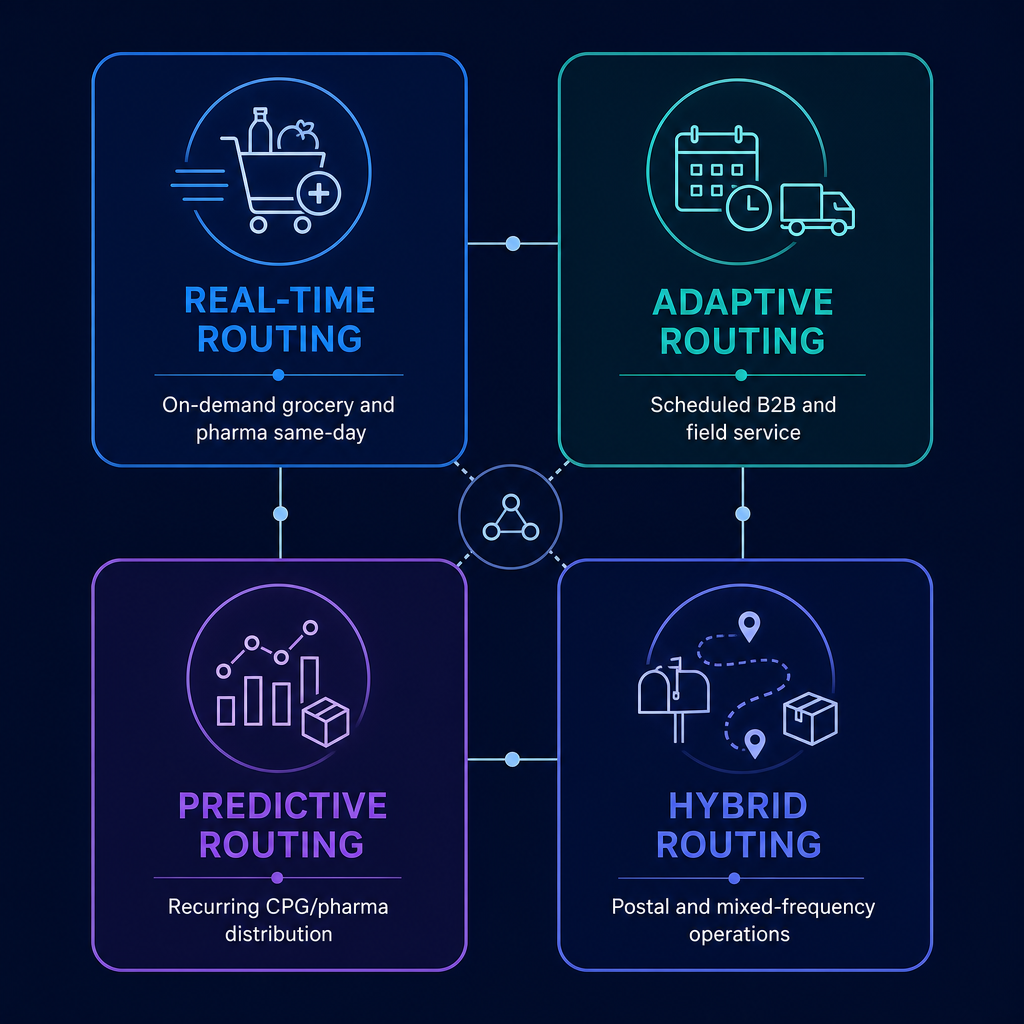
| Archetype | Recalculation Trigger | Primary Industry Fit | Operational Profile |
|---|---|---|---|
| Real-Time Dynamic | Continuous — routes recalculated instantly on live inputs | On-demand grocery, same-day e-commerce, express courier, urgent pharma | Highest computational load; requires live GPS, traffic feeds, and order streams at all times |
| Adaptive | Scheduled intervals (every 30–60 minutes) | Scheduled B2B delivery, utility field service, multi-stop commercial routes | Balances responsiveness with driver predictability; lower infrastructure demand than real-time |
| Predictive | Pre-dispatch using historical patterns and ML forecasts | Recurring CPG/B2B distribution, pharmaceutical scheduled delivery, postal routes | Uses historical demand and traffic patterns to pre-empt disruptions; strongest ROI on stable, recurring routes |
| Hybrid | Base schedule with real-time or adaptive overlay | Postal operations, mixed-frequency retail delivery, regional 3PL networks | Preserves planned structure while absorbing operational exceptions without full replanning |
Quantified Outcome Ranges
Academic validation provides a controlled baseline. The T-ALNS-RRD framework, tested on a synthetic 47-customer urban delivery scenario, achieved a 24.3% reduction in total operational cost and improved on-time delivery from 68.1% under static routing to 92.8% — alongside a 54.4% reduction in congestion exposure. These figures represent validated research results from a controlled test environment, not commercial deployment benchmarks.
Commercial deployment data from Locus and third-party analysts documents 15–30% reductions in total delivery costs in the first year and 10–28% reductions in traveled distance, with on-time delivery rates exceeding 90% for operations using dynamic routing. These figures are sourced from vendor-authored content and third-party market research cited within that content — they are not independently verified. For a documented case study of AI route optimization outcomes in a commercial carrier context, see the AI-Driven Route Optimization: Enterprise Carrier Deployment Case Study (note: that case study covers an LTL carrier network, not last-mile delivery specifically).
Industry-Vertical ROI Differentiation
ROI concentration varies materially by vertical. E-commerce and grocery operations — with high order volumes, tight delivery windows, and continuous order injection throughout the dispatch window — see the strongest returns from real-time archetypes. Pharma and CPG B2B distribution, with more stable demand patterns and recurring routes, see the strongest returns from predictive archetypes, where ML-based congestion pre-emption reduces late deliveries without requiring continuous route replanning.
| Vertical | Archetype Best Fit | Cost per Delivery Benchmark | On-Time Target | Primary ROI Driver |
|---|---|---|---|---|
| E-commerce | Real-Time | $8–12 (FleetRabbit, 2026, vendor estimate) | 95%+ | Distance reduction, failed delivery avoidance |
| Grocery / same-day | Real-Time | $10–15 (FleetRabbit, 2026, vendor estimate) | 98%+ | Time-window compliance, vehicle utilization |
| Food delivery | Real-Time | $5–8 (FleetRabbit, 2026, vendor estimate) | 90%+ | Speed, order injection handling |
| B2B / CPG distribution | Predictive or Adaptive | $15–25 (FleetRabbit, 2026, vendor estimate) | 99%+ | Congestion pre-emption, load consolidation |
| Pharma scheduled | Predictive | Variable by network | 99%+ | Compliance with delivery windows, cold-chain route stability |
| 3PL / mixed-frequency | Hybrid | Network-dependent | 95%+ | Schedule adherence with exception absorption |
Representative Vendors by Market Segment
The vendor landscape for AI-driven dynamic routing is organized into three segments with distinct operational profiles, integration requirements, and target deployment contexts. Vendor positioning reflects the market as of June 2026; active M&A activity in this space means product scope should be verified at time of evaluation.
Pure-Play AI Routing Platforms
These vendors are purpose-built for last-mile delivery optimization with AI/ML routing as the core product, not a bundled feature.
| Vendor | Routing Archetype Strengths | Target Deployment Context |
|---|---|---|
| Locus | Real-time and adaptive; strong multi-stop optimization at scale | Mid-market to enterprise retailers, 3PLs, FMCG distributors with high daily order volumes |
| FarEye | Real-time dynamic routing with live traffic and weather integration; recognized by Gartner and IDC | Enterprise and mid-market; strong in retail, logistics, and field service; documented EV route planning capability |
| OneRail | Real-time with carrier network integration; multi-carrier last-mile orchestration | Retailers and brands needing carrier-agnostic last-mile orchestration alongside dynamic routing |
Enterprise TMS with Embedded AI Routing
These vendors embed dynamic routing within broader transportation management platforms. Dynamic routing is one capability within a full TMS stack — not the standalone product.
| Vendor | Routing Archetype Strengths | Target Deployment Context |
|---|---|---|
| Descartes | Fixed, dynamic, and hybrid delivery models; real-time traffic analysis and predictive analytics; cited 40+ years of ML experience in last-mile stack | Enterprise shippers, carriers, and 3PLs requiring routing within a full delivery management platform |
| Blue Yonder | Adaptive and predictive routing embedded within TMS; strong integration with Blue Yonder WMS and planning suite | Enterprise retail, CPG, and manufacturing with existing Blue Yonder platform investment |
Mid-Market and SMB-Accessible Platforms
This segment covers platforms with lower implementation barriers, faster time-to-value, and pricing structures accessible to mid-market and smaller fleet operators.
| Vendor | Routing Archetype Strengths | Target Deployment Context |
|---|---|---|
| Route4Me | Adaptive and hybrid; strong multi-stop route planning with real-time adjustment | Mid-market field service, distribution, and delivery fleets |
| OptimoRoute | Adaptive; strong weekly planning with real-time exception handling | Mid-market and SMB with recurring route structures |
| Onfleet | Real-time dispatch and tracking; strong driver app and customer notification layer | Mid-market last-mile delivery operations; food and beverage, retail |
| DispatchTrack | Predictive and adaptive; strong in scheduled delivery with customer ETA management | Furniture, appliance, and home delivery operations with appointment scheduling |
| LogiNext | Real-time and adaptive; strong in high-volume courier and express delivery | Mid-market to enterprise in courier, express, and e-commerce last-mile |
Organizations evaluating dynamic routing within a full TMS capability stack — including carrier selection, load building, and freight rate analytics — should reference the AI in TMS: Route Optimization, Last-Mile Delivery, and Predictive Freight Rate Analytics entry for the bundled treatment.
Key Implementation Risks and Data Prerequisites
The primary failure modes in dynamic routing deployments are operational, not algorithmic. Most organizations that do not achieve expected ROI fail at the data and integration layer — before the routing model has a chance to demonstrate value.
Failure Mode 1: Data Fragmentation Across Disconnected Systems
Dynamic routing depends on unified real-time inputs from order management, TMS, WMS, fleet telematics, driver apps, and customer data. When these systems are siloed — a common condition in organizations that have grown through acquisition or run legacy ERP stacks — the routing model receives incomplete or inconsistent data and cannot generate reliable decisions. This is the leading failure mode identified across multiple independent assessments of AI last-mile deployments.
Failure Mode 2: GPS Data Quality and Traffic Feed Coverage
ML-based traffic predictors are only as accurate as their training data. Gaps in live traffic feed coverage, GPS signal degradation in dense urban environments, and inconsistent telematics data from mixed fleet hardware all degrade model performance in ways that are difficult to diagnose post-deployment. Traffic data accuracy is a documented core model dependency — not a solvable edge case.
Failure Mode 3: Driver Adoption Resistance and Dispatcher Distrust
Dispatchers and drivers who do not understand how routing recommendations are generated will override them — often correctly, based on local knowledge the model has not captured. Opaque AI recommendations without explainability features erode trust faster than suboptimal routes. Change management for dynamic routing is a people and process problem, not a technology configuration problem.
Failure Mode 4: Pilot-to-Production Scaling Without MLOps
Routing models trained on historical delivery data degrade as operational conditions change — seasonal demand shifts, network expansion, new customer segments, fleet composition changes. Without model retraining pipelines, performance monitoring, and MLOps infrastructure, a model that performs well in a six-week pilot will underperform in month four of production. This is a consistent failure pattern in AI last-mile deployments that achieve pilot success but stall at scale.
Failure Mode 5: Legacy ERP and TMS Integration Complexity
Embedding dynamic routing into real dispatch workflows requires bidirectional integration with existing order management and fleet systems. When routing recommendations are disconnected from the dispatcher interface or driver app — delivered as a separate tool rather than embedded in the workflow — adoption collapses and ROI does not materialize. Integration complexity is consistently cited as a primary deployment barrier across both analyst and practitioner sources. The Maersk AI Logistics deployment case study illustrates how large organizations navigate this integration challenge at scale.
Minimum Data Prerequisites
- Unified real-time order feed: all active orders with delivery addresses, time windows, and service requirements accessible in a single stream
- Live GPS and telematics: consistent, high-frequency vehicle location data from all fleet assets — not batch-uploaded at end of shift
- Traffic API integration: live and predictive traffic data from a commercial provider (Google Maps Platform, HERE, TomTom) covering the full delivery geography
- Historical delivery pattern data: minimum 12 months of completed delivery records with timestamps, stop sequences, and outcome data for ML model training
- Driver app integration: bidirectional data flow between routing engine and driver-facing application for real-time instruction updates and delivery confirmation capture
Adoption Maturity Assessment
Adoption maturity for AI-driven dynamic routing optimization is rated Growing. The use case is past the early-adopter stage — it is in active production deployment across e-commerce, 3PL, grocery, and CPG distribution — but is not yet universally deployed or commoditized. Significant variation in deployment quality and ROI realization persists across organizations.
Market Signals Supporting the Growing Rating
- AI route optimization has been adopted by approximately 45% of fleets as of 2026, with documented 15–30% cost savings reported by adopters (FleetRabbit, 2026 — vendor estimate, directional)
- AI/ML-powered dynamic route optimization leads market growth at a 14.2% CAGR, with cloud-based deployment holding 72% market share growing at 13.4% CAGR (Global Market Insights, cited in Locus 2026 guide)
- The last-mile route optimization software market was valued at USD 2.036 billion in 2025, projected to reach USD 3.819 billion by 2034 at 9.6% CAGR (Intelmarketresearch, 2026 — last-mile route optimization software scope specifically)
- The broader global route optimization software market was USD 6.0 billion in 2024, projected to reach USD 15.0 billion by 2033 (PreciseView Reports, cited in Locus 2026 guide — broader market scope, not directly comparable to the last-mile figure above)
- Enterprise-scale 3PL deployments are confirmed at production stage — the DHL deployment case study represents a large-scale readiness signal for AI routing in logistics networks. See the DHL AI Logistics Network Optimization deployment case study for enterprise-scale context.
Readiness Signals
Organizations that are deployment-ready typically show the following characteristics:
- High-volume last-mile operations (100+ deliveries per day per depot) where route quality has a material cost impact
- Unified data infrastructure with real-time order visibility, live GPS/telematics, and traffic API access already in place
- Existing TMS or WMS with API integration capability — not solely dependent on manual data export
- Dispatcher and operations team willing to operate in a human-in-the-loop model with AI recommendations
Organizations that are not yet deployment-ready typically show:
- Fragmented order management across multiple disconnected systems with no unified real-time feed
- No GPS or telematics integration — vehicle location tracked manually or via driver phone check-ins
- Legacy ERP or TMS with no published API — integration requires custom development
- No historical delivery data available for ML model training (fewer than 6 months of structured delivery records)
When deployed against high-impact use cases with the data foundation in place, measurable ROI typically appears within 3–6 months of production deployment.
Use Case Schema Reference
The following table summarizes the structured schema fields for this use case entry. ROI figures are source-attributed with framing consistent with the body — academic research results, vendor-reported commercial outcomes, and third-party analyst estimates are distinguished.
| Schema Field | Value |
|---|---|
| Supply Chain Function | Logistics — Last-Mile Delivery |
| AI / ML Technique | DVRP optimization (DVRPTW-TA, stochastic DVRP, time-dependent VRP); metaheuristic solvers (ALNS, Tabu Search, ACO); ML traffic surrogate models (CNN-based); reinforcement learning dispatch; rollout-based real-time decision-making |
| Applicable Industries | E-commerce, Grocery / Same-Day Retail, Pharma, CPG / B2B Distribution, 3PL, Food Delivery, Postal / Mixed-Frequency Operations |
| Adoption Maturity | Growing — active production deployment across e-commerce, 3PL, and grocery; not yet universally deployed |
| Typical ROI Indicators | 24.3% operational cost reduction, 92.8% on-time delivery rate vs. 68.1% static baseline (Nature/Scientific Reports 2025 — controlled 47-customer research scenario, not commercial benchmark); 15–30% delivery cost reduction, 10–28% distance reduction in first year (Locus customer data and Global Market Insights, vendor-authored); on-time rates exceeding 90% (Research and Markets, cited in Locus 2026 guide); ROI typically visible within 3–6 months when data prerequisites are met (RTS Labs) |
| Representative Vendors | Pure-play AI routing: Locus, FarEye, OneRail | Enterprise TMS with AI routing: Descartes, Blue Yonder | Mid-market / SMB: Route4Me, OptimoRoute, Onfleet, DispatchTrack, LogiNext |
| Key Implementation Risks | Data fragmentation across disconnected TMS/WMS/ERP/telematics (leading failure mode); GPS data quality degradation and incomplete traffic feed coverage; driver adoption resistance and dispatcher distrust of opaque recommendations; pilot-to-production scaling failure without MLOps and model retraining pipelines; legacy ERP/TMS integration complexity |
Comments
Join the discussion with an anonymous comment.