
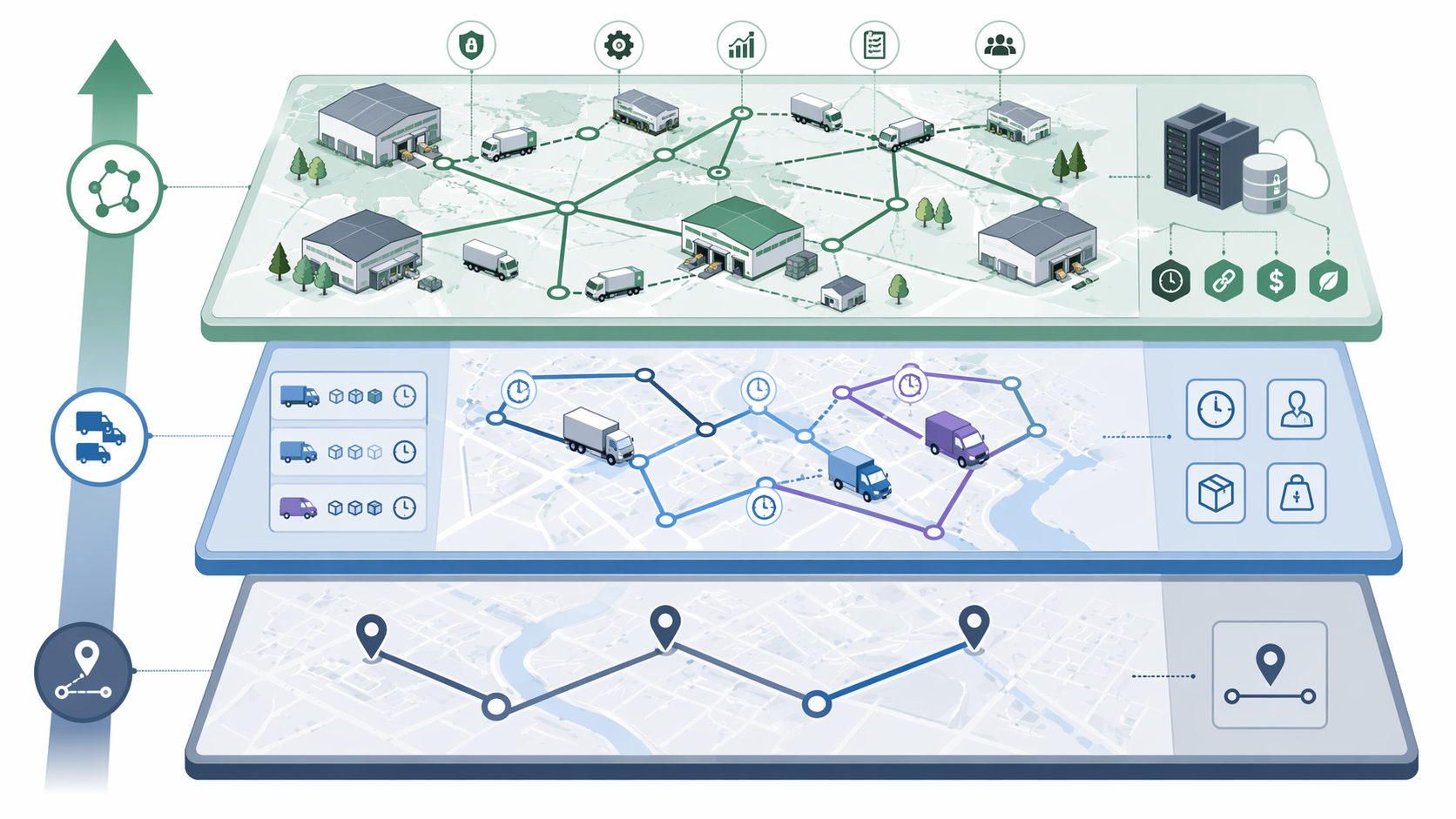
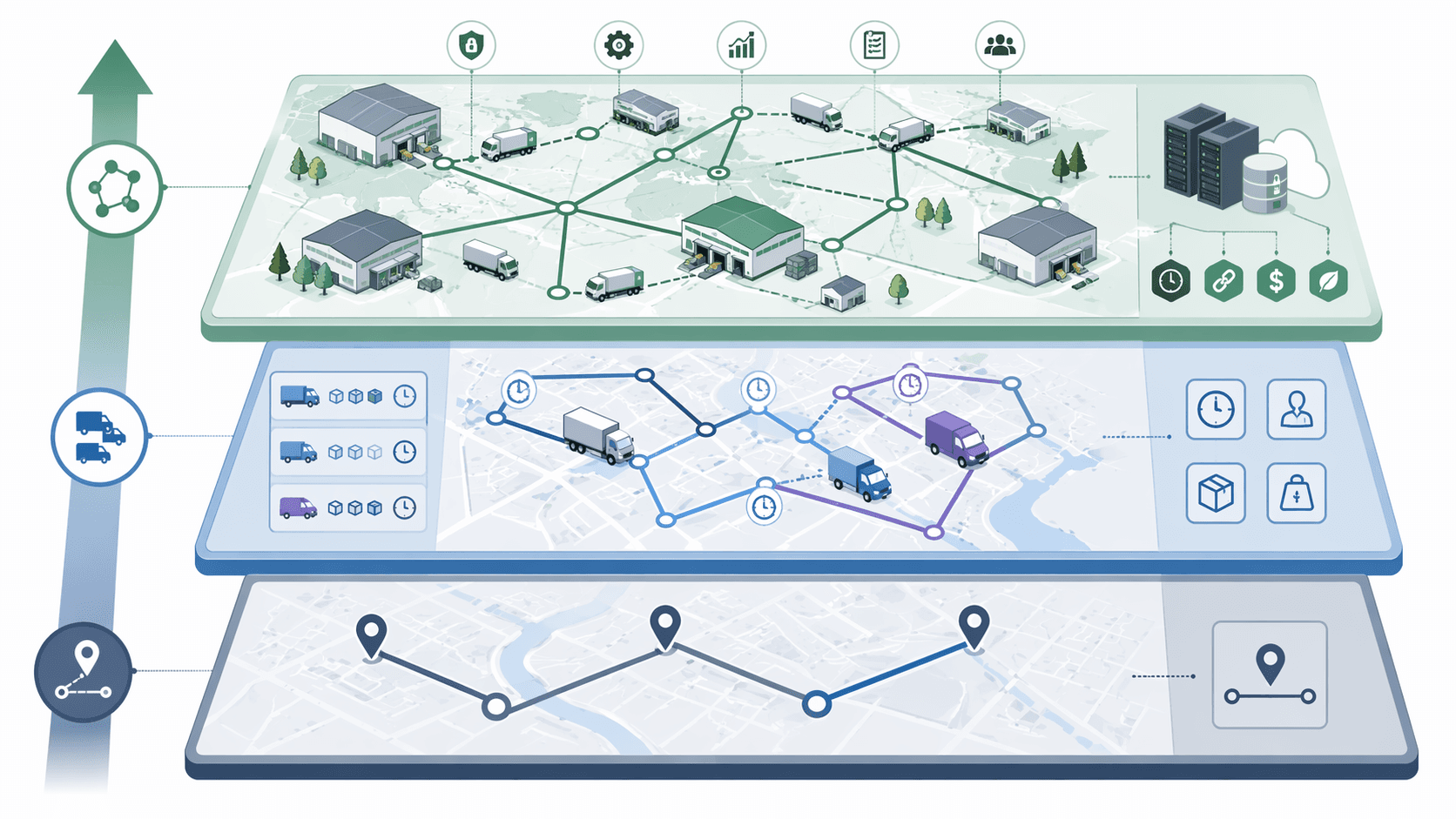
The first procurement mistake is comparing every Route Optimization API as if it solves the same problem. A basic routing API answers questions like distance, ETA, and turn-by-turn paths between points. A route optimization API is closer to a vehicle-routing-problem solver: it decides which vehicle should serve which stops, in what order, under constraints such as time windows, capacity, skills, service duration, and depot rules. Geoapify draws that distinction directly: routing APIs calculate routes, while route optimization APIs solve for better assignment and sequencing across multiple stops and vehicles.[1]
That difference sounds academic until the shortlist meeting. If the operation only needs reliable point-to-point travel times, a full VRP solver may be unnecessary. If dispatch has to balance hundreds or thousands of orders, driver shifts, time windows, vehicle capacity, pickup-and-delivery precedence, and regional business rules, “fast optimization” is not enough. The API has to expose the constraints the operation actually uses, price those runs in a way procurement can forecast, and deploy where the company is allowed to run logistics decisioning.
Route Optimization API comparison matrix
| Vendor | Pricing model | Constraint depth | Deployment model | Best-fit buyer | Major caveat |
|---|---|---|---|---|---|
| Google Route Optimization API | Published per-shipment billing across Single Vehicle Routing and Fleet Routing SKUs; monthly Google Maps Platform credit applies | Useful for standard shipment and fleet optimization, but public materials do not position it as a deep truck-specific or enterprise-custom solver | Google Cloud / Google Maps Platform API | Teams already committed to Google Cloud that want transparent billing and a managed API | Per-shipment exposure and quota limits need modeling before high-volume production use |
| NextBillion.ai | Custom pricing | Vendor claims 50+ constraints and up to 10,000 orders per request | Cloud and on-premises deployment options | Enterprise logistics teams with complex constraints, high order volume, and deployment restrictions | Custom pricing makes early cost comparison harder; comparison materials are vendor-authored |
| Timefold | Commercial solver/API positioning; pricing is not directly comparable to per-shipment billing from the cited materials | Solver-oriented, with deterministic behavior positioned as a differentiator | API and solver deployment model, depending on implementation | Engineering teams that care about repeatable solver behavior and constraint modeling | Vendor-reported outcome claims are useful signals, not universal benchmarks |
| Solvice | Vendor-published resource-based pricing cited at €16 per resource per month | Constraint-focused optimization API positioning | API-first deployment | Teams comparing specialist optimization APIs on resource-based cost logic | Its “20% better optimization” comparison is a competitor-authored claim, not independent validation |
| GraphHopper | Published plan / credit-style API pricing, not directly equivalent to shipment or resource billing | Developer-oriented routing and optimization capability | Hosted API and developer integration model | Teams that want a developer-friendly API surface and predictable plan-based procurement | Credit or plan limits need translation into the team’s actual optimization workload |
| Routific | Subscription-tier logic rather than raw per-shipment infrastructure billing | Delivery-route optimization for small and midsize operations | SaaS/API-oriented delivery planning | Local delivery teams that want route planning capability without building a solver stack | Less appropriate when procurement needs deep enterprise deployment control or unusually complex constraints |
The table is not a ranking because these products do not expose the same buying unit. A shipment, a vehicle resource, a credit, a subscription seat, and an enterprise quote are different procurement objects. Treating them as interchangeable is how a cheap pilot becomes an expensive production system.
Google gives procurement the clearest billing baseline
Google’s Route Optimization API is unusually concrete about what is being sold. The product documentation describes an API for optimizing routes for single or multiple vehicles and separates usage into two SKUs: Single Vehicle Routing and Fleet Routing.[2] That matters because procurement can at least start from a visible unit instead of asking engineering to reverse-engineer a sales quote.
The billing documentation prices usage per shipment, sets a 60 queries-per-minute limit, and states that the Google Maps Platform monthly credit applies.[3] Those three facts are more useful than a vague promise of scalability. A team can ask: how many shipments are in a typical optimization request, how often are routes recalculated, and what happens when dispatch wants near-real-time replanning during peak windows?
Per-shipment billing is clean when operational volume is clean. It becomes less clean when the business reruns optimizations repeatedly: failed delivery attempts, same-day insertions, driver callouts, cut-off changes, or customer rescheduling can all increase the number of optimization calls without increasing completed deliveries. The finance model should count optimization events, not just delivered orders.
Google is a sensible shortlist candidate for teams already standardized on Google Cloud and Google Maps Platform, especially when the routing problem fits the API’s exposed model. The caution is not that Google is weak; it is that a managed mapping-platform API may not be the same thing as a highly customized enterprise logistics solver. If the operation depends on specialized truck routing, unusual driver rules, depot-specific logic, or strict deployment controls, those requirements need to be tested before the pricing page wins the meeting.
NextBillion.ai sits at the enterprise-complexity end
NextBillion.ai’s public comparison against Google emphasizes a different shape of product: custom pricing, on-premises deployment, more than 50 constraint types, and up to 10,000 orders per request.[4] Those claims should be read as vendor-positioning material, but they are still directly relevant to shortlist design. They describe the kind of buyer NextBillion.ai wants: a logistics team whose problem is too constrained, too large, or too deployment-sensitive for a simple hosted API evaluation.
The on-premises option is not a cosmetic feature. For some supply chain IT teams, logistics decisioning cannot simply move into a vendor-hosted environment. Data residency, customer contracts, latency assumptions, integration with transport management systems, and internal security review can all turn deployment model into a gating criterion. A cheaper API loses its advantage if it cannot run where the company is allowed to run it.
The 50+ constraint claim also needs a practical reading. Constraint count by itself is not proof of fit. Procurement should ask for the exact constraints used in its own operation: time windows, vehicle capacity, service duration, pickup-and-delivery pairing, skills, breaks, zones, depot rules, driver shift limits, vehicle compatibility, route duration, priority orders, and hard-versus-soft penalties. A long list only helps if the API lets engineering express the constraints that actually block dispatch from using a route.
Custom pricing is defensible for complex operations, but it changes the evaluation work. A quote has to be tied to request size, request frequency, number of depots, deployment environment, support expectations, implementation services, and expected replanning behavior. Without that, procurement is comparing a negotiated bundle against a public unit price and pretending the math is neutral.
Timefold, Solvice, GraphHopper, and Routific are not the same kind of alternative
The specialist category is where comparison language gets slippery. Timefold, Solvice, GraphHopper, and Routific can all appear in a Route Optimization API search, but they do not necessarily compete on the same procurement axis. Some are solver-first. Some are routing-and-optimization APIs. Some are delivery-planning products with API access. That difference affects who should evaluate them: engineering, dispatch operations, procurement, or supply chain IT.
Timefold: solver behavior before procurement simplicity
Timefold positions deterministic solving as a differentiator: the same input produces the same output.[5] That is not a flashy executive claim, but it is valuable in implementation. When planners challenge a route, engineers need to know whether a change came from new input data, adjusted constraints, or solver variability. Determinism makes regression testing and route explainability less painful.
Timefold also reports customer outcomes including a 33% drive-time reduction and a 43% distance reduction.[5] Those numbers are best treated as evidence that meaningful savings are possible in a suitable implementation, not as a benchmark. The result a buyer gets depends on baseline route quality, constraint hardness, geography, traffic assumptions, driver rules, and whether dispatch actually follows the optimized plan.
Solvice: resource pricing and competitor-authored claims
Solvice’s public alternative-to-Google article cites pricing of €16 per resource per month and claims “20% better optimization” versus NextBillion.ai.[6] The pricing unit is useful because resource-based billing can be easier for some teams to forecast than per-shipment billing. The performance comparison needs a firmer grip: it comes from a competitor-authored post, so it should trigger a benchmark request, not a procurement conclusion.
A fair Solvice evaluation would use the buyer’s own historical orders, vehicles, constraints, and service rules. If the vendor claims better optimization, ask better than what baseline: current dispatcher routes, another API with default settings, or another solver tuned by its own implementation team? “Better” can mean fewer miles, fewer vehicles, fewer late stops, lower overtime, fewer constraint violations, or a weighted objective that hides trade-offs.
GraphHopper and Routific: useful only if the buying unit fits the operation
GraphHopper usually belongs in the API-first discussion for teams that want developer-accessible routing and optimization capability without committing immediately to an enterprise logistics platform. The procurement work is to translate plan or credit-style limits into actual workload: how many optimization jobs, how many vehicles, how many stops, how many recalculations, and what latency expectations apply during dispatch hours.
Routific is more naturally evaluated by teams that want practical delivery-route planning rather than a deeply customized solver environment. That can be the right call for local delivery operations where usability and dispatch adoption matter more than exotic constraint modeling. It is a weaker fit when the buyer needs strict deployment control, heavy custom constraints, or a solver embedded deeply into a larger logistics architecture.
Pricing units are not interchangeable
A procurement spreadsheet can make unlike units look comparable. That is dangerous here. Each pricing model creates a different failure mode:
- Per-shipment billing is transparent, but repeated replanning can increase spend faster than completed-delivery volume.
- Per-resource billing is easier to connect to fleet size, but it may not reflect seasonal stop density or order volatility.
- Credit-based plans require engineering to map each API action to credits before procurement can forecast production cost.
- Subscription tiers can be easy to approve, but tier boundaries may not match dispatch growth.
- Custom enterprise quotes can absorb complexity, but they reduce early price transparency and make vendor-to-vendor comparison slower.
The cleanest pricing exercise is not “what does one route cost?” It is a modeled month. Use real operating patterns: planned optimizations, same-day inserts, failed attempts, cancellations, driver absences, peak-day reruns, depot cutoffs, and customer time-window changes. Then ask every vendor to price the same workload. If one vendor prices shipments, another prices resources, and another prices a quote bundle, leave the units visible instead of forcing them into a fake common denominator.
Constraint depth decides whether the plan survives dispatch
The most expensive route optimization system is not the one with the highest API bill. It is the one dispatch cannot use because the model ignores a rule everyone on the floor treats as non-negotiable. That rule might be a customer receiving window, a vehicle refrigeration requirement, a driver certification, a loading sequence, a labor agreement, a depot cutoff, or a neighborhood restriction.
Constraint support should be tested in the API request, not accepted from a feature list. For each high-impact rule, the evaluation team should know whether it is supported natively, represented through a workaround, treated as a hard constraint, treated as a penalty, or left for post-processing. Workarounds are not automatically bad, but they have to be owned. A workaround maintained by one senior engineer is a business continuity risk.
| Constraint question | Why it matters in evaluation |
|---|---|
| Can the API express hard and soft time windows separately? | Late deliveries and preferred delivery times do not carry the same operational consequence. |
| Can it model capacity by vehicle type or compartment? | A simple stop count is not enough for weight, volume, cold-chain, or mixed-load operations. |
| Can it support pickup-and-delivery precedence? | Some orders are invalid if pickup and drop-off sequencing is not enforced. |
| Can it represent driver skills, territories, or vehicle compatibility? | The shortest route may assign work to someone who is not allowed to perform it. |
| Can it handle replanning without destabilizing the whole route set? | Dispatch needs useful changes, not a completely reshuffled plan every time one order moves. |
This is where NextBillion.ai’s constraint-heavy positioning and Timefold’s solver-oriented posture deserve more attention than a generic speed claim. It is also where Google’s transparent billing may or may not be enough, depending on how closely the operation fits the exposed model. A simple fleet routing problem and a constrained enterprise delivery network should not be evaluated with the same checklist.
Deployment model can overrule price
Deployment questions often arrive late because they are less exciting than route screenshots. They should arrive early. A Route Optimization API may need access to order data, customer addresses, driver data, fleet data, depot rules, historical delivery performance, and operational exceptions. That can pull security, legal, architecture, and data governance into the buying process.
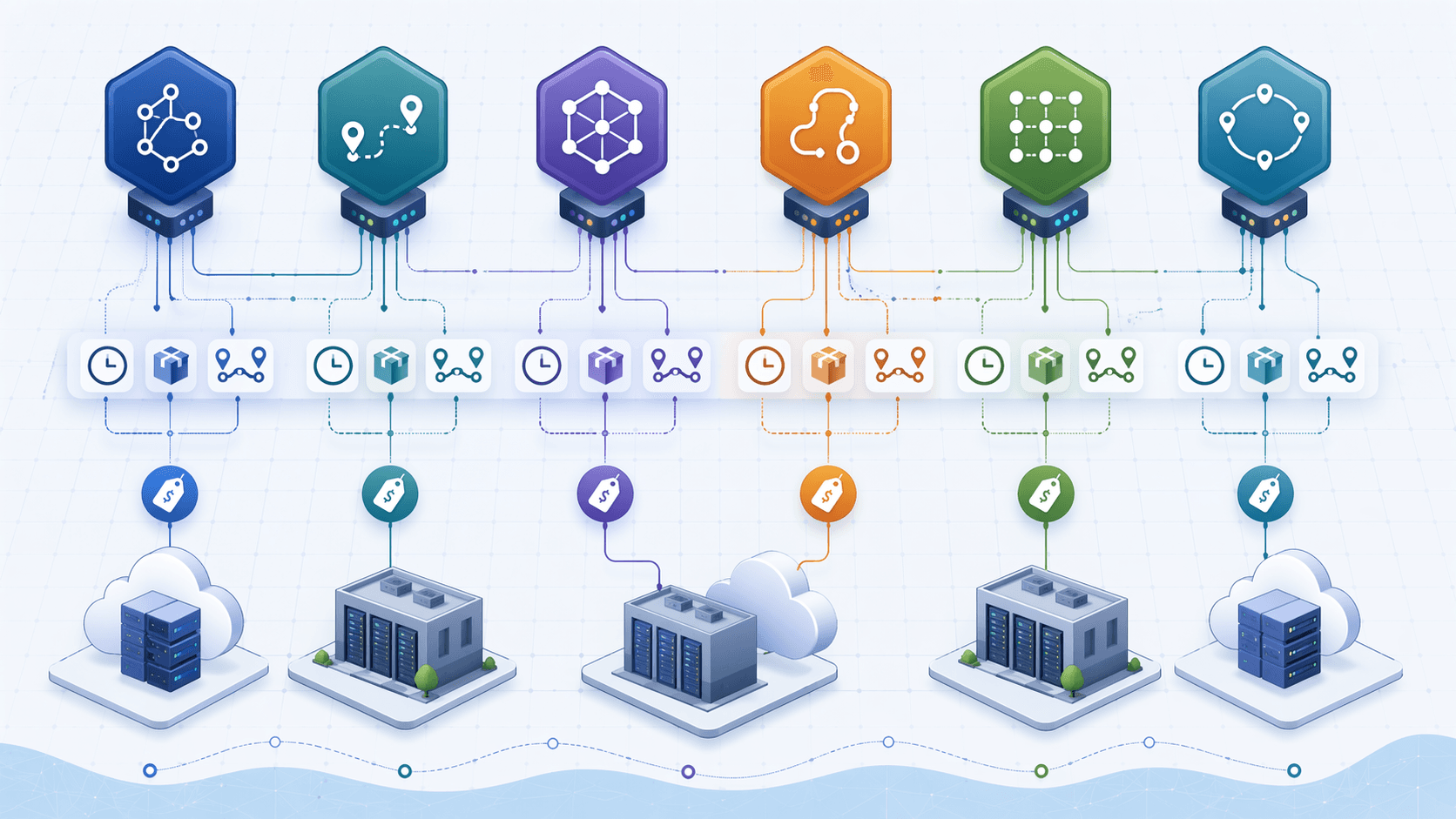
Hosted APIs are attractive when the team wants lower infrastructure burden and faster integration. They also fit organizations already comfortable with cloud-based mapping and logistics services. On-premises or more controlled deployment matters when routing decisions are tied to sensitive operational data, regulated customer information, strict residency requirements, or low-latency internal systems. NextBillion.ai’s on-premises positioning is therefore not just an enterprise checkbox; it changes who can buy the system and how it passes internal review.[4]
Engineering should also ask what happens around the optimization call. Is geocoding included or separate? Are distance matrices generated internally or supplied by the buyer? Can the system use live traffic, historical traffic, or custom travel-time assumptions? How are failed requests handled? What observability exists when a route looks wrong? These questions are not secondary; they determine whether the API becomes a dependable planning component or a black box that dispatch learns to distrust.
How to narrow the shortlist
A defensible shortlist usually starts with fit, not feature count.
- Shortlist Google when the team already uses Google Cloud or Google Maps Platform, wants published per-shipment billing, and has a routing problem that fits the API’s constraint model.
- Shortlist NextBillion.ai when the operation has high order volume, heavy constraints, and deployment requirements that may include on-premises environments.
- Shortlist Timefold when engineering needs solver depth, repeatable behavior, and clearer control over constraint modeling.
- Shortlist Solvice when resource-based pricing and specialist optimization are attractive, but validate performance claims on your own workload.
- Shortlist GraphHopper when developer-friendly API integration and routing/optimization access matter more than buying a full enterprise logistics platform.
- Shortlist Routific when the team needs delivery route planning with practical adoption more than deep deployment control or unusual enterprise constraints.
Market momentum and savings anecdotes can support the business case, but they should not select the API. Timefold’s reported reductions show that optimization can matter materially in the right setting.[5] The commonly cited UPS ORION savings story belongs in the same category: useful context for why route optimization attracts investment, not proof that any specific API will deliver the same result. The procurement decision still comes back to the buyer’s constraints, pricing exposure, and deployment limits.
The practical test is simple: give each vendor the same representative workload, including the ugly exceptions dispatch deals with on a normal week. Ask for the modeled constraints, the deployment architecture, the billable units, the quota limits, and the route outputs. Then let engineering and operations review not only the best route, but the route the API produces when something goes wrong.
The right Route Optimization API is not the one with the fastest demo. It is the one whose constraint model and deployment model match the operation before anyone starts arguing about raw optimization speed.
References
- Routing API vs Route Optimization API, Geoapify on dev.to
- Google Route Optimization API Overview, Google Developers
- Google Route Optimization API Usage and Billing, Google Developers
- NextBillion.ai vs Google Route Optimization API, NextBillion.ai
- How much fuel can route optimization actually save? An ROI guide for field service fleets, Timefold
- Google Routes API Alternatives: Route Optimization APIs for 2025, Solvice
Comments
Join the discussion with an anonymous comment.