
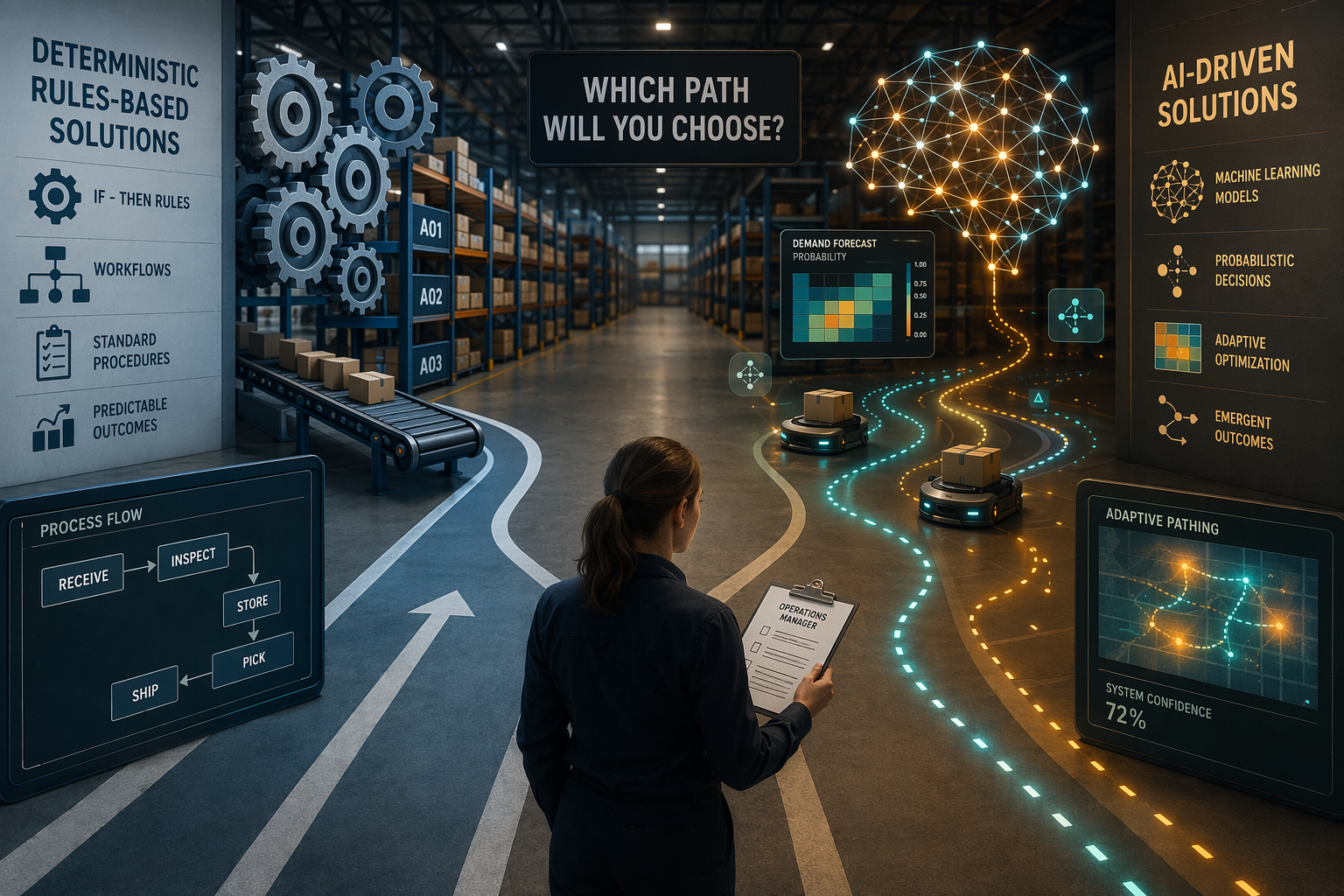
The first question in AI in warehouse management is usually not “Which model should we buy?” It is “Can the rule already be written?” If the answer is yes, and the operating conditions are stable, AI is often the wrong starting point.
FIFO inventory rotation does not need a prediction model to decide which lot should ship first. Min/Max replenishment does not become smarter because a probabilistic layer is placed on top of a reorder rule. Wave planning may be complex, but much of it is still a rules-and-constraints problem: carrier cutoffs, zone capacity, labor availability, order priority, equipment limits. LIDD makes this point directly in its discussion of warehouse AI: rules-based algorithms are not obsolete just because AI tools are available, and many warehouse decisions still belong to deterministic logic rather than machine learning. [1]
That boundary matters because AI projects have a habit of sounding successful until they are asked to survive ordinary warehouse conditions: late receipts, missing scans, short labor, damaged labels, duplicate SKUs, a WMS field nobody trusts, and a supervisor who still has to get the trailers loaded by 5 p.m. BCG’s 2024 finding that 74% of businesses report no meaningful value from AI is not warehouse-specific evidence, so it should not be treated as a warehouse failure rate. It is still a useful warning: broad AI adoption does not automatically turn into operational value. [2]
Start with the type of uncertainty, not the technology name
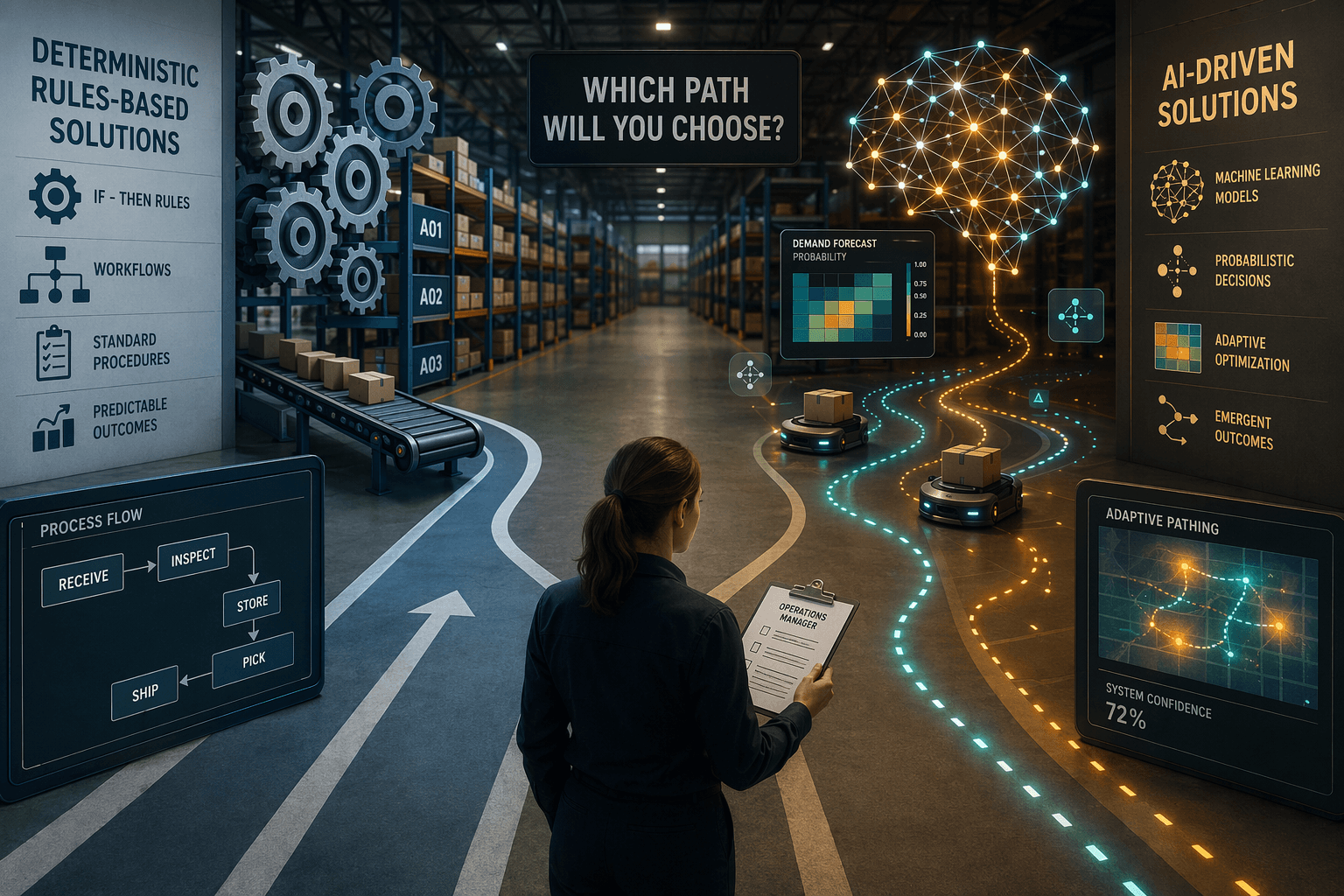
A useful warehouse AI decision starts by naming the uncertainty the operation cannot already handle with rules. “We need AI for inventory” is not a diagnosis. “We cannot reliably detect damaged packaging before putaway” is closer. “Our demand swings cause repeated stockouts and overstocks even after planner review” is closer. “Our pickers spend too much time walking because the SKU mix changes faster than the slotting plan” is closer.
The distinction is practical. A rules engine needs a clear rule, reliable inputs, and stable conditions. AI becomes more plausible when the decision depends on patterns that are hard to write down, conditions that keep changing, or sensory inputs a normal WMS was never built to interpret.
| Warehouse problem | What makes it uncertain | Technology that may fit | First question to ask |
|---|---|---|---|
| Demand and replenishment volatility | Future order patterns do not follow stable reorder assumptions | Machine learning forecasting or predictive analytics | Is the forecast error large enough to change buying, labor, or inventory decisions? |
| Visual inspection, counting, or damage detection | The system must interpret images, labels, pallet condition, or product appearance | Computer vision or edge AI | Can the model see the defect or exception under real lighting, camera angles, and packaging variation? |
| Picking travel, congestion, and labor flow | Movement changes by order mix, staffing, layout, and equipment availability | AMRs, AI-assisted routing, or AI slotting | Is travel or waiting time the real constraint, or is the bottleneck elsewhere? |
| Layout, capacity, and process redesign | Changing one area affects dock flow, storage, labor, replenishment, and pick paths | Digital twin simulation | Will a simulation decision be acted on, or will it become a presentation artifact? |
| Equipment reliability | Failure patterns appear before downtime but are not obvious in routine maintenance schedules | Predictive maintenance analytics | Do sensors and maintenance records capture the signals that precede failure? |
This is also where performance claims need to be read carefully. A reported improvement may be real in one operating context and irrelevant in another. The number that matters is not the highest benchmark in a vendor deck; it is the local constraint the technology removes.
Prediction: when the warehouse is paying for forecast error
Machine learning forecasting belongs in the conversation when historical rules and planner overrides are not keeping up with volatility. The operational symptom is not “we have a forecast.” It is excess safety stock in one aisle, stockouts in another, emergency replenishment, short shipments, labor plans that miss the real order profile, or repeated expediting because demand changed faster than the planning cycle.
Reported McKinsey ranges of 20–35% forecast accuracy improvement and 20–30% inventory reduction for AI-enabled forecasting are useful as directional benchmarks, not as a promise that a warehouse will get the same result after connecting a model to its WMS. Forecasting gains depend on data quality, demand variability, planning discipline, and whether the forecast actually changes replenishment or labor decisions. [3]
A good test is whether the operation can name the decision that will change if the prediction improves. If a better forecast will adjust forward pick replenishment, labor scheduling, purchase timing, or slotting priority, the model has somewhere to land. If the forecast is just another dashboard for a planner to ignore, the project is already weak.
Visual verification: when the problem is seeing, not calculating
Computer vision fits a different class of warehouse problem. It is not there to replace a replenishment rule. It is there when the process depends on visual judgment: carton damage, incorrect labels, pallet overhang, missing items, seal verification, count validation, PPE detection, or whether a staging lane contains what the system says it contains.
Oracle and SafetyCulture materials point to 40–60% faster inspection for computer-vision-supported inventory or quality control workflows. That kind of improvement is plausible where inspection delay is a real bottleneck and image capture is consistent. It is less persuasive where the real issue is unclear disposition rules after the exception is found. [4][5]
The model can flag the damaged case. Someone still has to decide whether it is reworked, returned, quarantined, discounted, or released. If that downstream rule is missing, computer vision only makes the queue of unresolved exceptions more visible.
Movement: when travel, congestion, and sequencing are the constraint
Picking problems often get mislabeled. A warehouse may say it needs robots when it actually needs cleaner slotting, better replenishment timing, fewer stock location errors, or a different wave release pattern. But when travel and congestion are the measurable constraint, AI-enabled movement systems can be worth evaluating.
An industry baseline that more than 50% of picking time can be travel time makes travel reduction a legitimate target, but only after the operation verifies that walking is the bottleneck rather than waiting for replenishment, searching for missing inventory, or dealing with exceptions at packout. [6]
AMRs and AI-assisted routing are strongest when paths, queues, and priorities change throughout the shift. A static conveyor has a defined path. A mobile robot fleet has to negotiate changing traffic, task priority, blocked aisles, charging cycles, and human movement. That is an adaptive problem, and it is one reason robotics claims can look dramatically better than traditional labor comparisons in the right environment.
One cited benchmark includes a 200% AMR productivity boost and 50% cycle time reduction attributed to McKinsey research through Atomic Loops. The provenance matters: that is a vendor-authored post citing consulting research, so it should be treated as a benchmark to test, not a number to paste into a business case without local validation. [7]
Before an AMR pilot, the useful questions are basic: Which touches disappear? Which travel legs shrink? Which roles change? What happens during peak? Who clears exceptions? What does the system do when inventory is not where the WMS says it is? Robotics can expose bad process definitions quickly because a human picker quietly compensates for ambiguity that a robot workflow cannot ignore.
Layout and capacity: when a change in one area moves the bottleneck somewhere else
Digital twins are most useful when the warehouse is considering a change whose consequences are hard to see from a spreadsheet: a new pick module, different dock door allocation, SKU velocity changes, automation in one zone, revised replenishment paths, or a layout change that may improve storage density while hurting labor flow.
A McKinsey documented case reported roughly a 10% warehouse capacity gain from digital twin layout optimization. That is the right scale of claim to examine: not a magical redesign, but a simulated decision that found usable capacity by testing interactions before physical changes were made. [8]
The trap is building a beautiful model of a process nobody will maintain. A digital twin needs current master data, credible travel assumptions, order profiles, labor standards, storage rules, and change governance. If the model is not refreshed as the operation changes, it becomes an expensive memory of last quarter’s warehouse.
Equipment reliability: when maintenance history contains signals the schedule misses
Predictive maintenance is not just “maintenance, but with AI.” It is a fit when equipment failures are costly, operating conditions vary, and sensor or maintenance data can reveal early warning patterns. Conveyors, sorters, automated storage systems, lifts, chargers, and climate-sensitive equipment can all create downtime that spreads into shipping delays and labor idle time.
Reported 30–50% downtime reduction ranges for predictive maintenance should be interrogated by failure mode. A model cannot predict what the operation does not measure, and it cannot create parts availability, maintenance labor, or repair procedures by itself. [9]
Keep definitions short; spend the time on operating fit
The terminology is worth knowing, but it should not dominate the decision. Machine learning finds patterns in data and uses them to make predictions or classifications. Computer vision interprets images or video. Natural language processing works with text or speech. Edge AI runs models close to the device or sensor instead of sending every decision back to a central cloud system. Digital twins simulate a physical operation so alternatives can be tested before changes are made.
For a fuller terminology primer, use What Is Artificial Intelligence and Machine Learning in Supply Chain?. In a warehouse technology decision, the more important question is still whether the technique matches the uncertainty in the process.
The data gate comes before the vendor shortlist
Even a well-matched AI technology fails if the data layer cannot support it. Oracle, SafetyCulture, and Deposco all emphasize some version of the same prerequisite: warehouse AI needs a usable data foundation across WMS, ERP, IoT, equipment, labor, and operational event streams. The exact architecture can vary, but the operating requirement is not optional: the system needs to know which source is authoritative for inventory, orders, locations, equipment state, labor events, and exceptions. [4][5][10]
This is where pilots often become misleading. A vendor can run a controlled proof of concept with a cleaned data extract and a narrow workflow. The warehouse then tries to extend the same approach into daily operations, where item masters are inconsistent, location status is stale, scan compliance varies by shift, and exception codes mean different things to different supervisors.
The data-readiness check should be blunt:
- Is there one trusted source for on-hand inventory, or do WMS, ERP, and manual spreadsheets disagree?
- Are location, SKU, lot, serial, and order attributes complete enough for the model’s decision?
- Are operational events timestamped consistently enough to reconstruct what happened?
- Are exception codes specific, or do they hide different root causes under one label?
- Can the AI output be written back into the WMS, labor system, maintenance system, or control layer where work is actually released?
- Who owns model performance after go-live: operations, IT, engineering, the vendor, or nobody in particular?
For a deeper pass on that layer, see The Data Foundations That Warehouse AI Actually Needs and the AI WMS Integration Readiness Checklist. Those checks are not administrative cleanup. They are the difference between a model that can be trusted and a model that produces another queue for supervisors to review manually.
A practical evaluation sequence
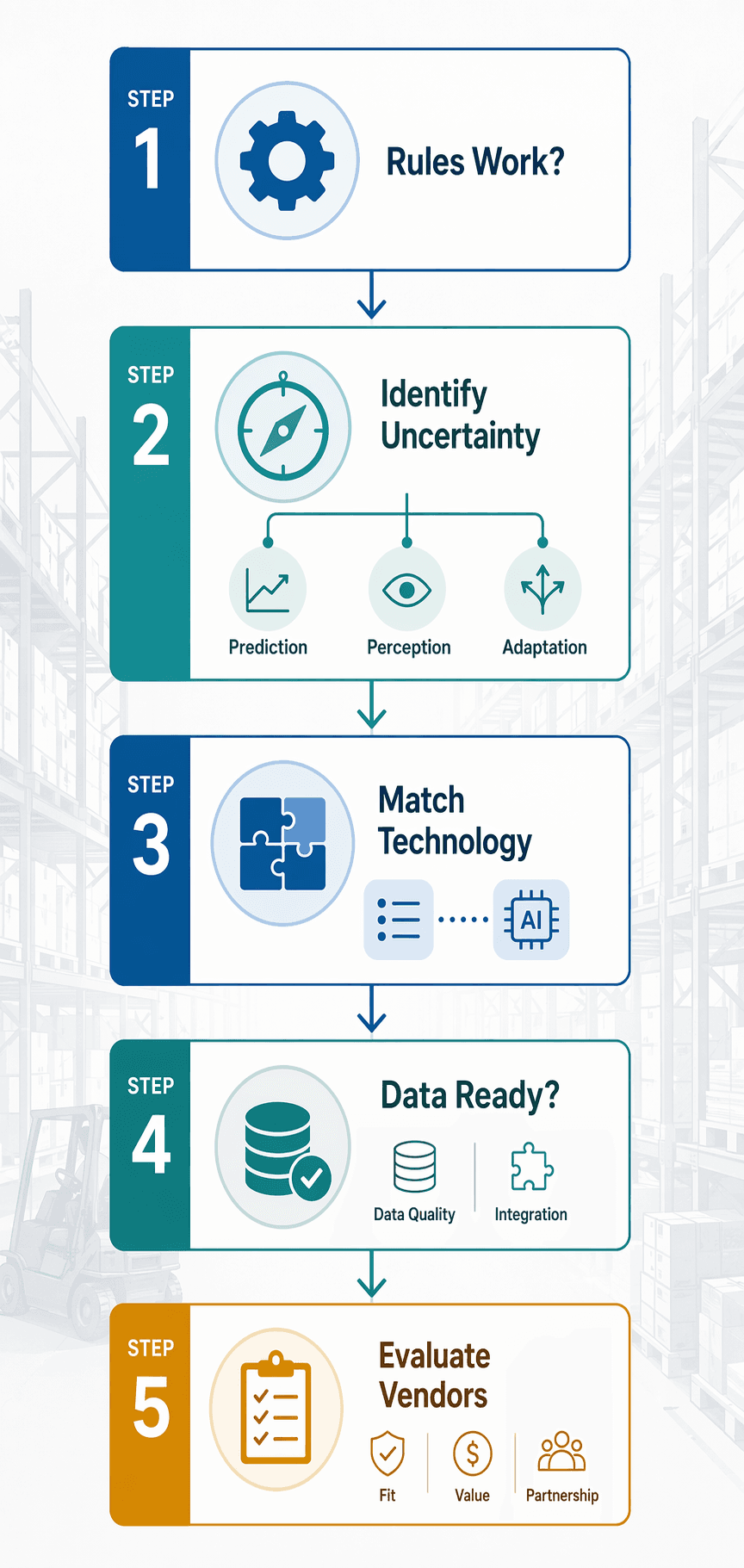
The cleanest way to keep an AI project grounded is to force every proposal through the same sequence before vendor comparison starts.
- Write the current rule. If the rule is clear, stable, and enforceable, improve the WMS configuration or process discipline first.
- Name the uncertainty. Is the problem prediction, visual recognition, movement adaptation, layout simulation, reliability detection, or something else?
- Match the technology to that uncertainty. Do not evaluate computer vision for a forecasting problem or forecasting software for a location-control problem.
- Check the data and integration layer. A model that cannot consume trusted data or return a decision into the workflow is not operationally ready.
- Interrogate the claim. Ask which metric improved, over what baseline, in what operating environment, with which exclusions, and who maintained the result after the pilot.
That last step is where vendor conversations become more useful. A vendor saying “AI optimizes picking” should be able to say whether it reduces travel, balances zones, sequences work, changes slotting, improves replenishment timing, or coordinates robots. A vendor saying “AI improves inventory accuracy” should be able to say whether it detects visual mismatches, predicts shrink risk, reconciles cycle counts, or flags transaction anomalies.
Readers ready to compare solution categories can use AI Supply Chain Companies: Planning vs. Execution and How to Evaluate Supply Chain AI Software: A Buyer’s Guide for 2026. For use-case-level ROI thinking, see AI in Warehousing Use Cases: A Structured Guide to ROI and Prioritization.
AI in warehouse management is useful when it handles uncertainty that rules cannot handle well: prediction under volatility, perception from images, adaptive movement, simulation of interacting constraints, or detection of failure patterns. It is wasteful when it decorates a process that was already rule-bound. The disciplined move is not to reject AI. It is to make the warehouse problem earn it.
References
- AI Warehouse Management — LIDD
- BCG 2024 AI value finding — Boston Consulting Group, 2024
- McKinsey 2024 AI forecasting and inventory performance figures
- Oracle warehouse AI and data foundation materials
- SafetyCulture warehouse AI, inspection, edge AI, and data foundation materials
- Industry picking travel-time baseline
- McKinsey AMR productivity and cycle-time figures cited by Atomic Loops
- McKinsey documented digital twin warehouse capacity case
- Predictive maintenance downtime reduction ranges summarized across multiple sources
- Deposco warehouse AI data unification materials
Comments
Join the discussion with an anonymous comment.