
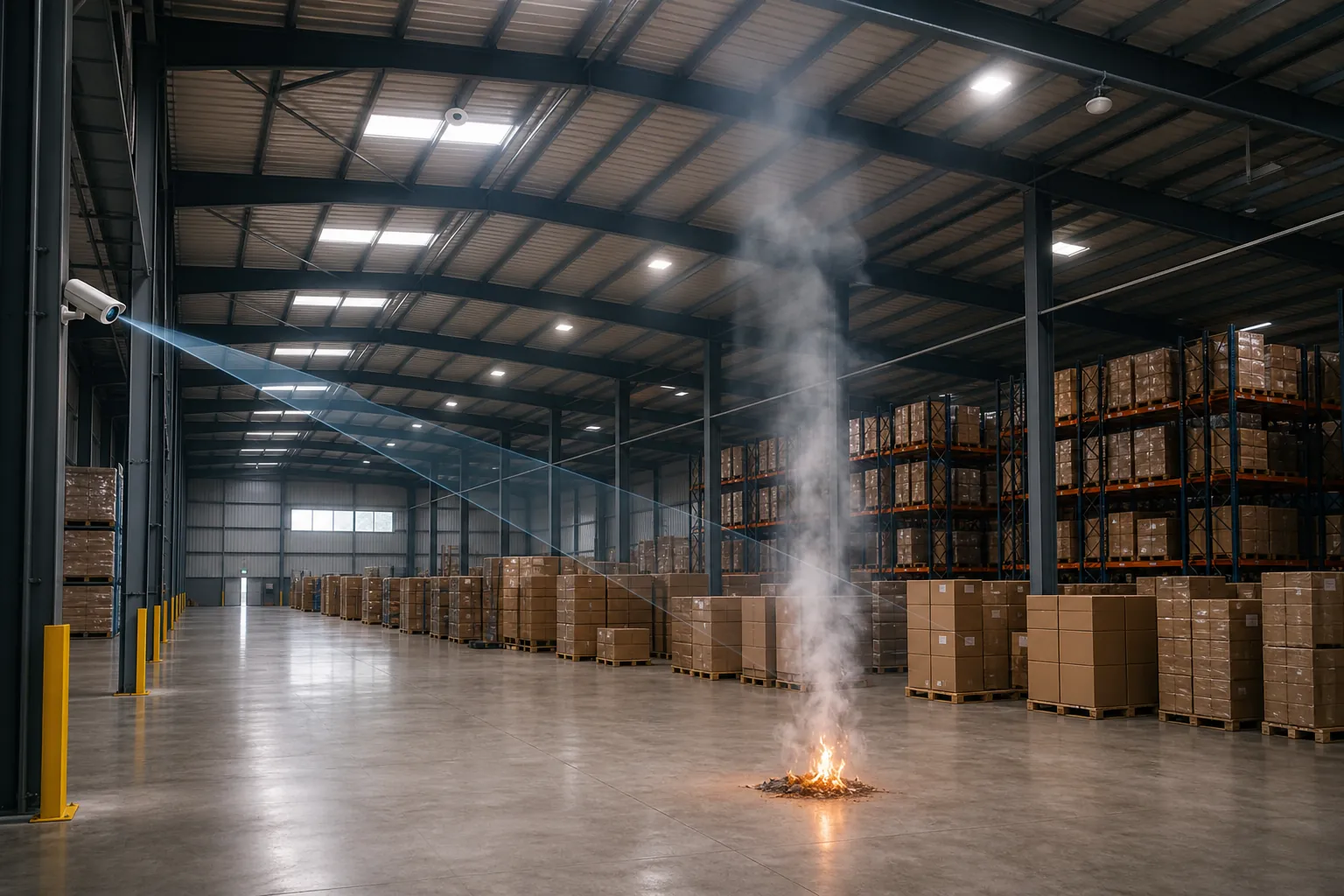
Warehouse fire prevention starts with an uncomfortable physical fact: in a large, high-ceiling building, the first useful signal may be nowhere near the ceiling. A small flame at a conveyor motor, charger, pallet stack, or packaging area can produce smoke that spreads, cools, and dilutes before it reaches a conventional detector. That does not make smoke detectors unimportant. It means the warehouse geometry itself can make them late.
The baseline is not abstract. NFPA data puts warehouse structure fires at about 1,544 per year on average from 2020 through 2024, with roughly $314 million to $323 million in direct property damage, 2 to 3 deaths, and 17 to 19 injuries annually.[1] Those numbers sit behind the practical question for an EHS director or warehouse manager: can a camera-based system buy enough response time to change what happens before the alarm panel, sprinkler system, or responding crew becomes the main actor?
The Delay Is Above the Fire, Not in the Dashboard
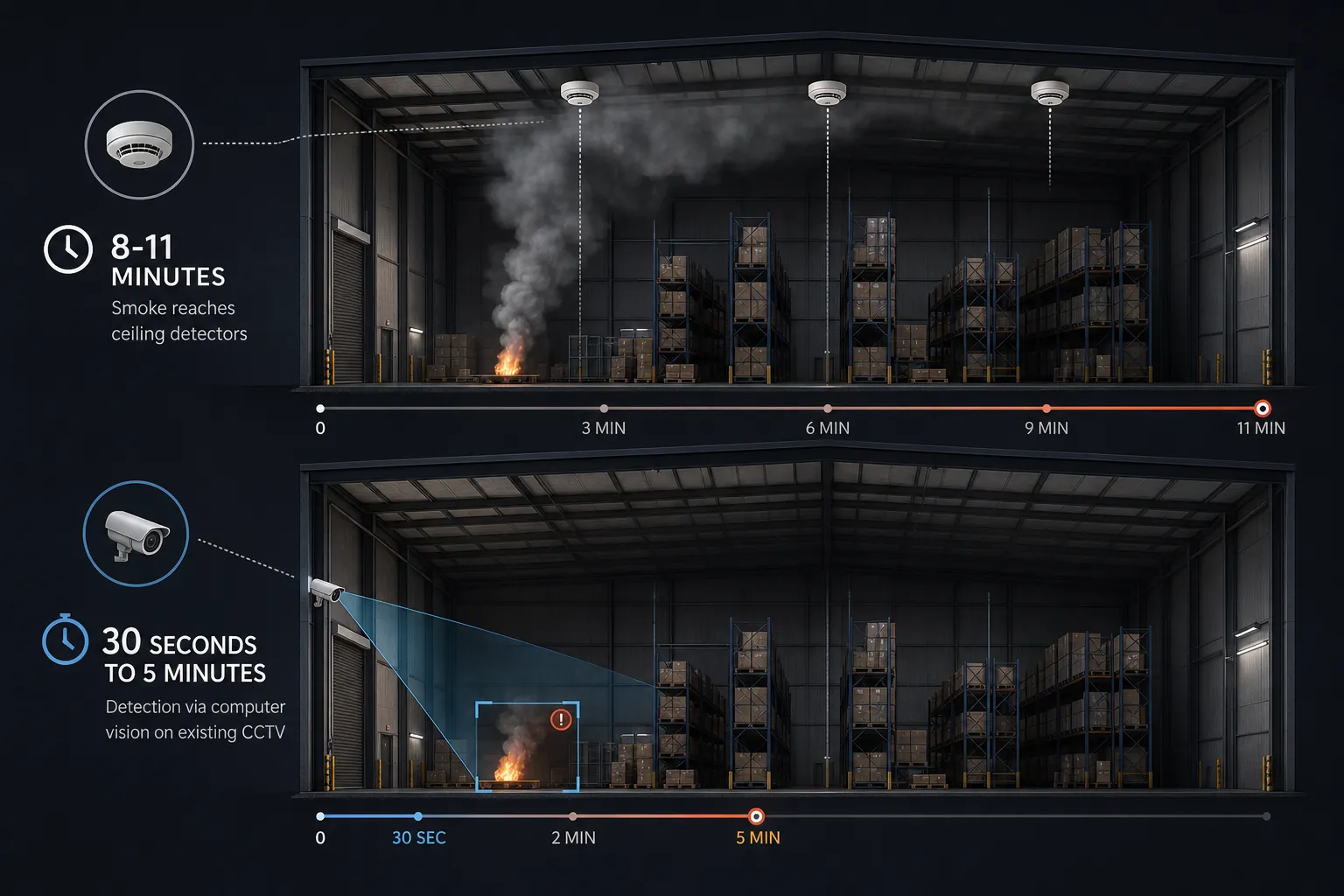
In high-ceiling industrial spaces, smoke can take 8 to 11 minutes to reach ceiling-mounted detectors, according to Hypernology’s discussion of factory and warehouse fire detection.[2] Treat that as a vendor-published operational claim, not a universal stopwatch. Still, anyone who has watched smoke move in a tall bay understands the mechanism: buoyant smoke rises, spreads under air movement, loses concentration, and may not present a clean detector event immediately.
Computer vision addresses a narrower vulnerability. It does not extinguish a fire, verify sprinkler adequacy, or make combustible storage less combustible. It watches video feeds for visible flame or smoke near the source, often from cameras already mounted on walls, columns, dock areas, or production lines. If that alert reaches the right person or system before ceiling detection would have activated, the value is not “AI prevention” in the magical sense. The value is a response window.
That window is the whole use case. A 30-second improvement may matter for an incipient motor fire next to cardboard. A few minutes may matter in a battery charging area, a foam storage zone, or a palletized commodity aisle. It only matters, though, if the warehouse has a defined action after the alert: who receives it, who verifies it, who can isolate power, who calls emergency services, and when the event escalates into the regulated fire alarm and suppression stack.
The Strongest Evidence Comes From the NYU Tandon Benchmark
The most useful independent evidence in this area is not a vendor case study. It is the NYU Tandon work reported in connection with an IEEE Internet of Things Journal study in 2025. The system used Scaled-YOLOv4 with temporal bounding-box tracking and achieved 80.6% detection accuracy at 0.016 seconds per frame, while reducing false alarms by 92.6%.[3]
Those three figures deserve to be read together. The 80.6% accuracy number says the model is not perfect. The 0.016 seconds per frame figure says the system can analyze video fast enough for real-time use rather than retrospective review. The 92.6% false-alarm reduction matters because warehouses are full of nuisance conditions: dust, steam, exhaust, glare, shadows, shrink-wrap reflections, forklift traffic, and partial occlusion.[3]
The temporal tracking piece is especially important. A single frame that looks smoky is cheap evidence. A region that persists across consecutive frames, grows, changes shape, or remains spatially tied to a plausible ignition area is stronger evidence. Bounding-box tracking gives the model a way to treat fire and smoke as events over time rather than as isolated pixels. That is how an AI system can reduce nuisance alerts without waiting so long that the early-detection benefit disappears.
This is also where the difference between detection and dependable response begins. A model can process frames quickly and still fail operationally if the camera is blocked by stacked inventory, if low-bay lighting washes out smoke, if the network video recorder drops frames, or if the alert lands in an inbox no one watches after shift change. The benchmark supports the credibility of visual detection. It does not certify a warehouse deployment.
What Field Deployments Actually Show
The field evidence is promising, but it is not all the same grade. Bosch’s AVIOTEC materials describe warehouse and logistics deployments at Mouka Nigeria, Richetti Italy, and IncarPalm Ecuador, and state that the system can detect fire within 30 seconds in lighting conditions as low as 2 lux.[4] That is a useful practical claim because low light is not an edge case in warehouses; it appears in shutdown periods, dim aisles, dock areas, outdoor transitions, and power-saving zones.
Bosch’s examples also show why retrofitting matters. A system that can work with camera placement and visual coverage may be easier to approve across a warehouse network than a project that requires extensive new fire-detection infrastructure. The caveat is that case studies published by the vendor are deployment evidence, not independent performance validation. They show that products exist, have been installed, and are marketed for industrial environments. They do not establish universal detection speed or return on investment.
IncoreSoft reports a warehouse case in which computer vision detected smoke from a malfunctioning conveyor motor 90 seconds earlier than the existing fire alarm system, preventing production downtime.[5] The scenario is exactly the kind of event where earlier visual detection is plausible: a localized equipment fault, a visible smoke source, and a camera view close enough to see the problem before ceiling detection. It is also anonymous and vendor-published, so it should be used as a credible illustration, not as a frequency estimate.
Visionify says its smoke and fire detection can go live within one week on existing CCTV, requires no new hardware, and detects smoke in under 30 seconds.[6] That deployment promise is attractive because many warehouses already have an ONVIF-compatible camera estate. But “works on existing CCTV” should never be read as “works on every existing camera view.” The useful question is which views are usable for fire detection after accounting for lens angle, mounting height, darkness, glare, obstructions, and the normal habit of putting temporary inventory exactly where a clear sightline used to be.
The 30-Second to 5-Minute Claim Needs Conditions Around It
A faster visual alert is most defensible when four things are true: the camera can see the likely ignition zone, smoke or flame is visually distinguishable from normal operations, the analytics run with low enough latency, and the alert is routed into a response procedure that someone owns. Without those conditions, the system may still be technically impressive and operationally weak.
| Condition | Why it changes the value of earlier detection |
|---|---|
| Camera coverage | Blind spots around conveyors, chargers, racking, dock doors, and temporary storage can erase the detection advantage. |
| Lighting and image quality | Low-light capability matters, but so do glare, dust, lens contamination, compression, and camera aging. |
| Occlusion control | A blocked camera is not a detector. Ownership for keeping views clear has to sit with operations, not only IT. |
| Alert routing | The difference between a useful alert and a nuisance event is often who gets called, at what threshold, and with what escalation rule. |
| Integration boundary | AI video alerts should complement fire alarms, sprinklers, and emergency procedures rather than masquerade as code-equivalent protection. |
This is why a pilot should start with risk zones, not with the most convenient cameras. Electrical rooms, battery charging areas, conveyor motors, packaging lines, foam or plastic storage, and high-fuel-load staging areas deserve priority. NIST’s adjacent work on lithium-ion battery failure is relevant here: its machine-learning model analyzed sound spectrograms to detect safety-valve rupture with 94% accuracy about 2 minutes before thermal runaway.[7] That does not validate computer vision fire detection. It does reinforce the same operational lesson for battery zones: pre-ignition or early-ignition signals may appear before conventional fire response is in motion.
Where the Existing Fire-Risk Profile Points the Cameras
Warehouse camera placement is usually designed for security, process visibility, or claims investigation. Fire detection asks for a different map. A wide overview camera that is good for theft review may be poor at seeing thin smoke from a motor housing. A camera pointed down an aisle may see forklift travel perfectly while missing a charger alcove just outside the frame.
Cause data helps decide where a visual layer is most worth testing. Fireline’s NFPA-based summary says electrical distribution and lighting equipment account for 18% of warehouse fires but 31% of direct property damage, the highest damage ratio among cause categories.[8] That does not mean AI should watch only electrical assets. It does suggest that panels, charging infrastructure, lighting-related equipment, conveyors, and powered handling zones deserve more attention than a generic “cover the warehouse” camera plan.
A practical assessment walks the floor with two views in mind. The first is the fire-protection view: sprinklers, alarms, detector placement, fire doors, commodity classification, storage height, housekeeping, and inspection history. The second is the video-analytics view: camera angle, pixels on target, obstructions, lighting, network path, edge-device location, and who maintains the system. The overlap between those two views is where a pilot has a chance of producing evidence that facilities, IT, insurers, and safety leadership can all read without squinting.
A Fragmented Vendor Market, Not a Single Product Category
The vendor landscape is already broad enough that “AI fire detection” is too loose a label. Bosch emphasizes dedicated video-based fire detection for challenging warehouse and logistics environments.[4] Visionify emphasizes rapid deployment on existing CCTV and sub-30-second smoke detection.[6] IncoreSoft presents fire and smoke detection as a computer-vision application that can identify events earlier than existing alarm systems in at least one warehouse case.[5] Hypernology frames visual fire detection as an alternative to manual patrols in factories and industrial sites.[2] Frandzzo positions AI fire and smoke detection around warehouse risk prevention.[9] Protex AI discusses AI warehouse safety more broadly, where fire detection sits beside other safety-monitoring use cases.[10]
Broader video-analytics providers such as icetana and Chooch may also appear in enterprise shortlists, especially where a company wants one analytics layer for multiple camera-based use cases. That can be useful, but it makes comparison harder. A model tuned for anomaly detection, PPE compliance, or yard security is not automatically a strong smoke-and-flame detector in a dim, high-rack warehouse.
| Evaluation question | What to ask before buying |
|---|---|
| Detection model | Is the system detecting smoke, flame, heat-related visual patterns, generic anomalies, or some combination? |
| Processing architecture | Does analysis run at the edge, in the cloud, or through a hybrid design, and what happens when connectivity fails? |
| Camera compatibility | Which existing cameras are usable, which need repositioning, and what ONVIF or VMS integrations are actually supported? |
| False-alarm policy | How does the system handle dust, steam, fog, headlights, welding, exhaust, and seasonal lighting changes? |
| Escalation path | Does the alert go to security, maintenance, EHS, a monitoring center, the fire alarm panel, or a separate dashboard? |
| Maintenance ownership | Who cleans lenses, checks blocked views, updates models, tests alert routing, and documents missed or false events? |
| Cybersecurity | How are camera feeds, stored clips, user access, cloud connections, and vendor remote support controlled? |
The shortlist should not reward the loudest claim. It should reward the vendor that can stand in the warehouse, point to the actual cameras, identify where detection will and will not work, and describe the alert path without hand-waving. If the answer to a blind spot is always “the AI will learn,” keep walking.
False Alarms Are Reduced, Not Abolished
The NYU Tandon benchmark’s 92.6% false-alarm reduction is a serious result, particularly because false alarms are one of the main reasons safety technology loses trust on a busy floor.[3] A system that cries fire during routine dust, steam, or lighting changes will eventually be muted, routed around, or ignored. The interesting part of the benchmark is that temporal tracking gives the model a way to demand persistence before escalating.
But lower false alarms do not remove operational review. Camera-based systems introduce their own failure modes: a lens is dirty, a lift blocks the scene, a seasonal sun angle creates glare, a network switch fails, a firmware update changes stream quality, or a new storage pattern hides the ignition zone. These are not reasons to dismiss the technology. They are reasons to put camera-view checks into the same maintenance discipline that already surrounds alarms, extinguishers, emergency lighting, and sprinkler inspections.
A useful pilot log records both types of error. False positives show where the model or threshold needs tuning. Missed detections show where the camera plan or operational assumptions were wrong. Near-misses and early alerts should be reviewed with the same seriousness as nuisance events, because the real measure is not whether the dashboard looked accurate in a demo. It is whether the system changed the time at which a human or integrated response process knew something was wrong.
Regulatory Acceptance Is the Line Vendors Cannot Blur
The strongest near-term role for AI computer vision is as an augmenting detection layer. That distinction matters because building codes, insurance underwriting practices, and fire protection standards do not universally treat AI video fire detection as a substitute for conventional detection, alarms, sprinklers, or suppression systems. A warehouse can use earlier visual alerts while still maintaining the regulated protection infrastructure that life safety and property protection depend on.
This is also the safest way to defend the spend internally. The business case should not promise that AI eliminates sprinkler obligations or guarantees insurance savings. Some vendor materials cite damage-reduction or premium-reduction estimates, but the more defensible case is narrower: earlier visibility into incipient fire conditions in locations where ceiling-mounted detection may be structurally delayed. That is enough of a claim to evaluate without turning the project into a compliance argument it cannot yet win.
For teams already using cameras for safety or security analytics, fire detection can sit beside adjacent use cases such as computer vision for warehouse safety or AI video surveillance in warehouse yards. The architecture may look familiar: existing cameras, edge or cloud analytics, event clips, alert workflows, and review dashboards. The acceptance criteria should be different because a fire alert carries a different consequence than a missing hard hat or a yard intrusion.
How to Evaluate the Extra Response Window
The cleanest pilot design compares detection time, alert quality, and response action in a few high-risk zones. It does not need to cover the whole warehouse on day one. A better first question is: where would 30 seconds to 5 minutes plausibly change the outcome, and can existing cameras see those zones well enough to test that claim?
- Select zones where early smoke or flame would be visible before ceiling detection is expected to activate.
- Review camera views during normal operations, low-light periods, peak congestion, cleaning, and seasonal lighting changes.
- Define alert recipients by shift, including nights, weekends, holidays, and unmanned periods.
- Separate advisory alerts from events that require emergency escalation or fire alarm integration.
- Track false positives, missed events, time to acknowledgment, time to verification, and action taken.
- Document which fire protection systems remain primary and which AI alerts are supplemental.
A live-fire test may not be practical or appropriate in many facilities, so evaluation often depends on controlled visual tests, historical incident footage if available, staged non-hazardous smoke-like conditions where permitted, and vendor-provided validation. That makes independent benchmark evidence more important, not less. It gives buyers a technical baseline before they accept a vendor’s site-specific claims.
The buying decision should end with a protection-stack view. AI computer vision is credible as an earlier detection layer in high-ceiling warehouses, especially where smoke travel time makes ceiling-mounted detectors late. The independent benchmark is strong enough to take seriously, and the field examples show deployable systems rather than lab curiosities. But the system’s job is to shorten detection and response time. It does not replace sprinklers, code-compliant fire alarms, inspection programs, suppression infrastructure, or the people who have to act when the alert arrives.
References
- Warehouse Structure Fires — NFPA
- Fire detection AI: How computer vision replaces manual safety patrols in factories — Hypernology
- AI system detects fires before alarms sound, NYU study shows — International Fire & Safety Journal
- Overcoming the challenges of fire safety in the warehouse and logistics industry (AVIOTEC) — Bosch Building Technologies
- Fire & Smoke Detection Using Computer Vision — IncoreSoft
- AI-Powered Smoke and Fire Detection — Visionify
- AI Can 'Hear' When a Lithium Battery Is About to Catch Fire — NIST, November 2024
- Warehouse Fires (NFPA data summary) — Fireline Corporation
- AI-Based Fire & Smoke Detection for Warehouse Risk Prevention — Frandzzo
- The Complete Guide to AI Warehouse Safety — Protex AI
Comments
Join the discussion with an anonymous comment.