
The useful moment is not when a dashboard turns red. It is the narrower window before the market has repriced the lane, before the carrier advisory has reached every inbox, and before the planner has to choose between waiting out a delay and buying capacity at emergency rates. During the March 2026 Strait of Hormuz closure, Shanghai-to-Jebel Ali spot rates moved from about $1,800 per FEU to more than $4,000 per FEU within days, a 122% increase reported by UN Cargo & Logistics citing Freightos/GetTransport data.[1] That is an extreme case, not a normal Tuesday at a congested port. But it shows the penalty for learning about disruption at the same time as everyone else.
For freight teams evaluating AI for supply chain travel disruption planning, the question is less glamorous than the phrase suggests: did the system create a decision window large enough to act? A prediction that arrives after free time is gone, after alternative sailings are full, or after finance will not approve a rate premium is only a better explanation of a cost that has already landed. Predictive rerouting earns its keep when it joins three decisions that are often handled separately: spotting the disruption early, proving that the alternative route can actually absorb the cargo, and triggering a booking or diversion before the economics deteriorate.
The Rerouting Stack Starts Before the Advisory
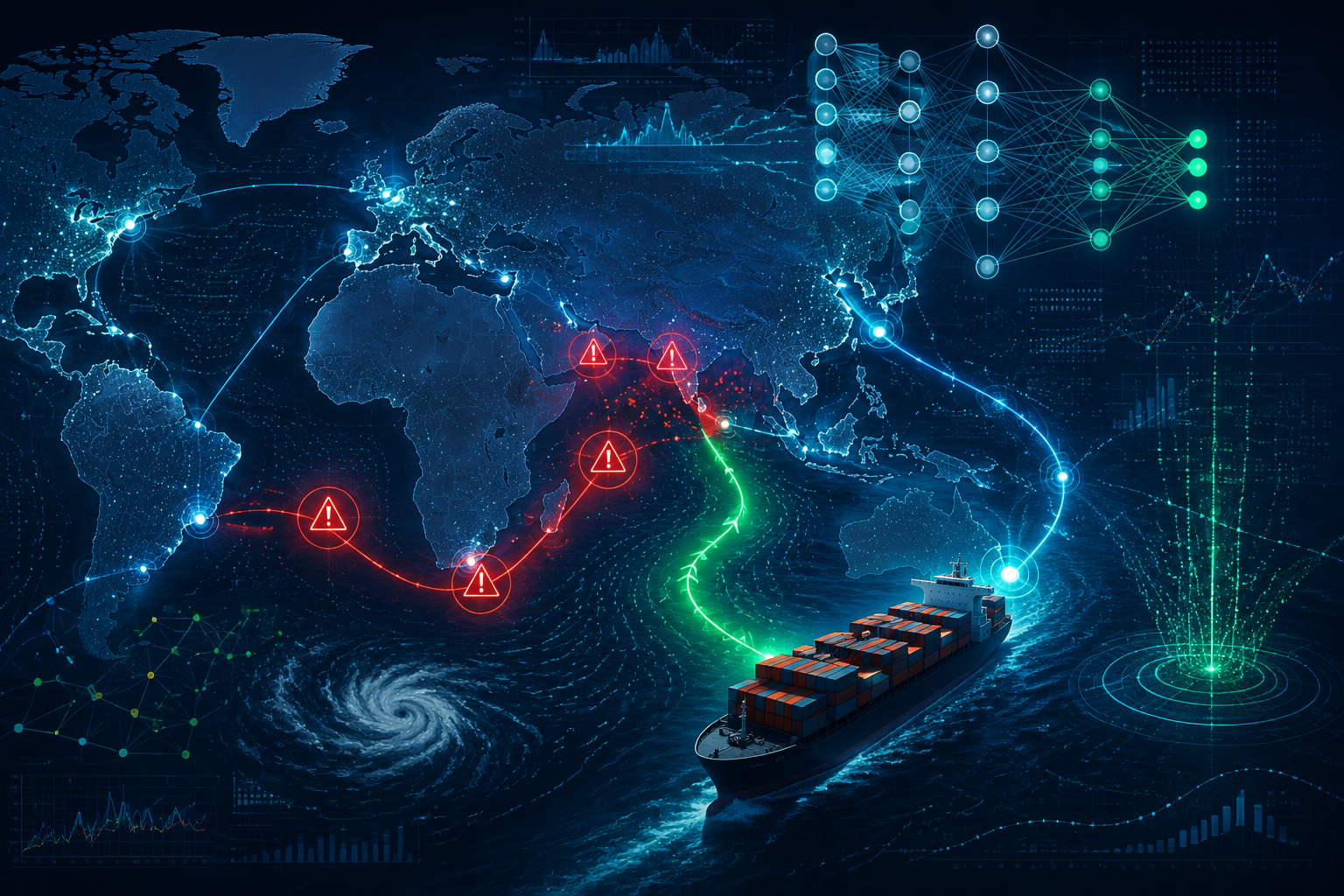
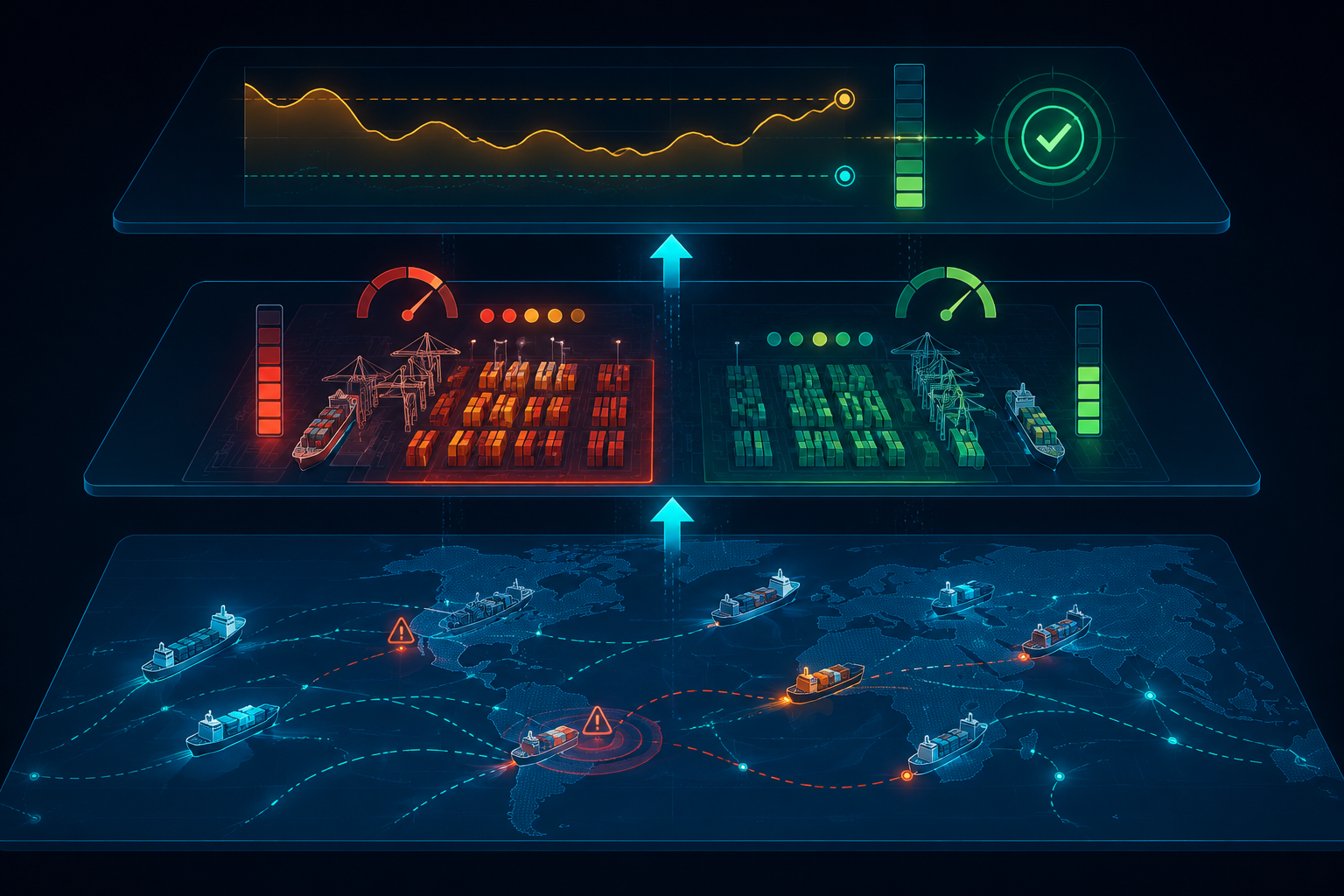
The most useful AI rerouting systems are not simply ETA calculators with better graphics. They combine vessel movement, port operating conditions, weather, schedules, and rate signals into a workflow that tells a planner whether a shipment still has options. In the UN Cargo description of the March 2026 Gulf disruption, the predictive stack has three layers: AIS vessel intelligence that can detect route deviations hours before carrier advisories, port congestion models that forecast terminal-level yard occupancy and berth wait times, and rate intelligence that can trigger pre-set booking thresholds.[1]
That sequence matters. Vessel behavior is often the first weak signal. A ship slows, drifts, changes heading, or avoids a usual approach pattern. On its own, that signal may be ambiguous; vessels deviate for operational reasons that never become a shipper problem. The planner needs to know whether the deviation is consistent with weather, a route closure, a port queue, or a carrier-specific decision. AI is useful here when it compares the movement against historical route behavior, nearby vessel patterns, marine weather, and known port conditions quickly enough to separate a routine adjustment from the beginning of a disruption.
The second layer is where many visibility programs become more or less useful. Port-level congestion is a blunt instrument. If a model only says that Le Havre is congested, the next question still has to be answered manually: which terminal, which service, which yard, which berth window, and which drayage plan? Siemens Digital Logistics describes a Portcast analysis at Le Havre that showed Terminal de France GMP at 85–90% yard utilization while an adjacent terminal was much clearer.[2] That is the kind of distinction that can change a transshipment discussion. It does not merely describe risk; it narrows the operational choice.
A planner can work with that level of detail. If a vessel is likely to miss a window and the intended terminal is already tight, the alternative is not simply “reroute to another port.” The team has to test whether a nearby terminal has yard capacity, whether the alternate service protects customer delivery dates, whether inland handoff still works, and whether the cost of moving now is lower than the likely detention, demurrage, or expedite bill later. AI does not remove those trade-offs. It can, however, put them on the table while there is still something to buy.
Early Warning, Alternative Evaluation, and Rate Discipline Are Different Jobs
The phrase predictive rerouting can hide three separate jobs. The first is warning: something is changing before the normal exception process catches it. The second is evaluation: one or more alternatives are operationally viable. The third is financial discipline: the team has already agreed on the point at which paying for an alternative is better than waiting. When those jobs are blurred, an organization can end up with impressive disruption detection and no authority to act.
| Decision Job | Primary Signals | Operational Question |
|---|---|---|
| Earlier warning | AIS route deviations, vessel speed changes, marine weather, carrier behavior | Is this shipment likely to lose its planned window before the carrier confirms it? |
| Alternative evaluation | Terminal yard utilization, berth waits, schedules, port performance history | Is the proposed alternate hub actually available, or only less bad at the port level? |
| Financial trigger discipline | Spot rates, threshold rules, detention and demurrage exposure, expedite risk | Has the cost of waiting crossed the agreed point for booking or rerouting? |
The third job is often the least mature. Teams may know a disruption is building and still wait because nobody wants to be the person who bought expensive capacity too early. Rate intelligence changes the discussion when thresholds are agreed in advance. If the lane price, delay probability, and free-time exposure cross a pre-set level, the decision can move from debate to execution. In a shock like the March 2026 Strait of Hormuz closure, that discipline matters because the rate curve can move faster than a normal approval chain.[1]
For routine congestion, the same structure applies at a smaller scale. A system might not justify a dramatic diversion; it may only recommend pulling a container earlier, selecting a different sailing, or protecting inventory on a service with lower downstream risk. Those are less exciting than a crisis reroute, but they are often where the business case accumulates: fewer penalty-clock surprises, fewer late-night status chases, and fewer emergency bookings made after all good alternatives have disappeared.
What the Siemens and Portcast Results Actually Show
The most concrete deployment evidence cited here comes from Siemens Digital Logistics writing about Portcast. Siemens says Portcast’s AI ETA predictions combine more than 200 data sources, including satellite and vessel metadata, marine weather patterns, port performance analytics, and economic indices.[2] That breadth is relevant because ocean exceptions rarely come from one clean signal. A vessel may be late because of weather, but the cost consequence may be determined by terminal congestion, cut-off timing, and the shipper’s ability to change a booking.
Siemens reports three deployment outcomes: an 80% reduction in manual updates and missing data, a 15% decrease in detention and demurrage charges, and a 5% reduction in expedited freight costs.[2] Those numbers should be read carefully. They are useful evidence that the workflow can move cost lines that freight teams recognize. They are not independent benchmarks that every shipper should plug into a business case unchanged. The first number, the 80% reduction in manual updates and missing data, may be the most immediately believable to anyone who has watched a planner reconcile carrier portals, spreadsheets, emails, and forwarder status messages long after the exception itself was obvious.
Manual reconciliation is not clerical background noise. It consumes the time needed to make the next decision. If a planner spends the first hours of a disruption proving which containers are affected, which ETAs are stale, and which terminal is actually constrained, the rerouting window shrinks. A system that reduces missing data and status chasing can create value even before it recommends a new route, because it moves the team from fact-gathering into exception handling sooner.
The detention and demurrage result is also plausible in the specific sense that earlier, cleaner exception handling can prevent containers from sitting unmanaged through free time. But the mechanism is not magic prediction. Someone still has to change a pickup plan, escalate a document issue, approve a move, or book an alternative. The AI system can reduce the uncertainty and surface the exposure; the organization still needs operating authority to act before the charge becomes unavoidable.
Terminal-Level Congestion Is Where Port Visibility Becomes Actionable
A port is not a single operating condition. Adjacent terminals can have different yard utilization, berth delays, labor constraints, carrier calls, and gate behavior. That is why the Le Havre example is more important than it first appears. A planner cannot make a routing decision from “Le Havre is busy” unless the only option is to avoid the port entirely. A planner can make a more specific decision from “Terminal de France GMP is running at 85–90% yard utilization while an adjacent terminal is clearer,” because that points to a particular service, handoff, or transshipment alternative.[2]
UN Cargo’s description of Kpler-style AI models makes the same distinction: the useful forecast is terminal-level, not just port-level, using historical performance, current yard occupancy, and vessel schedules to estimate wait times at alternative hubs.[1] That matters because a port-level green signal can hide the terminal that will actually receive the box. Conversely, a port-level red signal can cause overreaction if the affected terminal is not part of the shipper’s route.
This is also where weather and vessel intelligence need to be fused rather than displayed side by side. Bad weather near a port does not automatically mean the shipment should be rerouted. The question is whether the weather changes arrival timing enough to miss the berth window, whether the receiving terminal can absorb the revised arrival, and whether the downstream delivery plan has enough slack. Bronson.AI frames the broader mechanism this way: models trained on satellite data, shipping logs, and weather forecasts can predict port congestion days or weeks in advance, enabling proactive rerouting before delays cascade.[3] That is a useful description of the method, as long as the decision still comes back to route, terminal, timing, and cost.
The Cost Case Is Built Before the Crisis
Predictive rerouting looks most persuasive during acute disruptions because delay costs become nonlinear. The March 2026 Gulf example is a clean illustration: a shipper that waited until the spot market had absorbed the closure faced a very different buying environment than one with priced alternatives already evaluated.[1] But using that event as the whole argument would be misleading. A geopolitical closure is not the same as ordinary terminal congestion, and the savings pattern should not be treated as routine.
In daily operations, the cost case is usually less dramatic. A team avoids a demurrage charge because it escalates a container before free time expires. It avoids an expedited freight move because an ocean delay is detected early enough to adjust allocation. It avoids several hours of manual reconciliation because the exception record already combines vessel movement, port status, and shipment data. Siemens’ reported 15% detention and demurrage decrease and 5% expedited freight cost reduction belong in that practical category: meaningful, but dependent on the shipper’s lanes, exception volume, carrier mix, and authority model.[2]
The approval model deserves as much attention as the model accuracy. If planners can only recommend rerouting, while booking authority sits elsewhere, the prediction has to arrive earlier. If finance requires case-by-case approval for premium moves, the threshold has to be simple enough to defend quickly. If customer service owns delivery promises but transportation owns cost, the system has to show both service risk and charge exposure. Otherwise, AI improves awareness while the decision remains stuck in the same queue.
That is also where disruption-aware planning connects with broader model maintenance. ChainSignal has covered why planning systems can keep running on stale disruption assumptions after trade-policy changes; the same discipline applies here. Predictive rerouting models need recent lane behavior, current carrier patterns, and updated cost thresholds, not last year’s idea of what counts as an acceptable delay. See the related discussion on stale AI supply chain lead-time assumptions for the planning-side version of the same problem.
Representative Platforms, Not a Ranking
Several platforms sit in this space, with different emphases rather than one simple hierarchy. Siemens AX4 with Portcast brings AI ETA prediction and logistics execution context into the same conversation. FourKites Dynamic ETA is commonly positioned around shipment visibility and arrival prediction. Project44 Disruption Navigator is framed around disruption monitoring and network impact. Everstream Analytics focuses on risk intelligence across supply chain events. The sources cited here support naming these as representative approaches, not ranking their performance against one another.
For a freight team, the more useful comparison is functional. Does the system detect vessel behavior before the carrier advisory? Does it distinguish the receiving terminal from the port average? Does it combine weather and port data with the shipment record rather than leaving the planner to reconcile them? Does it support rate or cost thresholds that trigger action? Does it preserve the audit trail that explains why a premium booking or reroute was approved?
ABI Research’s 2026 discussion of supply chain disruptions places AI and automation inside a broader resilience agenda.[4] That context is useful, but ocean rerouting should not be stretched into a generic claim about every mode. The evidence here is strongest for sea freight: AIS vessel signals, port telemetry, terminal congestion, marine weather, and ocean rate behavior. Air cargo, rail, and trucking have their own data structures and disruption clocks; the same conclusions would need separate support.
What Has to Be True Before a Prediction Can Save Money
A predictive signal becomes operational only when it changes a decision before the penalty clock starts. That requires more than a model output. The shipment record has to be complete enough to identify affected containers. The alternative route has to be available. The receiving terminal has to have capacity. The rate premium has to be compared against likely detention, demurrage, lost service, or expedite exposure. Someone has to own the decision.
- Lead time: the alert arrives while sailings, transshipment options, or pickup changes are still available.
- Granularity: the model shows terminal, berth, yard, and shipment-level exposure rather than a broad port warning.
- Economic trigger: the team has an agreed threshold for paying more now to avoid larger charges later.
- Execution authority: planners know who can approve a diversion, premium booking, or customer allocation change.
- Data hygiene: the system reduces missing and conflicting status updates instead of adding another screen to reconcile.
The last condition is easy to underestimate. A platform can predict congestion and still fail the user if the planner must spend the evening reconciling five screens and three carrier emails before trusting the recommendation. The operational win is not the risk map. It is the reduced time between signal, evaluated alternative, approval, and booking.
AI does not eliminate port congestion, weather disruption, or route closures. It changes whether the freight team meets them with options already priced and evaluated. The most dramatic savings will appear when disruption is acute and delay costs rise quickly. The everyday case is quieter: smaller avoided charges, fewer emergency bookings, and less manual reconciliation before the next exception arrives.
References
- AI Rerouting vs. 2026 Port Congestion: Is Your Cargo Smart Enough to Survive the Gulf Disruption — UN Cargo & Logistics
- When sea freight gets smarter: How AI is turning supply chain chaos into competitive advantage — Siemens Digital Logistics, September 5, 2025
- AI in Supply Chain Resilience: Forecasting Disruptions Before They Hit the Line — Bronson.AI, September 2025
- Supply Chain Disruptions 2026: How to Build Resilience with AI and Automation — ABI Research
Comments
Join the discussion with an anonymous comment.