
A warehouse does not need a dramatic failure to have a safety problem. It only needs forklifts crossing pedestrian lanes all day, pallets staged where sightlines disappear, workers lifting in a hurry, and PPE rules that depend on a supervisor being in the right aisle at the right minute. That is why computer vision for warehouse safety is getting attention: not because a camera is new, but because many facilities already have cameras and still miss the small unsafe interactions that become injury reports later.
The baseline is not theoretical. Voxel’s safety statistics page, citing 2024 Bureau of Labor Statistics data, reports a warehouse injury rate of 4.8 injuries per 100 full-time equivalent workers, compared with a 2.6 all-industry average. The same source cites Liberty Mutual’s 2025 Workplace Safety Index estimate that the top 10 workplace injuries cost employers $50.87 billion annually.[1] Those numbers explain why operations teams keep looking for more than posters, toolbox talks, and incident forms filled out after the fact.
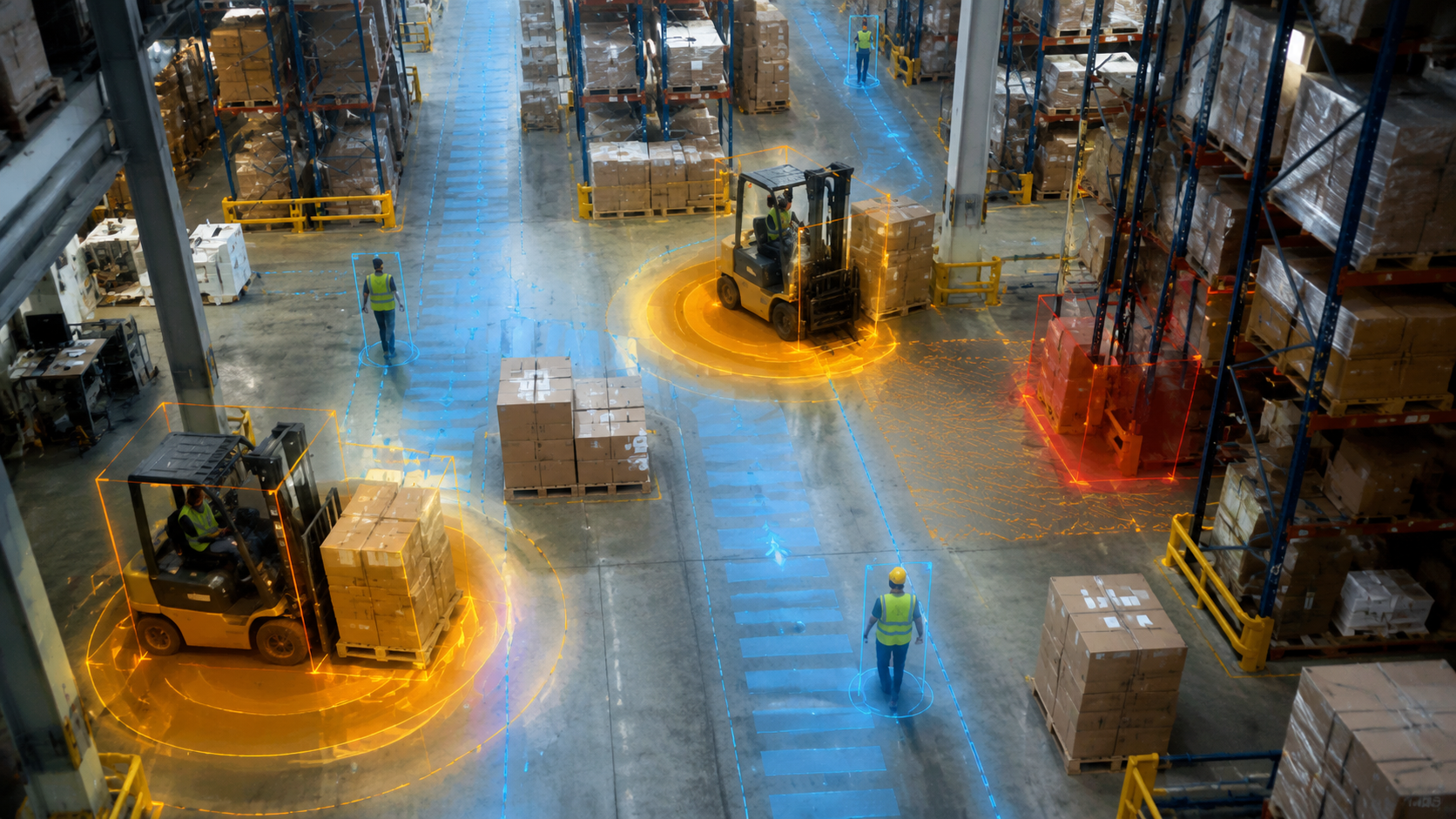
In a warehouse safety setting, computer vision is most useful when it watches for defined, repeatable hazards and pushes those events into a response workflow. The practical detection scope usually falls into five categories:
- PPE compliance: hard hats, high-visibility vests, gloves, and other required equipment in specified areas.
- Vehicle-pedestrian interaction: forklifts, yard trucks, pallet jacks, pedestrians, separation distances, speed, and blind-corner conflicts.
- Ergonomic risk: repeated bending, awkward lifting posture, overreaching, and other visible body-position patterns.
- Housekeeping hazards: spills, blocked walkways, abandoned pallets, debris, or other floor conditions that create trip and struck-by risks.
- Restricted-zone control: unauthorized occupancy in marked zones, machine areas, dock edges, or vehicle-only lanes.
Those categories are described across vendor and industry materials from Voxel, Protex AI, Ultralytics, and DHL.[2][3][4][5] They are also the right level of detail for an EHS or operations review. “AI safety” is too broad to buy, train, or govern. “Alert the shift lead when a pedestrian enters a forklift-only aisle” is something a facility can test.
What Changes On The Floor
Most warehouse computer vision deployments do not start by replacing the camera network. They connect to existing CCTV feeds, process video either at the edge or in the cloud, and flag configured events for review. Some alerts go to supervisors in near real time. Others appear in a daily safety dashboard, grouped by location, shift, behavior type, and trend.
That workflow matters more than the model demo. A system that detects a forklift-pedestrian near miss but sends the alert to someone who checks a dashboard once a week has not changed the risk window. A system that routes repeated aisle conflicts to the floor lead before the next pre-shift huddle can change the conversation: not “who broke the rule,” but “why does this crossing keep producing close calls?”
The better deployments also keep the event small enough to act on. A supervisor does not need a thousand clips. They need the ten clips that show the same corner, the same staging habit, the same missing vest pattern, or the same lift posture. When the alert stream becomes another inbox, the technology becomes the extra clipboard everyone quietly resents.
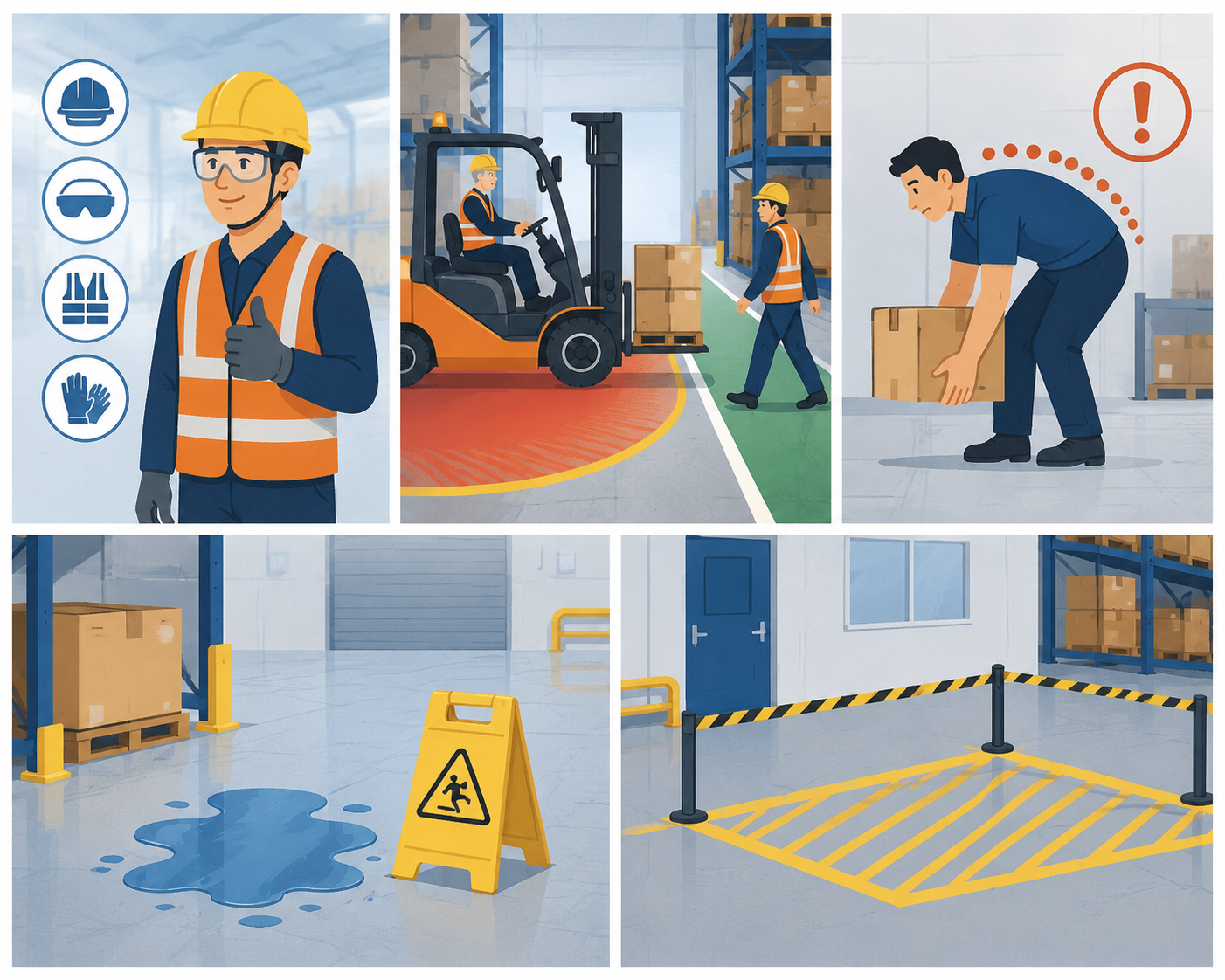
Documented Outcomes: Strong Signals, With Source Labels Attached
The most concrete outcome claims available for this use case come from Voxel-documented customer deployments. That distinction matters. The figures are named-company outcomes, but they are vendor-published rather than independently audited in the materials provided. They are still useful for stakeholder validation because they connect specific facilities and operating problems to measurable changes, instead of relying on category-level optimism.
Americold is the cleanest safety-and-financial example in the evidence set. Voxel reports that a single-facility deployment produced a 77% injury reduction, $1.1 million in EBITDA savings, and 288 lost-time days eliminated.[2] The lost-time figure is the part that should get a warehouse leader’s attention. It means the claimed benefit was not limited to a cleaner dashboard or more recorded observations. It reached the part of the operation where staffing, overtime, workers’ compensation exposure, and line continuity all start to bend around injuries.
Vertical Cold Storage gives a different view of the same use case: near misses rather than injuries. Voxel reports a 98% near-miss reduction within six months and 15% maintenance cost savings.[2] Cold storage environments make that result especially relevant because response windows are unforgiving. Visibility can be limited, equipment routes are tight, and rushed movement tends to compound risk. A near-miss reduction claim in that setting is not just a safety metric; it suggests fewer repeated contacts between people, vehicles, doors, racks, and floor conditions.
| Deployment | Voxel-documented result | What the result helps evaluate |
|---|---|---|
| Americold | 77% injury reduction; $1.1M EBITDA savings; 288 lost-time days eliminated | Whether safety CV can connect injury reduction to operational and financial outcomes |
| Vertical Cold Storage | 98% near-miss reduction within six months; 15% maintenance cost savings | Whether repeated unsafe interactions decline before they become recordable injuries |
| Piston Automotive | 86% reduction in vehicle incidents within three months; 60% handler utilization identified | Whether vehicle movement data can support both safety coaching and operational visibility |
| NSG Group | 62% PPE compliance improvement within 30 days; expansion across 10 countries | Whether compliance alerts can scale across multiple sites |
| Port of Virginia | 50% speeding reduction; 85% safety team time savings, freeing more than 125 minutes per day for coaching | Whether automated review can reduce manual video-scrubbing and redirect time to field work |
| Marks & Spencer | 80% incident reduction; reported shift in worker perception from surveillance to support | Whether worker acceptance can improve when the program is framed around help, not discipline |
Piston Automotive broadens the pattern into vehicle-heavy manufacturing and logistics movement. Voxel reports an 86% reduction in vehicle incidents within three months and says the deployment also revealed a 60% handler utilization rate through operational intelligence.[2] The utilization finding should not be confused with a safety outcome, but it explains why these systems often land on an operations leader’s desk as well as an EHS leader’s desk. The same video event data that shows unsafe proximity can also show congestion, idle equipment, and avoidable travel.
NSG Group and the Port of Virginia show two other operational questions buyers tend to ask. NSG Group’s Voxel-documented 62% PPE compliance improvement within 30 days, followed by expansion across 10 countries, speaks to whether the system can standardize a basic behavior across sites.[2] The Port of Virginia’s reported 50% speeding reduction and 85% safety team time savings, including more than 125 minutes per day freed for coaching, speaks to whether the technology reduces the review burden instead of adding to it.[2]
Marks & Spencer is useful for a different reason. Voxel reports an 80% incident reduction and says worker perception shifted from surveillance to support.[2] The perception claim is not the same kind of metric as an injury rate, and it should be treated as a vendor-reported deployment observation. Still, it points to a practical truth: if employees believe the system exists mainly to catch and punish them, the safety program starts with resistance. If they see hazards corrected faster and coaching applied consistently, the conversation changes.
Adoption Momentum Is Context, Not Proof
There is plenty of market momentum around warehouse AI, but broad adoption data should not be stretched into proof that safety computer vision is mature everywhere. A Mecalux/MIT study of more than 2,000 logistics leaders across 21 countries, published in 2025, found that 60% of warehouses already integrated AI and more than 90% were expected to do so by 2030. The same study reported that more than 75% saw improved employee productivity or satisfaction, more than 50% grew their workforce after AI adoption, and typical payback was two to three years.[6]
That is useful boardroom context. It does not mean 90% of warehouses are using computer vision for safety, or that any AI project will reduce vehicle-pedestrian incidents. Warehousing AI includes forecasting, slotting, labor planning, robotics, document automation, and many other tools. For safety CV, the sharper question is whether the facility has visible, repeated, high-consequence behaviors that cameras can reliably detect and supervisors can realistically address.
The same caution applies to market-size figures. Voxel’s statistics materials cite a projected $12.69 billion AI-in-warehousing market by 2030 and an approximately 28% compound annual growth rate.[1] A growing market can make vendor shortlisting easier; it does not tell a site manager who answers the alert at 2:15 a.m. on third shift.
Where Safety CV Fits Best
The strongest fit is a facility with meaningful camera coverage and recurring hazards that are visible in normal operations. Forklift-pedestrian conflicts are the obvious starting point because the event is concrete: a vehicle, a person, a zone, a distance, a speed, and a timestamp. PPE compliance can also be a strong fit when the rule varies by area and supervisors cannot monitor every entry point. Ergonomic detection is more sensitive because posture interpretation can be less straightforward and coaching needs to be handled carefully, but it can still surface patterns that workers and supervisors normalize because “that’s just how this lane runs.”
Housekeeping alerts are often underestimated. A blocked pedestrian path or pallet staged outside its lane may look minor compared with a forklift near miss, but it is exactly the kind of condition that becomes background noise until someone trips, twists, or steps into vehicle travel to get around it. Computer vision is well suited to these low-drama hazards because it does not get bored of checking the same corner.
Facilities with poor camera placement, heavy occlusion, inconsistent lighting, or weak supervision coverage should be more cautious. The issue is not only whether the model can detect an event. It is whether the facility can trust the event enough to act, route it quickly, and close the loop with coaching, layout changes, maintenance, or rule enforcement.
A Practical Readiness Check
- Camera coverage: the highest-risk aisles, dock doors, pedestrian crossings, and restricted zones are visible without constant blind spots.
- Event ownership: each alert category has a named owner by shift, not just a dashboard administrator.
- Coaching capacity: supervisors have time and guidance to use clips for correction, not only for documentation.
- Baseline data: the facility can compare near misses, incidents, PPE observations, or lost-time days before and after deployment.
- Workforce communication: employees know what is detected, what is not detected, who reviews events, and how footage will not be used.
For readers comparing this use case with other supply chain AI investments, broader ROI benchmarks can help frame the budget conversation, but safety CV needs its own operating case. A labor-planning model can miss quietly. A vehicle-pedestrian alert that nobody owns fails in public. ChainSignal’s analysis of supply chain AI ROI by use case is useful context, but the validation standard here should stay tied to safety events, response time, coaching quality, and measured reduction.
Privacy And Labor Acceptance Are Part Of The System
A warehouse camera program can become a safety tool or a surveillance program depending on design and governance. Privacy controls are not a procurement footnote. They determine whether workers believe the system is watching hazards or watching them.
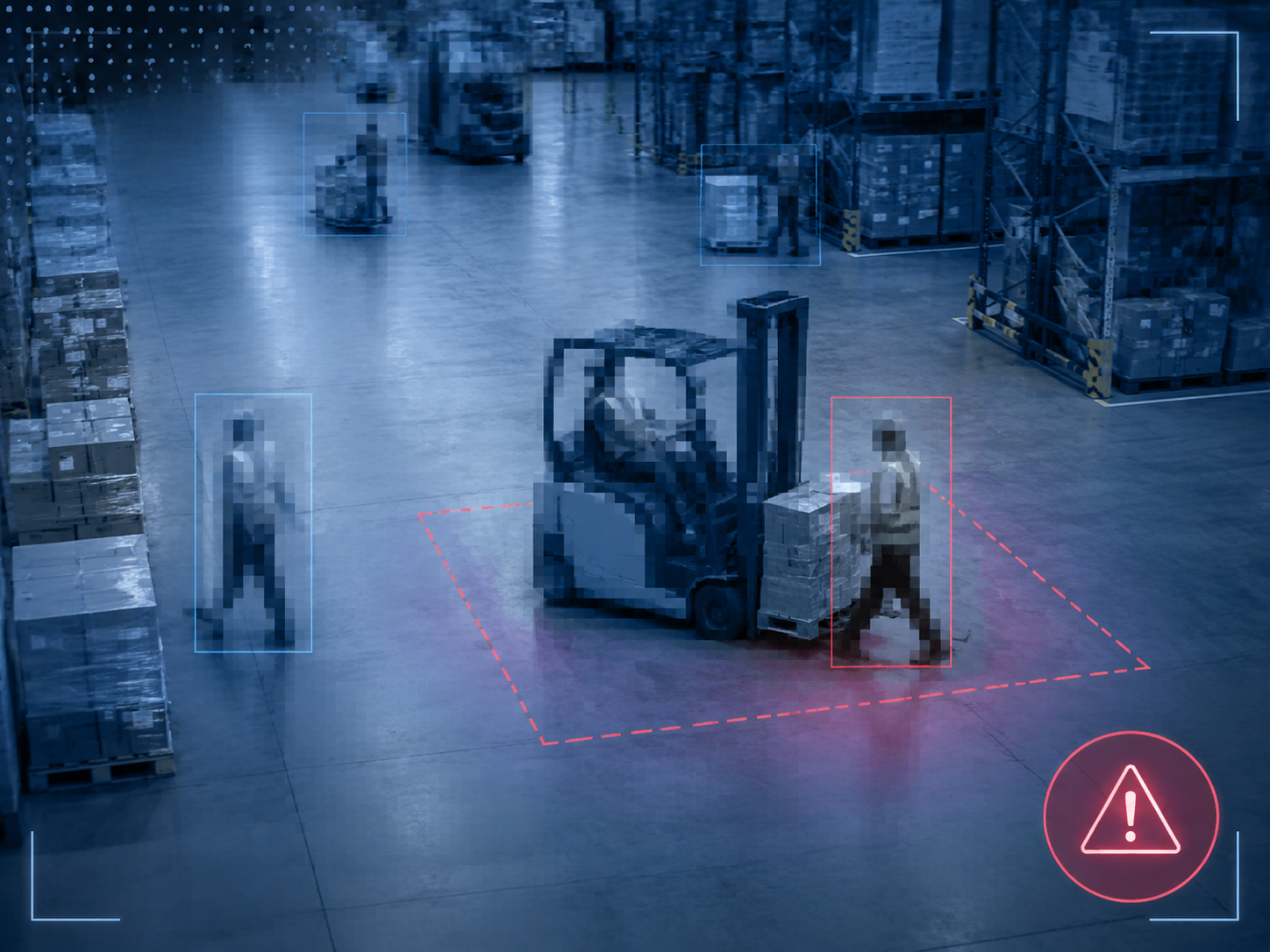
The safeguards described in the research materials include body blurring, no facial recognition, edge processing options, cloud-based processing options, and compliance programs such as SOC 2 Type II, ISO 27001, and GDPR-aligned configurations.[2] Those controls should be visible to employees, not buried in a vendor security appendix. If the program says it is non-punitive, workers need to see how that promise is enforced in review rules, access permissions, retention windows, and supervisor behavior.
Carlex Glass is the useful example here because the reported deployment involved a unionized environment and a non-punitive “Caught You Being Safe” program with the UAW.[2] That does not prove every unionized site will accept safety CV. It does show that labor acceptance is not impossible when the program is designed around coaching, positive reinforcement, and limits on individual surveillance.
The governance questions should be asked before installation:
- Will the system identify people, or only detect safety-relevant actions and objects?
- Who can view clips, and for what purpose?
- How long are clips retained?
- Which event types trigger coaching, maintenance work, layout changes, or discipline?
- How will hourly workers, supervisors, EHS teams, and labor representatives challenge false positives or misuse?
That last question is not legal polish. It is operational protection. If associates believe the camera is a one-way discipline machine, they will route around it, distrust the clips, and treat every safety huddle as evidence gathering. If the system helps fix a blind corner, change a staging habit, or recognize safe behavior, it has a better chance of becoming part of the floor rhythm.
Deployment Complexity: Fast Connection, Slower Operating Change
The research materials describe deployment using existing security cameras, with some vendor materials claiming 48-hour implementation and no new hardware requirement.[2] That can be true for technical connection in a camera-ready site. It should not be read as a 48-hour safety transformation. The operating work takes longer: selecting event categories, tuning zones, validating false positives, assigning alert owners, training supervisors, communicating worker safeguards, and deciding how success will be measured.
A sensible first deployment usually starts with a narrow hazard set. Vehicle-pedestrian interaction, speeding, and restricted-zone entry are often easier to validate than broad “unsafe behavior” monitoring. PPE detection can be added where rules are clear and camera angles support it. Ergonomics may need more careful piloting because the consequence of a bad interpretation is not just a false alert; it can be a worker feeling blamed for a job design problem.
Accuracy claims also need context. Voxel’s statistics page references peer-reviewed research showing more than 92% mean average precision in PPE and hazard detection.[1] Mean average precision is a model-performance measure, not a guarantee that a specific warehouse, camera angle, lighting condition, or PPE color will perform the same way. A facility should validate its own event samples before using alerts for performance management or compliance reporting.
The Qualification Standard
Computer vision for warehouse safety is commercially credible and operationally proven enough to deserve stakeholder validation in the right facility profile. The strongest evidence is not a general claim that AI makes warehouses safer. It is the named deployment cluster: Voxel-documented reductions at Americold, Vertical Cold Storage, Piston Automotive, NSG Group, the Port of Virginia, and Marks & Spencer, with Carlex Glass showing why labor-facing governance matters.[2]
The right candidate site has meaningful CCTV coverage, repeated vehicle-pedestrian, PPE, ergonomic, housekeeping, or restricted-zone risks, and supervisors who can respond with coaching and corrective action. The weaker candidate site wants a camera system to compensate for unclear ownership, poor layout discipline, or a safety culture built mainly on blame.
The limits should stay visible. The best outcome figures in the available materials are vendor-documented. Deployment success depends on who receives the alert and what they do next. Privacy controls are not optional decoration. Safety computer vision is most persuasive where it turns previously invisible near misses into timely coaching and measurable reductions, while keeping source attribution and worker safeguards clear.
References
- Voxel AI statistics pages, Voxel AI.
- Voxel AI customer outcome claims, Voxel AI.
- Protex AI guide, Protex AI.
- Ultralytics blog, Ultralytics.
- DHL materials on warehouse safety detection categories, DHL.
- Mecalux/MIT study, Mecalux, 2025.
Comments
Join the discussion with an anonymous comment.