
The yard is where a lot of cargo theft stops looking like a highway problem and starts looking like a handoff problem. A trailer is checked in, dropped, staged, or waiting for a door. The site has cameras. The gate has rules. The freight is supposed to be under control. Yet warehouse storage accounts for 41% of cargo theft, and unsecured lots account for another 16%.[1] That makes the warehouse and distribution center yard the largest exposed layer in the theft chain, not a peripheral security concern.
The loss numbers explain why this has moved from a security department complaint to an executive risk issue. Cargo theft losses reached about $725 million in 2025, up 60% year over year, while average per-incident value rose 36% to $273,990.[2] Those figures are direct cargo theft losses. They should not be blended with broader economic-impact estimates, such as the $35 billion figure cited elsewhere for indirect losses, downstream disruption, and stolen-goods market effects. The yard conversation is better kept narrower: when freight is sitting still, can the facility see suspicious behavior soon enough to do anything useful?
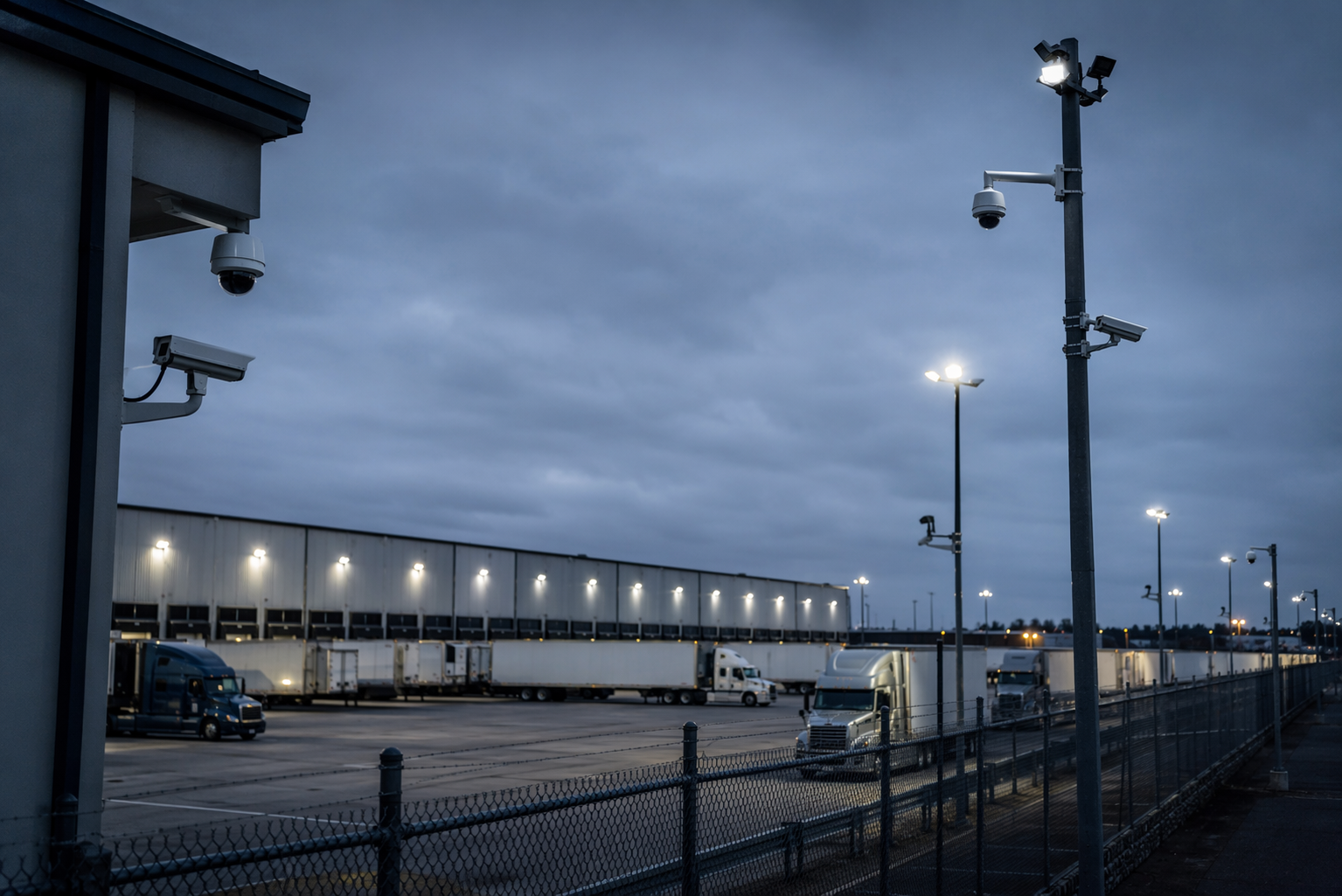
Why Passive CCTV Misses Yard Theft
Most yard cameras are not useless. They are often very good at proving what happened after a load is gone. That is different from creating a live response window. A conventional camera wall depends on someone noticing a vehicle that should not be parked near a row of trailers, a person lingering at the fence line, a yard tractor moving at the wrong hour, or a brief cut-through that looks ordinary until it is paired with a missing load.
The practical failure is workload. Industry research cited by IntelliSee says human operators lose effective attention after about 20 minutes of continuous monitoring, and many facilities run roughly a 1:100 operator-to-camera ratio, making intrusions under two minutes easy to miss.[1] That claim comes through vendor-cited industry research, so it should not be treated as a universal law. But anyone who has watched a night yard on a quiet shift knows the shape of the problem: most pixels are normal until one small behavior is not.
Motion alerts do not solve that problem by themselves. Rain, headlights, blowing debris, animals, employees crossing the lot, and routine trailer moves can all produce noise. After enough noise, people start muting, delaying, or informally downgrading alerts. Cargo theft exploits that gap: a short event inside a busy visual field, with no one clearly owning the decision until the exception becomes a claim.
What AI Surveillance Changes In A Yard
In practical terms, AI surveillance for supply chain security is not a magic camera. It is a way to turn existing video into a set of behavioral questions: what object is in view, where is it, how long has it been there, is it moving in an allowed direction, and does that behavior match the rules for this yard at this time?
A typical retrofit architecture is straightforward. Existing ONVIF or RTSP IP camera feeds are connected to a computer vision inference layer. That layer classifies objects such as vehicles, people, trailers, and yard tractors, applies site-specific behavioral rules, routes alerts through SMS, email, or an app workflow, and stores an audit trail for incident review, claims, or insurance documentation. Facilities with usable IP cameras do not necessarily need to rip out their camera estate to begin testing this model.[1]
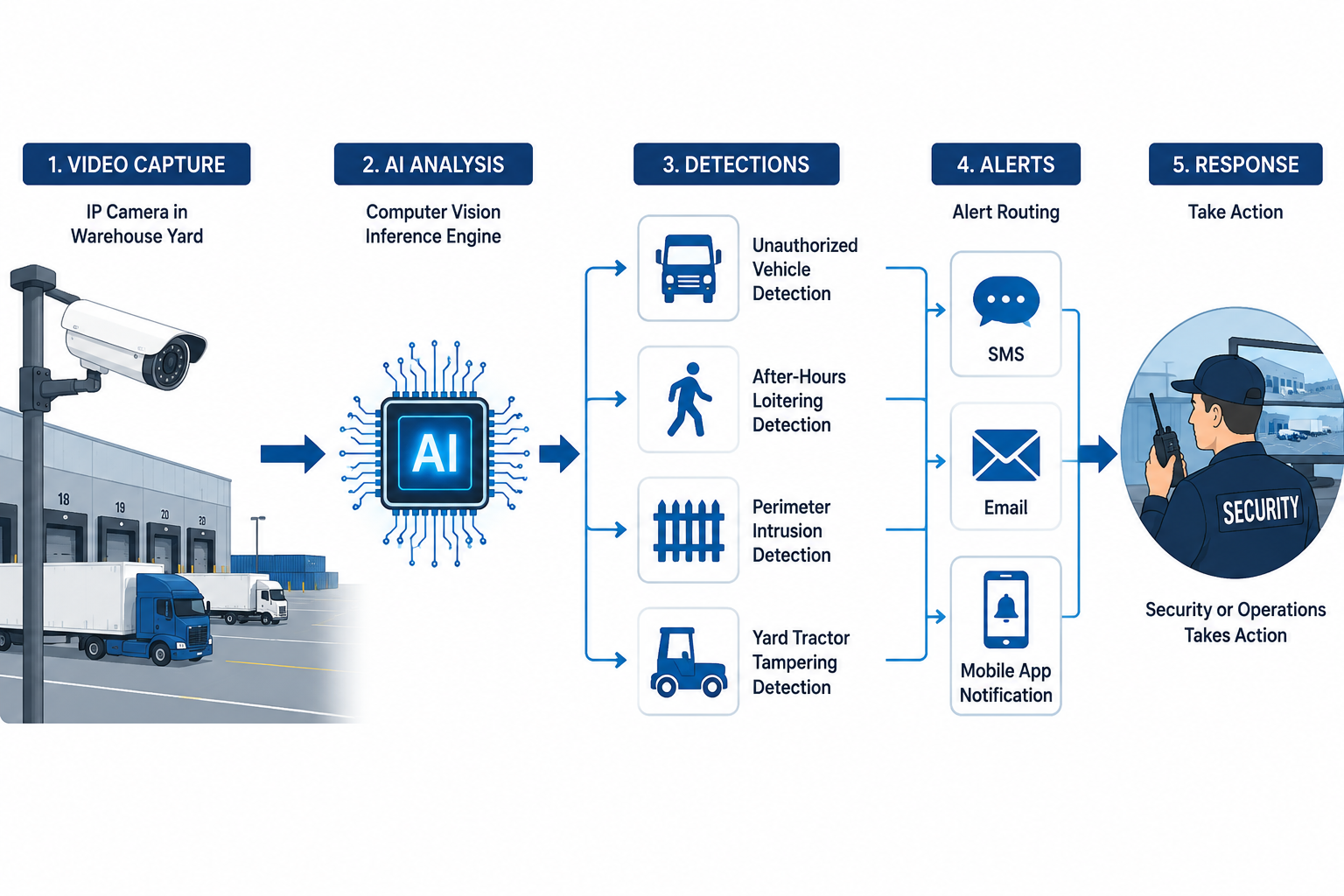
That architecture matters because the benefit is not simply better recording. The benefit is compression: fewer minutes between suspicious behavior and a person who can verify, call, dispatch, lock down a gate, wake up a carrier contact, or preserve the right evidence. The system earns its place only if the alert lands with someone who can act.
Unauthorized Vehicle Detection
Unauthorized vehicle detection is one of the clearest yard use cases because it maps to a real operating rule. A vehicle is either expected, checked in, assigned to a door, staged in an allowed zone, or it is not. AI video analytics can flag a vehicle entering a restricted lane, stopping near parked trailers after hours, circling a drop lot, or remaining in a zone beyond a defined dwell threshold.
The useful alert is not “motion at camera 14.” It is closer to “unknown vehicle stopped beside loaded outbound trailers for more than the allowed time.” That gives the guard or supervisor a decision instead of a guessing game. It also gives the claims lead a cleaner record later: camera, time, zone, object class, rule triggered, alert recipient, and response.
After-Hours Loitering
Loitering detection is less about seeing a person and more about deciding when presence becomes suspicious. A driver walking from a cab to a check-in window during shift change should not be treated like a person standing at a fence line near parked trailers at 2 a.m. The same object class has a different meaning depending on zone, schedule, route, and dwell time.
This is where behavioral rules beat simple motion. A person crossing a lit walkway may be routine. A person entering a blind-side row, pausing near kingpins, or moving between trailers outside normal operating hours deserves faster review. The alert should carry enough context that the responder knows whether to look, call, or dispatch rather than spend the first minute figuring out which camera matters.
Perimeter Intrusion
Perimeter intrusion is easy to oversell because every fence line has its own noise. Wind, shadows, vegetation, traffic, and animals can make a motion-based perimeter system miserable. AI behavioral detection is more useful when it classifies what crossed the boundary, where it crossed, and whether movement continued toward a protected asset.
IntelliSee’s briefing says AI behavioral detection can reduce false alarms by up to 90% compared with motion-based systems by distinguishing genuine threats from weather, animals, and routine activity.[1] That is vendor briefing material, not a guarantee for every yard. Still, the direction is credible: alerts based on object and behavior should be more actionable than alerts based on pixel change alone, especially on large outdoor sites.
Yard Tractor Tampering
Yard tractor tampering sits in the awkward space between operations and security. Yard trucks move freight legitimately all night at some facilities. At others, any tractor movement after a certain hour should be questioned. AI surveillance can help by watching for unexpected approach, coupling behavior, movement in restricted rows, or a tractor operating outside its approved schedule.
The rule has to be built with operations, not handed down as a generic security setting. A high-volume cross-dock, a weekend overflow lot, and a manufacturing yard with staged finished goods will each have different normal patterns. Bad rules create noise. Good rules reflect how the yard actually breathes.
The Deployment Pattern That Actually Matters
For most operators, the decision is less about whether AI video exists and more about whether the facility can absorb it into daily control. A retrofit-friendly deployment usually starts with the camera map: which ONVIF or RTSP feeds cover gates, fence lines, drop rows, trailer doors, fuel areas, yard tractor parking, and blind corners. The first pass often reveals that the camera system was designed for evidence capture, not behavioral detection.
| Layer | Practical Question | Yard Security Consequence |
|---|---|---|
| Camera coverage | Can existing IP cameras see the zones where loaded trailers dwell? | Blind spots remain blind even with better analytics. |
| Computer vision inference | Can the system classify vehicles, people, trailers, and yard tractors reliably enough for rules? | The alert becomes behavior-based instead of motion-based. |
| Behavioral rules | Do rules reflect hours, zones, carrier activity, and yard movement patterns? | Good rules reduce noise; poor rules train people to ignore the system. |
| Alert routing | Who receives the alert, through SMS, email, app, or dispatch workflow? | Detection only matters if someone can respond. |
| Audit logging | Can the site show what was detected, when, who received it, and what happened next? | Claims, insurance reviews, and post-incident investigations become cleaner. |
Camera placement is usually the first hard conversation. A camera mounted for a beautiful wide shot of the yard may be poor at reading behavior near a trailer row. A gate camera may capture plates but miss the staging lane where a vehicle waits before tailgating in. A pole camera may cover three rows during the day and lose usable detail under glare or rain at night. AI cannot fix a camera that cannot see the action clearly enough.
The inference layer should be tested against the yard’s own conditions: headlights, reflective trailer sides, weather, shift-change surges, seasonal volume, temporary overflow parking, and normal carrier dwell. A proof of concept that only watches a clean daytime feed will not answer the night-shift question.
Alert routing deserves as much scrutiny as the model. If a guard receives an app alert but the operations supervisor controls the gate, the workflow is already split. If the regional security director receives after-hours alerts but no local responder is assigned, the system is documenting exposure rather than reducing it. If the warehouse team owns the yard during operating hours and a contracted guard owns it after midnight, the escalation tree has to follow that handoff.
Audit logging is where the operational record becomes insurance and claims material. The log should preserve the camera, zone, rule, timestamp, alert path, acknowledgement, escalation, and disposition. That record does not prove the system prevented theft. It does show whether the facility had a documented detection architecture and whether people followed the response workflow.
Where Vendor Claims Fit
The vendor ecosystem is already full enough that buyers should avoid treating “AI surveillance” as a single product category. IntelliSee, Lumana, Scylla, LVT, and Cloudastructure all present retrofit-compatible AI video surveillance or warehouse security offerings, but the useful evaluation is not a logo comparison. It is whether the system can run on existing camera feeds, support the yard’s behavioral rules, route alerts into the facility’s response workflow, and produce records that stand up after an incident.
A vendor demo should be pushed toward ordinary yard messiness. Ask what happens when a carrier arrives early and waits near a gate. Ask how the system handles two tractors moving at once, a pedestrian shortcut, a trailer reposition, a temporary overflow row, or a guard acknowledging an alert without closing the loop. The answers reveal more than a polished detection montage.
There is a broader academic frame for this kind of monitoring. Brintrup et al. describe “Digital Supply Chain Surveillance” as data-driven monitoring across supply chain activity, including physical-security-related visibility.[3] That framing is useful, but the reported survey base is narrow for this specific yard-theft problem: 62 UK respondents in 2022. It should not carry the argument for a 2026 U.S. distribution yard deployment.
Why Some Sites Feel The Pressure First
Risk is not evenly distributed. California and Texas accounted for 58% of U.S. cargo theft incidents in 2025, and the same reporting noted inland displacement from Los Angeles County toward Kern County, up 82%, and San Joaquin County, up 44%.[2] For operators exposed to those lanes, the yard may receive more scrutiny from customers, carriers, insurers, and internal risk teams because a parked load is not just parked freight; it is accumulated exposure.
That does not mean every facility in a lower-theft region needs the same controls. It means site priority should follow dwell time, commodity attractiveness, lane risk, local theft patterns, yard layout, and the ability to respond. A facility with short dwell, low-value goods, strong gate discipline, and clear sight lines may not justify the same investment as a high-theft-lane distribution center holding loaded trailers overnight.
The Insurance Case Comes After The Workflow
Insurance pressure can make AI surveillance easier to fund, but it should not be the first design principle. A carrier, broker, or customer may want evidence that the site has documented detection, alerting, and response controls for high-theft freight. That evidence is only meaningful if the underlying workflow works.
The ROI case is strongest when AI video surveillance replaces a weak after-the-fact record with a live, logged process: behavior detected, alert sent, person assigned, action taken, event retained. That record can support claims handling and renewal conversations, but it also helps operations answer the uncomfortable internal questions after an event. Who saw it? Who received the alert? Was the gate notified? Did anyone dispatch? Was the trailer checked before departure?
For teams already evaluating warehouse automation, yard security belongs beside other practical AI use cases rather than in a separate futurist bucket. A broader warehouse AI use-case library can help place theft detection alongside labor, slotting, and throughput opportunities. The readiness questions also overlap with closing the warehouse AI execution gap: data access, workflow ownership, exception handling, and change management.
Keep The Scope Honest
AI video surveillance does not secure the whole shipment journey. In-transit monitoring, route deviation alerts, idle detection, driver communication, and telematics belong to the adjacent layer of cargo security. They matter, especially for theft in motion, but they do not replace yard detection.
The warehouse-yard layer is justified when freight sits long enough to create exposure, existing cameras can be converted from passive evidence capture into behavioral detection, and alerts are routed to people who can intervene. The value is not that AI “prevents theft” in the abstract. The value is a shorter, better-documented path from suspicious behavior to human response.
References
- Cargo Theft and Distribution Center Yard Security: The 2026 Threat Intelligence Briefing, IntelliSee.
- Cargo Theft Statistics (2026): $725M Record, California #1, Guardian Integrated Security.
- Digital Supply Chain Surveillance, International Journal of Production Research, 2023.
Comments
Join the discussion with an anonymous comment.