
A waterspout is the kind of hazard that makes a neat voyage plan look fragile. It may occupy only a narrow patch of sea and still force a master, routing desk, carrier, shipper, and 3PL to make the same uncomfortable decision: slow down, divert, warn the customer, or keep the vessel moving toward the slot. That is why AI for maritime supply chain safety during waterspouts is best treated as an operational question before it is treated as a forecasting question.
The short answer is still narrow: no production AI system exists solely to detect or forecast waterspouts. What is becoming more useful is a layered severe-weather stack that can identify risky atmospheric setup, confirm local vessel-level anomalies, and turn those signals into routing and escalation decisions. That stack does not make a waterspout certain. It can, however, reduce the odds that a vessel enters a small, violent patch of water with only a generic forecast and a watchkeeper’s eyes.
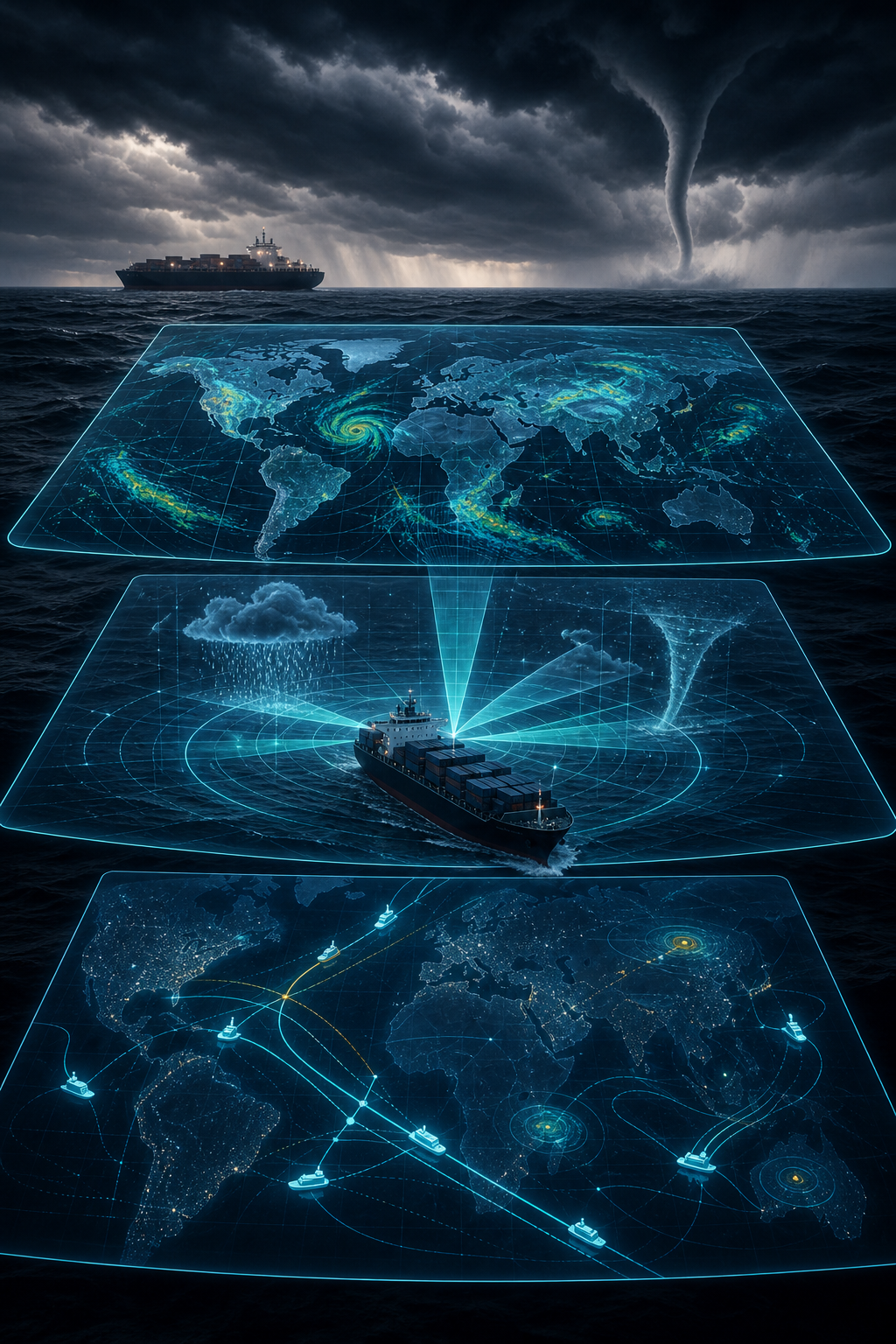
Why waterspouts sit awkwardly inside maritime risk systems
Waterspouts are rotating columns of air that form over water, and NOAA treats them as hazards for marine users rather than curiosities on the horizon.[1] The operational difficulty is their scale. A synoptic forecast can tell a fleet that a region is unstable. A marine warning can tell a bridge team that severe weather is possible. Neither necessarily gives a useful, vessel-specific lead time for a funnel forming near a route line.
The Szilagyi Waterspout Index is a useful reminder of the difference between risk conditions and event prediction. It is a deterministic thermodynamic index used to assess waterspout potential, not a machine-learning model that sees a funnel and tells a vessel what to do next.[2] For supply chain teams, that distinction matters. A high-risk environment is not the same as a confirmed hazard on the intended track, and a confirmed hazard is not the same as a validated autonomous routing instruction.
This is also why the August 2024 Bayesian superyacht sinking near Porticello, Sicily, should be handled carefully. The case drew attention to waterspout risk after Mediterranean sea surface temperatures reached 30°C, about 3°C above average, but the waterspout connection remained under investigation rather than settled causation.[3] It is a serious maritime safety case, not proof that a specific AI alert would have prevented the loss.
The practical stack: broad risk, local confirmation, fleet action
The most credible near-term use case is not a single “waterspout detector.” It is a workflow with three jobs assigned to three different layers. Global AI weather models look for broader severe-weather setup. Vessel-level sensing watches the immediate sea state and visibility around the ship. Fleet intelligence platforms decide whether the signal changes routing, monitoring, escalation, or customer commitments.
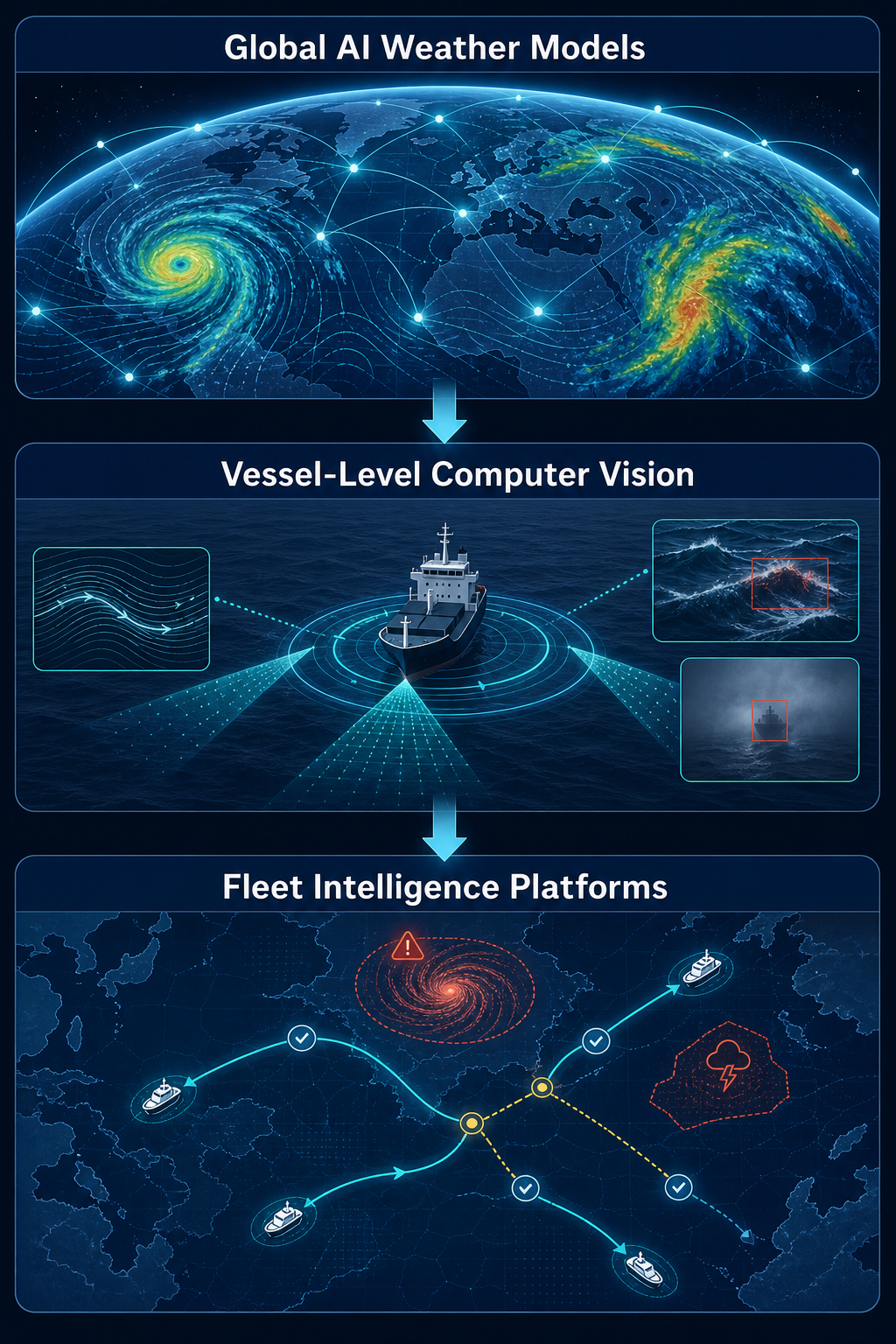
| Layer | What it can contribute | What it does not prove |
|---|---|---|
| Global AI weather models | Earlier awareness of severe convective conditions across ocean regions | A vessel-specific waterspout forecast |
| Vessel-level computer vision | Local observation of wind, wave, visibility, and sea-surface anomalies near the ship | A validated waterspout classification system |
| Fleet intelligence platforms | Routing, escalation, monitoring, and customer-facing decision support | Autonomous authority to treat every severe-weather signal as a confirmed waterspout |
That division of labor is not cosmetic. Maritime weather risk becomes expensive when the signal arrives in the wrong format: a broad forecast too vague for a route decision, a bridge observation too late for a diversion, or a platform alert too generic for customer communication. A layered approach gives each signal somewhere to go.
Layer 1: AI weather models can widen the severe-weather watch zone
Global AI weather models such as Google DeepMind’s GraphCast, ECMWF’s AIFS, and Microsoft’s Aurora are relevant because waterspouts rarely announce themselves as tidy, isolated logistics events. They sit inside larger atmospheric patterns: instability, convection, wind shifts, and localized severe weather. Reporting on AI weather models for shipping has focused on their ability to improve awareness of extreme and severe-weather risks that affect maritime operations.[4]
That still leaves a last-mile problem. A model that improves severe-weather awareness is not automatically a waterspout predictor. For a routing desk, the useful question is whether the model changes the timing or confidence of an intervention before a vessel reaches a risky area. Better atmospheric pattern recognition can move a route review earlier in the watch cycle. It cannot, by itself, prove that a funnel will form near a specific ship.
The Met Office and AWS shipping-forecast experiment is a good example of both progress and restraint. In April 2026, the Met Office described work on AI-assisted text-based weather services, including an LLM-based shipping forecast generation approach that achieved 62% word-match accuracy, with vision-language model approaches still in development.[5] That is an experiment in forecast production, not an operational waterspout warning service. It may improve the machinery around maritime forecast wording; it does not close the gap between “severe weather likely” and “waterspout now forming off the starboard bow.”
Layer 2: vessel vision can see what broad forecasts cannot localize
The second layer is where the supply chain problem becomes more concrete. A vessel does not sail through a probability field; it sails through changing wind, waves, rain, visibility, clutter, traffic, and available sea room. Orca AI describes its SeaPod system as using computer vision for real-time maritime perception, including Beaufort-scale wind, wave, and visibility anomaly detection at up to 4 nautical miles, with 99.999% uptime.[6]
Those details matter because waterspout-scale hazards are local. A bridge team may not need the AI to name the phenomenon perfectly in order to take a safer posture. If the system confirms a rapid deterioration in visibility, abnormal sea surface behavior, or severe local wind and wave conditions near the vessel, the routing conversation changes from “the forecast region is unstable” to “this vessel is encountering conditions that deserve escalation.”
Still, the wording has to stay disciplined. Vessel-level computer vision can detect local anomalies associated with dangerous weather. It may detect waterspout-scale phenomena if the sensor view, training data, and classification logic support that outcome. The available documentation does not establish Orca AI SeaPod, or comparable vessel perception systems, as validated waterspout detectors.
Layer 3: fleet platforms turn alerts into decisions someone can audit
The third layer is where supply chain value usually appears. An alert that stays on the bridge may protect the vessel, but a fleet platform can connect it to voyage monitoring, route alternatives, port arrival planning, customer notification, and post-event review. StormGeo says it monitors more than 75,000 voyages annually and, through its voyage optimization work, has reported saving more than 5 million metric tons of fuel and more than 15 million metric tons of CO2.[7] StormGeo has also added Bearing AI to its partner network, extending the connection between voyage optimization and AI-enabled vessel performance analysis.[8]
Weathernews’ SeaNavigator AI Agent points to a different operational rhythm. The company describes an agent that checks every fleet vessel every 6 hours, uses a 5-day severe-weather lookahead, and draws on more than 300,000 voyage records and 40 years of data.[9] For waterspout risk, the useful part is not that the product claims waterspout prediction; it does not need to. The useful part is the recurring fleet-wide review cycle: which vessels are entering a severe-weather corridor, which have limited maneuvering room, and which customer commitments need early attention.
Windward’s Maritime AI is broader still, using more than 15 proprietary models for behavioral anomaly detection and risk scoring across maritime activity.[10] That kind of platform belongs in this discussion because weather is only one risk signal among many. A vessel’s route, speed behavior, port exposure, cargo sensitivity, and schedule pressure all affect whether a probabilistic severe-weather alert becomes a supply chain disruption.
Where the evidence is strongest, and where it thins out
The strongest evidence is not waterspout-specific. It sits around adjacent capabilities: better severe-weather modeling, better onboard perception, and better fleet decision support. That is enough to justify monitored pilots for maritime severe-weather risk. It is not enough to market a production waterspout alarm.
The TorNet dataset shows why the next step is technically plausible. MIT Lincoln Laboratory described TorNet as a machine-learning dataset with more than 200,000 radar images and 13,587 labeled tornado samples; models trained on it detected 85% of EF-2 or stronger tornadoes in the reported work.[11] For anyone building waterspout detection, that is an important signal: machine learning can learn severe rotating-storm signatures from radar data when labeled examples exist.
It also exposes the missing piece. TorNet is a land tornado dataset, not a waterspout dataset. Transferability to waterspout radar signatures may be reasonable as a research hypothesis, but it is not validation. A maritime operator cannot turn an EF-2 tornado detection result into a waterspout forecast KPI without labeled waterspout cases, marine radar context, sensor metadata, false-alarm analysis, and operational outcome testing.
That distinction is more than academic. A false positive can slow a vessel, miss a berth window, trigger customer alerts, or create avoidable fuel burn. A false negative can put crew and cargo into a dangerous local event. The model score that matters is not only detection accuracy; it is whether the alert improves a decision in time, with enough confidence, and with a clear chain of human responsibility.
How a monitored pilot should look
A useful pilot does not start by asking a vendor to prove it can predict waterspouts. It starts by selecting routes and seasons where localized convective marine weather already creates recurring operational concern, then testing whether the AI stack changes decisions before the vessel reaches the risk area.
- Define the event class carefully: severe convective marine risk, waterspout-favorable conditions, vessel-level anomaly, confirmed waterspout sighting, and supply chain disruption are different labels.
- Track lead time by decision, not only by weather signal: route review, speed adjustment, master notification, customer update, and port-slot escalation.
- Keep humans in the loop for route changes, especially when the alert is probabilistic or the platform documentation does not explicitly identify waterspouts.
- Record misses and nuisance alerts with the same discipline as successful warnings, because false confidence is the hidden cost in narrow hazards.
- Separate safety outcomes from commercial outcomes: avoiding a dangerous patch of water and preserving an ETA are related, but they are not the same metric.
The broader business case for AI supply chain risk tools is already drawing attention. Reported benchmarks suggest AI systems can reduce supply chain errors by 20% to 50%, and Johnson & Johnson has reported detecting 85% of major disruptions 7 days before impact.[12] Market projections are similarly aggressive, with one cited forecast expecting growth from $7.15 billion to $192.51 billion by 2034.[12] Those figures support the reason leaders are evaluating AI risk systems, but they should not be used as evidence that waterspout detection has been solved.
The adoption posture for 2026
For Q3 2026, the defensible posture is cautious adoption under the severe-weather umbrella. Global AI weather models can improve awareness of convective risk. Vessel-level computer vision can add immediate local confirmation. Fleet intelligence platforms can make the signal operational by tying it to routing, escalation, and customer communication. Together, they can help manage waterspout-scale risk better than a single forecast feed.
The line not to cross is equally clear. Detecting conditions associated with waterspouts is not the same as detecting a waterspout. Detecting a waterspout-scale anomaly is not the same as forecasting where a waterspout will form. A validated production waterspout alarm would need waterspout-specific data, marine-domain testing, and documented operational performance. Until then, the right deployment model is monitored, layered, and human-in-the-loop.
References
- Waterspout Threat, NOAA, https://www.weather.gov/mlb/waterspout_threat
- A New Spin On Waterspout Forecasting, LakeErieWX, https://www.lakeeriewx.com/CaseStudies/WaterspoutPrediction/Waterspouts.html
- Waterspouts can be as dangerous as tornadoes on land, PreventionWeb, https://www.preventionweb.net/news/waterspouts-can-be-dangerous-tornadoes-land-expert-qa
- Can AI Weather Models Protect Shipping From Extreme Weather?, Sustainability Magazine, https://sustainabilitymag.com/news/can-ai-weather-models-protect-shipping-from-extreme-weather
- Met Office and AWS are pioneering how AI could shape the future of text-based weather services, Met Office, April 2026, https://www.metoffice.gov.uk/blog/2026/aws-met-office-ai-shipping-forecast
- The Missing Piece: AI-Driven Maritime Weather Data Aggregation, Orca AI, https://www.orca-ai.io/blog/ai-driven-weather-data-aggregation/
- Weather Routing & Voyage Optimization, StormGeo, https://stormgeo.com/shipping/weather-routing-and-voyage-optimization
- StormGeo Adds Bearing AI, StormGeo, https://stormgeo.com/insights/stormgeo-adds-bearing-ai-to-its-growing-partner-network
- SeaNavigator AI Agent, Weathernews, https://sea.weathernews.com/resources/202511/43
- What is Maritime AI™?, Windward, https://windward.ai/glossary/what-is-maritime-ai/
- An AI dataset carves new paths to tornado detection, MIT Lincoln Laboratory, https://sustainability.mit.edu/article/ai-dataset-carves-new-paths-tornado-detection
- From Reactive to Proactive: How AI-Driven Supply Chains Weather Every Storm, World Certification Institute, https://www.worldcertification.org/from-reactive-to-proactive-how-ai-driven-supply-chains-weather-every-storm/
Comments
Join the discussion with an anonymous comment.