
For tropical storm landfall supply chain logistics, a plan becomes useful at the point where probability turns into a named action. A forecast cone by itself does not move inventory. A dashboard alert does not tell a regional DC manager whether to pull forward replenishment, freeze a delivery promise, reroute outbound trucks, or ask procurement to buy ahead of a supplier cutoff. The useful AI tool is the one that connects storm timing, facility exposure, supplier dependency, transportation capacity, and demand movement while there is still time to choose.
The pressure behind that choice is no longer theoretical. Resilinc, using its own platform data, reported that extreme weather alerts rose 119% in 2024, while overall supply chain disruptions rose 38%.[1] Interos, also using vendor-sourced analytics, estimated that 94.5 million businesses were at risk from extreme weather in 2025, a 48% year-over-year increase representing 30.8 million additional businesses at risk.[2] Those figures should not be treated as independent industry benchmarks, but they are a fair warning about the operating environment: storm risk is appearing often enough that waiting for a late-stage scramble is a bad procurement strategy.
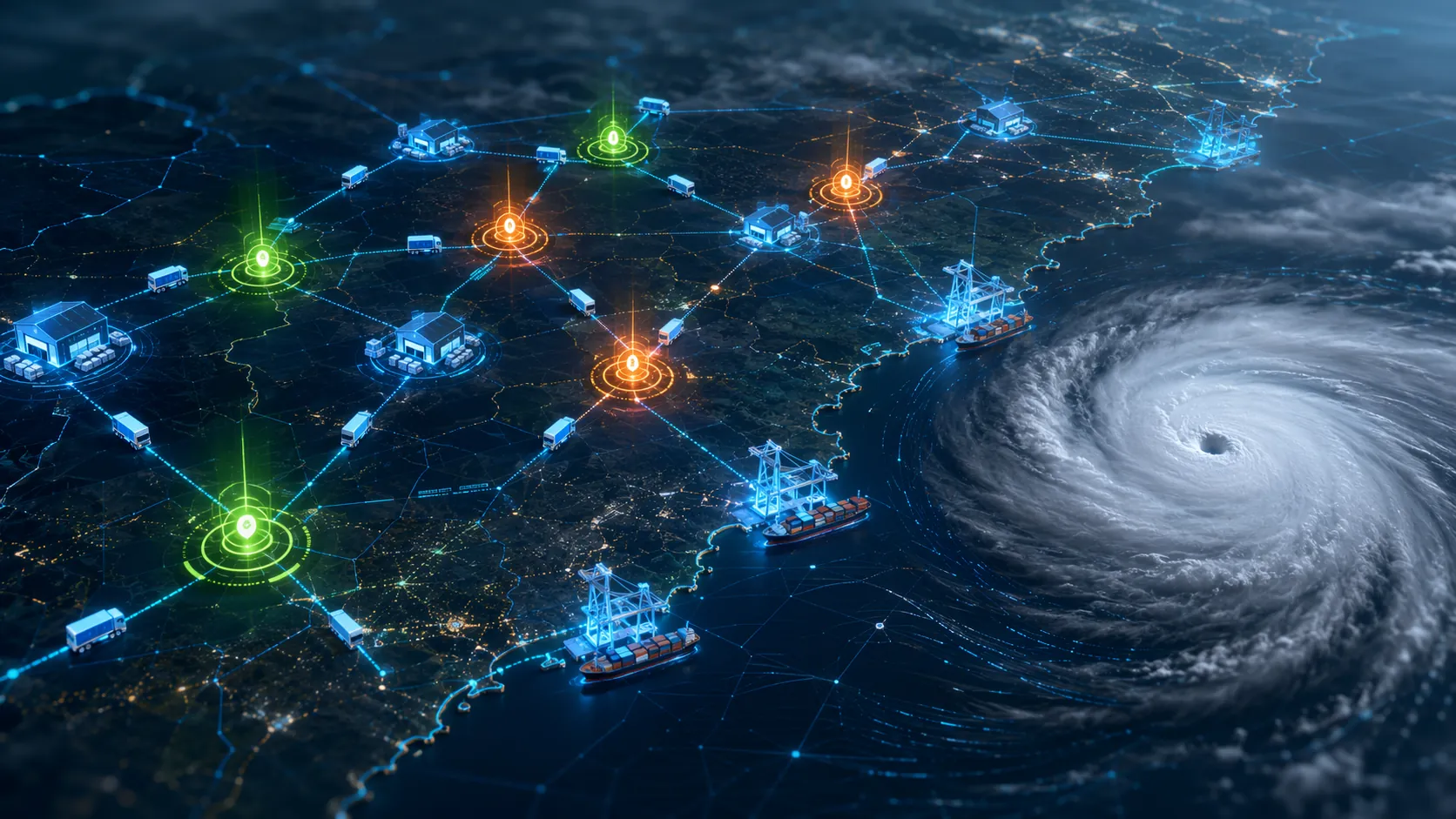
For readers who need the broader use-case primer, AI applications in hurricane planning covers demand planning, rerouting, and cost control at a higher level. The harder shortlisting question is narrower: which platforms can turn landfall probability into pre-positioning, rerouting, safety stock, sourcing, and customer-commitment decisions before the lane closes?
The Decision Window Opens Before the Forecast Is Certain
Storm preparedness is uncomfortable because the important decisions come before certainty. The track is still moving. The supplier may or may not lose power. A port may remain open but lose drayage capacity. A hospital buyer may need to place an order before a cutoff, while a retailer may need to shift roofing, batteries, bottled water, or repair materials toward the region most likely to see demand.
That is why lead time only matters when it creates a decision window. Two extra weeks matter if they let a planner stage material, approve overtime, reserve capacity, or change an allocation rule. Two extra days matter if they let a logistics team abandon a coastal route before trucks are trapped in a closure pattern. A risk score matters only after it is attached to an exposed lane, supplier, facility, part, order, or customer promise.
ClimateAi’s Hurricane Ian case is useful for exactly that reason. In a single-company example, a building materials producer used ClimateAi’s probabilistic demand forecast more than two weeks before landfall and captured $15 million in additional sales by acting before the storm hit.[3] That does not prove a typical ROI for storm AI. It does show the kind of evidence worth paying attention to: a timestamped forecast, a commercial decision, and a reported outcome tied to action rather than awareness.
Where the Vendor Stack Actually Sits
The vendor landscape is easier to evaluate if the tools are not all thrown into the same “AI visibility” bucket. Everstream, Interos, Resilinc, and ClimateAi can all support storm preparedness, but they operate at different layers of the decision window. A logistics leader shortlisting platforms should ask which operating lever the tool reaches, not whether the demo map looks sophisticated.
| Platform | Storm-preparedness layer | Operational lever to test in a shortlist |
|---|---|---|
| Everstream Analytics | Network digital twin, probabilistic risk scoring, and disruption pattern analysis | Can teams simulate exposed facilities, lanes, ports, suppliers, and fulfillment choices before landfall? |
| Interos | Multi-tier supplier network visibility and catastrophic risk modeling | Can procurement identify sub-tier exposure and place orders or qualify alternatives before supplier cutoffs? |
| Resilinc | Event detection, monitoring, and collaboration workflow | Can the system move from alert to WarRoom-style coordination, ownership, and supplier response tracking? |
| ClimateAi | Probabilistic, sector-specific climate and demand forecasting | Can planners change demand positioning, inventory allocation, or commercial execution before demand spikes? |
This distinction matters because a platform that is strong at supplier exposure may not be the best demand-sensing engine. A digital twin may be excellent for scenario simulation but still need clean master data, current lane assumptions, and planners willing to abandon a familiar route. A collaboration tool may be weak as a long-range forecasting engine but valuable once the company needs supplier replies, task owners, and escalation discipline.
Digital Twins Are the Workspace, Not the Magic
The best use of a digital twin before landfall is not to admire a model of the network. It is to run uncomfortable what-if exercises while there is still time to act: What if the coastal DC loses outbound capacity for three days? What if the preferred lane becomes unreliable? What if a supplier’s sub-tier dependency is inside the probable impact zone? What if the inland alternate route can move freight but cannot support the same delivery promise?
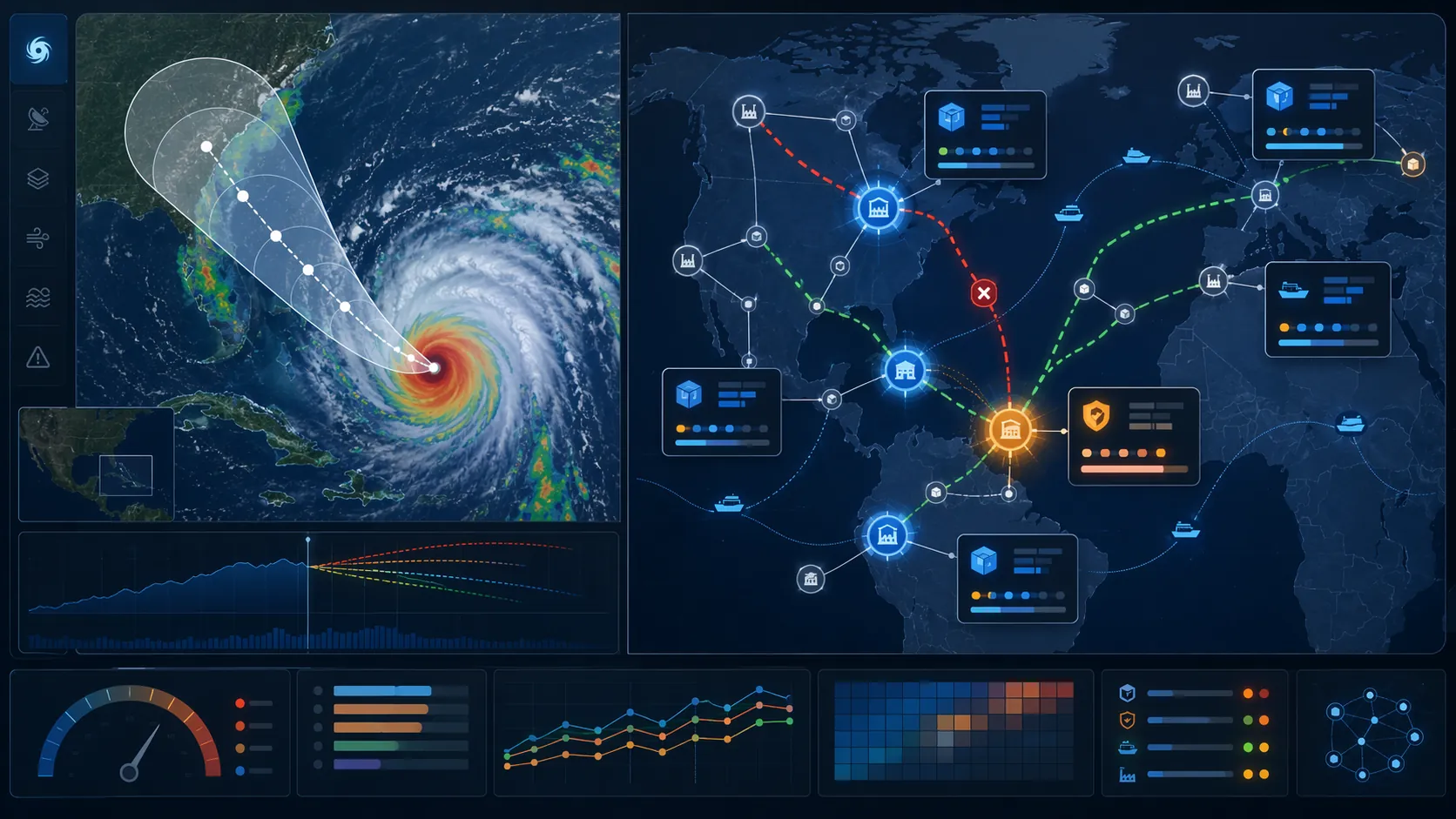
The National Academies’ post-hurricane framework helps explain why that level of modeling matters. Based on the 2017 hurricane experience, it emphasized that post-hurricane supply chain bottlenecks often emerge at the distribution level rather than the production level, and it used criticality and vulnerability scoring to assess where disruption would hurt most.[4] The technology stack has changed since those storms, but the underlying lesson is still practical: a product can exist somewhere in the network and still fail the customer if the exposed distribution node, route, or handoff is the weak point.
Everstream is positioned in this part of the stack. The company describes an AI digital twin drawing on more than 30,000 data sources, with climate attribution analysis used to examine accelerating disruption patterns.[5] The capability to interrogate the network before the event is the reason the category deserves attention. SupplyChainBrain has described digital twins as a way to run what-if reroute and inventory exercises before a storm reaches landfall, which is the difference between a map of risk and a rehearsal of the operating plan.[6]
A serious digital twin shortlist should therefore include working-session tests, not only reference calls. Give the vendor a real lane family, a real facility cluster, a real SKU group, and a real supplier dependency. Then ask the system to show which decision changes first as the storm cone shifts: inventory movement, alternate fulfillment, route abandonment, supplier acceleration, customer allocation, or service-level revision. If the output is only a heat map, the decision burden has been pushed back to the planner.
Supplier Exposure Needs to Reach Past Tier One
Storm disruption is rarely polite enough to stop at a company’s direct supplier list. A tier-one supplier may look safe while a sub-tier site, sterilization partner, component source, or logistics handoff sits inside the impact zone. This is where Interos belongs in the comparison: not as a generic weather app, but as a supplier-network exposure tool that can connect catastrophic risk to specific companies and relationships.
The Cooper University Health Care example is narrow but concrete. Interos says Cooper identified three suppliers in Hurricane Idalia’s path and placed pre-cutoff orders.[2] That does not establish a universal healthcare storm playbook, and it does not say every exposed supplier would have failed. It does show the operational lever that supplier intelligence should create: procurement sees exposure early enough to order ahead, qualify an alternative, or at least stop discovering the dependency after the cutoff has passed.
This is also where vendor-sourced risk totals need careful handling. Interos’s 94.5 million businesses-at-risk estimate is a useful pressure signal, but a buyer still needs to know whether the platform can map that macro exposure to the buyer’s own purchase orders, supplier sites, contract manufacturers, and logistics nodes.[2] A large exposed-business count does not by itself tell a planner which shipment to pull forward tomorrow morning.
Alerts Need Owners, Deadlines, and Supplier Responses
Event detection is not a minor layer. It is where many storm programs fail quietly. The company receives an alert, forwards it to a group inbox, waits for the next forecast update, and then discovers that nobody owned the supplier call, the inventory exception, or the customer-service decision.
Resilinc’s storm relevance sits in this workflow layer. Its vendor-sourced 2024 data reported the 119% jump in extreme weather alerts, and its platform positioning includes EventWatchAI and a WarRoom collaboration environment for coordinating response activity.[1] The buying question is not whether the tool detects more events. It is whether those events become assigned tasks with affected suppliers, facilities, materials, owners, deadlines, and documented outcomes.
A practical test is simple: ask how the platform handles a storm expected to affect two suppliers, one DC, and three outbound lanes. The answer should show who receives the alert, which exposed objects are attached, what supplier message is sent, how responses are tracked, when the issue escalates, and which operating decision is recorded. If a vendor cannot show that chain, the system may improve awareness without improving execution.
Demand Signals Can Be as Important as Damage Signals
Storm planning often overweights physical damage and underweights demand distortion. A landfall threat can pull demand forward before impact, shift category mix, change regional replenishment priorities, and create temporary allocation questions. Building materials, generators, medical supplies, repair parts, bottled water, and emergency consumables do not all respond on the same clock.
The same Hurricane Ian case illustrates this demand layer. The reported $15 million in additional sales came from acting on a probabilistic demand forecast more than two weeks before landfall, not from waiting to measure actual damage.[3] That is a different value proposition from supplier mapping or route simulation. The decision is commercial and inventory-facing: where to place supply, which demand signal to trust, and how early to commit while uncertainty remains.
For teams benchmarking the demand-planning side, AI demand forecasting accuracy expectations for 2026 are a useful companion question. Storm demand models should be judged less by a generic accuracy claim than by whether they change replenishment timing, allocation logic, and sales execution early enough to matter.
Transportation Exposure Still Needs a Cost Lens
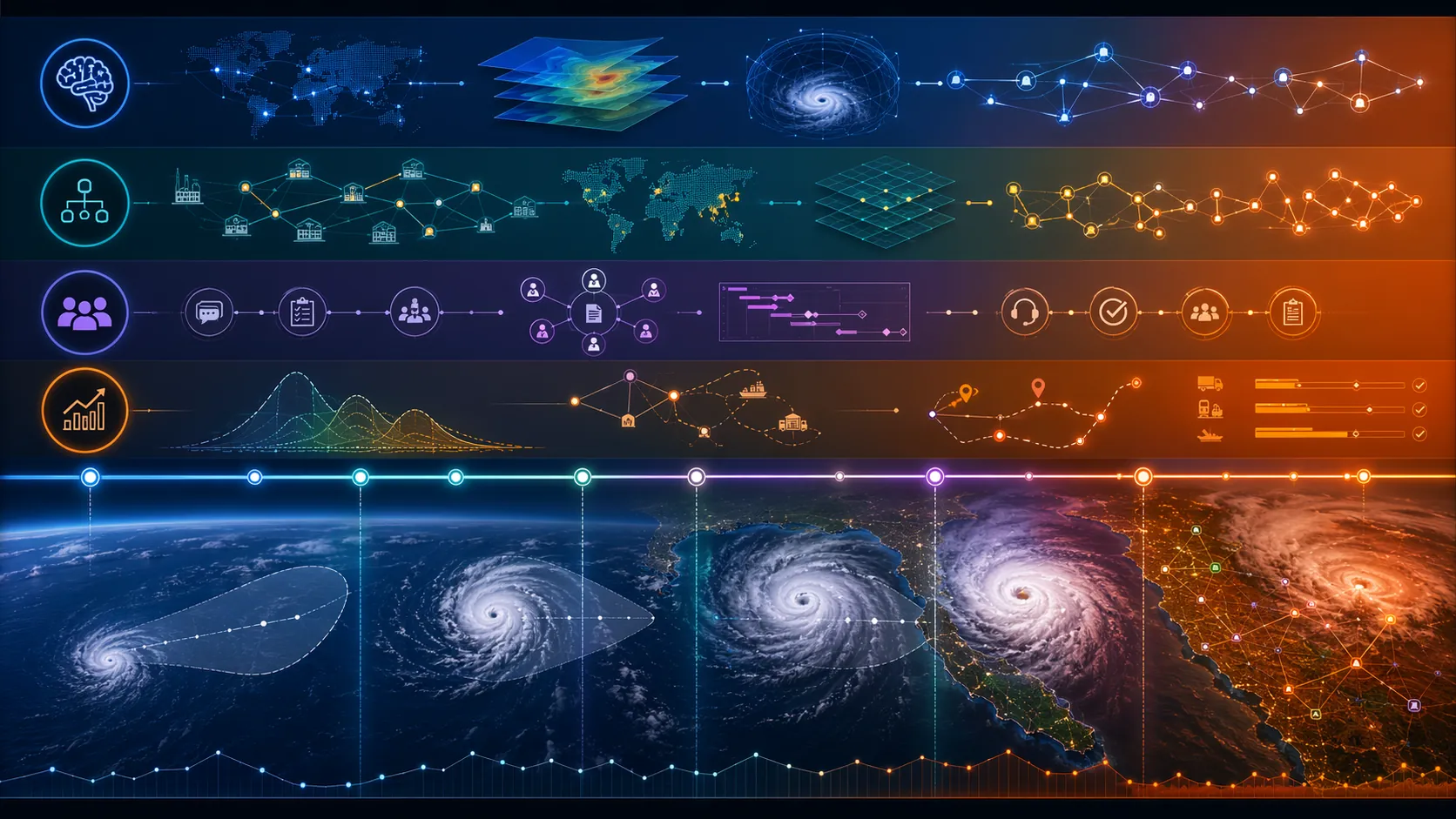
Transportation risk is where storm plans become painfully visible. A road closure turns a modeled delay into detention, missed appointments, spoilage risk, emergency freight, and customer-service triage. Geotab and WeatherOptics noted the Hurricane Helene context around I-40, where closure effects were described as potentially lasting a year, and cited a 2012 FHWA study finding that weather accounted for 23% of roadway delays at an annual cost of $2.2 billion to $3.5 billion.[7] The dollar figure is old and should be treated in that context, but the operating point remains current: weather delay is expensive because it breaks planned flow.
For logistics teams, the AI question is not whether a storm may close roads. It is whether the platform can show which lanes should be abandoned before capacity tightens, which shipments can move early, which orders can shift to alternate fulfillment, and which customer promises should be revised before the service failure is already baked in. Adjacent use cases such as AI flood disruption planning and wildfire risk prediction across supplier networks follow the same discipline: the value is in the decision window, not the hazard label.
How to Shortlist Without Buying a Passive Dashboard
A storm-preparedness AI shortlist should force vendors to show the chain from signal to lever. A strong demo starts with a changing probability signal and ends with a named action: move inventory from DC A to DC B, place supplier orders before cutoff, reroute away from a lane family, raise safety stock on exposed SKUs, protect a hospital’s critical supply, or revise a customer promise.
- Ask what object the risk score attaches to: supplier, site, lane, SKU, order, facility, customer, or all of them.
- Ask how early the system has produced usable recommendations in comparable storm events, and separate adoption claims from measured outcomes.
- Ask whether scenario simulation can compare alternate routes, DCs, suppliers, and allocation policies before landfall.
- Ask how alerts become owned work: task assignment, supplier outreach, escalation, approval, and closure evidence.
- Ask which ROI evidence is vendor-sourced, which is a single customer case, and which has independent validation.
This is also where broader capability planning belongs. Teams comparing investments across disruption planning, risk assessment, and weather intelligence can use AI disruption-planning capability criteria or logistics risk-assessment benchmarks to keep the storm use case from becoming an isolated technology purchase.
What the Evidence Proves, and What It Does Not
The evidence base is useful, but uneven. Resilinc’s disruption figures and Interos’s businesses-at-risk estimate show elevated weather-risk pressure in vendor-observed networks; they do not establish a neutral market-wide frequency rate.[1][2] ClimateAi’s Hurricane Ian case shows that an early probabilistic signal can support a materially better commercial outcome for one building materials company; it does not prove that every deployment will generate comparable sales uplift.[3] Cooper University Health Care’s Idalia example shows supplier-path visibility turning into pre-cutoff ordering; it should not be stretched into a universal healthcare procurement model.[2]
That still leaves enough to make a procurement judgment. In Q3 2026, AI tools for tropical storm landfall supply chain logistics are worth shortlisting when they can show the operating chain clearly: probability signal, exposed network object, decision owner, available action, timing window, and outcome evidence. If the tool stops at a warning, it is a weather-aware dashboard. If it changes where inventory sits, which lane moves, which supplier order is accelerated, or which customer promise is protected, it belongs in the budget conversation.
References
- Global Supply Chains See Nearly 40% Annual Increase in Disruptions, Resilinc
- Protecting Your Supply Chain from Extreme Weather: Steps to Minimize Risk, Interos
- Accurate Hurricane Forecasting Helps Roofing Materials Producer, ClimateAi
- Strengthening Post-Hurricane Supply Chain Resilience, National Academies
- Climate Change Is Accelerating Supply Chain Disruption, Everstream Analytics
- How Digital Twins Help Supply Chains Weather the Storm, SupplyChainBrain
- Hurricanes, Supply Chain and Transportation, Geotab
Comments
Join the discussion with an anonymous comment.