
The awkward truth in AI infrastructure planning is that the easiest part of the schedule to photograph is no longer the hardest part to deliver. A company can announce GPU capacity, negotiate the site, advance permits, sign customers, and still be left with an expensive shell waiting for energization. The constraint has moved into equipment that rarely appears in investor decks: generation step-up transformers, high-voltage switchgear, breakers, and medium-voltage gear.
That is why the most important number in the energy supply chain for AI infrastructure is not always a chip count or a megawatt total. In Q2 2025, average U.S. lead times for generation step-up transformers reached 143 weeks, according to Wood Mackenzie data cited in reporting and supply-chain analysis of the transformer market.[1] A 143-week lead time is not a purchasing inconvenience. It is a critical-path item that can outrun the rest of the deployment plan.
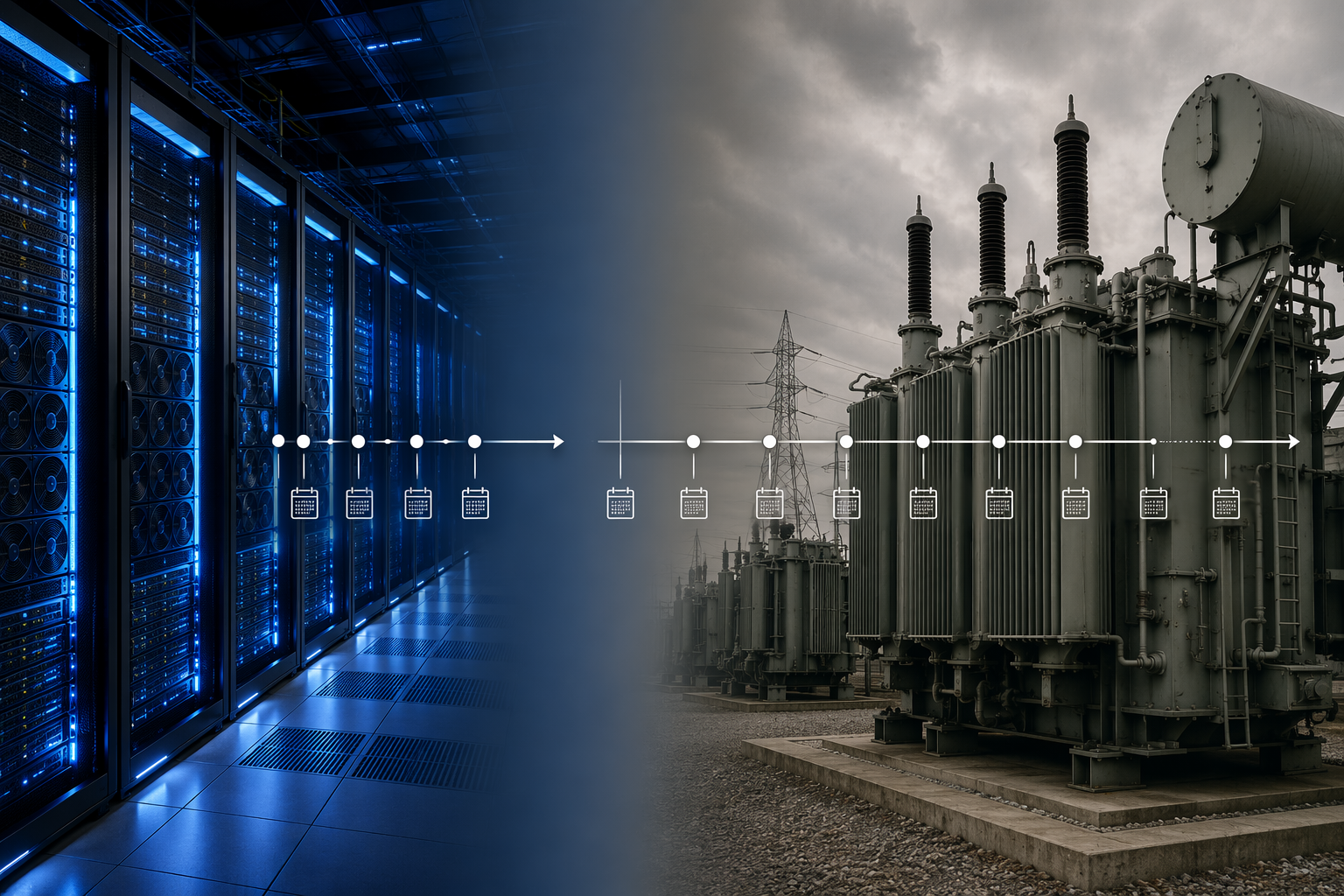
The figure needs one caveat. It is Q2 2025 data, not a live reading from Q3 2026. New manufacturing capacity from major suppliers may already be easing some categories of transformer pressure. But that caveat does not restore the old sequencing logic. Even if lead times improve from the worst reported levels, electrical equipment still belongs at the front of the AI data center schedule, not in a procurement workstream that starts after the commercial story is already sold.
The critical path now runs through energization
In a cleaner version of the buildout story, compute demand appears, land is found, power is requested, construction begins, and servers arrive. The site becomes revenue-producing when racks are installed. That sequence is too tidy for 2026 planning.
A real deployment schedule has a harsher dependency: the data hall cannot carry AI load until the electrical path is complete. The transformer has to be specified, ordered, manufactured, tested, shipped, installed, and integrated with the utility interconnection and on-site electrical system. Switchgear and breakers have to arrive in time for commissioning. Utility reviews and construction milestones have to line up with equipment that may have been ordered years earlier.
This changes the meaning of “available capacity.” A site with GPUs allocated but no dependable energization date is not deployable AI capacity. It is inventory attached to a promise. The procurement lead and interconnection team are then forced to reconcile commitments made on one clock with equipment moving on another.
The transformer lead time is only the most visible part of the problem. Wood Mackenzie estimates cited in the same supply-chain discussion pointed to 2025 market shortages of 40% for high-voltage switchgear, 25% for breakers, and 20% for medium-voltage switchgear.[1] Those are estimates, not official statistics, but they describe the practical issue accurately enough: the bottleneck is not one exotic component. It is the electrical package required to turn contracted power into usable load.
| Electrical component | Why it changes the AI data center schedule |
|---|---|
| Generation step-up transformers | Long-lead, custom-engineered equipment can determine whether a site can be energized on time. |
| High-voltage switchgear | Shortages can delay utility-side and substation integration even when transformers are secured. |
| Breakers | Missing breaker capacity can hold up protection schemes, testing, and commissioning. |
| Medium-voltage switchgear | Delays can affect distribution inside the campus and the readiness of phased data hall deployment. |
Why the shortage is structural, not just cyclical
The transformer market is being pulled by several demand streams at once. AI data centers are the loudest buyer in the room, but they are not the only one. Renewable generation, grid modernization, and EV charging infrastructure all require electrical equipment, and U.S. demand for generation step-up transformers surged 274% between 2019 and 2025, according to Wood Mackenzie data cited in the transformer shortage analysis.[1]
That demand cannot be met by simply adding another shift in a factory. Large transformers are custom-engineered assets with production cycles commonly measured in months rather than weeks, and the supply chain depends on specialized inputs such as grain-oriented electrical steel.[1] The result is a queue that behaves very differently from many technology procurement queues. It is less elastic, more engineered, and more exposed to manufacturing capacity that was not built for the AI data center boom.
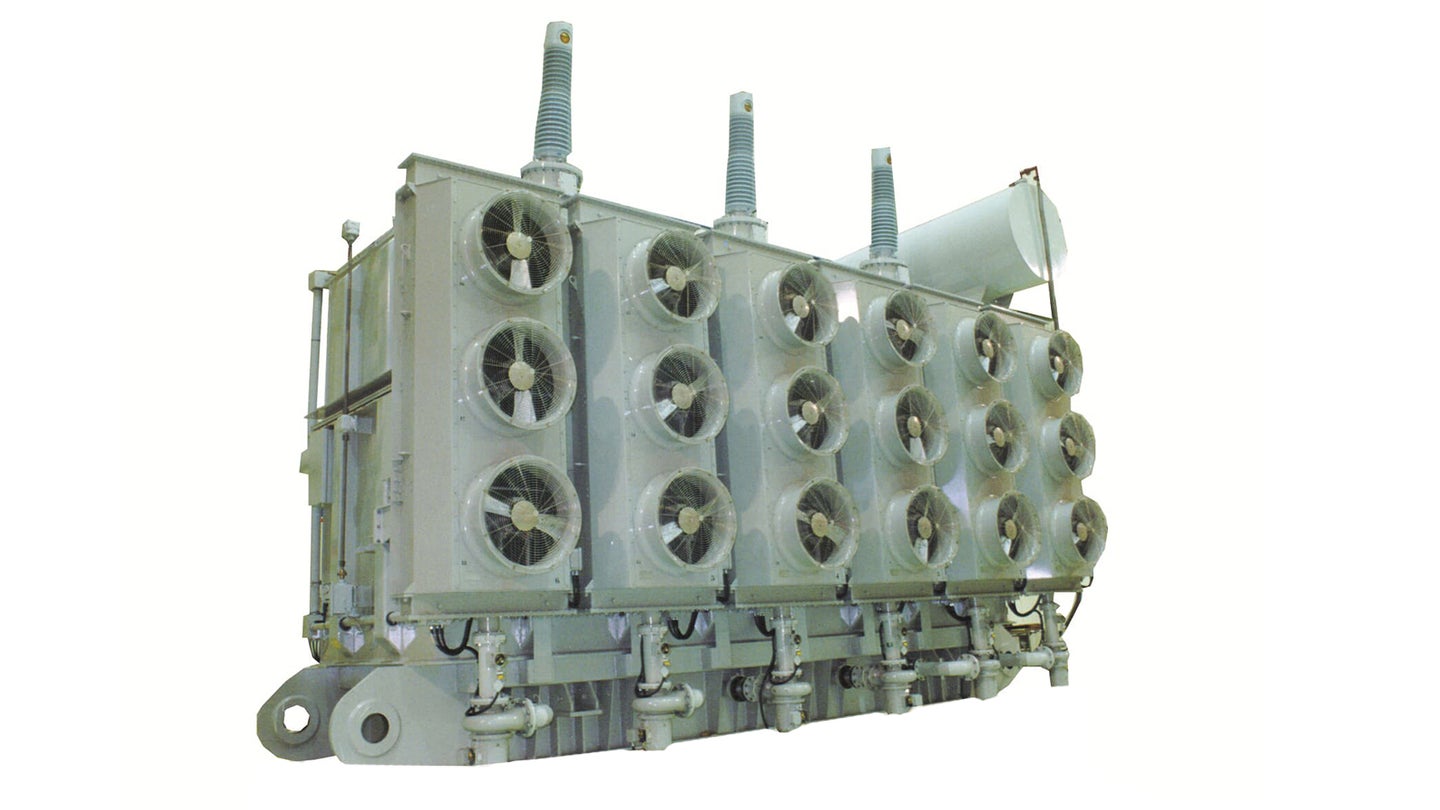
Production geography adds another layer of risk. NPC Electric describes China as controlling about 60% of global transformer production, creating exposure to tariffs, geopolitical disruption, and qualification constraints for buyers that need equipment approved for U.S. utility and industrial use.[2] Diversification is possible, but not instant. A new supplier still has to meet technical specifications, utility acceptance standards, testing requirements, and delivery commitments.
Policy intervention confirms that this is not being treated as an ordinary sourcing hiccup. The Department of Energy has convened transformer working groups, and the White House has invoked Defense Production Act authorities for transformer capacity.[1] Those actions may help expand domestic capability, but they do not erase the immediate scheduling problem for projects trying to energize in the current planning window.
The old deployment sequence is backwards
AI data center planning has often treated power as a parallel track: important, expensive, and difficult, but still something that can be advanced alongside the compute and real estate work. Transformer shortages make that assumption dangerous. The power package is no longer a supporting schedule. It is the schedule.
A more realistic sequence starts with the energization path. Before a project team celebrates a GPU allocation or a tenant commitment, it should know which transformer capacity is reserved, what switchgear and breaker slots are protected, how the utility interconnection study affects equipment specifications, and whether the site can absorb slippage without stranding hardware.
This does not mean every data center sponsor should order identical equipment before it has a final site. Transformers are not interchangeable commodities. Ordering too early with incomplete specifications can create its own waste. The point is narrower and more operational: equipment strategy has to begin before the project is commercially locked into an energization date that procurement cannot support.
Site selection also has to change. A parcel with cheap land and a compelling power headline may be worse than a more expensive site with a clearer interconnection path, fewer transmission dependencies, and better visibility into utility equipment requirements. Land control matters, but land control without electrical deliverability is not capacity. Transmission corridor disputes can make this worse, as eminent domain delays can cascade into procurement timing and utility construction plans; that connection is visible in AI data center eminent domain bottlenecks.
The same discipline applies to phased builds. A campus plan that assumes the first data hall energizes while later halls wait for utility upgrades may be reasonable. A plan that assumes all phases can draw power on a commercial timetable without confirmed equipment slots is not. The difference is not ambition. It is whether the construction schedule is tied to the electrical bill of materials.
Procurement has to reserve time, not just equipment
The practical response starts earlier than many project teams are comfortable with. Transformer and switchgear procurement should move into the earliest feasibility work, alongside interconnection screening, site due diligence, and utility engagement. Waiting for final commercial certainty may feel prudent, but it can also mean joining the equipment queue after the energization date has already become unrealistic.
Supply chain leaders should be asking different questions at investment committee and site approval meetings:
- Which transformer, switchgear, and breaker slots are actually reserved, and under what commercial terms?
- Which specifications are still exposed to utility study outcomes or design changes?
- What happens to GPU delivery, tenant commitments, and construction sequencing if energization slips by several quarters?
- Which suppliers are qualified by the utility, EPC partner, insurer, and internal engineering team?
- Where are the contractual protections for delivery slots, liquidated damages, substitution rights, and escalation exposure?
Supplier diversification helps, but only where it is technically and institutionally real. A second supplier that cannot meet utility requirements does not reduce risk. A factory slot that depends on unproven qualification can become a different kind of delay. Diversification should focus on approved manufacturers, tested designs, credible logistics plans, and the ability to hold production priority when the market tightens.
Contract structure matters because equipment queues are now strategic assets. A letter of intent that does not protect a production slot may be little more than a placeholder. Stronger procurement programs will separate price negotiation from schedule protection, identify the points at which specifications can no longer change without resetting delivery, and make clear who bears the consequence if the utility, EPC contractor, or owner changes scope after the supplier has begun engineering.
There is also a portfolio question. A hyperscaler or AI infrastructure operator with multiple sites may need to allocate scarce electrical equipment the way it allocates compute: toward projects with the highest probability of timely energization. That can mean delaying a commercially attractive site if the power path is weak, or advancing a less glamorous site because the transformer and switchgear path is already secured.
Alternative power does not remove the equipment problem
On-site generation and private power structures are becoming more relevant because the grid interconnection path can be too slow for AI demand. They deserve a place in the planning discussion, especially for campuses where utility upgrades are uncertain or where phased capacity can support near-term revenue. But they are not a magic exit from the electrical supply chain.
A gas generation project, fuel cell installation, or other behind-the-meter strategy still needs electrical integration, protection equipment, permitting, fuel or service arrangements, and operating risk management. It may reduce dependence on one utility-side bottleneck while creating another set of procurement and execution dependencies. The useful comparison is not “grid power versus no grid problem.” It is which power architecture creates the most reliable energization path for the site, phase, and load profile. That tradeoff is the center of the Bloom Energy versus Constellation Energy comparison for AI data center power.
For some projects, alternative power may buy time. For others, it may complicate permitting, community acceptance, fuel supply, or emissions strategy. The mistake is treating it as a late-stage patch after transformer procurement has already failed. If private power is relevant, it should be evaluated early enough to influence site design, interconnection assumptions, equipment specifications, and commercial commitments.
The consequence is idle capital
The financial market can be right about AI compute demand and still understate the deployment friction. Demand does not energize a substation. A signed customer does not shorten a transformer production cycle. A GPU delivery window does not make switchgear appear on site.
This is where the shortage becomes more than a utility procurement story. If electrical equipment slips, construction sequencing changes. Commissioning teams wait. Customers revise start dates. Expensive hardware risks arriving before the site can use it. Revenue forecasts built around nominal megawatts begin to depend on a procurement appendix that may not have received the same scrutiny as the commercial model.
Real-world AI capacity cases are already being read through this lens. Discussions of whether IREN can meet its AI cloud revenue ambitions, for example, turn partly on whether power delivery and transformer lead times align with the pace implied by commercial targets; that is why the analysis of IREN’s AI cloud revenue target treats transformer availability as a capacity-delivery constraint rather than a footnote.
The better operating standard for 2026 is blunt: do not count AI capacity as deployable until the electrical equipment path supports the energization date. Land, permits, tenants, and GPUs matter. But if transformer, switchgear, and breaker availability are not treated as the primary scheduling variable, the project plan is probably overstating how much AI infrastructure can actually come online.
Comments
Join the discussion with an anonymous comment.