
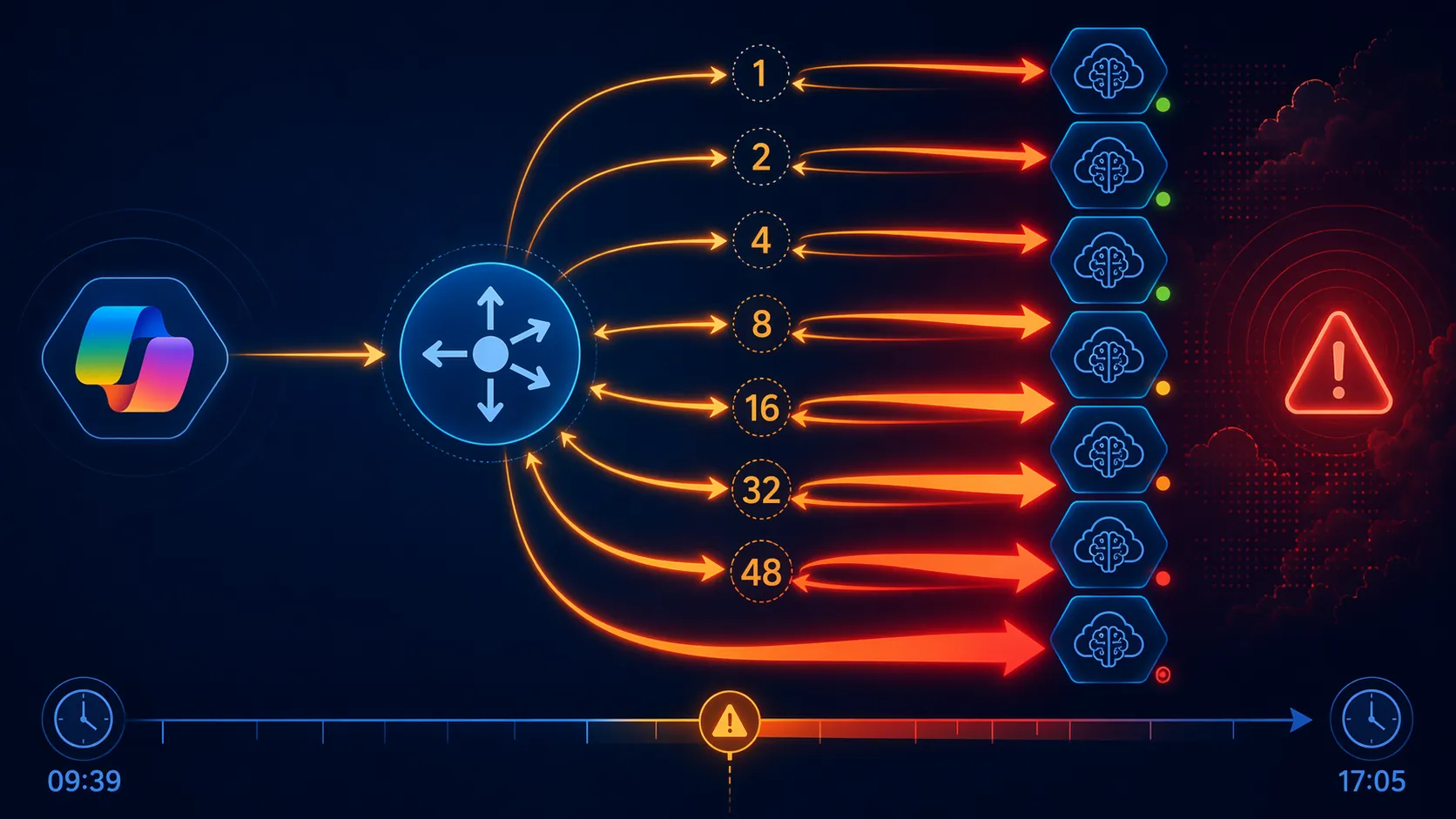
The uncomfortable part of the May 29 Azure OpenAI outage is not that an AI service failed. Services fail. The part worth studying is that Microsoft says the failure began with an upstream API change that caused Microsoft 365 Copilot traffic to retry failed requests aggressively, reaching up to 48 retry attempts per failed request, and those retries overwhelmed shared inference load balancers used by Azure OpenAI customers in affected regions.[1]
That distinction matters for anyone running supply chain AI on cloud inference. This was not a clean story of external demand exceeding capacity. It was an internal first-party workload amplifying failure inside a shared path. The reported customer-impact window ran from 09:39 to 17:05 UTC on 29 May 2026, with Azure OpenAI inference affected in Europe and Australia East.[1] For a planning organization, that is not an abstract availability percentage. It is a full business day in some operating regions, long enough for forecast generation, replenishment recommendations, exception triage, and route-planning jobs to miss their handoff windows.
What Broke on May 29
Microsoft’s post-incident review for Tracking ID LYXT-C1Z describes a causal chain with three important links. First, an upstream API change affected M365 Copilot request behavior. Second, failed requests retried far beyond what a shared inference layer could absorb, with Microsoft identifying up to 48 retry attempts per failed request. Third, those retries overwhelmed shared inference load balancers, degrading Azure OpenAI inference for customers in affected regions.[1]
Retries are usually introduced as a reliability feature. A client gets a timeout, a transient 5xx, or a throttling response, waits briefly, and tries again. In a small isolated system, that can smooth over brief instability. In a shared high-volume inference system, the same mechanism can become load multiplication. If the first request fails because the system is already stressed, then an immediate retry adds load to the same stressed path. If thousands or millions of requests follow the same retry rule, the recovery mechanism becomes another failure source.
The number Microsoft published is the operational tell. “Up to 48 retry attempts per failed request” is not a minor tuning mistake in a dependency that sits quietly behind an application.[1] It means one failed inference request could become dozens of additional attempts competing for the same load-balancer and model-serving capacity. Once that pattern is attached to a large first-party workload, the system no longer sees one failing caller. It sees a caller manufacturing a storm.
The shared route is the second tell. Microsoft’s remediation plan includes moving large first-party AI workloads onto dedicated infrastructure in June 2026, redesigning retry policy in July 2026, and adding stronger overload controls in July 2026.[1] Those mitigations are useful because they reveal the architectural weakness Microsoft itself chose to address: first-party AI traffic and customer inference traffic should not be able to exhaust the same critical serving path under retry amplification.
| Failure Element | Why It Matters Operationally |
|---|---|
| Upstream API change | A dependency change outside the customer workload altered request behavior. |
| Up to 48 retries per failed request | Failure traffic multiplied instead of backing off cleanly. |
| Shared inference load balancers | First-party retry load and customer inference demand converged on the same layer. |
| 09:39-17:05 UTC impact window | The event lasted long enough to collide with scheduled planning and integration jobs. |
| Europe and Australia East Azure OpenAI inference impact | Regional AI workloads depending on Azure OpenAI could see degraded inference even if their own applications were unchanged. |
Why Supply Chain AI Has a Larger Blast Radius Than a Chat Window
A failed chatbot response is visible and irritating. A failed supply chain inference call can be quieter and more expensive to unwind. The user may not be staring at the failed request. The failure may sit between an ERP extract, a forecasting agent, an optimization run, a control-tower exception workflow, and a writeback step that another system is waiting to consume.
The impact of a Microsoft outage on supply chain AI operations is best understood as an architecture problem, not a headline about AI downtime. Supply chain AI is increasingly placed inside scheduled, chained workflows. A demand forecast may classify exceptions, generate narrative drivers, call a model to explain variance, and then pass recommended changes to a planner. An inventory workflow may ask an agent to interpret supplier risk, compare policy options, and prepare a replenishment recommendation. A routing workflow may combine constraints, disruption signals, and human-readable exception explanations before a dispatcher sees the result.
Each of those steps can contain more than one inference call. Some calls are direct. Some are hidden behind agent orchestration. Some are embedded in a vendor platform where the customer sees only a job status, a delayed recommendation, or a missing exception summary. When the inference layer starts returning failures or latency spikes, the application does not merely wait. It may retry, split work into smaller calls, fall back to another execution path, or push partial output into a queue for later completion.
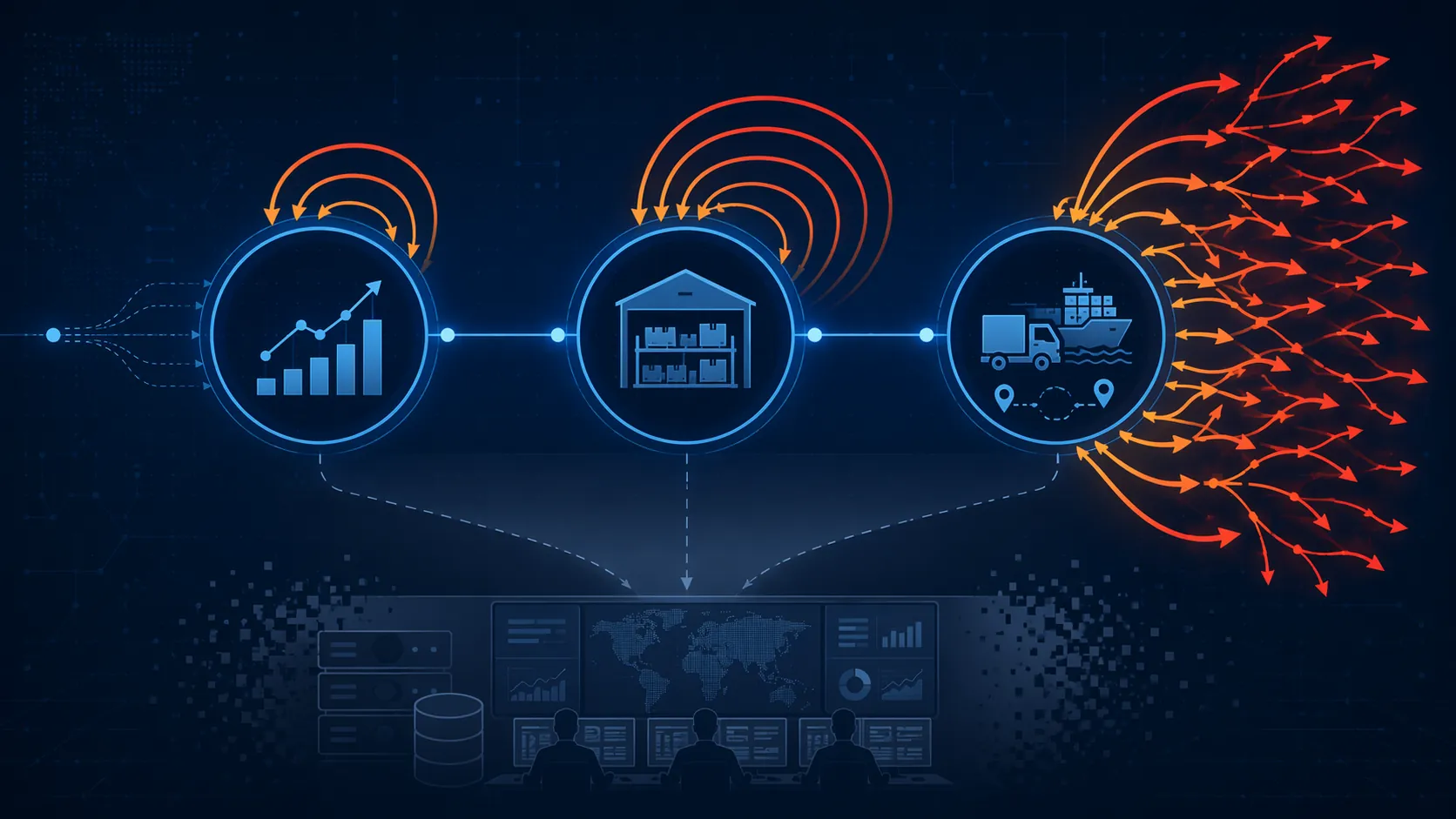
This is where retry storms become especially ugly. In a single-step application, a retry repeats one failed action. In a planning cycle, retries can stack across the orchestration layer, the vendor API layer, the cloud SDK, and the model-serving layer. The planner sees one workflow. The infrastructure sees a tree of attempts.
A hypothetical example makes the compounding visible. Suppose a forecasting workflow calls an inference model to classify demand anomalies, then calls again to summarize drivers, then calls again to draft planner actions. If the orchestration layer retries each failed step, the vendor connector retries the API call, and the cloud-side client also retries, the total attempt count can climb without anyone intentionally increasing business workload. The forecast batch did not get larger. The retry surface did.
The consequence is not limited to a missing AI answer. A delayed forecast can push back inventory optimization. A delayed inventory recommendation can miss an ERP writeback window. A delayed routing exception can leave a control tower with stale explanations while transportation teams move to manual triage. None of that proves a named customer suffered those outcomes on May 29; Microsoft’s PIR did not name supply chain customers or publish supply chain-specific incident reports. It does show why the affected service category is dangerous for supply chain systems that depend on inference as part of operational sequencing.[1]
Azure-Native Supply Chain AI Is Not Hypothetical
The supply chain relevance is not being inferred from cloud usage in general. In March 2026, Microsoft described a Supply Chain 2.0 ecosystem that included o9 Digital Brain, Kinaxis Maestro, Blue Yonder Inventory Ops Agent, Resilinc, GEP SMART and NEXXE, Cosmo Tech, and paiqo prognotix as platforms built natively on Azure for supply chain workflows.[2] That is Microsoft’s own partnership framing, so it should be read with the usual caution attached to vendor ecosystem claims. It does not establish which customers, if any, were disrupted during the May 29 event.
It does establish something narrower and still important: Azure-native supply chain AI is a real deployment pattern, and the kinds of workflows Microsoft promotes in that ecosystem are exactly the kinds of workflows that can depend on repeated inference. Agentic planning, inventory recommendations, supplier-risk interpretation, and exception workflows do not behave like a static database lookup. They assemble context, call models, evaluate outputs, and often pass results to other operational systems.
That dependency map changes the way an outage should be investigated. The first question is not only whether the vendor application was available. It is whether the inference calls behind a scheduled business process completed in time, whether partial outputs were quarantined or written back, whether retries consumed the workflow’s execution window, and whether planners could distinguish stale recommendations from fresh ones.
This is also why generic “AI feature unavailable” incident labels are insufficient for supply chain teams. A procurement assistant failing during an ad hoc question and a replenishment agent failing halfway through a nightly run are not the same operational event. The first creates user inconvenience. The second creates reconciliation work.
Multi-Region Failover Alone Does Not Solve This
The familiar answer to cloud dependency risk is multi-region design. It helps, but the May 29 mechanism shows why it is not sufficient by itself. If the application can move traffic to another region but the agent framework, SDK, token service, model version, rate-limit policy, or retry behavior remains coupled to the same failure pattern, the failover diagram may be more reassuring than the runtime behavior.
Cross-region inference failover has to be tested against dependency behavior. Does the workflow stop retrying the unhealthy region before sending work elsewhere? Does it preserve idempotency when a partially completed inference chain resumes? Does it avoid duplicating ERP writebacks when a late response arrives from the original region? Does it degrade to a deterministic rule, cached forecast, or human review queue when inference is unavailable?
Those questions matter because supply chain AI is rarely isolated at the edge of the business. It is placed near handoffs. A control tower exception may be reviewed by a planner, approved by a manager, and written into a transportation or order-management system. A forecast adjustment may feed inventory targets. An inventory target may feed purchase recommendations. If inference is retried, duplicated, or resumed without clear state control, the downstream system inherits ambiguity.
Failover also has a timing problem. A planning run that finishes six hours late may be technically successful and operationally useless. If a replenishment batch misses the approval window, the team still has to decide whether to rerun, accept stale recommendations, or fall back to yesterday’s policy. Cloud health dashboards do not make that call. The supply chain operations team does.
Not Every Azure Outage Creates the Same Supply Chain Risk
It is tempting to group every Azure incident under one reliability bucket, but the failure mode determines the operating response. A January 10, 2026 West US 2 outage involved a power event.[3] An April 24, 2026 East US outage involved control plane issues.[4] The May 29 Azure OpenAI incident involved inference retry amplification through shared load balancers.[1] Those are not interchangeable risks.
A power outage pushes architects toward zone and regional resilience, backup capacity, and recovery sequencing. A control plane outage raises questions about whether teams can deploy, scale, or reconfigure during the incident. An inference retry storm asks a different set of questions: which callers are allowed to multiply traffic, which routes are shared, which retry budgets exist, and whether first-party workloads can consume the same serving path customers rely on.
The broader industry data points in the same direction without replacing the incident evidence. An Equinix article published in July 2026 cited Splunk’s 2026 finding that 100% of surveyed technology leaders experienced AI-related downtime and that 63% said third-party dependencies cause downtime often or very often.[5] That is a useful warning about dependency exposure, but it is not a root-cause analysis of May 29. The PIR is the evidence that explains this specific failure.
The 2024 CrowdStrike outage is another useful but limited comparison. That event disrupted ports, air freight, and logistics operations, but its mechanism was a software update failure across Windows systems, not an Azure OpenAI inference failure.[6] The lesson is not that all infrastructure failures behave the same. It is that supply chains feel failures that begin far outside the supply chain organization.
The Patterns Supply Chain AI Teams Should Demand
Start with route isolation. Microsoft’s own mitigation plan points in that direction by moving large first-party AI workloads onto dedicated infrastructure.[1] Customer-facing inference paths should not be exposed to unbounded retry behavior from a first-party productivity workload. In supply chain terms, the planning job should not fail because another tenant class turned a degraded dependency into a shared-system load event.
Circuit breakers need to stop retry amplification before it reaches the shared layer. A circuit breaker is not just a nicer retry loop. It is a decision to stop sending work to a dependency that is already failing, preserve capacity, and route the business process into a known degraded mode. For a supply chain workflow, that degraded mode may be a cached forecast, a rules-based recommendation, a manual review queue, or a delayed run with explicit stale-data labeling.
Retry budgets should be set at the workflow level, not only at the HTTP client level. A multi-step agent needs a maximum attempt budget across the whole planning run. If anomaly classification has already consumed the budget, the summarization step should not quietly start its own retry storm. If the vendor connector retries, the customer orchestration layer needs to know that; otherwise every layer believes it is being conservative while the combined system is not.
- Set a total retry budget per planning workflow, not only per API call.
- Use exponential backoff with jitter, but also define a hard stop when the business window is at risk.
- Make inference writes idempotent before enabling cross-region resume.
- Label recommendations generated from stale, cached, or fallback logic.
- Test failover while the primary dependency is slow and partially failing, not only when it is fully unavailable.
Observability has to follow the business process, not only the model endpoint. Supply chain teams need to know whether the forecast run completed, which inference steps were skipped or retried, which recommendations were written back, and which downstream jobs consumed them. Endpoint latency and error rate are necessary signals, but they do not answer the planner’s question after an incident: can I trust the output sitting in the system?
Vendor contracts should also be explicit about inference dependencies. If a supply chain platform uses Azure OpenAI or another third-party inference service under the hood, the customer needs to know which regions are used, what retry controls exist, whether first-party and customer workloads share serving paths, and what degraded mode the platform enters when inference fails. The answer cannot stop at “multi-region architecture.” Multi-region architecture without tested dependency behavior is a drawing, not a recovery plan.
The Work After the Incident
The hard work after an incident like May 29 does not happen in the post-incident review alone. It happens when an AI ops manager has to rerun a forecast, compare two sets of recommendations, explain why the ERP handoff missed its window, and prove that the next run is not carrying partial state from the failed one. That work is usually invisible in cloud outage narratives, but it is where supply chain reliability is either recovered or quietly damaged.
Microsoft’s PIR is valuable because it gives the mechanism enough shape to design against it: internal retry amplification, shared inference load balancers, affected Azure OpenAI regions, and remediation aimed at dedicated infrastructure, retry redesign, and overload controls.[1] The right lesson is not to avoid Azure OpenAI or to assume every AI outage will damage supply chain operations. The lesson is narrower and more useful: inference-dependent planning systems need isolation, circuit breakers, retry budgets, and failover tests that reflect how agents actually call their dependencies.
Dedicated route isolation for first-party and customer inference paths reduces the chance that one workload class can exhaust another. Circuit breakers stop runaway retries before they become system load. Retry budgets keep multi-step agents from compounding failure across orchestration layers. Cross-region inference failover has to be exercised against slow, partial, retry-heavy dependency behavior, because that is the shape of the failure Microsoft documented on May 29.
References
- Post Incident Review, Tracking ID LYXT-C1Z, Microsoft, 2026.
- Supply Chain 2.0, Microsoft, March 2026.
- West US 2 Power Outage, Microsoft, January 10, 2026.
- East US Control Plane Outage, Microsoft, April 24, 2026.
- Equinix Blog Citing Splunk 2026 AI Downtime Findings, Equinix, July 2026.
- CrowdStrike 2024 IT Outage Coverage, 2024.
Comments
Join the discussion with an anonymous comment.