

Gartner’s $53 billion forecast is the kind of number that will travel quickly through board decks, budget memos, and vendor presentations. It deserves attention, but it also needs its frame kept intact: Gartner is forecasting spending on supply chain management software with agentic AI capabilities, not the entire market for AI in supply chain and logistics. That narrower wording matters because it separates a software category with autonomous capabilities from every forecasting model, dashboard, chatbot, optimizer, and analytics add-on already carrying an AI label.
Within that boundary, the trajectory is still striking. Gartner expects this segment to grow from less than $2 billion in 2025 to $53 billion by 2030, and forecasts that 60% of enterprises using SCM software will adopt agentic AI features by 2030.[1] For supply chain technology leaders, the useful question is not whether the forecast sounds large enough. It is what has to become true inside the operating model before that spending turns into captured value rather than purchased functionality.

The Forecast Is About Capability, Not Magic
The phrase “agentic AI” is being stretched in the market. In supply chain software, it should mean more than an assistant that answers questions about inventory or summarizes late shipments. The operational promise is a system that can sense a condition, decide within defined limits, coordinate with other agents, and execute or route an action across functions such as planning, procurement, logistics, and manufacturing.
That distinction changes the roadmap discussion. A copilot may help a planner interrogate demand signals faster. A task-specific automation may classify exceptions or draft supplier messages. An agentic supply chain capability starts to matter when the demand signal, supplier constraint, inventory position, transport option, and production schedule are not handled as disconnected work queues.
This is why the $53 billion number should not be read as a license to relabel every AI enhancement as autonomous supply chain transformation. If an application can recommend but not coordinate, it may still be valuable. If it cannot operate within explicit decision rights, log its reasoning, trigger downstream steps, or hand off cleanly to a human, it is not yet the kind of agentic capability that will carry the strategic weight implied by the forecast.
From Point Solutions to Multi-Agent Orchestration
The shift now underway is less about replacing existing supply chain systems than about changing how work moves between them. Most organizations already have pockets of AI: a forecasting model in planning, a classification model in procurement, an ETA model in logistics, a quality model in manufacturing. Those tools can improve local decisions without changing the end-to-end operating rhythm.
Agentic orchestration is different because it introduces a coordination layer. A disruption in one node can be interpreted by one agent, evaluated by another, checked against policy by a third, and converted into a recommended or automated action by a fourth. The result is not simply faster analytics. It is a new pattern of exception handling, where the organization has to decide which decisions remain advisory, which can be semi-autonomous, and which can be executed without human approval under bounded conditions.
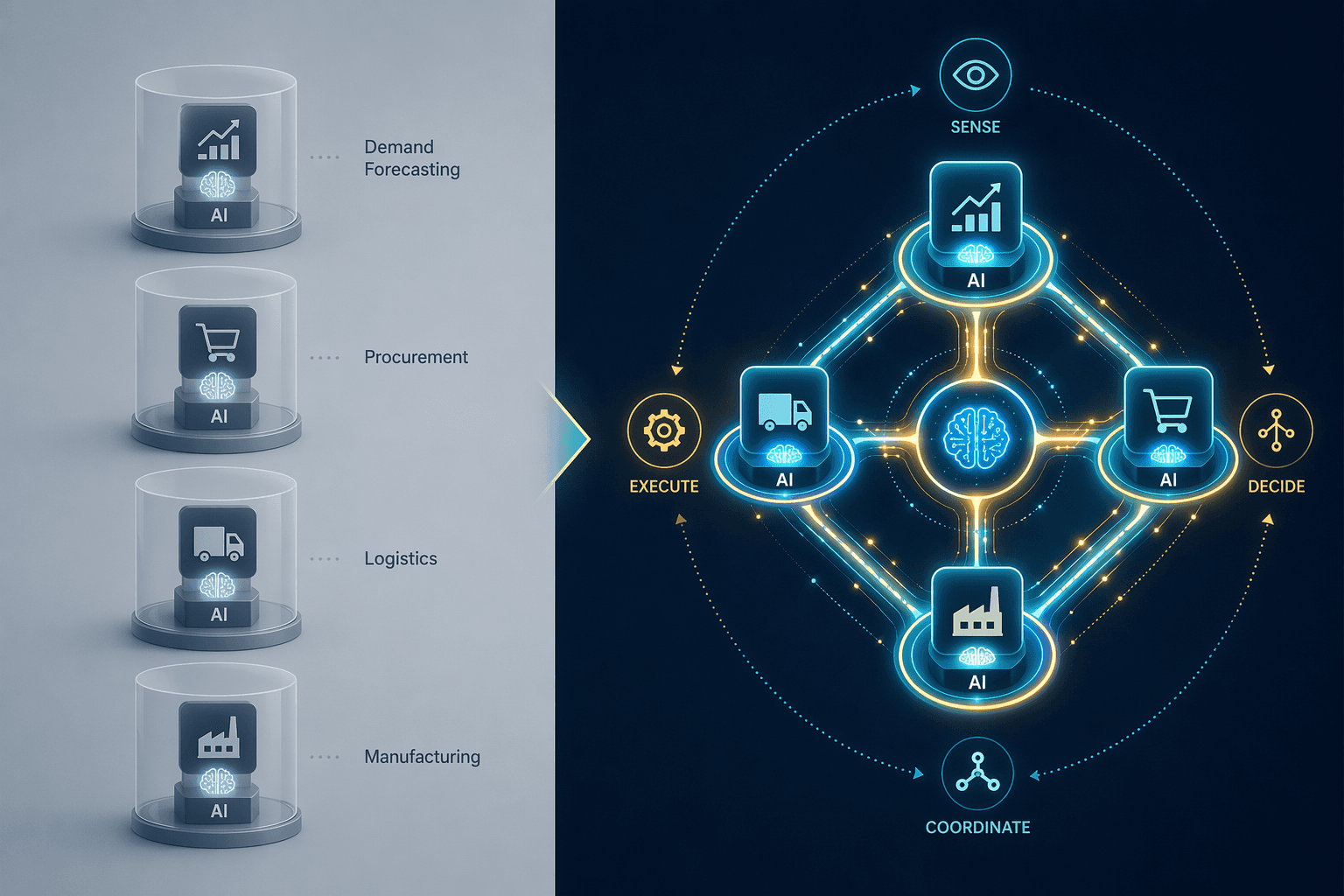
BCG’s maturity framing is useful here because it avoids treating agentic AI as a single jump. It describes progression from task-specific point solutions toward broader process automation across functions. In the same analysis, BCG estimates that agentic systems account for 17% of total AI value in 2025 and projects that share will reach 29% by 2028.[2] That is not a claim that every enterprise will be running autonomous supply chains by then. It is a signal that more of the value pool is expected to move from isolated assistance toward systems that act across process boundaries.
| Roadmap Position | What It Usually Looks Like | What Leaders Should Test |
|---|---|---|
| Task-specific AI | Models or assistants improve a narrow activity such as classification, forecasting, or exception summarization. | Is the output trusted, used, and measurable inside the existing workflow? |
| Function-level automation | AI supports a recurring decision inside one domain such as procurement, transport, planning, or production. | Are decision rights, escalation paths, and data dependencies clear enough to expand safely? |
| Cross-functional coordination | Multiple agents or AI-enabled workflows exchange context across planning, sourcing, logistics, and operations. | Can the system explain handoffs, preserve audit trails, and manage conflicting objectives? |
| Process-level autonomy | Bounded decisions are executed across functions with human oversight reserved for exceptions, policy breaches, or material risk. | Does governance keep pace with autonomy, and can operations intervene before small errors compound? |
The maturity question is not academic. A company sitting at task-specific AI should not write an RFP as if it is ready for cross-functional autonomous execution. A company already operating integrated planning and execution workflows should not limit vendor evaluation to embedded assistants. The budget conversation changes depending on where the organization actually sits.
The Four Foundations That Decide Whether Agents Scale
The hard part of the 2026–2028 roadmap is that agentic AI asks for infrastructure work before the most attractive use cases can scale. Deloitte identifies four foundations for agentic supply chains: modern data architecture, tech stack modernization, workforce readiness, and governance-by-design.[3] Those are not decorative prerequisites. They are the difference between a controlled agentic workflow and an impressive demo trapped beside the real operation.
Modern Data Architecture
Agents need more than data access. They need reliable context. A replenishment agent interpreting demand volatility cannot make a useful decision if product hierarchies, supplier lead times, transport constraints, inventory availability, and service policies disagree across systems. A procurement agent cannot safely negotiate alternatives if supplier records are incomplete or contract terms are not machine-readable enough to constrain the action.
This is where modern data architecture becomes a funding issue, not a technical preference. Data fabric, data mesh, and ontology work can sound like platform language until the first agent takes a bad input from one system and propagates it into a planning or execution decision. For many organizations, the near-term business case for agentic AI will have to include master data remediation, semantic alignment, and event-stream integration that never fit neatly into the AI pilot budget.
Tech Stack Modernization
A multi-agent workflow is only as useful as the systems it can reach and the actions it is allowed to trigger. If planning, transportation, warehouse, supplier management, and manufacturing systems require manual rekeying or brittle batch transfers, autonomy collapses into notification. Someone still has to carry the decision across the process boundary.
This is one reason the forecast should influence integration priorities now. Leaders do not need to buy every agentic feature in 2026, but they do need to know which systems will become action endpoints, which APIs are reliable enough, where middleware will be required, and where legacy constraints will keep agents in advisory mode. The roadmap should identify the difference between an AI feature that can be switched on and an autonomous workflow that requires a more modern execution spine.
Workforce Readiness
Agentic AI changes work before it eliminates work. Planners, buyers, logistics coordinators, and manufacturing teams will still review exceptions, override decisions, tune thresholds, investigate unexpected outputs, and decide when the system’s autonomy should expand or contract. That requires training, but it also requires role design.
The weakest implementation pattern is to add agents to an already overloaded control tower and assume adoption will follow. If operational teams are asked to supervise more automated decisions without clearer accountability, they will either rubber-stamp the tool or route around it. Neither behavior produces the value implied by agentic forecasts.
Governance by Design
Governance cannot arrive after autonomy. Supply chain agents need boundaries around decision value, customer impact, supplier commitments, regulatory exposure, and financial authority. They need escalation rules when objectives conflict: protect service, reduce cost, preserve margin, avoid obsolescence, honor a contract, or maintain production continuity.
Auditability also moves from nice-to-have to operating requirement. When an agent proposes a supplier substitution, expedites transport, adjusts a production sequence, or releases a purchase order within a policy limit, the organization needs to know which data was used, which constraint applied, which human approved the policy, and how the decision can be reviewed later.
The Evidence Is Promising, but It Is Not Yet Universal Proof
There is now enough operational evidence to treat agentic supply chain capability as more than a laboratory idea. SAP reports examples including 20–30% procurement efficiency gains, 55% scrap reduction, 80% reduction in nonperfect batches, 20–30% inventory reduction, and 5–20% logistics cost reduction in the context of autonomous supply chain transformation.[4] Those figures are useful because they show where value may emerge: fewer manual procurement steps, less quality loss, lower inventory exposure, and lower logistics cost.
They should also be read with discipline. Vendor-adjacent and client-reported metrics are not population averages. They reflect particular processes, data conditions, implementation choices, and change programs. A procurement efficiency gain in one environment does not guarantee the same improvement in a company with fragmented supplier records, inconsistent category taxonomies, or poor contract digitization.
SAP also describes a European agricultural equipment company that has deployed more than 1,000 AI agents.[4] The important point is scale, not imitation. A deployment of that size suggests that agentic systems can move beyond scattered pilots, but it does not mean the next organization can skip the architecture, governance, and workforce work that made scale possible. The case is a proof point that the operating model can be reconfigured around many agents; it is not proof that every supply chain is ready to do so.
Deloitte’s cited forecast that 40% of enterprise applications will integrate task-specific AI agents by the end of 2026, up from less than 5%, adds another reason to prepare evaluation criteria now.[3] But that is still a forecast about integration into applications, not a measured outcome showing that enterprises are already running cross-functional autonomous operations. Adoption of agent features and effectiveness of agentic operating models are related, but they are not the same thing.
Do Not Blend Market Forecasts Without Checking the Definition
The broader market for AI in supply chain and logistics is being sized in several ways, and those definitions are not interchangeable. Some forecasts include analytics, robotics, optimization, visibility tools, and other AI-enabled categories. Gartner’s number is narrower: SCM software with agentic AI capabilities.[1] That makes it especially relevant to enterprise application strategy, but it also means it should not be compared casually with broader AI-in-supply-chain estimates.
For internal planning, this distinction prevents two common errors. The first is underestimating agentic AI because the current pilot portfolio looks small compared with the headline market. The second is overestimating readiness because the organization already uses AI somewhere in supply chain. A demand-sensing model and a bounded agent that coordinates a supplier substitution through planning, procurement, and logistics belong to different maturity levels.
What This Changes in Vendor Evaluation
By 2030, AI assistant features may be treated less as differentiators and more as table stakes. Gartner expects agent capabilities to become a common requirement in RFPs as enterprises adopt agentic AI features in SCM software.[1] That means the evaluation conversation has to move past “Do you have AI?” quickly.
A better RFP separates interface, intelligence, orchestration, and control. The vendor demo may start with a natural-language assistant, but the buying team needs to keep pressing into the workflow: what data sources does the agent require, which systems can it act in, how does it coordinate with other agents, what happens when objectives conflict, and where does human approval enter?
- Ask vendors to distinguish recommendations, task automation, and autonomous execution rather than presenting all AI features as one category.
- Require a clear map of data dependencies, including master data, transactional data, external signals, and policy rules.
- Test cross-functional handoffs, not just single-screen productivity gains inside one module.
- Review audit trails, override mechanisms, approval thresholds, and exception-routing logic before expanding autonomy.
- Evaluate integration depth with planning, ERP, transportation, warehouse, supplier, and manufacturing systems as part of the AI business case.
This also affects commercial discipline. If the value case depends on inventory reduction, logistics cost reduction, or procurement productivity, the contract and implementation plan should identify which workflows will change, which decisions will become faster or more autonomous, and which baseline metrics will be used. Otherwise, the organization buys agentic potential and measures only software deployment.
The 2026–2028 Roadmap Implication
The next two years should not be spent waiting for the market to become cleaner. The forecast is credible enough to affect architecture, integration, data, and governance decisions now. It is also early enough that most organizations can still avoid locking themselves into a collection of attractive but isolated agent features.
A practical roadmap starts by deciding where autonomy is actually useful. High-volume, rule-constrained, exception-heavy processes are often better candidates than rare strategic decisions with ambiguous tradeoffs. From there, leaders can identify the data gaps, system constraints, approval rules, and role changes that stand between the current workflow and a bounded agentic one.
The organizations most likely to capture value through 2030 will not be the ones with the longest list of AI features. They will be the ones that treat agentic AI as an operating-model and infrastructure transition: a coordinated change in how supply chain decisions are sensed, made, executed, supervised, and improved.
References
- Gartner Forecasts Supply Chain Management Software with Agentic AI Will Grow to $53 Billion in Spend by 2030, Gartner, April 7, 2026
- GenAI Reimagines Supply Chain, BCG
- Agentic supply chain artificial intelligence manufacturing, Deloitte, March 2026
- Autonomous Supply Chain: Why Agentic AI Is Rewriting the Operating Model, SAP News, June 2026
Comments
Join the discussion with an anonymous comment.