
AI can probably detect livestock supply chain border disruption patterns earlier than a procurement team manually refreshing agency pages, local news, port notices, and disease-status updates. That is the practical answer. The more careful answer is just as important: there is no documented production case showing that a livestock-specific AI system predicted the U.S.-Mexico New World screwworm border closure before USDA announced it. The strongest claim the evidence supports is narrower: the signals were visible, scattered, and operationally meaningful before and during the closure, and an AI risk platform built to normalize those signals could have raised escalation alerts sooner than manual monitoring.
That distinction matters because this was not a paper exercise. USDA suspended imports of live cattle, horses, and bison through southern border ports on May 11, 2025, after New World screwworm risk escalated in Mexico.[1] By mid-2026, the disruption was still shaping cattle flows. Mexican feeder cattle imports fell from roughly 493,300 head to about 197,844 head, a drop of about 60% year over year, according to the FreightFlow Advisor synthesis of trade and industry data.[2] For a cattle buyer, that is not “visibility.” It is fewer animals available, changed basis assumptions, tighter trucking and pen-space planning, and more calls that have to be made before official language catches up.
The Disruption Was Commercial Before It Was Cleanly Legible
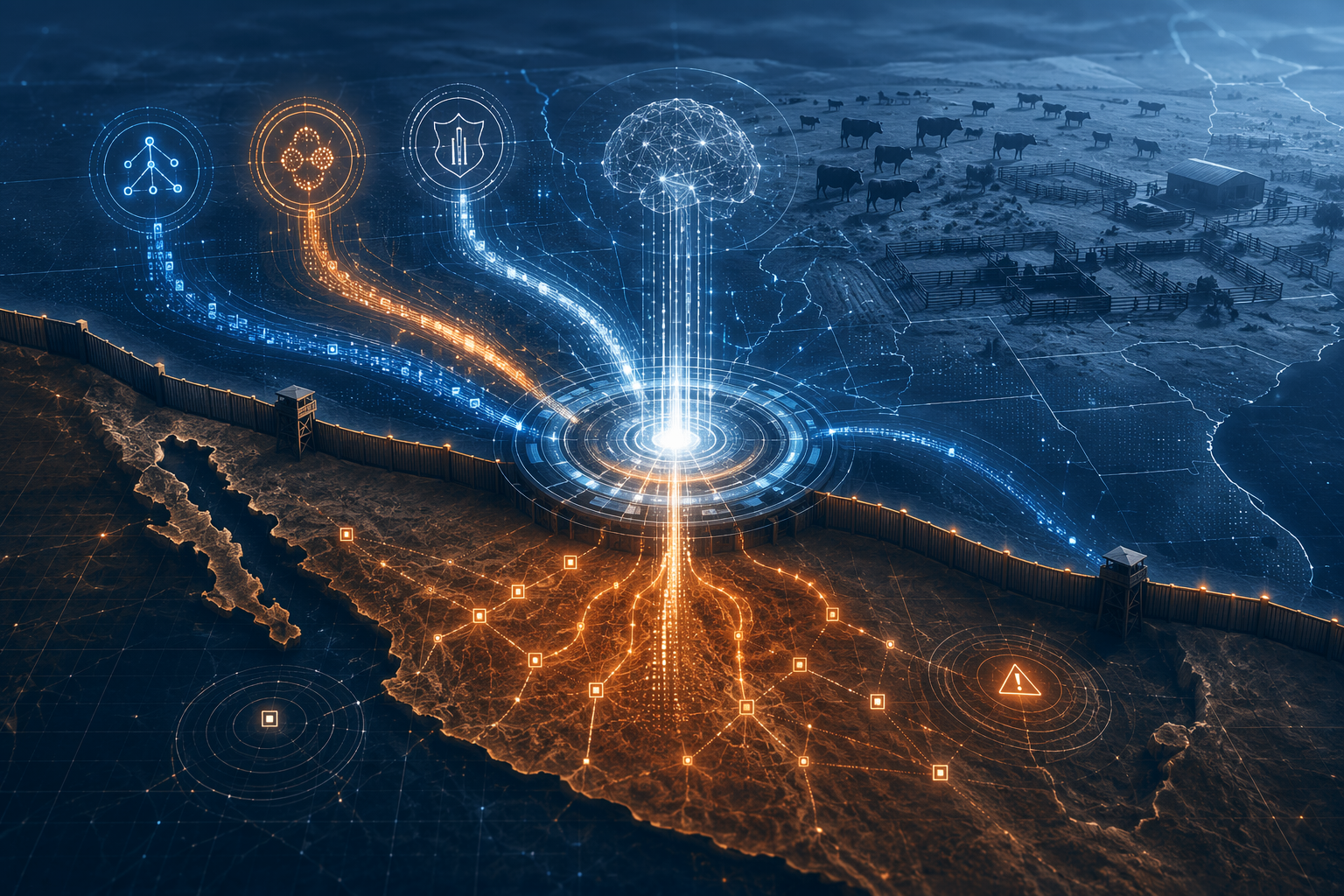
The New World screwworm outbreak had a signal trail. It was first detected in Mexico in November 2024, months before the May 2025 border action.[2] By mid-2026, official situation reporting described more than 171,700 confirmed animal cases across Central America and Mexico, with detections within 31 miles of the U.S. border.[3] The United States still had zero reported domestic cases in the cited situation summary, which is exactly why the procurement problem is hard: the operational risk was not an outbreak inside U.S. herds, but a border-control response to proximity and spread.
A closure based on disease proximity is difficult to manage from inside a weekly sourcing meeting. The buyer is not only asking whether a shipment can cross today. She is asking whether a planned delivery window, a forward contract, a receiving crew, and a feedlot placement assumption will still make sense if the risk radius tightens, if one port opens and another remains constrained, or if a phased reopening is withdrawn.
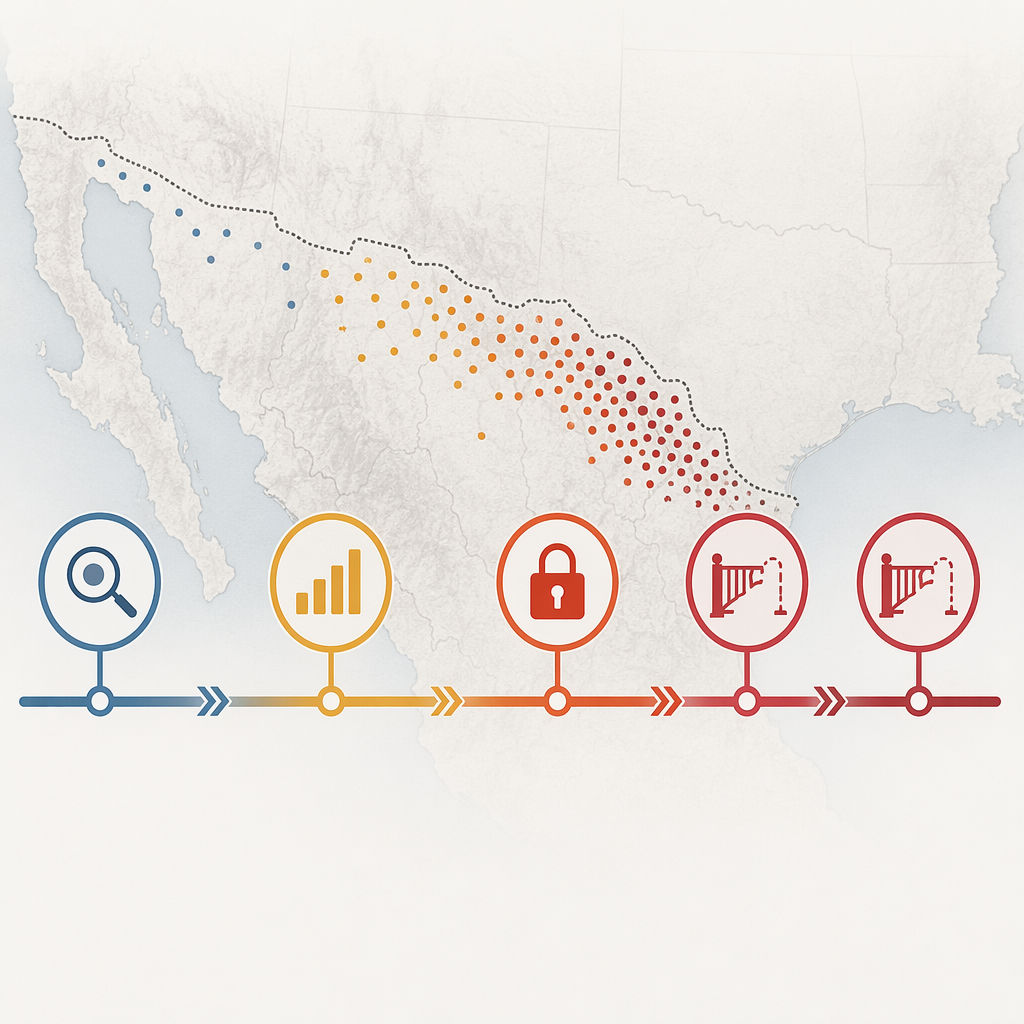
The reopening sequence showed why “wait for the official announcement” is a weak operating model. A phased reopening plan announced in June 2025 targeted Del Rio by August 18 and Laredo by September 15, but subsequent screwworm cases prompted another closure and challenged those plans.[4] That reversal is one of the most important facts in the whole timeline. It tells procurement teams that the risk was not a single closure date. It was an unstable policy corridor.
What An AI System Would Have Needed To See
The useful version of AI here is not a black-box prediction that announces “border closed” before a regulator does. The useful version is a monitoring system that notices when weak signals from different institutions start pointing in the same direction, then routes a graded alert to the people who can still change buying plans.
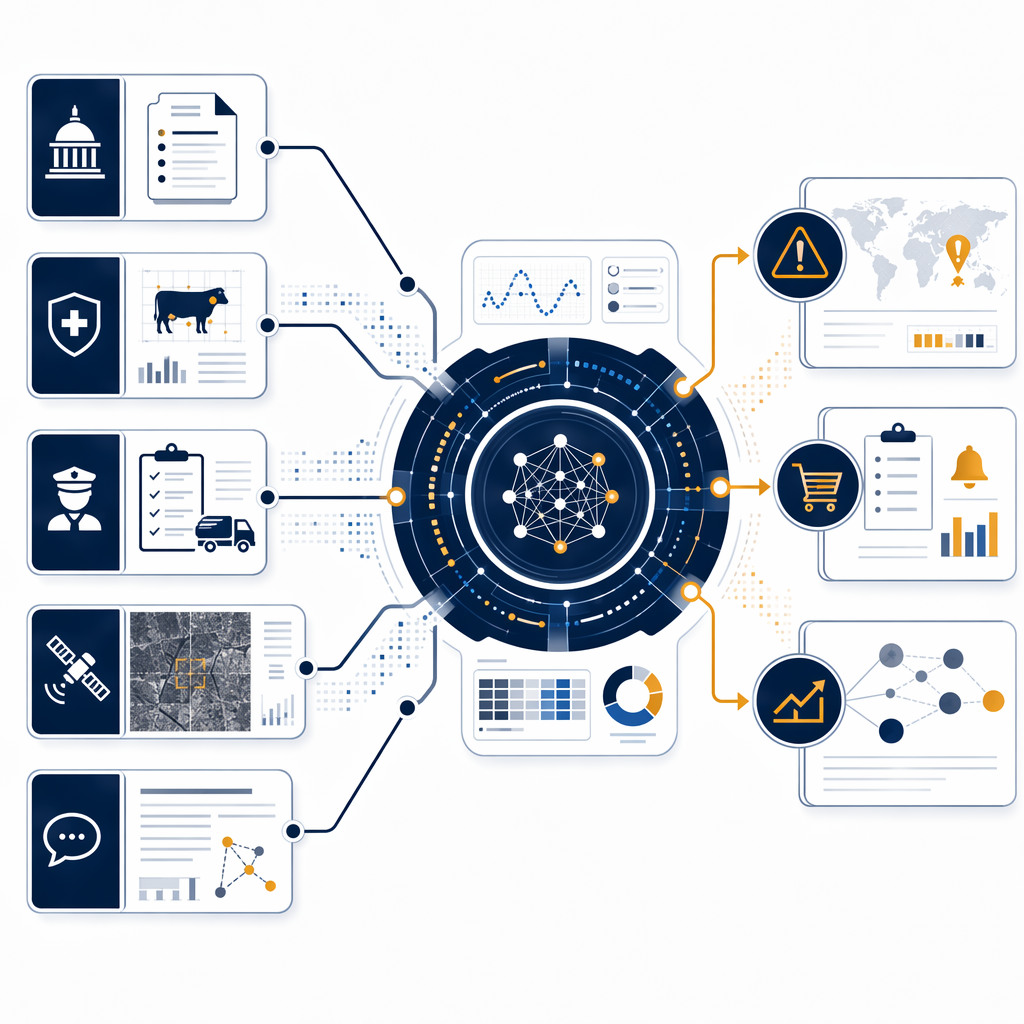
| Signal source | What it changes operationally |
|---|---|
| USDA APHIS bulletins and import-status actions | Defines the official gate: which animals, ports, inspection requirements, and reopening or suspension language matter for live-animal movement. |
| CDC animal situation data | Shows case scale, geography, and proximity to the U.S. border, which helps distinguish background disease reporting from border-relevant escalation. |
| Port and inspection-status feeds | Turns national policy into lane-level questions: where cattle can cross, where inspections slow, and where contingency routing may fail. |
| CBP agricultural inspection signals | Adds friction data at the border, especially when policy has not fully settled into predictable crossing behavior. |
| Satellite surveillance and geospatial layers | Helps place outbreak geography, animal-production zones, transport routes, and border chokepoints in the same operating picture. |
| News and local-report NLP | Captures local movement restrictions, producer concerns, reopening rumors, and case reports before they are fully reflected in national summaries. |
Those inputs are not equally valuable at every point in the disruption. Early in the timeline, local reports and disease-status bulletins matter because they show whether the outbreak is moving north. As detections approach the border, geospatial scoring becomes more important than simple case counts. Once USDA changes import status, port and inspection feeds become the daily operating layer. During reopening attempts, the system should watch for contradictory signals: a reopening calendar moving forward while new detections, containment measures, or inspection friction suggest the gate may not stay open.
The Threshold Is Not Disease Detection; It Is Procurement Action
A procurement-facing alert cannot stop at “NWS cases increasing.” It has to translate disease and policy signals into a sourcing decision window. A low-level alert might tell a team to review Mexican feeder exposure by supplier, port, and delivery month. A higher-level alert might trigger conversations with domestic suppliers, reserve transport capacity, or stress-test feedlot placement assumptions. A severe alert might change contracting behavior before the official closure or reopening reversal becomes unavoidable.
That is where the often-cited two-to-six-week lead-time idea belongs: not as a proven result from the NWS closure, but as a plausible operating target for systems that already monitor geopolitical and natural-disaster disruptions. In livestock border risk, the benchmark should be whether the alert arrives early enough for a buyer to adjust cattle origin, delivery timing, contract exposure, or contingency supply—not whether a dashboard produced a dramatic prediction.
How The Scoring Would Work In Practice
A practical system would not give every mention of New World screwworm the same weight. It would score signals by operational relevance. A confirmed case far from the border is different from a confirmed case near a major crossing region. A USDA containment update is different from a port-specific suspension notice. A local news report may be useful, but only after the system tags its location, source reliability, and relationship to official data.
A basic operating sequence would look like this:
- Ingest official disease, trade, border, inspection, weather, satellite, and local-report feeds on a continuous schedule.
- Normalize locations so case reports, ports, production areas, and transport corridors can be compared on the same map.
- Classify each event by type: new detection, proximity change, containment action, port-status change, reopening notice, reversal risk, or inspection friction.
- Score the event against exposure: supplier geography, expected border crossing, delivery window, animal class, contract dependency, and available substitutes.
- Route alerts by action owner: procurement, logistics, feedlot operations, risk management, or executive escalation.
The key move is normalization. Without it, a team sees separate fragments: a CDC update, an APHIS page, a Farm Progress article, a broker call, a port-status rumor, and a local note from northern Mexico. With it, the team sees whether those fragments are converging toward the same commercial exposure.
For example, in a hypothetical monitoring setup, a procurement team with high exposure to Mexican feeder cattle could set an internal threshold tied to border proximity, not just total cases. A new confirmed detection within a defined distance of a key crossing region, combined with APHIS containment language and local reports of movement restrictions, could raise the sourcing-risk score even before USDA formally changes import status. The example is hypothetical; the important point is the decision logic, not a claim that such a system operated during the 2025 closure.
Why Manual Monitoring Falls Behind
Manual monitoring is not careless; it is structurally slow. Procurement staff usually do not have one clean source that says, “This disease event is now likely to disrupt your cattle flow through this port in this delivery window.” They have agency pages written for public status reporting, industry publications written for broad audiences, local signals with uneven reliability, and phone calls that may arrive after competitors have already adjusted.
The NWS case also crossed institutional boundaries. USDA controlled the import action. CDC summarized animal case status and proximity. APHIS described containment work, including the release of 100 million sterile insects per week as part of the response.[5] Industry outlets tracked cattle-flow consequences and reopening plans. No single feed automatically converted those facts into a procurement recommendation.
That is the gap AI can plausibly reduce. Natural-language processing can extract entities from bulletins and local reports. Geospatial models can compare detections with ports, ranching regions, and transport corridors. Anomaly detection can flag a shift from routine disease monitoring to border-relevant escalation. Automated routing can send different alerts to cattle buyers, logistics coordinators, and risk managers instead of leaving everyone to interpret the same public update.
The Analogies Help, But They Do Not Prove The Livestock Case
There is a credible analogy to AI systems used for geopolitical chokepoints and weather-driven disruption planning. A platform watching Houthi-related Red Sea disruption, Strait of Hormuz risk, hurricane exposure, or flood risk also has to fuse public reporting, geospatial exposure, asset dependency, and operational thresholds. The pattern is familiar: a weak signal becomes important when it lines up with a route, supplier, facility, vessel, warehouse, or customer promise.
But the analogy has limits. A livestock biosecurity closure is not a shipping-lane attack or a hurricane cone. The official response depends on animal-health policy, inspection confidence, containment strategy, disease biology, and cross-border trade protocols. A vendor platform that ingests public data does not automatically become a livestock biosecurity system. It needs disease-specific taxonomies, port and animal-class logic, source traceability, and thresholds that procurement teams are willing to act on.
What The Closure Did Downstream
The import drop is the cleanest commercial signal because it measures changed animal flow. Price effects are messier. FreightFlow Advisor cites Dallas Fed work showing beef prices up 57% since 2020, with a 3% increase in the first four months of 2026.[2] That number should not be loaded onto the border closure alone. Drought, herd liquidation, inflation, feed costs, and consumer demand all interact with border restrictions. The closure can tighten supply conditions without being the single explanation for beef-price inflation.
The feedlot evidence adds texture, but it should also be handled carefully. Drovers reported national feedlot utilization at 81% and described the permanent closure of Lubbock Feeders, a 50,000-head Texas feedlot that relied on Mexican cattle for 60% to 70% of its supply.[6] Those details are useful because they show how a border disruption can move from trade statistics into pen utilization and business viability. They also rely on a single industry source in the research set, so they deserve verification before being used as the foundation for a broader industry claim.
For procurement planning, the lesson is more immediate than the macroeconomic debate. If a feedlot expects a certain class of cattle from Mexico and that channel loses capacity, the adjustment is not abstract. Someone has to replace supply, accept lighter placement volume, renegotiate timing, pay more, idle capacity, or explain why the original plan no longer clears.
What A Pilot Should Prove Before Anyone Calls This Predictive
A serious pilot would start with the NWS timeline and ask whether the system would have alerted before the operational decision points, not merely before a news story was widely shared. The test should include the November 2024 Mexico detection, the lead-up to the May 2025 suspension, the June 2025 reopening plan, the August and September target dates, and the later reversal. The question is not whether the model can explain the past after reading the outcome. The question is whether it would have raised a dated, source-traced, exposure-specific alert when a procurement team still had choices.
The evaluation should be practical:
- Lead time: How many days before each official action or failed reopening did the system raise the risk level?
- Source traceability: Could a buyer see which USDA, CDC, port, satellite, or news signals drove the alert?
- Exposure matching: Did the alert identify affected suppliers, ports, animal classes, contracts, and delivery windows?
- False positives: How often did the system escalate events that did not become procurement-relevant?
- Action routing: Did the right person receive the alert with enough time to change sourcing, transport, or feedlot assumptions?
That last test is where many risk dashboards fail. An alert that lives only in a system of record may be accurate and still useless. A cattle buyer needs a trigger tied to a decision: call alternative suppliers, hold off on a cross-border commitment, reserve domestic transportation, ask finance to reprice exposure, or brief operations on lower placement assumptions.
The Procurement-Facing Judgment
AI risk platforms are credible candidates for earlier alerts on livestock supply chain border disruption when they can integrate cross-agency disease data, border policy, port status, inspection signals, geospatial proximity, and local reporting. The NWS closure supplied the kind of fragmented signal chain such systems are designed to organize: first detection in Mexico, rising case scale, proximity within 31 miles of the U.S. border, a May 2025 suspension, planned reopenings, and later reversals.[1][3][4]
The capability should still be treated as emerging. No available evidence shows that a livestock-specific AI deployment predicted the NWS closure in production. The defensible use case is earlier escalation monitoring, source-traced alerting, and procurement workflow support. If a platform can show that it would have flagged border-relevant risk before cattle flows tightened, and if the alert maps to decisions a buyer can actually take, then AI has an operational role in border-risk planning rather than a standalone prediction claim.
References
- Secretary Rollins Suspends Live Animal Imports Through Ports of Entry Along Southern Border Due to New World Screwworm, USDA, May 11, 2025,
- New World Screwworm Is No Longer Just a Ranch Story. It's a Border Supply Chain Story., FreightFlow Advisor,
- New World Screwworm Situation Summary, CDC,
- Screwworm cases prompt another border closure, challenge U.S. industry, Farm Progress,
- New World Screwworm Current Status, USDA APHIS,
- Tighter Supplies and Border Closures: A Snapshot of Today's Cattle Feeding Industry, Drovers,
Comments
Join the discussion with an anonymous comment.