
Tropical storm supply chain planning usually fails in a sequence, not in a single event. A forecast cone shifts. Retail demand jumps in the affected region. A port announces restrictions. Carriers stop accepting freight into exposed lanes. A Tier 2 supplier loses power, but the Tier 1 supplier does not report the problem until after the cutoff. By then, the issue has moved from risk monitoring into allocation, expediting, and executive escalation.
That is the practical lens for AI supply chain disruption planning for tropical storms. The useful question is not whether AI can “make supply chains resilient.” The useful question is whether a specific capability changes a decision early enough to protect service, revenue, or continuity before landfall turns into a physical cutoff.
The pressure is not theoretical. Steptoe’s analysis of escalating hurricane and typhoon supply chain risks cites 2024 Hurricanes Helene and Milton as each producing single-storm supply chain costs above $50 billion, and it reports Resilinc EventWatchAI alert-based data showing extreme weather events up 119% year over year in 2024, with hurricane and typhoon alerts up 101%.[1] Those figures should not be read as a clean measure of physical disruption severity; alerts measure detected and reported risk signals. But for a planner watching exposure build across lanes, facilities, and suppliers, alert volume still matters because it increases the triage burden.
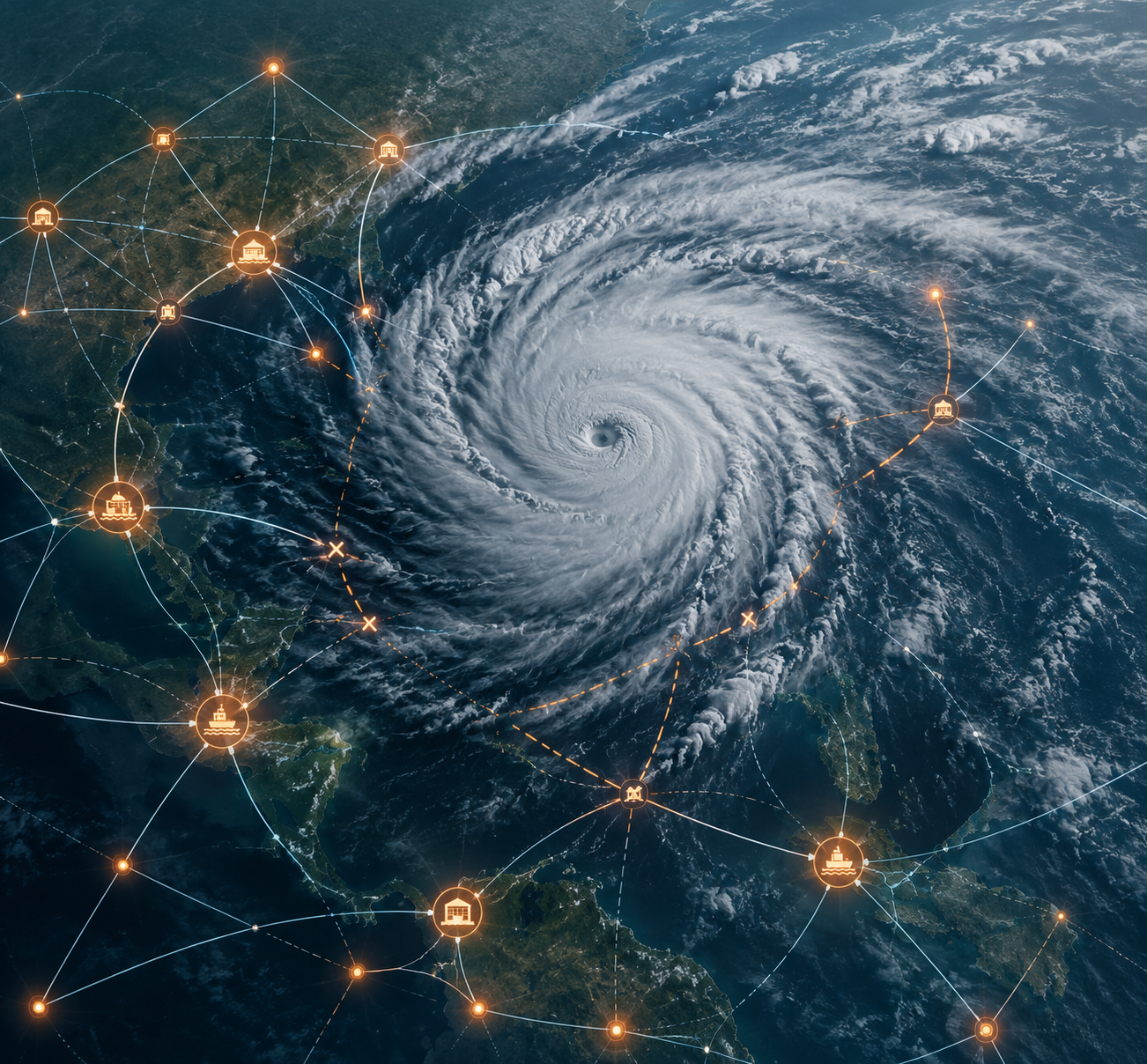
The storm pattern is repetitive enough to map to five AI capabilities. Demand and inventory tools address the surge before and after impact. Supplier risk detection looks for exposed vendors before they go dark. Weather-integrated control towers help transportation teams change lanes, appointments, and modes while networks are still movable. Digital twins test scenarios when the question is not one shipment but a whole operating model. Agentic AI sits at the edge of that stack, promising coordinated response workflows, but in 2026 it still belongs under governance rather than free-running autonomy.
Start With The Disruption Pattern, Not The Tool
Tropical storms create several planning problems at once. A retailer may need more bottled water, roofing materials, generators, prescription refills, or replacement parts in one geography while inbound freight to that same geography becomes harder to execute. A port closure can delay imports that were supposed to replenish national inventory, while regional warehouses face a short-term demand spike. A supplier outage may not appear as a finished-goods shortage until days later, when there is no longer time to place an alternate order.
That is why broad AI categories are less useful than disruption-to-decision mapping. A forecasting model that helps place inventory in Florida before a hurricane is solving a different problem from a supplier graph that identifies an exposed component maker. A digital twin that compares rerouting strategies is not the same thing as an alerting engine. Treating them as one “AI resilience” bucket makes investment easier to sell and harder to govern.
| Tropical storm disruption | Planning decision under pressure | AI capability that fits |
|---|---|---|
| Regional demand spike | Where to pre-position inventory before landfall | Predictive analytics for demand and inventory positioning |
| Supplier outage or facility exposure | Which suppliers need early orders, alternate sourcing, or escalation | AI-driven supplier risk detection |
| Port, lane, or carrier disruption | Which shipments to reroute, hold, expedite, or re-sequence | Weather-integrated logistics control tower |
| Infrastructure damage and network constraint | Which scenario preserves the most service with available capacity | Digital twin simulation |
| Many simultaneous alerts and handoffs | Which response actions can be recommended, assigned, or executed under rules | Governed agentic AI workflow |
For a broader overview of hurricane-specific planning use cases, How AI Helps Supply Chains Plan for Hurricane Disruptions covers the general operating context. The sharper investment question is which of these capabilities can be piloted or scaled with the data, integrations, and decision rights the organization already has.
Predictive Analytics: Move Inventory Before Everyone Is Competing For The Same Capacity
Predictive analytics is the most operationally legible starting point because it connects directly to a familiar storm-week decision: where should inventory be before transportation options tighten? The model does not need to run the company. It needs to improve the timing and location of a replenishment, allocation, or pre-build decision.
The ClimateAi roofing materials case is useful because it stays close to that decision. In a vendor-published case study, a building materials producer used ClimateAi’s hurricane demand forecasting to position Florida-specific inventory ahead of Hurricane Ian and attributed $15 million in additional sales to that preparation.[2] Because the outcome is vendor-reported, it should not be treated as an independently audited ROI benchmark. It is still a concrete example of the right pattern: forecast signal, regional inventory action, measurable commercial outcome.
The planning value came from moving earlier. Roofing demand after a hurricane is not surprising; the hard part is deciding how much exposure-specific inventory to build or reposition before the storm track, demand curve, and transport capacity are fully settled. A conventional planning process can hesitate because the forecast will change. An AI-assisted process is useful when it quantifies enough of the demand and risk envelope to justify a pre-landfall move without pretending certainty exists.
This capability is especially attractive for products with storm-sensitive regional demand, such as building materials, emergency supplies, health products, repair parts, and categories tied to post-storm cleanup. It is less compelling when inventory is not movable, when substitutes are weak, or when the organization cannot act on the forecast because allocation rules and distribution authority are unresolved.
What The Forecast Has To Connect To
- Regional demand history that distinguishes normal seasonality from storm-driven spikes.
- Inventory visibility across plants, distribution centers, stores, forward locations, and in-transit stock.
- Transportation capacity assumptions, including when inbound and outbound lanes are likely to become constrained.
- Clear rules for pre-positioning inventory when the forecast is probable but not final.
The last point is often the real limiter. If the model flags a likely Florida demand surge but no one has authority to pull stock from another region before landfall, the forecast becomes an interesting dashboard item rather than a planning capability.
Supplier Risk Detection: Find The Cutoff Before The Supplier Tells You
Supplier risk detection matters because tropical storms often damage the supply chain indirectly. The final assembly site may be outside the cone, but a packaging supplier, chemical input, sterilization provider, warehouse, or logistics node may sit inside the affected region. If the supplier map is shallow, the risk does not appear until the purchase order slips.
Interos.ai’s Cooper University Health Care example shows the kind of early action that risk teams actually need. In a vendor-published account, Cooper used interos.ai’s catastrophic risk model ahead of Hurricane Idalia to identify three at-risk suppliers and secured days of orders before the cutoff.[3] Again, the evidence is vendor-sourced, not an independent benchmark. But the action is operationally credible: identify exposed suppliers, order before cutoff, reduce the chance of a service disruption.
This is not glamorous work. It depends on supplier locations, sub-tier relationships, category criticality, open orders, inventory on hand, and substitute options. AI helps when it can combine those signals faster than a planner can search across procurement systems, weather feeds, emails, and spreadsheets. It does not help much if the supplier master lists a headquarters address while the actual production site sits on a different coast.
The supplier-risk use case also has a different threshold from demand forecasting. A demand model can be useful with imperfect SKU-level precision if it still points inventory in the right direction. A supplier exposure model can be actively misleading if facility locations, alternate sources, or supplier dependencies are wrong. Before hurricane season, the remedial work is supplier mapping, not model selection.
A Practical Supplier-Risk Trigger
A workable trigger does not need to be elaborate. If a critical supplier facility is inside the projected impact zone, has open orders due inside the disruption window, and supports a product with low days of supply, the workflow should assign an owner immediately. That owner can place an early order, check alternate stock, contact the supplier, or escalate a substitution decision. The AI is valuable because it compresses the time between hazard signal and accountable action.
Weather-Integrated Control Towers: Reroute While There Is Still Something To Reroute
Logistics rerouting is where storm response becomes visibly constrained. A port closure, bridge restriction, terminal backlog, flooded road, or carrier embargo can turn a good plan into stranded freight. AI-enabled control towers are useful when they connect weather risk to transportation execution, not when they merely visualize late shipments.
Weather-integrated platforms can combine forecast data, shipment status, lane conditions, carrier capacity, facility hours, and customer priority to recommend whether freight should move early, hold outside the affected region, shift modes, or reroute around a closure. The Weather Company describes predictive analytics and real-time weather insights as tools for identifying weather risk to supply chain operations and supporting route and facility decisions.[4] That is a planning input, not a guarantee of execution.
The limitation is evidence granularity. Weather-integrated TMS and control tower capabilities are mature enough to be credible, and vendors such as FourKites and Blue Yonder commonly position them around disruption management. But tropical-storm-specific, independently quantified ROI is less clear than the ClimateAi inventory case or the Cooper supplier-risk example. Leaders should evaluate these tools against workflow speed: how fast does an alert become a route change, appointment update, carrier instruction, or customer promise revision?
Flooding deserves special attention because it often remains after the named storm has moved on. For flood-specific mitigation patterns, How AI Predicts and Mitigates Flood Risks in Supply Chains goes deeper into how water exposure changes facility and lane decisions.
Where Rerouting Tools Earn Their Keep
- Inbound materials headed toward exposed plants or distribution centers.
- Customer orders with narrow delivery windows or high service penalties.
- Temperature-sensitive, medical, or emergency goods that cannot sit through a closure.
- Shipments that can still be redirected before they enter the disrupted region.
The timing matters. Once freight is already parked outside a closed terminal or sitting in a flooded yard, AI may improve visibility, but the response options have already narrowed.
Digital Twins: Test The Network Before The Network Is Damaged
Digital twins become relevant when the storm decision is larger than a forecast adjustment or a single shipment. If a Gulf Coast facility goes offline, which alternate plant should absorb demand? If a Caribbean route is disrupted, which port and inland path preserves the most service? If two suppliers are exposed at once, which product families should get constrained inventory first?
Dataiku describes GE Aviation’s work with supply chain digital twins to model what-if scenarios, including rerouting under weather disruption conditions.[5] The World Economic Forum has also described digital twin initiatives for tropical cyclone resilience in the US-EU Caribbean corridor, aimed at stress-testing how critical supply routes and infrastructure might respond to cyclone disruption.[6] These are not plug-and-play proof points for every manufacturer, but they show where simulation fits: before the storm week, when leaders still have time to compare network choices.
A digital twin is overkill if the organization cannot trust its master data, bill of materials, inventory positions, or transportation constraints. Simulation quality depends on the operating model it represents. A beautiful model with stale facility capacity or incorrect supplier dependencies will produce confident scenarios that fail in the first operations meeting.
Where digital twins do make sense, they should be used before hurricane season to rehearse decisions that are too slow to invent during an event. That includes alternate sourcing rules, port diversion playbooks, production rebalancing, customer allocation logic, and recovery sequencing. The simulation does not eliminate judgment. It lets the team see the trade-offs before every option is urgent.
Agentic AI: Useful For Orchestration, Not Ready To Own The Storm
Agentic AI is the most tempting capability to overstate. In supply chain disruption planning, the appeal is obvious: an agent monitors weather, detects exposed suppliers, checks orders and inventory, recommends actions, drafts supplier messages, opens tasks, and escalates when response windows shrink. For teams losing institutional knowledge, that kind of orchestration is not a novelty; it is a capacity hedge.
ABI Research’s 2026 supply chain disruption outlook reports that 65% of supply chain professionals say AI or GenAI is important in purchase decisions, and it notes that US manufacturing faces up to 600,000 job vacancies tied to Baby Boomer retirement.[7] Those are adoption and workforce-pressure signals, not proof that autonomous storm response is broadly effective. They do, however, explain why leaders are looking beyond dashboards toward systems that can preserve playbooks and reduce manual coordination load.
The safer 2026 posture is human-in-the-loop. Agentic workflows can prepare recommendations, assign tasks, collect approvals, draft communications, and execute low-risk actions under rules. They should not independently decide allocation for scarce medical goods, override a human forecaster’s hazard assessment, or reroute critical freight without escalation paths. The closer the action gets to customer commitments, safety, regulatory obligations, or revenue allocation, the more visible the governance needs to be.
There are useful parallels in other response domains. How AI Agents Automate Recall Response Across Retail Supply Chains shows a more bounded agentic pattern: structured triggers, known stakeholders, auditable actions, and escalation rules. Storm response needs the same discipline, with weather uncertainty added on top.
Weather AI Improves The Input, But It Does Not Remove Forecast Judgment
Supply chain AI often depends on weather forecasts, so weather model limitations matter. A 2026 Rice University study reported through PreventionWeb found that leading AI weather models, including Pangu-Weather and Aurora, showed promise in predicting tropical cyclone tracks but had systematic biases in windfield structure and inner-core size estimation; the report emphasized that human forecasters remain essential for assessing hazard intensity.[8]
That finding does not invalidate AI-enabled supply chain tools. A demand or supplier-risk system usually uses weather as one input among others. But it does set a boundary. If a model is good at track direction but weaker on windfield structure or intensity-related hazards, the supply chain workflow should not treat the forecast feed as an unquestioned trigger for autonomous action.
This is similar to other hazard-planning problems where lead time only matters if it becomes an executable decision. Can AI Predict Earthquakes in Time to Protect Your Supply Chain? makes that distinction in a different risk context: prediction value depends on whether the organization can act inside the available window.
A Maturity-Based Way To Prioritize The Next AI Capability
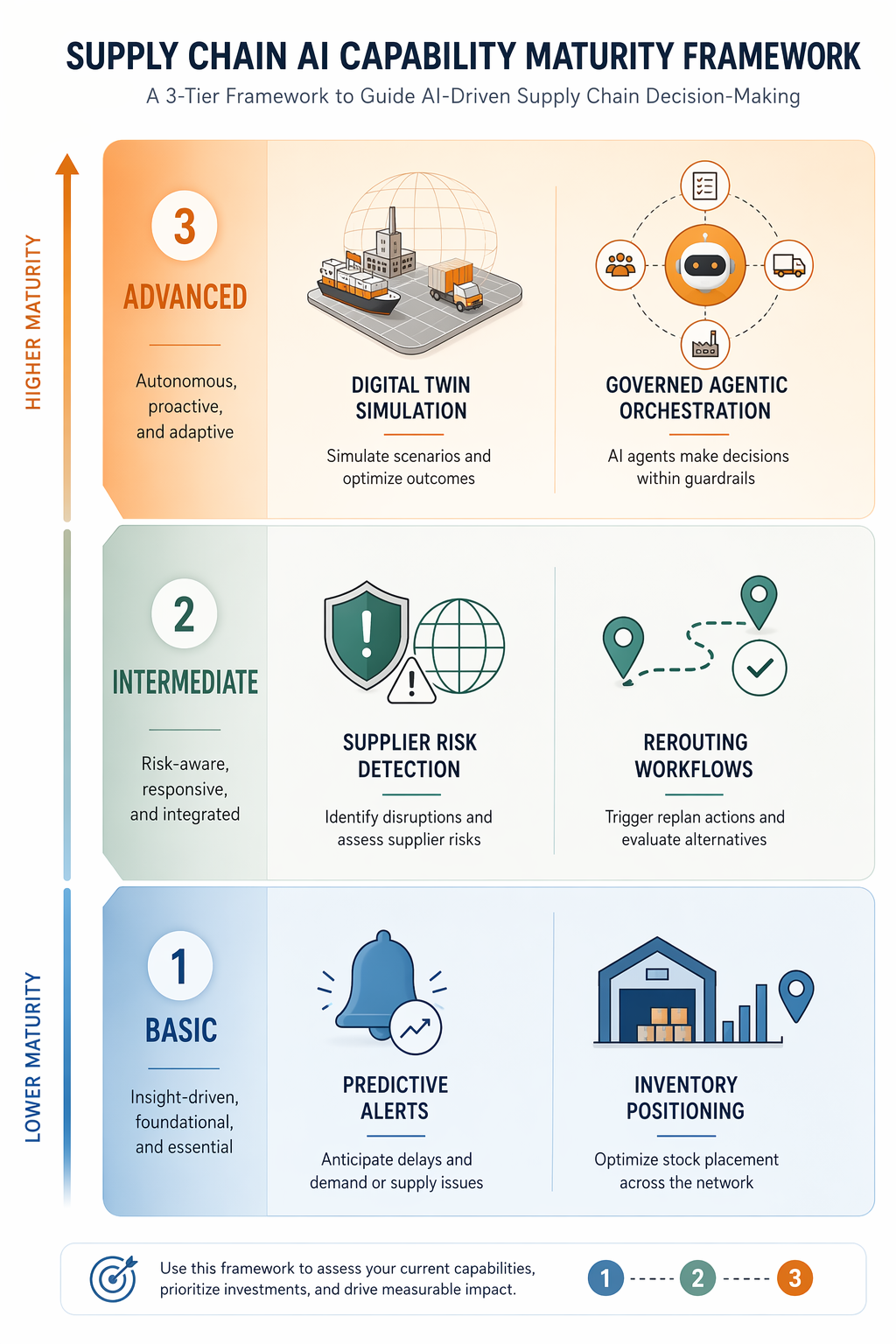
The best AI capability for tropical storm planning is not the most advanced one. It is the one that matches the organization’s data quality, integration readiness, and governance capacity before hurricane season starts. A company with weak supplier location data should not begin with autonomous orchestration. A company that cannot see inventory across nodes should not expect a demand model to produce reliable pre-positioning decisions.
| Maturity level | What is usually ready | AI capability to prioritize | What must be governed |
|---|---|---|---|
| Basic | Weather alerts, historical demand, visible inventory at major nodes, manual planning workflows | Predictive alerts and inventory positioning | Who can move inventory early, and what confidence threshold is enough |
| Intermediate | Supplier location data, criticality tiers, TMS visibility, cross-functional response owners | Supplier risk detection and rerouting workflows | Who contacts suppliers, changes routes, approves substitutions, and updates customers |
| Advanced | Integrated planning data, trusted network constraints, scenario libraries, audit-ready workflows | Digital twins and governed agentic orchestration | Which actions agents may execute, which require approval, and when human forecasters or executives override |
For organizations at basic maturity, the strongest first pilot is usually predictive demand and inventory positioning for a storm-sensitive category and region. Keep the scope narrow enough to verify whether the model changed a decision: Did inventory move earlier? Did the organization reduce stockouts, avoid unnecessary transfers, or capture demand it would otherwise have missed? The ClimateAi case is relevant here because the claimed value came from pre-positioning inventory before Hurricane Ian, not from a generic resilience dashboard.[2]
At intermediate maturity, supplier risk detection and rerouting workflows become more attractive because the organization can act on more connected signals. The Cooper example is the clean pattern: identify exposed suppliers, secure orders before cutoff, and prevent a later shortage conversation.[3] In transportation, the equivalent is not simply seeing a red lane on a map; it is having the TMS, carrier process, and authority structure to change the shipment plan.
At advanced maturity, digital twins and agentic workflows can be justified when the organization already has trusted data and tested playbooks. A digital twin can compare network-level options. An agentic workflow can coordinate alerts, recommendations, task assignment, and approved execution. The pilot should still be bounded: one region, one hazard season, one category group, one set of governed actions. For a broader prioritization lens across disruption types, Which AI Capabilities Should You Invest in for Disruption Planning? extends the same maturity logic beyond tropical storms.
The Readiness Questions That Matter Before Hurricane Season
- Can weather alerts be tied to specific facilities, suppliers, lanes, orders, and inventory positions?
- Are supplier production sites and sub-tier dependencies mapped well enough to support exposure decisions?
- Can planners change inventory, routing, allocation, or sourcing decisions inside the forecast lead time?
- Are approval paths clear when AI recommendations affect scarce inventory, high-value customers, or regulated products?
- Does the team know when a human forecaster, risk officer, or executive decision overrides the automated workflow?
If those answers are weak, AI can still inform planning. It can surface exposed nodes, estimate demand pressure, and shorten analysis. But it should not own the response. Until weather inputs, supplier data, and decision rights are reliable, the defensible role for AI in tropical storm supply chain disruption planning is to move humans earlier and make their trade-offs clearer.
References
- Hurricanes, Typhoons Leading to Escalating Supply Chain Risks — Steptoe
- Accurate Hurricane Forecasting Helps Roofing Materials Producer Come Out on Top — ClimateAi
- Protecting Your Supply Chain from Extreme Weather — interos.ai
- Managing supply chain weather risks with predictive analytics — The Weather Company
- Supply chain AI trends 2026: building resilient operations — Dataiku
- AI will protect global supply chains from the next major shock — World Economic Forum, January 2025
- Supply Chain Disruptions 2026: How to Build Resilience with AI and Automation — ABI Research
- Study finds physical limitations to AI models for hurricane forecasts — PreventionWeb/Rice University
Comments
Join the discussion with an anonymous comment.