The useful question for AI oil supply chain disruption at the Strait of Hormuz is not whether a model can announce that a crisis is bad. Everyone already knows that when tankers stop moving through a chokepoint. The harder question is whether the system creates usable lead time: enough time to reroute cargo, reserve capacity, revise inventory assumptions, and tell customers something better than “we are monitoring the situation.”
The 2026 Hormuz closure is a good test because the operating picture deteriorated in ways that make ordinary dashboards look calmer than the world outside them. Vessel traffic through the strait fell from 138 ships per day before the war to just 2 by March 5, 2026, according to figures attributed to Z2Data and JMIC.[1] In the same operating area, 36 vessels were reported broadcasting false nationality data, and more than 600 GNSS disruption events were recorded.[2] Those are not abstract risk indicators. They are exactly the kind of data contamination, signal loss, and adversarial behavior that turns a logistics meeting into a long argument over whether the ETA is real.
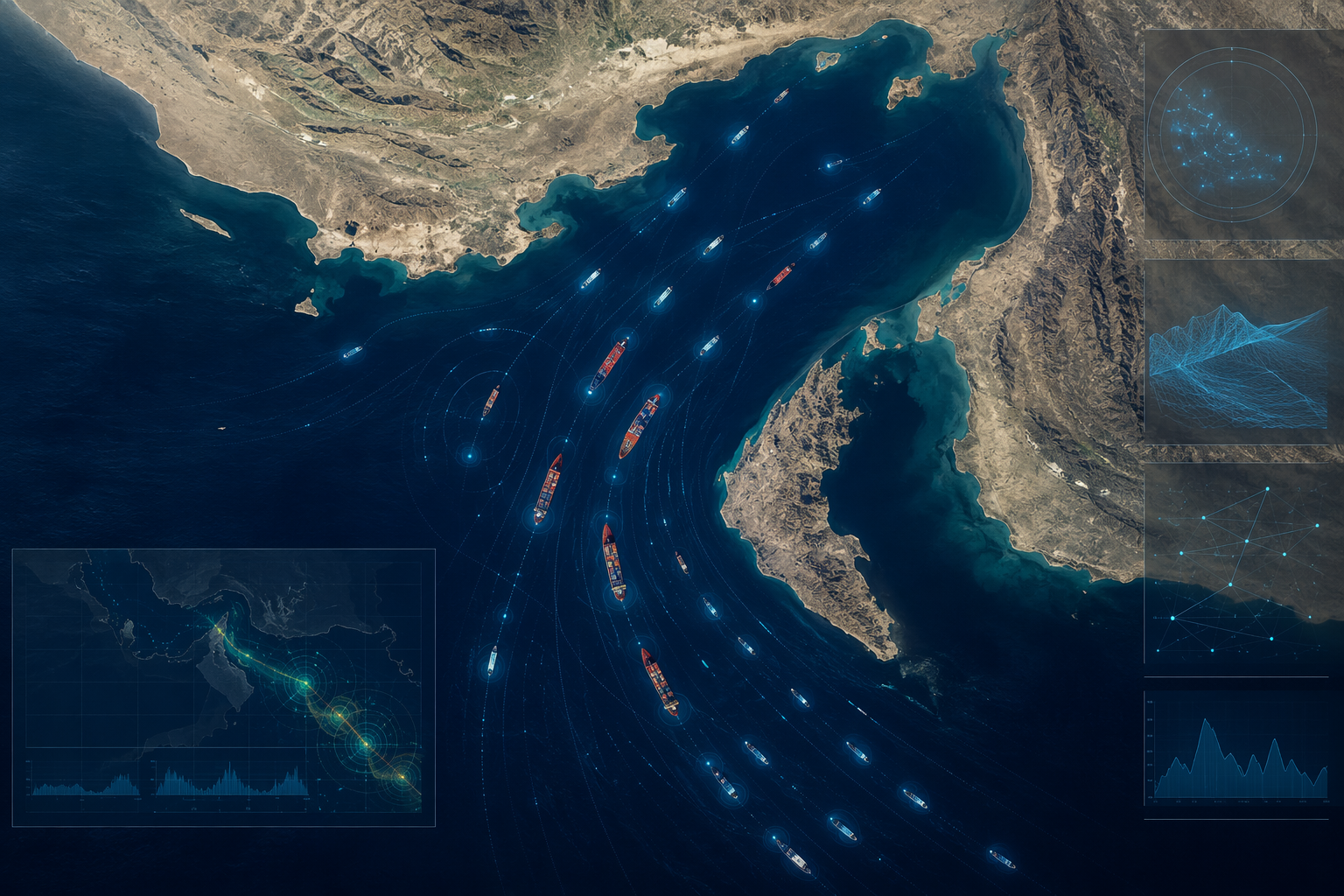
AI helps most when it is already wired into that messy environment before the closure arrives. Real-time AIS anomaly detection can flag that vessel behavior has stopped looking normal. Predictive analytics can score whether the anomaly is likely to become a material disruption. Digital twins can test what happens if cargo shifts to different routings, ports, suppliers, or inventory buffers. A control tower can then push the chosen response into transportation, procurement, allocation, and customer-service workflows. None of those capabilities is the same as “the AI predicted Hormuz.” Each solves a different piece of the response cycle.
When the Data Environment Turns Hostile
A chokepoint crisis is not just a shortage of capacity. It is also a shortage of trustworthy information. Vessel counts fall. Carriers revise schedules. Some ships loiter. Some turn off or distort signals. Some ports become relief valves while others become queues. Insurance, security advisories, and customer commitments start moving on different clocks.
The Hormuz numbers matter because they describe that shift from normal volatility to operational unreliability. A drop from 138 ships per day to 2 is not a marginal delay pattern; it changes the baseline a model should compare against.[1] False nationality broadcasts and GNSS disruptions add another layer: the system is not merely missing some updates, it may be receiving updates designed to mislead routing, compliance, or security assumptions.[2]
For a supply chain team, that changes the first job. The first job is not optimization. It is detection and classification: which shipments are probably still moving, which are now unreliable, which vessel records deserve scrutiny, which suppliers or plants will feel the delay first, and which customer commitments have crossed from watchlist to exception.
| Observed signal | AI-enabled capability | Operational decision it supports |
|---|---|---|
| Sharp collapse in vessel traffic | Anomaly detection against historical and current movement patterns | Escalate from monitoring to disruption-response mode |
| False nationality broadcasts | AIS behavior scoring and identity-risk flags | Review vessel-level reliability before accepting ETA updates |
| GNSS disruption events | Signal-quality monitoring and confidence scoring | Separate low-confidence tracking data from usable planning data |
| Port and route congestion spillover | Predictive ETA and capacity modeling | Prioritize cargo, reserve alternatives, and reset customer promises |
| Inventory exposure by site or customer | Digital twin stress-testing | Choose which orders, plants, or SKUs need intervention first |
AIS Anomaly Detection Buys the First Useful Window
AIS anomaly detection is the earliest layer, and it should be judged as an early-warning tool, not a decision engine. Its value is in finding the break from expected behavior quickly enough that planners can start working before all downstream systems agree that something is wrong.
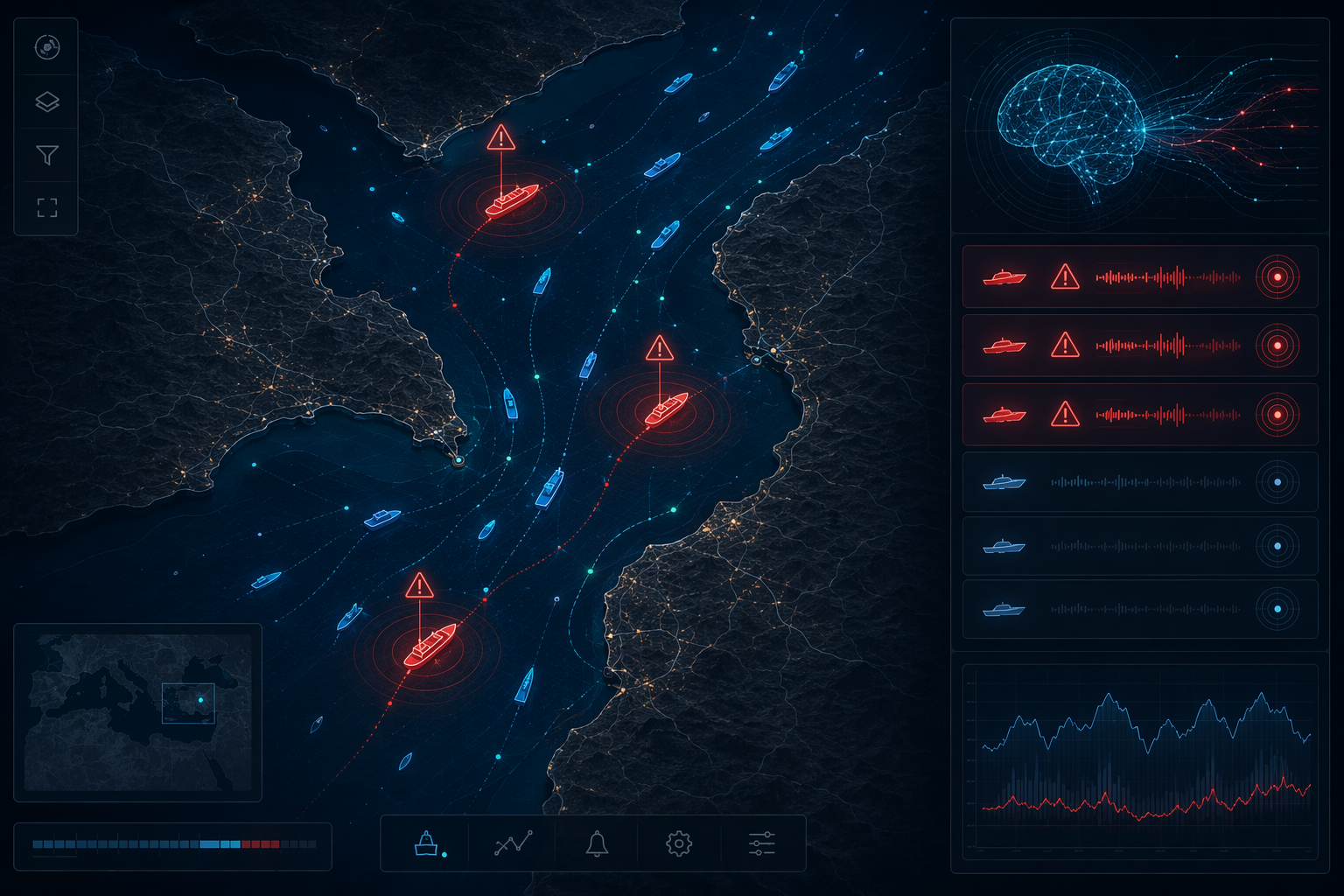
In a Hormuz-type event, the model is looking for changes that humans may see only after several manual checks: vessels slowing outside normal patterns, route deviations, gaps in transmission, clusters of ships behaving differently from comparable traffic, identity fields that conflict with prior records, and sudden deterioration in signal confidence. The reported false nationality broadcasts and GNSS disruption events make this layer more important, but also less clean.[2] A model can flag the inconsistency; it cannot make the inconsistency disappear.
That distinction matters inside a control room. A poor implementation produces more alerts than the team can investigate. A useful implementation ranks the alerts by business exposure: which vessel is carrying critical feedstock, which shipment supports a plant with low inventory, which customer order has contractual penalties, and which lane has no approved alternate carrier. The AI is not just saying “this ship looks odd.” It is saying “this odd ship matters more than the other odd ships.”
This is where supply chain visibility stops being a map and becomes a risk workflow. AIS data alone cannot tell a procurement lead whether to expedite substitute material. It has to be connected to purchase orders, inventory positions, supplier commitments, production schedules, port data, and transportation contracts. Without those links, the alert may be technically correct and still operationally late.
Prediction Means Scoring the Next Constraint, Not Naming the Crisis
By the time vessel traffic has collapsed, the organization does not need a model to “predict” that Hormuz is disrupted. It needs a model to predict where the disruption will bite next. That is a narrower, more useful standard.
For oil-linked supply chains, that may mean estimating whether a delayed cargo changes refinery feedstock availability, whether a downstream chemical input misses a production window, whether substitute supply is already committed elsewhere, or whether a reroute saves the shipment but misses the customer’s actual need date. The answer is usually not a single forecast. It is a ranked set of exposures with confidence levels attached.
The better systems also separate likelihood from severity. A vessel with a high probability of delay may be less urgent than a lower-probability event tied to a plant shutdown. A shipment with a reliable ETA may still be a poor planning anchor if the receiving port, inland carrier, or storage capacity is already constrained. Predictive analytics earns its place when it helps the team stop treating every red marker as equal.
This is the practical difference between situational awareness and lead time. Situational awareness says the lane is unstable. Lead time says which customer-service scripts must change today, which inventory buffers will be exhausted first, which alternate routes are still bookable, and which decisions become more expensive if they wait until tomorrow.
Digital Twins Turn the Alert Into Choices
Once the anomaly is real enough to act on, the planning question changes from “what is happening?” to “which response fails least?” That is where digital twins are more useful than another dashboard panel. A digital twin can test the supply chain consequences of a reroute before the team commits scarce capacity, changes purchase orders, or sends revised dates to customers.
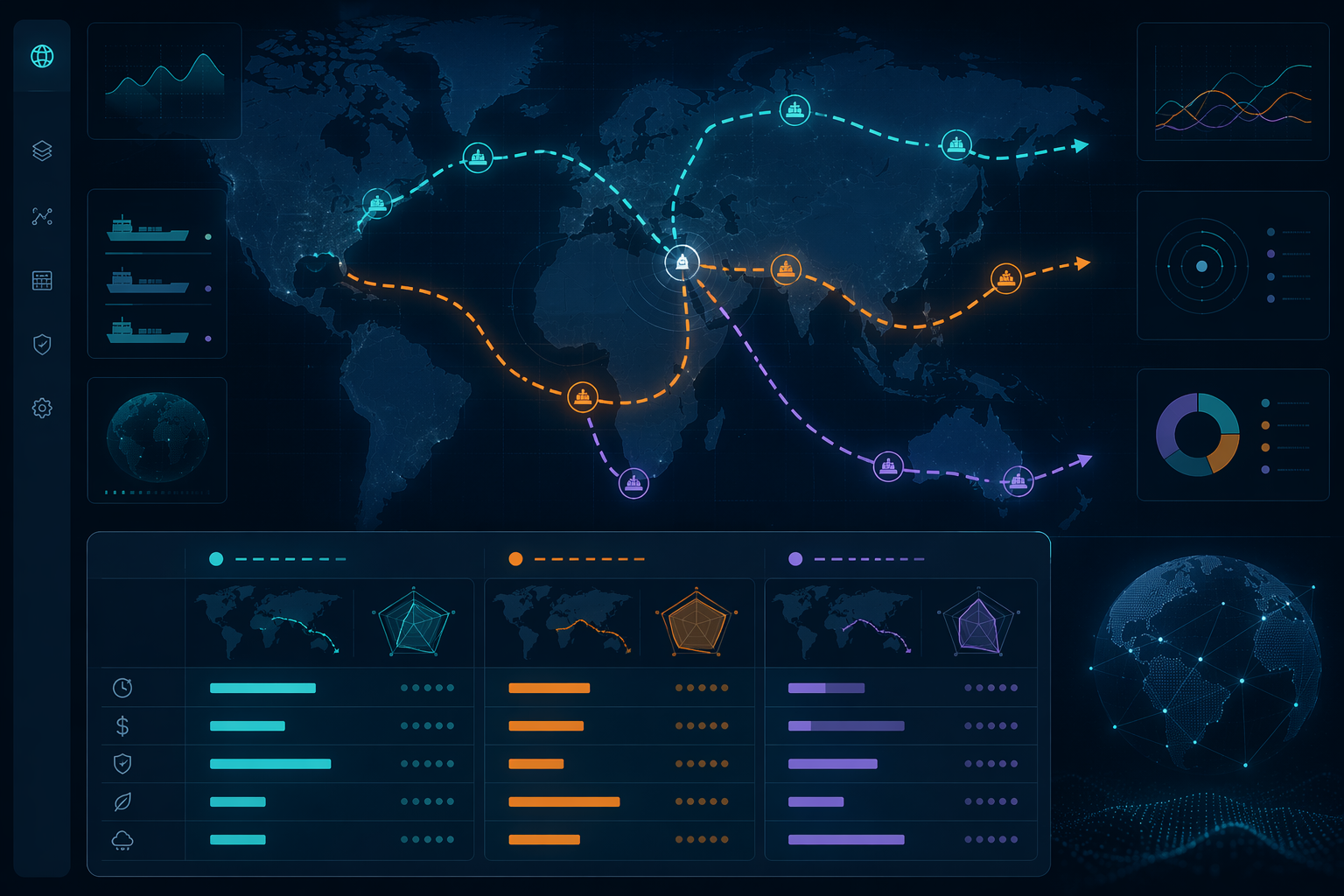
The stress test should not stop at the ocean leg. A reroute that looks acceptable on a maritime map may fail at a transshipment port, storage terminal, inland leg, customs process, or production sequence. It may also solve one customer commitment by consuming inventory meant for another. The useful model follows the consequence chain far enough to expose the tradeoff.
Körber and SCMR have described generative AI digital twins as capable of stress-testing supply chains against thousands of “what-if” scenarios.[3] That kind of scenario depth is valuable only if the scenarios are grounded in actual constraints: approved carriers, viable ports, inventory by location, supplier lead times, contract terms, storage capacity, and customer priority rules. Thousands of unrealistic options are just a faster way to fill a meeting.
A useful Hormuz scenario set might compare several kinds of response without pretending to know the future perfectly: hold and monitor for a defined review window; divert cargo already on the water; shift upcoming bookings to pre-approved alternative lanes; rebalance inventory across regions; qualify substitute supply; or protect selected customer commitments while resetting others. The goal is not to find a painless option. It is to make the cost, delay, and service consequences visible before the organization commits.
The digital twin also gives finance and commercial teams something more concrete than a risk headline. It can show which choice creates premium freight, which choice increases working capital, which choice raises stockout exposure, and which choice changes revenue timing. That does not remove judgment. It gives the judgment a shared operating picture.
The Control Tower Is Where the Response Either Happens or Dies
A control tower matters because the chosen scenario still has to become work. Someone must approve the route. Someone must contact the carrier. Someone must check contract coverage. Someone must tell procurement whether substitute supply is needed. Someone must decide which customer commitments are protected and which are renegotiated.
AI orchestration can compress those handoffs if the workflow is already designed. It can generate exception queues, recommend owners, attach the evidence behind a rerouting recommendation, update estimated arrival ranges, and trigger review steps for transportation, procurement, finance, and customer service. It can also preserve the decision trail, which matters later when the team has to explain why one order was expedited and another was not.
The weak version of a control tower is a screen that everyone looks at while continuing to make decisions in email and spreadsheets. The stronger version connects detection, scenario modeling, approvals, carrier execution, and customer communication. In a Hormuz closure, that difference shows up quickly. If the reroute file, alternate carrier list, and approval thresholds are missing, the control tower becomes a prettier war room.
This is also why the word “autonomous” should be handled carefully. A system may automate alert triage, scenario generation, ETA updates, or workflow routing. It should not be assumed to autonomously make geopolitical tradeoffs involving sanctions exposure, security risk, insurance terms, customer allocation, or executive risk appetite. Those decisions still need accountable humans.
Why the 30–40% Speed Advantage Has Preconditions
Industry literature supports a 30–40% faster disruption-response benchmark for AI-enabled supply chain risk workflows, but that figure should not be read as a software installation result.[4] The speed advantage appears when data and decisions are already connected before the event: multi-modal transport visibility, supplier and inventory data, port and carrier feeds, routing alternatives, approval rules, and exception ownership.
The prework is unglamorous. It includes mapping which materials and orders depend on the chokepoint, identifying alternate ports and lanes, validating which carriers can actually execute them, setting escalation thresholds, and agreeing on customer-allocation rules before everyone is tired and defensive. AI can accelerate a prepared process. It cannot invent an operating model during a closure.
- Data readiness: AIS, carrier ETAs, port conditions, supplier commitments, inventory, purchase orders, production schedules, and customer orders are connected to the same exposure view.
- Route readiness: alternative lanes, ports, carriers, and service levels are pre-mapped rather than discovered during the crisis.
- Decision readiness: approval limits, risk owners, customer priority rules, and finance thresholds are known before recommendations appear.
- Workflow readiness: alerts move into assigned actions, not just shared dashboards.
- Confidence readiness: the system shows data quality and signal reliability, especially when AIS or GNSS inputs are suspect.
The Sensos example is useful here, with the label kept on. In a vendor-published case study, Sensos says an automaker avoided $220 million in losses during the 2024 Red Sea crisis by using AI to dynamically reroute through 12 pre-mapped alternative ports scored by political stability; related vendor-published material also cites 63% faster crisis recovery.[5] That is directional evidence, not independently verified proof. The part worth taking seriously is the preparation embedded in the claim: the alternatives were already mapped and scored. The AI did not discover the network from scratch after the disruption began.
That distinction applies directly to Hormuz. If an oil-linked manufacturer has already linked inbound feedstock, maritime movements, port options, production constraints, and customer commitments, AI can help it move from alert to executable response faster. If those pieces live in separate systems and informal knowledge, the same AI layer may still detect the disruption early, but the organization will spend the saved time arguing over the response.
What AI Still Cannot Negotiate
A closed or contested chokepoint is a physical and political constraint. Software cannot negotiate passage through it. It cannot create tanker availability, erase insurance exclusions, guarantee port capacity, or make a sanctioned route acceptable. It also cannot decide, on its own, whether one customer should absorb a delay so another can be protected.
The best current systems are decision accelerators. They detect abnormal movement, degrade confidence in suspicious data, model consequences, rank response options, and push approved actions through a control tower. They make uncertainty more explicit. They do not eliminate it.
That matters because the 2026 Hormuz crisis remains fast-moving as of Q3 2026. Vessel counts, signal-disruption reports, and route behavior can change as security conditions, advisories, and commercial decisions change. A model trained to recognize the first phase of a crisis must keep ingesting current observations and keep showing where its confidence is weakening.
AI can materially shorten the disruption-response cycle for Strait of Hormuz-type events, and a 30–40% response-time improvement is a reasonable benchmark when the underlying operating model is ready.[4] But the advantage belongs to organizations that did the integration, visibility, and routing work before the strait became the headline.
References
- Z2Data/JMIC Strait of Hormuz vessel traffic figures, Z2Data/JMIC
- Safety4Sea/Windward/JMIC false nationality and GNSS disruption reporting, Safety4Sea/Windward/JMIC
- Generative AI digital twin supply chain stress-testing findings, Körber/SCMR
- Industry literature on AI-enabled supply chain disruption response-time improvement, industry literature
- Sensos vendor-published AI crisis recovery and automaker rerouting case study, Sensos
Comments
Join the discussion with an anonymous comment.